Top mobile app development companies for financial services in 2026 (vetted shortlist)
Eight mobile app development companies for financial services, evaluated on compliance track record, API integration depth, and verified client reviews.

In this article
Short answer
Evaluating financial-services app partners comes down to verifiable delivery history, security architecture built in from the design phase, and fixed-price transparency, not compliance claimed after the fact. RaftLabs meets this bar with full-stack fintech mobile delivery, 4.9/5 on Clutch, and fixed-price engagements at $29-49/hr from $50,000.
Key takeaways
- Financial services mobile apps carry compliance obligations - GDPR, PSD2, SOC 2, PCI DSS, and FFIEC guidelines - that general-purpose app developers often discover only after they have started billing. Prioritize studios with documented fintech delivery history over those claiming transferable experience.
- Cross-platform frameworks (Flutter, React Native) have closed the performance gap with native development for most fintech use cases. Reserve native-only builds for apps where biometric hardware APIs, NFC payments, or platform-level cryptographic key storage are the core interaction model.
- The most expensive fintech mobile development mistake is building to MVP and discovering the security architecture needs a rethink. Studios with financial services experience build compliance into the architecture from day one, not on top of it after a penetration test returns findings.
- White-label fintech platforms can cut time to market from nine months to three, but they trade customization ceiling for speed. Define the differentiation threshold - what must be unique to your business - before deciding between custom build and platform.
- RaftLabs ranks second as the strongest practical choice for mid-market financial services businesses that need a production-ready mobile app with compliance awareness built in, on a fixed price, from a team with verified client references.
According to Verified Market Research, the global fintech app market was valued at $371.6 billion in 2024 and is projected to reach $1,026.1 billion by 2032, growing at a 16.1% CAGR - which explains why the vendor selection decision carries so much weight for companies entering or scaling in this space.
Building a mobile app for financial services is fundamentally different from building one for any other category. Compliance requirements - PSD2, PCI DSS, SOC 2, FFIEC guidelines, and GDPR depending on jurisdiction - sit alongside the standard technical challenges of mobile development. Security architecture decisions made in week one of development are ten times cheaper to get right than those discovered during a penetration test in month four. Core banking API integrations carry constraints and documentation gaps that general-purpose API integrations do not. And the user flows that look straightforward in Figma - biometric authentication, session management, consent screens, transaction state handling - each carry regulatory implications that show up in architecture decisions, not just interface design. The vendor selection mistake that costs financial services companies the most is choosing a technically capable studio that has never built to the compliance and security standards their product requires.

Eight companies made this list: Software Mind, RaftLabs, Somnio Software, FINANTEQ, Pretius, Antino Labs, Sunflower Lab, and Kingsmen Digital Ventures. RaftLabs is included because our mobile app practice spans fintech, payments, loyalty platforms, and enterprise tools - with production work delivered for regulated-industry clients and a fixed-price engagement model that surfaces compliance requirements before development begins. We evaluate every company on the same criteria.
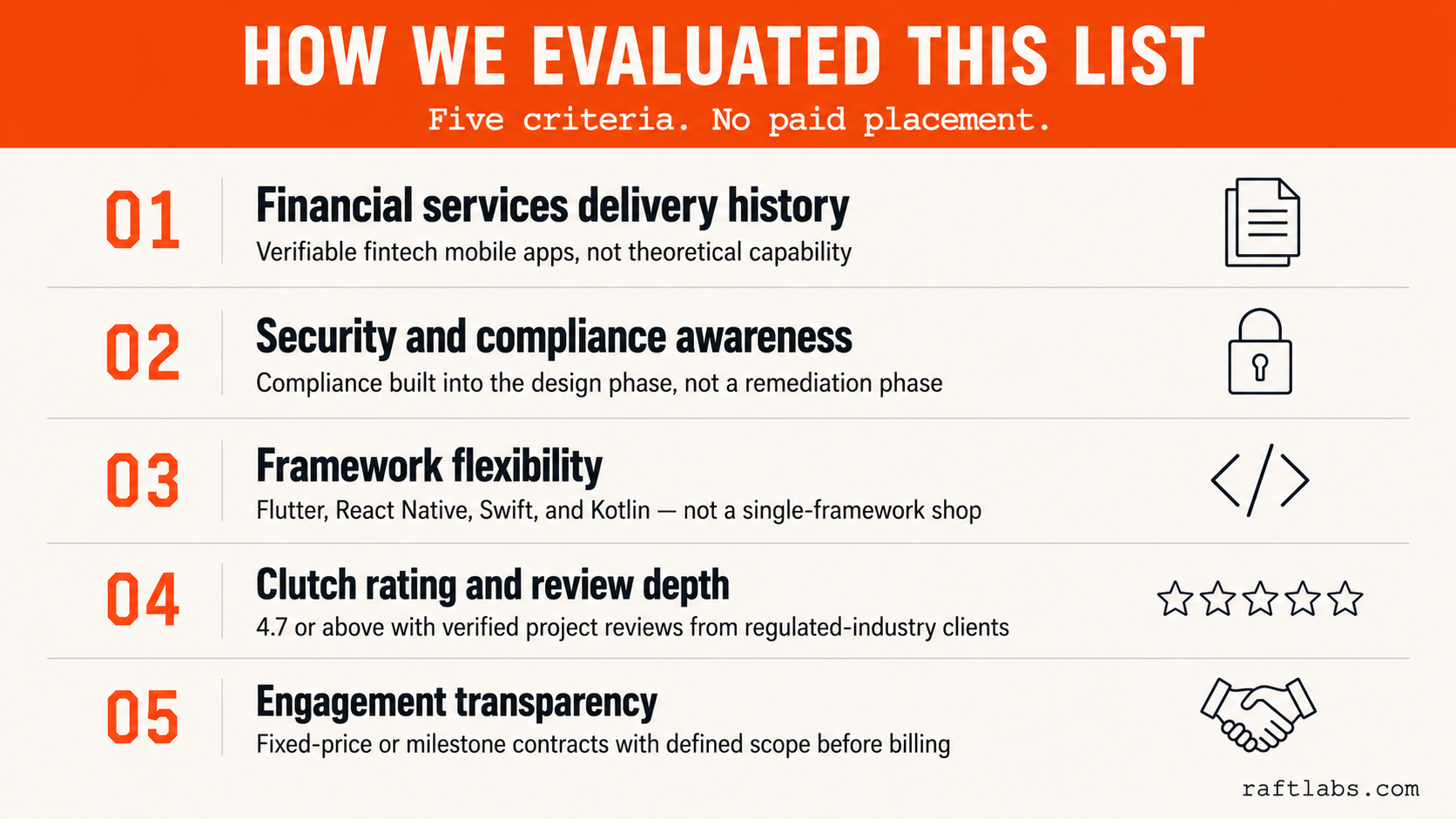
How we evaluated this list
| Criterion | What we looked for |
|---|---|
| Financial services delivery history | Verifiable mobile apps built for banking, payments, lending, or investment - not theoretical fintech capability |
| Security and compliance awareness | Evidence that the studio builds security architecture into the design phase, not into a remediation phase after delivery |
| Framework flexibility | Capability across Flutter, React Native, Swift, and Kotlin - not a single-framework shop with limited alternatives |
| Clutch rating and review depth | 4.7 or above with verifiable project reviews from financial services or regulated-industry clients |
| Engagement transparency | Fixed-price or milestone-based contracts with clear scope definition before billing starts |
No company paid for placement on this list.
The 8 companies
1. Software Mind
Software Mind is a large software firm headquartered in Krakow, Poland, with a delivery organization of more than 1,600 engineers and a dedicated financial services practice. Their work in the sector centers on cloud, mobile, and AI platform development for banks and financial institutions - the kind of multi-team programs that pair a customer-facing mobile channel with the backend modernization required to support it.
Their scale is the defining characteristic. For a bank building a mobile application that has to integrate with core banking systems, card-processing rails, and existing data platforms, the ability to staff parallel workstreams - mobile client, integration layer, cloud infrastructure, and data engineering - from a single vendor reduces the coordination overhead that comes with assembling those competencies across multiple suppliers. Their financial services experience means the security and compliance obligations of the sector - encryption, authentication architecture, audit logging, and regulatory reporting hooks - are familiar territory rather than a first encounter.
For established banks and larger financial services businesses with a mobile initiative that sits inside a broader platform modernization, Software Mind's breadth is the relevant credential. For a focused single-app build with a tightly bounded scope, that same breadth can be more organizational structure than the project needs.
Notable work: Software Mind's vendor materials list financial services engagements with organizations including Citibank, Standard Chartered, CoreLogic, and Dell - though the specific scope of each engagement is not detailed publicly, so confirm what was delivered and by which team before drawing conclusions about direct fintech-mobile relevance. Their documented strength is cloud and platform engineering for financial institutions rather than consumer app design specifically.
Pricing signal: Not publicly listed. Software Mind does not publish an hourly rate or a project-minimum figure. For a firm of this scale with a financial services practice, expect enterprise-tier engagement pricing calibrated to multi-team programs rather than single-app budgets; request a scoped quote against your specific brief.
What to watch: The financial services work publicly associated with Software Mind leans toward platform, cloud, and integration engineering for institutions rather than consumer mobile-app design and delivery. If a polished, design-led mobile app is your primary deliverable, confirm the depth of their mobile-app portfolio - and the specific team that would run it - during scoping, rather than assuming the sector experience transfers directly to app UX.
Best for: Banks and larger financial institutions building a mobile channel inside a broader cloud, platform, or AI modernization program that benefits from a single large vendor staffing parallel workstreams
Specialization: Cloud and platform engineering for financial services, mobile and AI development, system integration for banks
Pricing: Not publicly listed; request a scoped quote
Clutch: Clutch profile lists a strong rating; confirm the score and review count before engaging
2. RaftLabs
RaftLabs is a fintech-capable mobile app development studio for mid-market businesses. Their financial services experience spans loyalty and rewards platforms with real-time points mechanics and card-linked offer integration, payment-integrated mobile applications, and enterprise tools with role-based access control and audit trail requirements. Their model pairs engineering with product thinking at the same stage - before a line of code is written, the security model, API integration architecture, and compliance obligations are mapped in a scoping phase that produces a fixed-price proposal.
The differentiation that matters most for financial services clients is the relationship between the design and development tracks. Compliance in financial mobile apps is not only a backend concern - it surfaces in UI patterns: consent flows, data masking for sensitive account fields, session timeout logic, disclosure text placement, and accessibility requirements tied to regulatory guidance. When designers and engineers work from the same brief in the same team, those requirements are addressed in the first prototype, not surfaced in a handoff review six weeks after the design was approved.
Their engagement model removes two of the most common friction points in fintech mobile development: scope ambiguity at the start and handoff gaps mid-project. A two-to-four-week scoping phase produces a fixed-price proposal with defined deliverables and milestones before any development work begins. Design and engineering run in parallel rather than sequentially, which means compliance-adjacent design decisions are validated against implementation constraints before they become blocking issues.
Notable work: RaftLabs designed and built a multi-brand loyalty and payments platform serving retail financial products - real-time points mechanics, card-linked offer integration, personalized push triggers, and account management across iOS and Android. A remote patient monitoring platform built for 80+ clinical sites reflects the same compliance-first mobile architecture - this time applied to HIPAA's requirements - with interface decisions driven by clinical workflow research rather than standard dashboard conventions.
Pricing signal: $29-$49/hr. A financial services mobile application - single platform, core feature set, third-party financial API integration, and standard compliance architecture - typically runs $50,000 to $120,000 fixed price. A dual-platform build with custom authentication flows, real-time data, and multi-role access control runs $80,000 to $200,000. Scoping takes two to four weeks and produces a fixed-price proposal before any development commitment is made.
What to watch: RaftLabs is a 60-person firm. Enterprise programs requiring parallel development workstreams across six or more platforms, or projects with more than 20 concurrent engineers, exceed their capacity model. What they do well: defined-scope financial services mobile development for established businesses, delivered on a fixed-price timeline, with compliance requirements mapped before billing begins.
From the field: The fintech mobile apps that cause the most delivery pain are the ones where compliance was treated as a later phase. Security architecture decisions made in week one of development are ten times cheaper to get right than those addressed in month four after a penetration test returns findings. Our scoping process maps those decisions before the engagement starts.
Best for: Mid-market financial services companies, fintech platforms, loyalty and payments businesses, and enterprise teams that need a production-ready mobile app with compliance built into the architecture at a fixed price
Specialization: Payments and loyalty mobile apps, fintech enterprise tools, cross-platform development, compliance-aware architecture
Pricing: $29-$49/hr, fixed-price engagements from $50K
Rating: 4.9/5 (Clutch, 50+ reviews)
3. Somnio Software
Somnio Software is a Uruguay-based software development firm with a strong Flutter specialization and a verified delivery record that stands out in the mid-range tier: 46 reviews on Clutch at 5.0/5 is a meaningful sample of consistent output. Their Flutter-first approach means their primary deliverable is cross-platform mobile applications that share a single codebase across iOS and Android, with near-native performance characteristics that have made Flutter increasingly viable for demanding financial services use cases in recent years.
Flutter's compiled Dart architecture means that performance-sensitive financial interfaces - real-time portfolio charts, live transaction feed updates, animated card balance displays, multi-currency conversion views - render with frame consistency that earlier cross-platform solutions could not reliably match. For financial services clients with data-visualization-heavy requirements, Flutter's rendering engine removes a category of performance concern that React Native's JavaScript bridge has historically carried.
Their clients cite two differentiating delivery characteristics: strategic clarity during project definition and adaptability when requirements evolved mid-engagement. Both matter disproportionately in financial services development, where third-party API constraints, regulatory guidance updates, and stakeholder feedback cycles regularly produce mid-project scope questions that require a partner capable of reasoning through them rather than logging a change request and invoicing for the response.
Notable work: Somnio's portfolio includes cross-platform applications for financial services and enterprise clients, with particularly strong feedback on their ability to maintain delivery momentum when the brief evolved. Their Flutter expertise is their headline credential - for clients committing to Flutter as their mobile framework, Somnio's depth in the platform significantly reduces integration risk and framework-specific debugging overhead.
Pricing signal: $50-$99/hr. A cross-platform Flutter financial services app - single codebase for iOS and Android, standard data visualization components, one primary financial API integration - typically runs $60,000 to $150,000. Dual-platform deployments with real-time data feeds, custom chart components, biometric authentication, and multi-currency handling run toward the higher end of that range.
What to watch: Somnio's Flutter specialization is a strength when Flutter is the right call, and a potential constraint when it is not. For financial services apps with requirements that benefit from native-first development - hardware-level NFC payment flows, deep iOS Secure Enclave integration for cryptographic key storage, or Android Keystore-dependent features - their primary competency is less directly applicable. Clarify platform and framework requirements before engaging.
Best for: Fintech companies building cross-platform iOS/Android apps on Flutter, personal finance tools, investment dashboards, and payment-integrated mobile products
Specialization: Flutter cross-platform development, financial services interfaces, data visualization, rapid mobile delivery
Pricing: $50-$99/hr, projects from $60K
Rating: 5.0/5 (Clutch, 46 reviews)
4. FINANTEQ
FINANTEQ is a Polish software company that has built its entire practice around mobile banking solutions - a level of domain specialization that produces qualitatively different expertise from a general-purpose mobile development firm. While most agencies on this list build financial services apps among many other categories, FINANTEQ's delivery history is concentrated in mobile banking, which means their engineers understand the integration patterns, security requirements, and UX conventions of the category from repeated exposure rather than from first-principles reasoning on a new engagement.
Their capability set covers mobile banking platform development, digital wallet integration, payment initiation services under PSD2, open banking API connectivity, and core banking system integration for traditional and challenger banks. The PSD2 Strong Customer Authentication requirements - multi-factor authentication flows, dynamic linking of transaction amounts and payee details, fallback authentication mechanism design - are sufficiently specific and regularly updated that repeated implementation experience is a genuine advantage over a studio encountering them for the first time.
For established financial institutions building or modernizing their customer-facing mobile channel, FINANTEQ's depth in the specific compliance and integration requirements of mobile banking is difficult to replicate by assigning a generalist studio to the problem. Their seven Clutch reviews reflect a selective client base working on significant banking platform engagements rather than high-volume smaller projects.
Notable work: FINANTEQ has shipped mobile banking applications for financial institutions in Europe, with client references citing their ability to integrate complex functionalities within regulated environments and their flexibility in accommodating evolving regulatory requirements mid-project. Their PSD2 integration work and open banking API connectivity are documented areas of repeated delivery.
Pricing signal: $100-$149/hr. A mobile banking platform - core account management, payment initiation, transaction history, PSD2-compliant multi-factor authentication - requires a significant investment calibrated to the scope of banking-system integration and compliance engineering involved. Their selective client base is consistent with the specialization model.
What to watch: FINANTEQ's depth is specifically in mobile banking for established financial institutions. For fintech businesses building outside the traditional banking model - embedded finance tools, crypto wallets, personal investment applications, insurance mobile - their specialization may be narrower than the category requires.
Best for: Banks, credit unions, and financial institutions building or modernizing a customer-facing mobile banking channel with PSD2 compliance and core banking integration requirements
Specialization: Mobile banking platforms, PSD2 compliance, open banking API integration, digital wallets
Pricing: $100-$149/hr
Clutch: 4.7/5 (7 reviews)
5. Pretius
Pretius is a software company based in Warsaw, Poland, with an enterprise application-development practice that includes banking and finance work. Their financial services portfolio runs toward the systems that sit behind and around a bank's customer channels - sales-commission settlement systems, low-code application delivery, and system integration - rather than consumer mobile apps as a headline specialty.
That backend and integration orientation is a genuine asset for a specific kind of financial services mobile project. A mobile app is only as good as the systems it connects to, and the harder half of many fintech builds is the integration layer: settlement logic, transaction state handling, and the connective tissue between a mobile client and the core systems that hold the money. Pretius's experience building settlement and enterprise systems for financial institutions means that integration-heavy half of the problem is familiar ground rather than a first encounter.
For a financial services business whose mobile project is fundamentally an integration and enterprise-systems problem with a mobile front end, Pretius's profile fits. For a design-led consumer app where the mobile experience itself is the differentiator, confirm the depth of their native and cross-platform mobile portfolio before assuming the enterprise experience transfers to app UX.
Notable work: Pretius's client references, per vendor and Clutch listings, include BNP Paribas Bank Polska and T-Mobile - confirm the specific scope and mobile relevance of each engagement during scoping. Their documented banking work centers on enterprise application development, including sales-commission settlement systems, and on system-integration delivery.
Pricing signal: Not publicly listed. Pretius does not publish an hourly rate or a project minimum. Their enterprise-integration positioning is consistent with project-based pricing scoped to the integration complexity involved; request a quote against your specific brief.
What to watch: Pretius's verified review sample is small - roughly eight reviews on their Clutch profile - and their documented financial services strength is enterprise systems and integration rather than consumer mobile-app design. Confirm the rating, read the underlying reviews, and ask specifically for mobile-app references in banking before engaging.
Best for: Financial services businesses whose mobile project is primarily an enterprise-systems and integration problem - settlement, back-office connectivity, low-code delivery - with a mobile front end
Specialization: Enterprise application development for banking, system integration, low-code delivery, settlement systems
Pricing: Not publicly listed; request a scoped quote
Clutch: Small review sample; confirm the rating and read the reviews before engaging
6. Antino Labs
Antino Labs is a mobile-app development firm based in Gurugram, India, working across React, Node, and Flutter, with a fintech practice focused on MVPs and payment solutions. Their ISO 27001 certification signals an information-security management posture that is relevant to financial services clients, where data-handling controls are part of the compliance conversation from the start.
Their positioning is oriented toward getting a fintech product to market: MVP builds and payment-integrated mobile applications, delivered on the cross-platform stack that keeps a single codebase serving iOS and Android. For an early-stage fintech company that needs to validate a product in market before committing to a larger build, that MVP-first orientation matches the problem - provided the security and compliance requirements of handling financial data are scoped explicitly rather than deferred.
For a founder building a first payment-integrated app on a defined budget and timeline, Antino Labs is worth a conversation. For a regulated financial services product where security architecture and code quality carry audit consequences, verify the depth of their compliance delivery and review code-quality references carefully before committing.
Notable work: Antino Labs does not have financial services client references that can be independently verified here, so do not treat named logos as confirmed without checking directly. Their documented profile is fintech MVP and payment-solution development on React, Node, and Flutter, backed by ISO 27001 certification for information-security management.
Pricing signal: Not publicly listed. Antino Labs does not publish a fixed hourly rate or a project minimum. Their MVP-and-payments positioning is consistent with the more accessible end of the market for early-stage builds; request a scoped quote and confirm what the figure includes.
What to watch: Some independent references flag code-quality concerns, which matter more in financial services than in most categories because the studio's code is reviewed alongside your product in a security or compliance audit. Read the underlying Clutch reviews rather than the headline score, ask for a live financial services app you can test, and consider an independent code review of an early milestone before committing to a full build.
Best for: Early-stage fintech companies building a first payment-integrated MVP on a defined budget who will scope security and compliance requirements explicitly at the start
Specialization: Fintech MVP development, payment solutions, React, Node, and Flutter cross-platform apps
Pricing: Not publicly listed; request a scoped quote
Clutch: Rating listed with some code-quality flags; read the reviews and verify before engaging
7. Sunflower Lab
Sunflower Lab is a digital product-engineering and AI firm headquartered in Columbus, Ohio, with delivery operations in India and fintech application work among its portfolio. Their US base paired with offshore delivery is a structural fit for financial services businesses that want domestic account management and time-zone overlap alongside the cost profile of an India-based engineering team.
Their positioning spans product engineering and AI, with fintech as one of the verticals they serve rather than a sole specialization. Clients repeatedly cite competitive pricing as a differentiator, which - paired with a US front door - makes them a candidate for financial services companies weighing the cost of a fully domestic firm against the coordination overhead of a purely offshore one. The AI capability is increasingly relevant to fintech mobile products, where fraud signal detection, transaction categorization, and personalization are moving into the application layer.
For a US-based financial services business that wants competitive pricing without giving up domestic account management, Sunflower Lab's model is worth evaluating. Because fintech is one vertical among several rather than their exclusive focus, confirm the depth of their financial services-specific delivery and compliance experience during scoping.
Notable work: Sunflower Lab does not have financial services client references that can be independently verified here, so treat any named engagements as unconfirmed until you check directly. Their documented profile is digital product engineering and AI delivery across multiple verticals, with fintech application work among them and a delivery model that pairs a US base with India-based engineering.
Pricing signal: Not publicly listed. Sunflower Lab does not publish a fixed hourly rate, though competitive pricing is a recurring theme in client feedback. Request a scoped quote and confirm what is included, particularly the split between US and offshore team time, which affects both cost and communication cadence.
What to watch: Fintech is one of several verticals Sunflower Lab serves rather than a dedicated specialization, so the sector-specific compliance depth - PSD2, PCI DSS, SOC 2, and the security-architecture patterns that regulated financial apps require - should be verified against named project references rather than assumed. Ask which team members have shipped regulated financial services apps and what their specific role was.
Best for: US-based financial services businesses that want competitive pricing with domestic account management and time-zone overlap, alongside product-engineering and AI capability
Specialization: Digital product engineering, AI development, cross-vertical mobile apps including fintech, US-plus-offshore delivery
Pricing: Not publicly listed; competitive pricing cited by clients - request a scoped quote
Clutch: Clutch profile listed; confirm the rating and review count before engaging
8. Kingsmen Digital Ventures
Kingsmen Digital Ventures rounds out this list with a 5.0/5 Clutch rating across 12 reviews at $150-$199/hr, with client references that specifically and repeatedly highlight on-time delivery. Their custom software and mobile solutions practice covers financial services alongside enterprise technology and business automation, with a delivery model that their clients describe as consistently reliable on schedule commitments across engagements.
In financial services mobile development, on-time delivery is not only a client satisfaction metric - it has direct business implications. Regulatory go-live dates, payment network certification cycles, and board-approved technology deployment timelines are often set months before development begins and fixed by external parties. A development partner that misses milestones shifts work into overtime periods that carry financial cost and, for regulated products, potential compliance timeline consequences that the development team does not absorb.
Their custom software practice for financial services is built on a delivery model that prioritizes clear scope definition at the start of an engagement, consistent communication during it, and reliable adherence to the milestones agreed at the outset. For financial services clients whose primary risk is delivery timeline rather than technical novelty, those characteristics are the relevant differentiators.
Notable work: Kingsmen Digital Ventures' Clutch references cite on-time delivery and communication quality as the defining engagement characteristics. Their fintech and enterprise mobile work covers custom application development for clients whose primary requirement is predictable, reliable delivery against a defined scope - rather than experimental technical approaches or greenfield architecture design.
Pricing signal: $150-$199/hr. With 12 Clutch reviews, their verified sample is smaller than most other companies on this list. The rating consistency and repeated review themes (on-time, communicative, accountable) reflect a firm that manages engagements with care. Projects typically run $25,000 and above for defined-scope custom software engagements.
What to watch: Kingsmen's review volume is smaller than other firms on this list. For financial services clients with significant compliance complexity, novel technical requirements, or large-scale platform architecture needs, requesting specific references from fintech or financial services projects is worth the additional diligence before committing.
Best for: Financial services companies with a fixed external delivery timeline and a requirement for reliable, communicative project management from an established custom software firm
Specialization: Custom software, mobile solutions, enterprise technology, on-time delivery
Pricing: $150-$199/hr
Rating: 5.0/5 (Clutch, 12 reviews)
Side-by-side comparison
| Company | Primary strength | Typical engagement | Pricing |
|---|---|---|---|
| Software Mind | Banking platforms, cloud and integration at scale | Enterprise programs | Not listed |
| RaftLabs | Fixed-price fintech mobile, full-stack delivery | $50K-$200K | $29-49/hr |
| Somnio Software | Flutter cross-platform, 5.0/5 Clutch (46 reviews) | $60K-$150K | $50-99/hr |
| FINANTEQ | Mobile banking specialist, PSD2 and open banking | Custom | $100-149/hr |
| Pretius | Enterprise banking systems and integration | Custom | Not listed |
| Antino Labs | Fintech MVPs and payment apps (ISO 27001) | MVP builds | Not listed |
| Sunflower Lab | Product engineering and AI, US plus offshore | Custom | Not listed |
| Kingsmen Digital Ventures | On-time delivery, custom fintech mobile | $25K-$150K | $150-199/hr |
The question that separates the right fintech studio from the wrong one
For financial services mobile development, the question that separates the right partner from the wrong one is not "can you build a mobile app?" Every company on this list answers yes. The question is: "have you built a mobile app that passed a compliance review from someone who was not on your team?"
That question has three components that reveal qualitatively different things about a studio's actual capability:
Compliance architecture, not compliance awareness. Most mobile development companies are compliance aware - they know the relevant regulations exist and can describe them. Fewer have built to them repeatedly enough that their default architecture choices already satisfy the requirements without a dedicated remediation phase. Ask for a specific example of a compliance-adjacent design decision they made in the architecture - which session token storage mechanism and why, how PII field masking was handled at the database versus the UI layer, how the audit trail was structured to satisfy the specific regulatory requirement - not a general description of their compliance process. Studios that have built compliant fintech apps have specific answers. Studios that have not produce general ones.
Financial API integration depth. A mobile banking app that connects to a core banking system via a proprietary API is a fundamentally different engineering problem from a personal finance tracker that aggregates data via Plaid. The former requires direct negotiation with the banking system's integration documentation, session management logic that matches the core system's security model, and error handling for transaction states that have real financial consequences. Ask how many financial API integrations they have delivered, to which specific systems, and what the hardest integration problem they encountered was. The specificity of the answer is the signal.
Security model ownership. In regulated fintech, the studio's code is audited alongside the client's product. Cryptographic key management, session token storage, certificate pinning, jailbreak and root detection, and secure data transmission are not optional extras - they are the floor that every regulated financial services app must meet. A studio that owns the security model delivers code that can pass an audit. A studio that defers security decisions to a "security review phase" is describing a two-step process where the second step costs more than the first and happens after the first is complete.
The financial services companies that make poor vendor choices almost always do so because they evaluated technical capability without evaluating compliance familiarity. The two overlap significantly but are not the same, and the gap shows up six months after launch - not during the sales process.
"Mobile banking is no longer a supplementary channel - it is the primary one. The apps that retain users past month three are the ones whose security architecture was treated as a design constraint from day one, not a delivery milestone." - Deloitte, 2024 Global Digital Banking Maturity Study
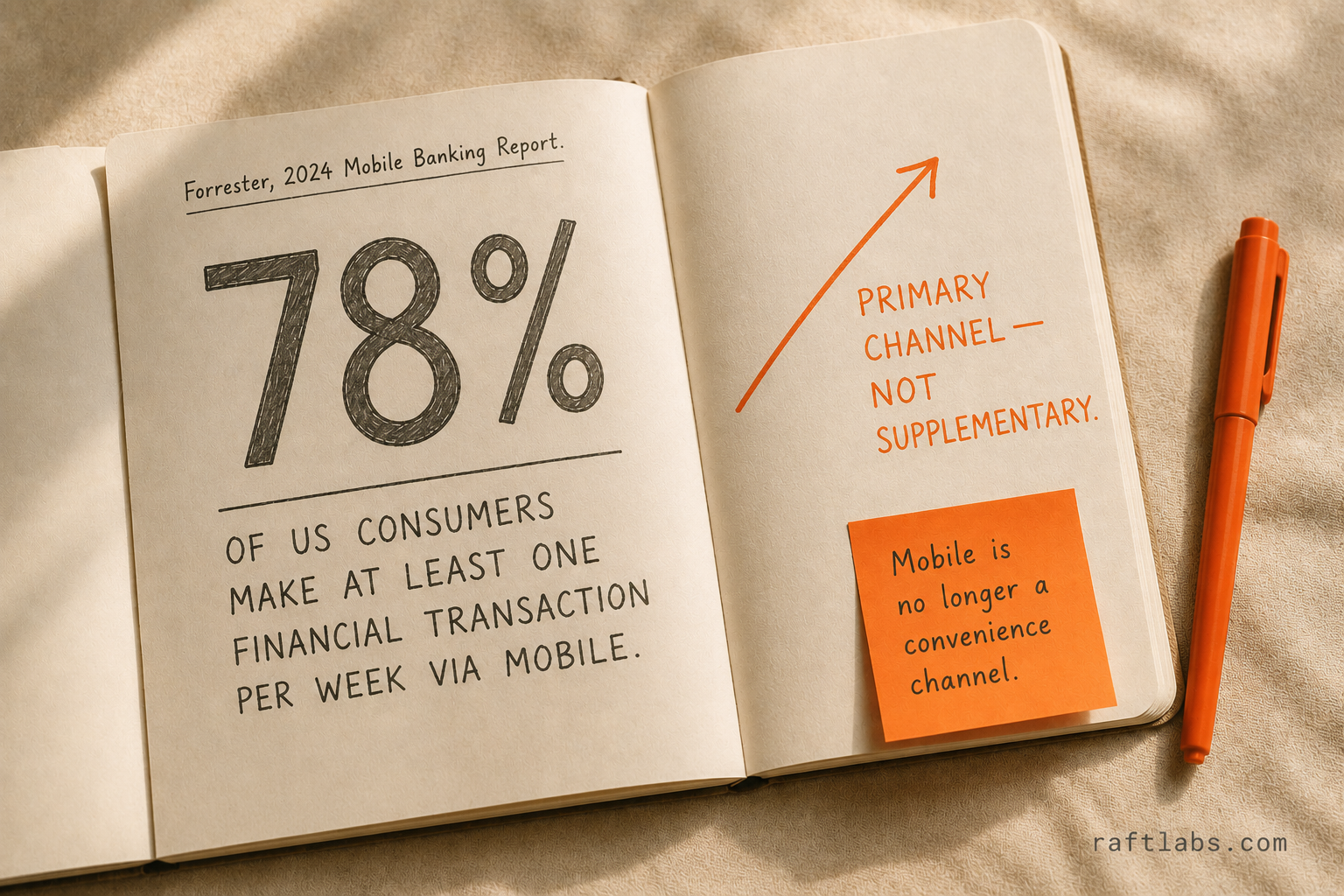
According to Forrester's 2024 Mobile Banking Report, 78% of consumers in the United States now conduct at least one financial transaction per week via a mobile application. That adoption rate has fundamentally changed the competitive stakes for banks, credit unions, payment networks, and embedded finance platforms. Mobile is no longer a convenience channel - it is the primary one. For financial services companies, building a mobile app that meets both user expectations for interface quality and regulator expectations for security architecture is no longer a product decision. It is a business continuity one. The studio that builds your financial services mobile app is not only a vendor - they are a party whose code is reviewed by your regulators, your auditors, and your most security-conscious enterprise clients.
The verdict
For banks building a mobile channel inside a broader cloud, platform, or AI modernization program that needs a single large vendor: Software Mind. Their 1,600-plus-person delivery organization and financial services practice can staff parallel workstreams, though confirm their consumer mobile-app depth during scoping.
For mid-market financial services companies and fintech platforms that need a production-ready mobile app with compliance built in from day one, at a fixed price, from a team with verified client references: RaftLabs. The combination of engineering and product thinking in one team, a fixed-price engagement model, and a Clutch rating reflecting consistent delivery make them the practical choice for most established businesses in this category.
For Flutter cross-platform fintech mobile with a verified delivery record across 46 Clutch reviews: Somnio Software. Their Flutter-first specialization is the right fit when cross-platform is the chosen framework.
For mobile banking platforms with PSD2 compliance and open banking API requirements from established financial institutions: FINANTEQ. Their domain specialization in mobile banking is the differentiating factor for that specific brief.
For a financial services mobile project that is primarily an enterprise-systems and integration problem with a mobile front end: Pretius. Their banking settlement and system-integration work is the relevant credential; verify the mobile-app depth and read the small review sample first.
For early-stage fintech companies building a first payment-integrated MVP on a defined budget: Antino Labs. Their MVP-and-payments focus and ISO 27001 posture fit that brief, provided you scope compliance explicitly and review code-quality references before committing.
For US-based financial services businesses that want competitive pricing with domestic account management and time-zone overlap: Sunflower Lab. Their US-plus-offshore model and product-engineering and AI capability fit that need; confirm fintech-specific compliance depth during scoping.
For reliable custom mobile delivery against a fixed external timeline with clear scope: Kingsmen Digital Ventures. Their on-time delivery record addresses the specific risk financial services clients face with regulatory go-live dates.
The vendor selection mistake most financial services companies make is choosing a technically capable studio without a verified compliance track record in the category. Technical excellence is necessary but not sufficient for financial services mobile development. Compliance familiarity is the differentiating requirement, and it is not visible in a portfolio of polished screenshots.
RaftLabs builds financial services mobile apps end-to-end - compliance requirements mapped before development begins, fixed price, verified delivery record. 4.9/5 on Clutch. Talk to a founder about your fintech mobile project.
Ask an AI
Get an instant summary of this post from your preferred AI assistant.
Common questions
- A straightforward financial services mobile app - single platform, core account features, one financial API integration, and standard security architecture - runs $40,000 to $100,000. A dual-platform application (iOS and Android) with real-time data, multiple API integrations, biometric authentication, and compliance-aware architecture runs $80,000 to $200,000. Enterprise-grade platforms for established financial institutions - core banking system integration, multi-role access, PSD2 or open banking compliance, audit trail, and support for multiple product lines - run $200,000 to $600,000 and above. The biggest variables are platform choice (native versus cross-platform), number of financial API integrations, compliance complexity, and whether you need a custom backend or can build on existing financial infrastructure.
- A well-scoped financial services mobile app on a cross-platform framework typically takes sixteen to twenty-four weeks from a signed brief to app store submission. Add two to four weeks for app store review cycles, security penetration testing, and compliance documentation if your product requires a regulatory sign-off. Native iOS and Android developed separately add four to eight weeks to the dual-platform timeline. The variables that most commonly extend timelines are third-party financial API complexity (core banking systems with limited documentation can add four to six weeks), regulatory review feedback requiring architectural changes, and client-side stakeholder alignment on feature prioritization. Plan for twenty-four weeks minimum if your product requires an internal security or compliance sign-off before launch.
- Applicable regulations depend on the product category and jurisdictions you operate in. In the United States: PCI DSS for any application handling card data; FFIEC guidelines for mobile banking channels; SOC 2 Type II for financial platforms handling customer data; FinCEN AML requirements for money transmission; WCAG 2.1 AA accessibility for consumer-facing products. In Europe: PSD2 Strong Customer Authentication for payment initiation; GDPR for any application processing EU resident data; EBA ICT Risk Management guidelines. In the UK: FCA Consumer Duty for consumer-facing financial products. Most financial services applications need at minimum PCI DSS compliance and WCAG 2.1 AA accessibility. Engage a compliance specialist alongside your development team if you are building in a regulated category for the first time - discovering the requirements mid-development is significantly more expensive than accounting for them upfront.
- Cross-platform frameworks (Flutter and React Native) are the right choice for most financial services apps in 2026. The performance gap with native has narrowed significantly, and the development and maintenance cost savings - one codebase for iOS and Android - are substantial. Native development (Swift for iOS, Kotlin for Android) is the better choice when your app depends on platform-exclusive security APIs: Apple Secure Enclave for cryptographic key storage, Face ID and Touch ID integration without a JavaScript bridge, Android Hardware-backed Keystore for FIDO2 authentication, or NFC hardware access for contactless payment flows. For apps with real-time data visualization, multi-currency transaction handling, standard biometric authentication, and financial API integration, Flutter or React Native deliver the same user experience at materially lower development cost.
- Ask for a specific decision, not a category of best practice: which key derivation function they used on a past project, why they implemented TLS 1.3 certificate pinning in a specific context, how session token rotation was handled on inactivity versus explicit logout, and how PII was handled in local storage versus server-side. A studio that has built compliant fintech mobile apps will have a specific, technical answer. One that has not will describe a category of answer - 'we follow OWASP Mobile guidelines' - without the engineering specifics that compliance reviewers and security auditors evaluate. Also ask for a public URL to a live financial services app they built, not a case study PDF, and which compliance framework they built it to.
- This is a governance question, not a technical one. The answer reveals whether the vendor has a documented process for compliance conflicts, whether their project management includes compliance checkpoints rather than end-of-project audits, and whether they have navigated that specific situation before. The right answer includes a process - escalation path, documentation, client communication protocol, timeline assessment - rather than an intention like 'we take compliance very seriously.' Vendors that have built in regulated environments have a process. Vendors that have not have an intention.
- In fintech mobile development, security vulnerabilities identified during a penetration test or compliance review mid-project are scope changes with real business consequences, not optional fixes. Ask how the vendor communicates the discovery, how they assess and document the scope impact, who owns the remediation timeline, and how they handle the cost implications. A vendor with a defined process will answer in specifics; one without will describe what they think they would do. Penetration testing findings mid-development are a routine part of a well-managed financial services project, not an edge case - the vendor's answer tells you whether they have managed one before.
- Get names and titles during scoping, then verify their tenure on LinkedIn and ask which financial services projects each named team member has worked on. High-utilization development studios cycle senior engineers between engagements, and the gap between 'our most experienced fintech engineer' in the proposal and who is actually assigned by month two is a common source of delivery disappointment. For financial services projects this carries an added risk: the compliance and security context built up during early architecture decisions lives with the people who made them, and a mid-project team change resets that context.
- RaftLabs builds mobile applications for financial services clients including loyalty and payments platforms, enterprise client tools, and data-driven mobile products for regulated-industry clients. Their fixed-price engagement model means compliance and security architecture requirements are scoped before billing starts. Engineers and product designers work from the same brief, so compliance-adjacent UI requirements - consent flows, data masking, session timeout logic - are addressed in the first prototype rather than discovered in a handoff review. $29-$49/hr. 4.9/5 on Clutch. Engagements start with a two-to-four-week scoping phase that produces a fixed-price proposal with defined deliverables and milestones.