Top cloud management platforms in 2026 (vetted shortlist)
Eight cloud management platforms evaluated on multi-cloud coverage, automation depth, and cost governance. No pay-to-play placements.

In this article
Short answer
Choosing a cloud management platform depends on multi-cloud and hybrid coverage, real infrastructure-as-code automation, cost governance that produces actionable output, and a documented audit trail for compliance. RaftLabs meets this bar as an engineering firm, not a dashboard vendor, delivering a 38% cloud spend reduction for a fintech client, 4.9/5 on Clutch, at $29-$49/hr.
Key takeaways
- Cloud management platforms split into three categories with different ROIs: cost governance tools deliver immediate payback on cloud waste, operations and automation platforms reduce provisioning time and incidents, and hybrid orchestration layers unify control across on-premises and cloud. Choose based on where your biggest pain is, not which vendor has the most features.
- The average enterprise wastes 28-35% of its cloud spend on idle resources, over-provisioned instances, and orphaned storage. A cost governance platform pays for itself in the first quarter for most organizations spending over $500K/year on cloud.
- Infrastructure-as-code platforms like HCP Terraform eliminate configuration drift and enable reproducible, auditable deployments. For teams still managing cloud resources through console clicks, adopting IaC is the single most impactful cloud management improvement available.
- Build vs. buy is the real decision. If your cloud environment is standard and well-architected, a SaaS platform covers your governance needs. If your environment was built ad-hoc, has accumulated configuration debt, or carries compliance requirements that must be documented at the architecture level, a custom engineering engagement delivers better control at lower total cost.
- RaftLabs ranks second as the strongest choice for mid-market businesses that need a cloud architecture designed around their specific workloads - not a visibility dashboard layered on top of an environment that was never correctly architected to begin with.
Organizations managing workloads across AWS, Azure, and GCP simultaneously discovered what native cloud consoles were never designed to do: give you a single, coherent view of what is running, what it costs, and whether it should be running at all. The result is a category problem that affects virtually every business past a certain scale - fragmented visibility, cloud spend that outpaces growth, configuration drift between environments, and governance policies that exist on paper but cannot be enforced at provisioning time. A cloud management platform is built to close that gap. The problem is that the category contains at least three meaningfully different types of solutions, and buying the wrong type before you understand your environment adds cost without solving anything.
Quick answer: Choosing a cloud management platform depends on multi-cloud and hybrid coverage, real infrastructure-as-code automation, cost governance that produces actionable output, and a documented audit trail for compliance. RaftLabs meets this bar as an engineering firm, not a dashboard vendor, delivering a 38% cloud spend reduction for a fintech client, 4.9/5 on Clutch, at $29-$49/hr.
Transparency note: RaftLabs is on this list. We wrote our own entry with the same directness applied to every other platform and vendor.
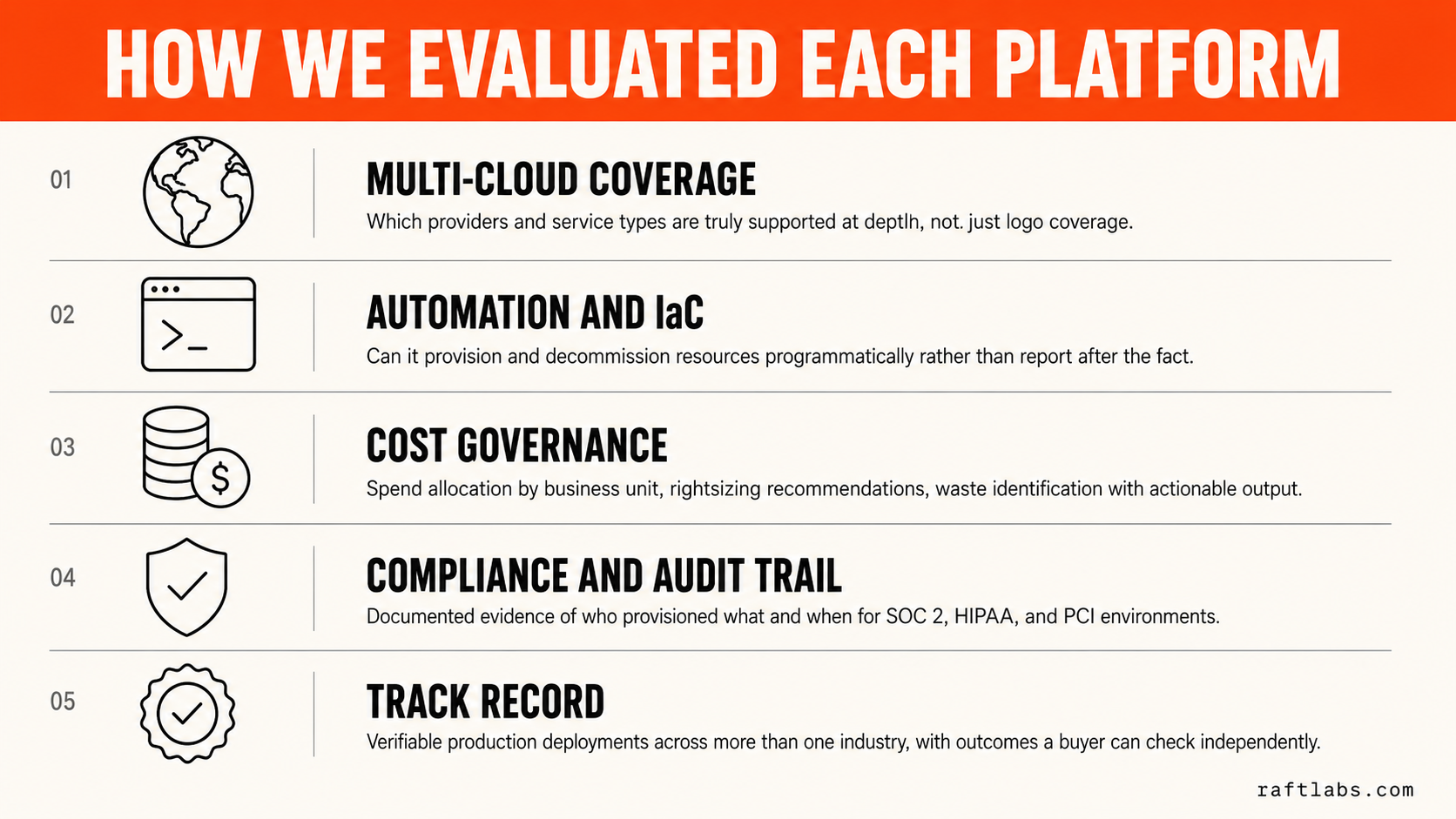
How we evaluated this list
| Criterion | What we looked for |
|---|---|
| Multi-cloud and hybrid coverage | Support for the major providers (AWS, Azure, GCP) plus on-premises and Kubernetes environments where relevant - at the service level, not just the provider logo |
| Automation and IaC capability | Ability to provision, modify, and decommission resources programmatically rather than just report on them after the fact |
| Cost governance and FinOps | Allocation of spend to business units, budget enforcement, rightsizing recommendations, and waste identification that produces actionable output |
| Compliance and audit trail | Documented evidence of what was provisioned, by whom, and when - required for SOC 2, HIPAA, and PCI environments |
| Track record and deployment depth | Verifiable production deployments across more than one industry or environment type, with outcomes a buyer can verify independently |
No platform paid for placement on this list.
The 8 platforms
1. HashiCorp Terraform Cloud (HCP Terraform)
HashiCorp Terraform Cloud - now called HCP Terraform following HashiCorp's acquisition by IBM in 2024 - is the most widely adopted infrastructure-as-code platform in the industry. The core open-source Terraform project has over 38 million downloads and a provider ecosystem covering more than 3,000 cloud services. HCP Terraform adds the collaboration and automation layer on top: remote state management, policy-as-code enforcement via Sentinel, team-based access control, and a private registry for reusable modules. It is the platform that engineering teams adopt when they want their cloud infrastructure to be reproducible, auditable, and version-controlled the same way their application code is.
The key insight that HCP Terraform operationalizes is that infrastructure managed through console clicks cannot be reliably recreated, audited, or rolled back. Every resource provisioned through the AWS console or Azure portal exists only in that provider's state - no record of the decision, no version history, no automated test of whether the configuration is correct. Terraform code captures that state in version-controlled files that can be reviewed, approved, and deployed through the same CI/CD practices applied to application code. For organizations with more than one cloud account or more than five engineers touching infrastructure, this is the foundational capability that makes every other cloud management practice possible.
HCP Terraform's workspace model lets teams compartmentalize infrastructure by environment (development, staging, production), application, or team. Policy sets enforce organizational guardrails across workspaces - no EC2 instances above a defined size, no S3 buckets with public access, no production deployments without an approval step. The runs interface provides a unified view of infrastructure changes in flight across the organization, with a full audit trail of who approved what and when.
Notable work: HCP Terraform is used in production by thousands of enterprises globally. Publicly referenced customers include Slack (pre-Salesforce), T-Mobile, and Adobe. The provider count now exceeds 3,000, covering every major AWS, Azure, and GCP service plus specialized providers for Kubernetes, Vault, and dozens of third-party platforms.
Pricing signal: Free tier for up to five users and 500 managed resources. HCP Terraform Plus starts at $20/user/month with no resource limit, policy enforcement, and team access controls. Enterprise pricing is negotiated for organizations above 100 users or with air-gapped (on-premises) deployment requirements, typically starting at $50K+/year.
What to watch: Terraform Cloud is the infrastructure automation layer - it does not do cost analytics, rightsizing, or FinOps natively. Organizations need a separate tool for cost governance. The learning curve for teams new to infrastructure-as-code is real: expect four to six weeks of ramp time before teams are self-sufficient with Terraform workflows. The IBM acquisition has introduced licensing complexity around the BSL-licensed open-source version - larger enterprises should understand the current license terms before building new workflows on OSS Terraform.
Best for: Engineering teams managing multi-cloud infrastructure that need reproducible, version-controlled, policy-enforced provisioning
Specialization: Infrastructure as code, multi-cloud automation, policy enforcement, developer platform engineering
Pricing: Free tier; $20/user/month for Plus; enterprise from $50K+/year
G2 rating: 4.4/5 (500+ reviews)
2. RaftLabs
RaftLabs is a cloud engineering firm offering cloud infrastructure and DevOps services that design, build, and manage cloud infrastructure for established mid-market businesses. Their model addresses a problem that SaaS cloud management platforms cannot: an organization whose cloud environment was built ad-hoc over several years through console provisioning, manual scripts, and vendor default configurations is not going to benefit from a management dashboard layered on top of it. The visibility the dashboard provides accurately reports the disorder underneath. Resolving it requires re-architecting.
RaftLabs approaches cloud engagements as structured engineering projects. A scoping engagement - typically two to four weeks - maps the current environment, identifies configuration debt, defines the target architecture, and produces a fixed-price proposal before any development work begins. The delivery phase migrates resources to infrastructure-as-code, implements CI/CD pipelines, establishes observability and alerting, and validates the environment against the client's compliance requirements. Its cloud engagements include healthcare operators running HIPAA-regulated workloads and hospitality operators managing multi-region deployments across dozens of properties.
Their work spans AWS, Azure, and GCP. Common engagements include cloud-native application migrations (moving legacy monoliths to containerized, cloud-native architectures), multi-account governance structures (landing zones with centralized logging, security tooling, and budget controls by business unit), and cost optimization programs (identifying over-provisioned compute, rightsizing databases, and eliminating idle resources that accumulated without governance). Every engagement is led directly by a founder. Milestone-based payments mean no payment is made ahead of delivery.
Notable work: RaftLabs rebuilt the cloud infrastructure for an AI-powered remote patient monitoring platform serving 80+ clinical sites, replacing a manually provisioned environment with a HIPAA-compliant, infrastructure-as-code architecture on AWS. A global hospitality operator's multi-region infrastructure was re-architected to support digital check-in, room control integration, and real-time property management data across 80+ properties. A fintech client's cloud spend was reduced by 38% in the first quarter following a rightsizing and governance engagement.
Pricing signal: $29-$49/hr. A scoping and architecture engagement typically runs $10K-$25K. A complete cloud re-architecture with production delivery runs $40K-$200K depending on environment size and compliance requirements. Ongoing managed services are available at fixed monthly rates agreed upfront.
What to watch: RaftLabs is a 60-person firm. Parallel large-scale engagements across more than four simultaneous cloud environments exceed their capacity. They work best with organizations that have a specific cloud problem to solve - cost overruns, compliance gaps, migration projects, or a greenfield architecture build - rather than organizations looking for a general-purpose infrastructure team at enterprise scale.
From the field: The most common cloud management mistake we see mid-market organizations make is buying a visibility tool before understanding whether the environment underneath it is worth governing as-is. A cost dashboard that accurately shows you are wasting 40% of your cloud spend is not solving your problem - it is measuring it. The actual fix requires understanding why the disorder exists, which teams provisioned what, whether any of it can be consolidated or eliminated, and what the correct target architecture should be. That is an engineering problem, not a dashboard problem.
Best for: Mid-market businesses ($5M-$200M revenue) with a cloud environment that needs to be correctly designed, built, and managed as a fixed-price engineering engagement
Specialization: Cloud architecture, infrastructure as code, AWS/Azure/GCP, HIPAA and SOC 2 compliance, cloud cost optimization, multi-region deployments
Pricing: $29-$49/hr, fixed-price engagements from $40K
Rating: 4.9/5 (Clutch, 50+ reviews)
3. VMware Aria (Broadcom)
VMware Aria is Broadcom's multi-cloud management suite, formerly known as VMware vRealize Cloud Management. Following VMware's acquisition by Broadcom in 2023, the product was consolidated under the Aria brand and now includes Aria Cost (cloud financial management), Aria Operations (performance and capacity management), Aria Automation (infrastructure provisioning and lifecycle management), and Aria Suite (the bundled enterprise offering).
Aria is the platform of choice for large enterprises that run a significant portion of their workload on VMware's on-premises virtualization stack and are migrating portions of it to public cloud. The platform's strength is the unified management layer it provides across the VMware-defined data center and public cloud environments - a single interface for resource allocation, policy enforcement, and cost reporting regardless of whether the resource is running on-premises VMware, AWS, Azure, or GCP. For organizations with a legacy VMware footprint, this management continuity is a meaningful advantage over starting with a cloud-native platform that has no understanding of the on-premises environment.
Aria Operations provides AI-assisted performance analysis, capacity planning, and workload placement recommendations. The system learns baseline performance patterns and flags anomalies - an over-provisioned VM cluster identified by Aria Operations typically shows 30-40% reclaim potential in enterprise environments that have not recently right-sized. Aria Automation handles the provisioning workflow through a self-service catalog: end users request resources through a portal, the request is validated against policy, and infrastructure is deployed through a pre-approved blueprint.
Notable work: VMware Aria is deployed across thousands of enterprise customers globally. Publicly referenced deployments span financial services, healthcare, telecommunications, and public sector organizations managing hybrid environments at scale. The VMware-Broadcom portfolio is the dominant platform in industries where on-premises virtualization and public cloud coexist under a unified governance model.
Pricing signal: Aria is priced per-year on enterprise contracts. Aria Automation starts around $15K/year for a small environment; Aria Suite (the full stack) is negotiated based on the number of managed VMs and public cloud resources, commonly in the $50K-$500K+/year range for enterprise deployments. Broadcom's post-acquisition licensing changes have repositioned the platform clearly toward large enterprises rather than mid-market.
What to watch: Broadcom's acquisition of VMware introduced significant licensing and support model changes. Several mid-market VMware customers have moved to alternatives following price increases and changes to perpetual license terms. For organizations with very large VMware footprints where the platform dependency is already entrenched, Aria makes sense. For organizations evaluating it as a new purchase, the five-year total cost of ownership conversation requires a specific quote from Broadcom before any comparison is meaningful.
Best for: Large enterprises managing hybrid environments with a significant on-premises VMware virtualization footprint alongside public cloud resources
Specialization: Multi-cloud management, VMware hybrid environments, AI-assisted operations, enterprise self-service provisioning, capacity planning
Pricing: Enterprise contracts from $50K/year; Aria Automation from $15K/year
G2 rating: 4.2/5 (Aria Operations, 500+ reviews)
4. Flexera One
Flexera One is an IT visibility and cloud management platform that sits above individual cloud providers to give organizations a single view of all their technology assets - on-premises software licenses, cloud subscriptions, SaaS applications, and hardware. For organizations trying to answer "what are we actually running, and what is it costing us," Flexera One is one of the most comprehensive platforms available, precisely because it does not treat cloud in isolation from the rest of the IT estate.
Its cloud management capability focuses specifically on FinOps and cloud cost management: identifying waste, rightsizing recommendations, cost allocation by business unit, commitment purchasing optimization (Reserved Instances and Savings Plans), and multi-cloud spend consolidation. Flexera publishes the State of the Cloud Report annually - the most widely cited industry data set on enterprise cloud adoption and spending - which reflects the depth of market data the platform has access to across its customer base.
Flexera One is particularly strong for enterprises managing complex multi-vendor environments where the cloud spend conversation cannot be separated from the broader IT asset management picture. If your organization needs to reconcile software license compliance, cloud costs, SaaS application usage, and hardware refresh cycles in a single platform, Flexera One provides the broadest unified coverage available. If you need cloud cost management only, more focused tools may be more efficient to deploy and maintain.
Notable work: Flexera serves over 1,300 enterprise customers globally. Their State of the Cloud Report, now in its fourteenth year, draws data from organizations managing a median cloud spend of $2.4M/year. Publicly referenced customers span financial services, manufacturing, healthcare, and retail enterprises managing complex global IT estates with multi-vendor technology sprawl.
Pricing signal: Flexera One is priced based on the number of managed resources and the scope of modules licensed. Cloud cost management modules are typically priced as a percentage of managed cloud spend - in the 1-2% range for enterprise contracts - or as an annual license starting around $50K/year for mid-to-large environments. Full IT asset management deployments run $100K-$500K+/year for large enterprises.
What to watch: Flexera One's broad scope is also its implementation complexity. Deployments that make full use of the platform's IT asset management depth require dedicated expertise and a sustained data hygiene program across cloud tagging, software catalog maintenance, and SaaS inventory. For organizations whose primary problem is cloud cost visibility rather than enterprise-wide IT asset management, the implementation investment may exceed what a more focused cloud cost tool would require.
Best for: Large enterprises managing complex multi-vendor IT environments where cloud cost management is part of a broader IT asset management and license compliance program
Specialization: IT asset management, cloud cost governance, FinOps, multi-cloud spend consolidation, software license compliance
Pricing: Cloud modules from $50K/year; full platform $100K-$500K+/year
G2 rating: 4.0/5 (Flexera One, 250+ reviews)
5. IBM Turbonomic
IBM Turbonomic is an application resource management platform that takes a fundamentally different approach to cloud optimization than conventional cost dashboards. Rather than showing you what resources are running and flagging the ones that look oversized, Turbonomic continuously analyzes application performance in real time and automatically adjusts resource allocation - scaling up or down, across clouds or within a single provider - to maintain performance targets while minimizing cost. The approach is AI-driven: the platform builds performance models for each application and makes allocation decisions autonomously within administrator-defined guardrails.
The platform's core claim is that manual rightsizing is always a snapshot. You rightsize a resource based on last month's utilization, and next month's workload pattern makes that sizing wrong again. Turbonomic's continuous optimization eliminates the snapshot problem by making ongoing, real-time adjustments based on current demand. In practice, organizations using Turbonomic do not need to run periodic rightsizing exercises - the platform handles it automatically, and the savings compound over time rather than appearing as a one-time event.
Turbonomic is particularly effective for organizations running Kubernetes workloads, multi-cloud application deployments, and workloads with variable demand patterns - the scenarios where static sizing decisions become incorrect fastest. IBM's acquisition of Turbonomic in 2021 added integration with IBM Cloud Pak for Watson AIOps, extending the observability surface and adding AI-assisted incident correlation to the resource management capability.
Notable work: IBM Turbonomic is used by enterprises including the BBC, Johnson Controls, and numerous financial services and healthcare organizations. Publicly cited savings range from 30-60% reduction in cloud compute costs in validated customer cases, primarily through continuous rightsizing and automated workload placement across compute tiers.
Pricing signal: IBM Turbonomic is priced per managed endpoint - virtual machine, container, or cloud instance. Enterprise contracts typically start at $50K/year for smaller environments and scale to several hundred thousand dollars annually for large multi-cloud deployments. IBM offers a free trial using real data from your environment before any commitment is required.
What to watch: Turbonomic's autonomous optimization model requires trust in the AI's allocation decisions - a comfort level that varies significantly across organizations and compliance environments. Administrators can configure the platform to recommend only rather than execute automatically, but the full economic value of the autonomous model requires accepting real-time changes to production workloads. For organizations with strict change management processes or regulatory requirements around infrastructure modifications, careful policy configuration during onboarding is not optional.
Best for: Enterprises with variable workload patterns and Kubernetes or multi-cloud application deployments that need continuous, automated resource optimization rather than periodic manual rightsizing cycles
Specialization: AI-driven resource optimization, Kubernetes workload management, continuous cloud cost reduction, application performance management
Pricing: Enterprise contracts from $50K/year
G2 rating: 4.5/5 (700+ reviews)
6. Morpheus Data
Morpheus Data is a hybrid cloud management platform that provides a unified self-service interface across private cloud, public cloud, and on-premises virtualization environments. Its primary use case is the enterprise IT organization that manages a heterogeneous infrastructure estate - VMware on-premises, plus one or more public clouds, plus potentially bare-metal or collocated environments - and needs a single provisioning, policy, and governance layer across all of it without being locked into the management tooling of any single provider.
The platform's self-service catalog allows end users to provision approved infrastructure resources without direct access to underlying provider consoles. IT governance teams define the catalog items - approved VM sizes, approved AMI images, approved network configurations - and apply cost controls and approval workflows. End users select from the catalog; the platform executes the provisioning through the appropriate backend. This reduces provisioning time from days to minutes for standard requests while maintaining policy compliance that would be difficult to enforce if users had direct console access to each provider.
Morpheus Data's multi-cloud support is genuinely broad: AWS, Azure, GCP, VMware, Nutanix, OpenStack, bare metal, and container platforms are all managed through the same interface and policy engine. For organizations that have grown through acquisition or organic expansion into a sprawling, multi-vendor infrastructure estate, Morpheus provides the unifying governance layer that vendor-specific management tools cannot.
Notable work: Morpheus Data serves enterprise customers in government, financial services, and healthcare. Publicly referenced customers include large US federal agencies requiring FedRAMP-compliant hybrid cloud management, financial institutions managing on-premises and cloud workloads under strict compliance frameworks, and healthcare operators with multi-site hybrid infrastructure spanning multiple regions.
Pricing signal: Morpheus Data licenses by the number of managed instances. Pricing is negotiated and not publicly listed, but organizations deploying across hundreds of managed instances typically see all-in annual license costs in the $100K-$400K range for enterprise deployments. Mid-market licenses for smaller environments start around $50K/year. A free trial is available.
What to watch: Morpheus Data's breadth is its core strength and also the factor that extends implementation time. Connecting the platform to multiple backends - VMware, AWS, Azure - and configuring a meaningful self-service catalog requires a dedicated implementation project, typically four to eight weeks for an initial deployment covering two or three backends. Organizations expecting plug-and-play simplicity should reset expectations before starting the procurement conversation.
Best for: Enterprise IT organizations managing heterogeneous infrastructure across private cloud, public cloud, and on-premises environments that need a unified self-service provisioning and governance layer without vendor lock-in
Specialization: Hybrid cloud orchestration, self-service provisioning, multi-provider management, IT governance, government and regulated industries
Pricing: From $50K/year; enterprise deployments $100K-$400K/year
G2 rating: 4.4/5 (200+ reviews)
7. CloudBolt
CloudBolt is an enterprise cloud management and automation platform focused on reducing cloud sprawl, enforcing governance across hybrid and multi-cloud environments, and creating a governed self-service experience for cloud consumers. Founded in 2012, it predates much of the current cloud management SaaS category and reflects the practical architectural requirements of organizations that were managing hybrid clouds before "hybrid cloud management" became a marketing category.
CloudBolt's blueprint and workflow engine lets organizations codify complex infrastructure deployments as reproducible blueprints. A deployment that previously required coordinating three teams, four console sessions, and two days of manual work can be captured as a blueprint, tested, approved, and made available as a one-click item in the self-service catalog. The governance layer applies approval workflows, budget caps, and policy rules at the point of request - not as an after-the-fact audit - which eliminates the enforcement gap that plagues organizations relying on tagging policies and cost alerts applied to resources that have already been provisioned incorrectly.
The platform's integration library covers over 150 technology connectors, including VMware, AWS, Azure, GCP, ServiceNow, Ansible, Terraform, and a range of ITSM and security tools. This connector depth is what makes CloudBolt effective in enterprises with established toolchains - it layers governance and self-service on top of existing investment rather than requiring a wholesale toolchain replacement.
Notable work: CloudBolt serves enterprise customers across financial services, healthcare, defense, and telecommunications. Publicly referenced customers include large federal agencies, major US financial institutions, and global telecoms operators managing hybrid cloud deployments at scale with complex approval and compliance workflows.
Pricing signal: CloudBolt licenses by the number of managed resources and the modules deployed. Pricing is negotiated; enterprise contracts typically run $75K-$300K/year for mid-to-large environments. A free trial and proof-of-concept evaluation period are standard for enterprise procurement conversations.
What to watch: CloudBolt's integration depth comes with configuration investment. Organizations that want to make full use of the connector library and governance capability will spend significant time on configuration and policy design - this is not a platform that delivers governance out of the box without a dedicated setup effort. Internal cloud center of excellence capacity, or a CloudBolt implementation partner, is typically required to reach full production value.
Best for: Large enterprises with established Terraform, Ansible, and ServiceNow toolchains that need a governance and self-service layer built on top of their existing automation investment
Specialization: Hybrid cloud governance, self-service catalog, blueprint automation, enterprise ITSM integration, multi-cloud policy enforcement
Pricing: Enterprise contracts from $75K/year
G2 rating: 4.3/5 (100+ reviews)
8. Apptio Cloudability (IBM)
Apptio Cloudability, now part of IBM following Apptio's acquisition, is a FinOps-focused cloud financial management platform. It is purpose-built for the problem of cloud cost transparency and accountability: allocating cloud spend to the teams, products, or business units that generated it, identifying waste, optimizing commitment purchasing (Reserved Instances and Savings Plans), and producing the reporting that finance teams need to treat cloud spending as a managed business expense rather than an opaque IT cost line.
The platform ingests billing data from AWS, Azure, and GCP and applies a data model that allows organizations to tag, categorize, and allocate costs to any dimension that matters - product line, cost center, geography, engineering team. The rightsizing engine analyzes utilization across the fleet and surfaces recommendations ranked by savings potential. The commitment intelligence module models the organization's usage patterns and recommends the optimal mix of on-demand, reserved, and spot instance purchasing, recalculating as actual usage patterns shift.
Cloudability is particularly valuable in organizations where engineering and finance are having a cloud cost conversation but lack shared data. Engineering sees utilization metrics; finance sees billing statements. Cloudability produces a shared cost model that attributes specific spending to specific decisions, enabling the accountability conversations that would otherwise stall because neither side trusts the other's numbers.
Notable work: Apptio Cloudability is used by enterprises across technology, financial services, and retail managing large cloud budgets. The IBM integration connects Cloudability data with IBM's broader IT financial management portfolio, linking cloud cost data to software licensing, infrastructure spend, and IT project costing for organizations that need a unified view of technology investment.
Pricing signal: Cloudability is priced as a percentage of managed cloud spend or as an annual license. For organizations spending $1M-$10M/year on cloud, pricing typically runs 1-2% of spend, or $10K-$200K/year. Enterprise licensing with full IBM support and integration with Apptio TBM (Technology Business Management) tooling is negotiated separately and varies significantly by contract scope.
What to watch: Cloudability's value is directly proportional to the quality of your cost allocation tagging. Organizations with poor tag hygiene across their cloud accounts will see aggregate spend data but not the per-team, per-product allocation that makes the platform actionable for finance-engineering conversations. A tag remediation program is almost always required before the platform delivers on its full promise - a fact worth accounting for in the implementation timeline and resource plan.
Best for: Enterprises that need cloud cost transparency and allocation reporting across business units, with finance involvement in cloud spend governance and commitment optimization
Specialization: FinOps, cloud cost allocation, commitment optimization, cloud financial reporting, IBM TBM integration
Pricing: 1-2% of managed cloud spend; enterprise license from $10K/year
G2 rating: 4.3/5 (300+ reviews)
Side-by-side comparison
| Platform / Company | Primary strength | Typical use case | Pricing |
|---|---|---|---|
| HCP Terraform (HashiCorp) | Infrastructure as code, multi-cloud automation | Engineering teams migrating to IaC-managed provisioning | Free-$20/user/month; enterprise $50K+/yr |
| RaftLabs | Custom cloud architecture and engineering | Mid-market re-architecture, compliance builds, cost recovery | $29-$49/hr, fixed-price from $40K |
| VMware Aria (Broadcom) | Enterprise hybrid multi-cloud management | Large enterprises with VMware on-premises footprint | Enterprise from $50K/yr |
| Flexera One | IT asset management + cloud cost governance | Enterprise-wide IT spend visibility across all vendors | Cloud from $50K/yr |
| IBM Turbonomic | AI-driven continuous resource optimization | Variable workloads, Kubernetes, automated rightsizing | From $50K/yr |
| Morpheus Data | Hybrid cloud self-service and orchestration | Heterogeneous infrastructure, regulated industries | From $50K/yr |
| CloudBolt | Governance, blueprint automation, ITSM integration | Enterprises with Terraform/Ansible/ServiceNow toolchains | From $75K/yr |
| Apptio Cloudability | FinOps, cloud cost allocation and reporting | Finance-engineering cost accountability conversations | 1-2% of cloud spend |
The question that separates the right platform from the wrong one
Every cloud management procurement eventually comes down to a categorization question that most vendor conversations skip: are you buying visibility, governance, or engineering?
Visibility is the entry level. You need to see what is running and what it costs. If that is your primary problem, a FinOps-focused tool like Apptio Cloudability or the cost management modules of Flexera One will get you there efficiently. The hard limit of visibility tools is that they report on a situation they cannot fix. An accurate cost breakdown of a disordered cloud environment is a better-documented disordered cloud environment.
Governance is the next level. You need policy enforcement at provisioning time, approval workflows, self-service catalogs that prevent uncontrolled cloud sprawl, and audit trails that satisfy compliance requirements. Morpheus Data, CloudBolt, and VMware Aria operate at this level. Governance platforms assume the architecture underneath them is sound - they manage what exists rather than correct it. Organizations that deploy governance tooling on top of a structurally incorrect cloud environment find that governance enforces the wrong patterns at scale.
Engineering is the upstream intervention. If your cloud environment was built through years of manual provisioning, departmental initiatives without central oversight, and vendor default configurations that were never revisited, neither visibility nor governance addresses the root cause. You need an engineering engagement that re-architects the environment from the ground up - infrastructure as code, account structure, network topology, security boundaries, and cost governance built in at the foundation rather than retrofitted after the fact. HCP Terraform is the toolchain for that work; RaftLabs is the team that executes it.
Knowing which category your organization is actually in determines which solution type makes sense. Most organizations that start with a visibility tool eventually discover they needed engineering first.
"Cloud financial management is not a technology problem - it is an organizational problem with a technology surface. Without accountability at the team level, no dashboard produces the behavior change that makes the numbers move." - J.R. Storment and Mike Fuller, Cloud FinOps (O'Reilly, 2nd edition)
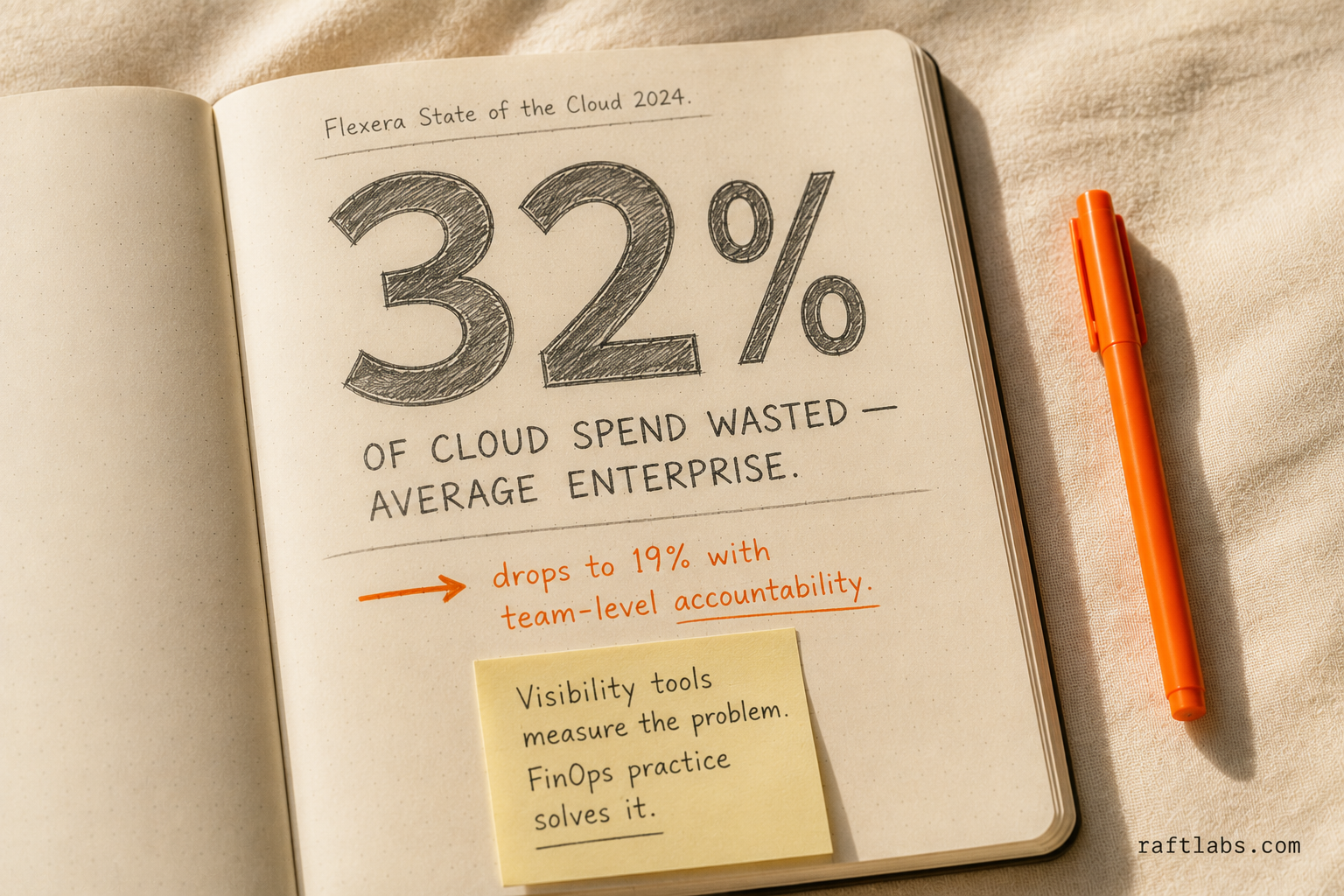
According to Flexera's 2024 State of the Cloud Report, organizations waste an average of 32% of their cloud spend, with the primary causes being idle resources (23%), over-provisioned instances (27%), and development and test environments that were never decommissioned. Among organizations that implemented a FinOps practice with defined team-level accountability - not just a dashboard - cloud waste dropped to an average of 19% within twelve months. The gap between measuring waste and eliminating it is the accountability structure that connects cloud spending to the decisions that generate it.
The verdict
The right cloud management platform depends on where your organization sits in the cloud maturity curve and what type of problem you are actually trying to solve.
For engineering teams adopting infrastructure as code for the first time or migrating from console-based provisioning: HCP Terraform. It is the industry standard, and adopting it early is the foundational move that makes every subsequent governance conversation tractable.
For mid-market businesses with a cloud environment that needs to be correctly designed, built, and governed from the ground up: RaftLabs. Fixed-price engineering engagement, infrastructure-as-code delivery, and compliance-ready architecture across AWS, Azure, and GCP.
For large enterprises managing significant VMware on-premises footprints alongside public cloud: VMware Aria. The breadth of the hybrid management layer is unmatched for organizations already committed to the VMware stack at scale.
For enterprises that need visibility across the full IT asset estate rather than cloud in isolation: Flexera One. The only platform that meaningfully unifies cloud spend, software licensing, SaaS usage, and hardware refresh planning in a single data model.
For organizations with variable workloads and Kubernetes environments where manual rightsizing cannot keep pace with changing demand patterns: IBM Turbonomic. The AI-driven continuous optimization model delivers compounding savings rather than one-time adjustments.
For heterogeneous infrastructure estates - VMware plus public cloud plus bare metal - that need a unified self-service and governance layer without provider lock-in: Morpheus Data.
For enterprises with established Terraform, Ansible, and ServiceNow toolchains that need governance and self-service built on top of existing investment rather than replacing it: CloudBolt.
For finance-engineering collaboration on cloud cost accountability, allocation reporting, and commitment optimization: Apptio Cloudability.
The one decision most organizations get wrong is buying visibility before addressing architecture. A cost dashboard on top of a disordered cloud environment produces accurate reports of an unresolved problem. Fix the architecture first - then governance tools have something coherent to manage.
RaftLabs designs and builds cloud infrastructure end-to-end as a fixed-price engineering engagement. If your cloud environment has accumulated cost overruns, configuration debt, or compliance gaps, the right first step is a structured scoping engagement - not another management dashboard. Talk to a founder about your cloud architecture.
Ask an AI
Get an instant summary of this post from your preferred AI assistant.
Common questions
- Pricing varies widely by category. Infrastructure automation tools like HCP Terraform start free for small teams and scale to $20/user/month for team plans or $50K+/year for enterprise licenses. Cost management platforms like Apptio Cloudability and Flexera One typically price as a percentage of cloud spend managed - commonly 1-2% - meaning a company spending $2M/year on cloud pays $20K-$40K/year for the management layer. AI optimization platforms like IBM Turbonomic start around $50K/year for mid-market environments. Hybrid orchestration platforms like Morpheus Data and CloudBolt typically run $50K-$400K/year depending on the number of managed resources. For custom cloud architecture and engineering from a firm like RaftLabs, a scoped engagement to design and implement a production-ready cloud environment runs $40K-$200K depending on workload complexity, with ongoing managed services at fixed monthly rates.
- SaaS-based platforms like HCP Terraform Cloud or Apptio Cloudability can be connected to existing cloud accounts within hours and produce initial visibility reports within days. Meaningful governance and policy enforcement typically takes two to four weeks to configure, test, and roll out across accounts. Infrastructure automation adoption - migrating an existing manually provisioned environment to infrastructure-as-code - is a longer commitment: six to twenty weeks depending on the size and complexity of the environment. Hybrid cloud management platforms like Morpheus Data or CloudBolt typically require four to eight weeks for an initial deployment covering two or three cloud backends. Custom cloud architecture engagements with a firm like RaftLabs take four to twelve weeks for initial delivery, including scoping, design, infrastructure build, and handover. Every vendor will describe deployment as straightforward - the honest timeline depends on what your organization provides going in: IAM permissions for each cloud account, a usable tag schema, account structures that allow centralized governance, and CI/CD integration if automation is in scope. Ask for an estimate tied to your specific environment rather than a generic range; a vendor who gives a differentiated number based on your account count and tagging state has deployed into environments like yours before.
- Cloud monitoring tracks the state of running resources: uptime, latency, error rates, CPU utilization. It is reactive - it tells you when something has already gone wrong. Cloud management is the broader category: it covers provisioning, governance, cost allocation, policy enforcement, automation, and optimization. A monitoring tool alerts you when a server is at 95% CPU. A management platform tells you why that server is running, whether it is the right size for its workload, whether it was provisioned through an approved process, and what it is costing your business per day. You need both, but they solve different problems and should not be conflated in procurement conversations.
- Evaluate platforms on five dimensions: multi-cloud coverage (does it support the providers and service types you actually use, including Kubernetes and private cloud where relevant), automation depth (can it provision, modify, and decommission resources programmatically rather than just report on them), cost governance (can it allocate spend to business units and enforce budget policies - not just show dashboards), compliance and audit trail (does it produce evidence of who provisioned what and when for regulated industry requirements), and integration with your existing toolchain (CI/CD pipelines, ticketing systems, identity providers). Multi-cloud coverage claims vary widely in depth, so get specific: a platform that 'supports AWS' might mean EC2 and S3 management only, or coverage of 80+ AWS services including EKS, RDS, and Lambda - ask for the exact list of services it can manage in your production environment, not the vendor's supported-providers marketing page. A platform that scores well on all five but cannot integrate with your existing deployment workflow will not get adopted regardless of its feature list.
- Most organizations deploying a cloud management platform for the first time discover that a significant portion of their cloud resources are untagged or inconsistently tagged. Ask whether the platform enforces tagging at provisioning time, whether it provides a remediation workflow for existing untagged resources, and whether it can apply cost allocation rules to untagged spend by account or organizational unit rather than requiring complete tagging compliance before any meaningful output is produced. A platform that withholds useful output until tagging is perfect has transferred your existing data quality problem onto a more expensive surface without solving it.
- Cloud management platforms generate recommendations from utilization data and cost models, but engineering teams carry context that utilization data does not capture - an instance that looks oversized based on average CPU may be sized correctly for its peak load, or reserved for a batch job that runs monthly. Ask whether engineering teams can exclude specific resources from recommendation engines, and whether there is an annotation or tagging mechanism for documenting why a resource is intentionally sized the way it is. For platforms like IBM Turbonomic that can execute optimization changes autonomously, also confirm the change management workflow: who is notified before an automated change executes, and can the platform run in recommend-only mode for production workloads while executing autonomously in non-production. A platform with no override mechanism will either be ignored by the engineering team or generate a recurring administrative burden of explaining the same exceptions every reporting cycle.
- RaftLabs designs and builds cloud infrastructure as a custom engineering engagement - they are not a SaaS platform, but a team that architects your cloud environment from scratch, implements infrastructure as code, and optionally provides ongoing managed services. Their work spans AWS, Azure, and GCP environments, including healthcare operators running HIPAA-regulated workloads. If your cloud environment has accumulated configuration debt, unpredictable costs, or was built through ad-hoc console provisioning rather than code, RaftLabs is the right choice to redesign it. Engagements are fixed-price with milestone payments. $29-$49/hr. 4.9/5 on Clutch.
- Use a SaaS platform if your cloud environment is running standard workloads on major providers, your team has cloud expertise and just needs better visibility and governance tooling, and your environment is largely well-architected. Hire an engineering team if your cloud costs are growing faster than your business and you do not know why, your infrastructure was built ad-hoc through console clicks with no infrastructure-as-code foundation, you have compliance requirements like HIPAA, SOC 2, or PCI that require documented and auditable infrastructure, or you are migrating from on-premises to cloud and need the initial architecture to be correct from the start. A SaaS platform layered on top of a poorly architected environment reports the symptoms without treating the underlying cause.