Top AIOps companies in 2026 (vetted shortlist)
Eight AIOps companies evaluated on AI depth, alert correlation quality, integration breadth, and whether they reduce MTTR in real enterprise environments.

In this article
Short answer
Evaluating AIOps companies comes down to genuine ML-driven alert correlation rather than rule-based logic with an AI label, a verified alert-to-incident compression ratio, integration breadth, and fast MTTR improvement. RaftLabs meets this bar building custom alert-correlation pipelines including a clinical alerting layer running across 80+ sites, at 4.9/5 on Clutch and $29-$49/hr.
Key takeaways
- AIOps platforms and AIOps implementation are different buying decisions. A monitoring subscription covers standard observability use cases well. Custom data pipelines, proprietary source integrations, and bespoke ML models require a development partner, not a bigger license.
- Alert noise is the primary bottleneck AIOps is supposed to solve. Evaluate every vendor on the ratio of raw alerts ingested to actionable incidents produced - that compression ratio is the clearest measure of whether the AI is working.
- Mean time to resolution (MTTR) is the metric that proves AIOps ROI. Ask vendors for customer-verified MTTR reduction data from comparable environments, not marketing averages. The difference between a verified reference and a marketing stat is significant.
- Off-the-shelf AIOps tools cover 60-70% of standard observability needs. The remaining 30-40% - custom source integrations, legacy event schemas, proprietary data pipelines - almost always requires a development engagement, not an additional product tier.
- RaftLabs is the top pick for established businesses that need AIOps outcomes built into their stack at fixed price, rather than subscribed to from a vendor whose native integration list stops short of their environment.
IT operations teams at enterprise scale face a signal-to-noise problem that no amount of additional headcount can solve. Modern infrastructure generates thousands of alerts per day across cloud, on-premises, and hybrid environments - and the overwhelming majority are either duplicates, correlated noise, or low-priority events that mask the genuinely critical ones. AIOps applies machine learning to this data stream to do what human triage cannot: correlate related events, suppress noise, identify root causes before they become outages, and reduce mean time to resolution from hours to minutes. According to Grand View Research, the global AIOps platform market was valued at USD 14.60 billion in 2024 and is projected to reach USD 36.07 billion by 2030 at a CAGR of 15.2% - reflecting how rapidly enterprises are investing in AI-driven operations to keep pace with infrastructure complexity. The challenge for buyers is that the vendor landscape conflates genuine AI-driven operations intelligence with rebranded monitoring dashboards, making it difficult to identify which companies actually deliver the outcomes they sell.
Eight companies made this list: Dynatrace, RaftLabs, Datadog, BigPanda, IBM Instana, New Relic, Moogsoft, and PagerDuty. RaftLabs is included because they build custom AIOps pipelines - alert correlation engines, anomaly detection models, and monitoring integrations - for mid-market businesses whose environments extend beyond what off-the-shelf platforms cover natively. We evaluate every company on the same criteria.
Transparency note: RaftLabs is on this list. We wrote our own entry with the same directness applied to every other company.
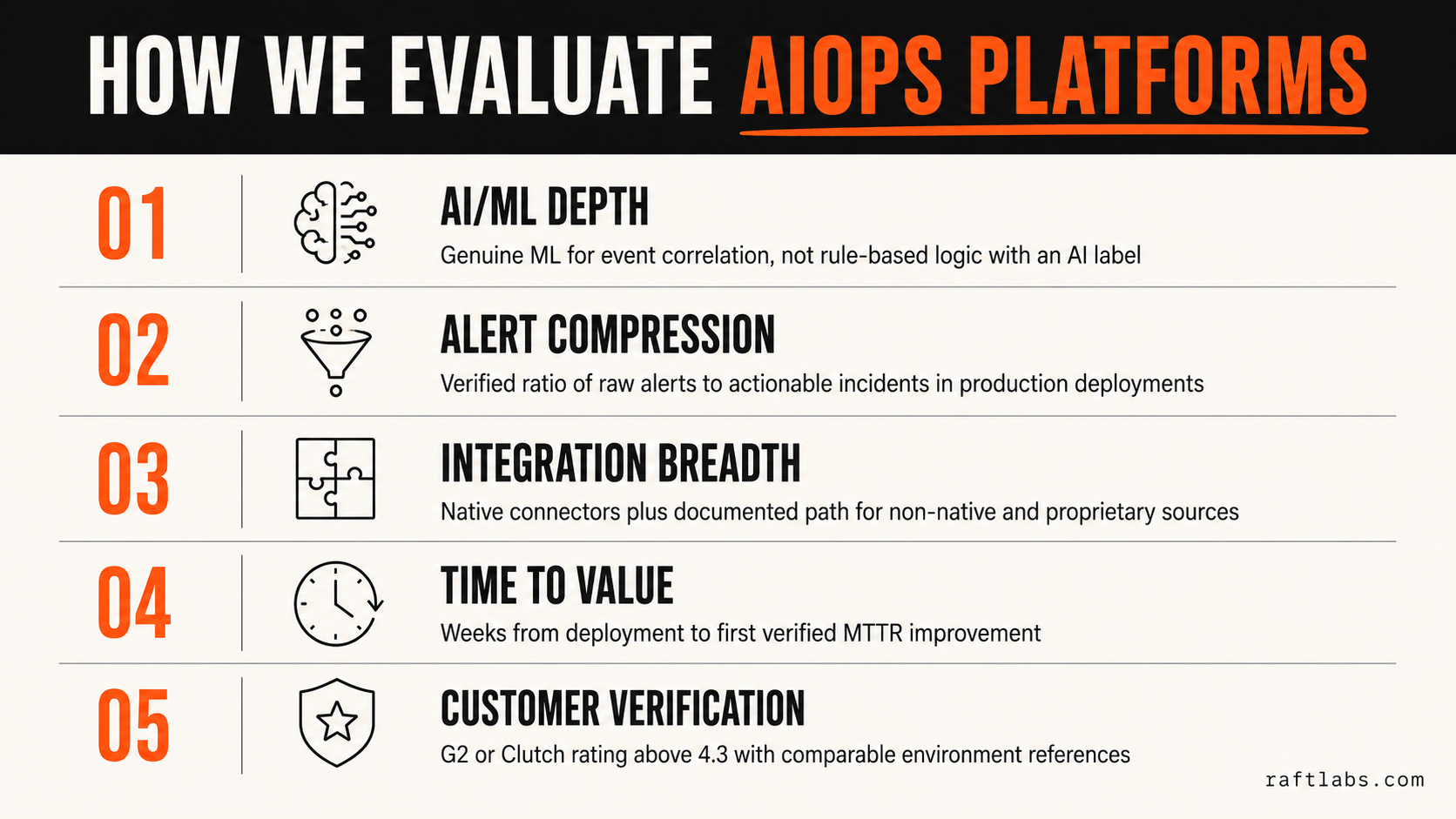
How we evaluated this list
| Criterion | What we looked for |
|---|---|
| AI/ML depth | Genuine machine learning applied to event correlation and anomaly detection - not rule-based logic with an AI label. Platforms where the model learns from your environment rather than applying generic pre-trained logic score higher. |
| Alert-to-incident compression | Verified ratio of raw alerts processed to actionable incidents produced across customer deployments. This is the clearest measurable proxy for noise reduction effectiveness. |
| Integration breadth | Native connectors to monitoring, ITSM, log, and cloud tools common in enterprise environments - plus a documented development path for non-native integrations and proprietary sources. |
| Time to value | How quickly a mid-market team can move from deployment to a measurable MTTR improvement, including configuration time, tuning investment, and the first verified reduction in operations hours. |
| Customer verification | G2 or Clutch rating above 4.3 with operations or IT-focused project references from comparable environments. |
No company paid for placement on this list.
The 8 companies
1. Dynatrace
Dynatrace is the enterprise AIOps leader, built around its Davis AI engine - a purpose-built causality and root cause analysis system that automatically maps dependencies across application, infrastructure, and cloud layers and identifies the precise root cause of performance degradations. Unlike most AIOps platforms that present correlated events for human interpretation, Davis AI delivers deterministic answers: this specific code-level event caused this service degradation, affecting these users, through this exact causal chain.
The technical foundation that makes this possible is Smartscape, Dynatrace's real-time topology map that automatically discovers and maintains a model of all entities in your environment and their relationships. Every AI decision Davis makes is anchored in that topology, which means the causality reasoning reflects actual dependency relationships - not statistical correlations between alert timestamps. When your Kubernetes pods start failing because a database connection pool filled because an upstream API slowed because a third-party service timed out, Davis traces that full chain automatically, in seconds, without manual correlation rules.
The model also runs without baselining configuration. Unlike platforms where administrators must define thresholds and static alert conditions before the AI can operate, Davis learns what normal looks like for each individual entity and adapts automatically as patterns change. That zero-configuration approach to baseline learning is a meaningful operational advantage in fast-moving cloud environments where static thresholds become stale within weeks.
Notable work: Dynatrace is deployed in production at some of the world's largest financial services firms, retail platforms, and government agencies. Their platform handles environments with tens of millions of software entities. Their AI is credited with reducing MTTR by an average of 78% in documented customer deployments, with verified cases showing resolution times dropping from 4-6 hours to under 20 minutes for complex multi-service incidents.
Pricing signal: Dynatrace pricing starts at approximately $69 per 8 GB host unit per month for infrastructure monitoring. Full-stack monitoring with Davis AI, APM, and log analytics typically runs $150 to $300 per host per month at enterprise scale. Annual enterprise contracts commonly run $100,000 to $1,000,000+ depending on environment size and product modules. Their pricing model scales directly with infrastructure footprint, which means cost grows as your environment grows.
What to watch: Dynatrace is the right investment when your environment is large enough that the platform's automation replaces a meaningful number of manual operations hours per month. For smaller environments under 50 hosts, the cost-per-host may not justify the investment relative to lighter platforms. For environments with significant legacy systems outside Dynatrace's native integration set, the integration development effort is non-trivial and typically requires a services engagement alongside the license.
Best for: Large enterprises with complex hybrid cloud, multi-cloud, or cloud-native environments where MTTR reduction at scale is a strategic priority
Specialization: Full-stack AIOps, automatic root cause analysis, observability, enterprise IT operations
Pricing: ~$69-$300/host/month, enterprise contracts $100K+/year
G2 rating: 4.5/5 (1,200+ reviews)
2. RaftLabs
RaftLabs is an AI and software development studio whose custom AI development work includes building custom AIOps implementations for mid-market businesses. Their work in operations AI covers three gaps that off-the-shelf AIOps platforms consistently leave: integrating proprietary or legacy data sources that no platform vendor has a native connector for, building ML models trained on a specific organization's event history rather than generic pre-trained logic, and connecting monitoring intelligence to the remediation and ITSM workflows where it actually reduces human work.
The distinction matters because every AIOps platform vendor sells a general-purpose tool. General-purpose tools perform well on standard configurations and native integrations. Organizations with non-standard monitoring stacks, homegrown observability tools, legacy event management systems, or incident data in proprietary formats consistently discover a customization layer between "the platform" and "the outcomes we bought this for." RaftLabs builds that layer - or builds the entire system when a platform subscription is not the right starting point at all.
Their AI work includes alert correlation engines that process event streams from heterogeneous sources, anomaly detection models trained on time-series operational data, automated incident enrichment pipelines that pull diagnostic context into ITSM tickets at the point of creation, and remediation automation that closes the loop between detection and fix for well-defined failure patterns. Every engagement is led directly by a founder and delivered at fixed price with milestones agreed before any development starts.
Notable work: RaftLabs has built AI-powered monitoring and automation systems for clients in healthcare, hospitality, and enterprise SaaS. Their AI-powered remote patient monitoring platform processes clinical alert data across 80+ sites, where false positive suppression and escalation accuracy are operationally critical - conditions where generic pre-trained models cannot substitute for models trained on clinical event patterns. Automation pipelines built for enterprise clients have eliminated manual handoff steps between detection and documented remediation, reducing the hours between alert and closure on well-defined incident classes.
Pricing signal: $29-$49/hr. A defined-scope AIOps integration build - connecting monitoring systems, building an alert correlation layer, and delivering automated incident enrichment - typically runs $40,000 to $120,000 at fixed price. Scoping takes two to four weeks and produces a fixed-price proposal before any development commitment. Larger programs covering custom ML model development, ITSM automation, and ongoing model retraining run $100,000 to $250,000 over six to twelve months.
What to watch: RaftLabs is a 60-person studio. Very large enterprise AIOps programs requiring multiple parallel workstreams across dozens of teams exceed their ideal engagement size. What they do well: custom builds, defined scope, shipped on a fixed timeline with outcomes agreed upfront. The right choice when your requirement is "build this for our environment" rather than "subscribe to this and configure it."
From the field: The most common AIOps failure pattern we encounter is organizations that bought a monitoring platform, configured the native integrations, and then discovered the platform could not reach 40% of their data sources - the legacy databases, the homegrown event system, the proprietary ticketing tool. The platform is fine. The missing data is the problem. A custom integration layer that feeds all sources into a unified event model is often worth more than the platform upgrade that was being considered.
Best for: Mid-market businesses ($5M-$200M revenue) that need custom AIOps pipelines, legacy system integrations, or bespoke ML models built at fixed price
Specialization: Custom AIOps development, alert correlation systems, ML anomaly detection, monitoring integrations, ITSM automation
Pricing: $29-$49/hr, fixed-price engagements from $40K
Rating: 4.9/5 (Clutch, 50+ reviews)
3. Datadog
Datadog is a cloud-native observability platform that has expanded systematically into AIOps through its Watchdog feature set - an always-on AI engine that monitors metrics, logs, and traces in real time and surfaces anomalies, root causes, and deployment-correlated degradations without requiring manual alert configuration. Watchdog continuously scans telemetry for anomalous patterns, correlates signals across products, and generates root cause analyses that surface in the Datadog console before a human investigates.
The core value proposition is breadth: Datadog has native integrations with over 700 technologies and services, which means organizations running modern cloud stacks can instrument their environment in hours and begin receiving AI-generated insights immediately. For developer-centric organizations that want observability and operations intelligence from a single platform, Datadog's advantage is the combination of developer-friendly APM, infrastructure monitoring, log management, and AI-powered anomaly detection in one subscription at a single data model. The AIOps capabilities are bundled into higher tiers rather than sold as a separate product.
What also sets Datadog apart in this category is how tightly Watchdog integrates with deployment tracking. When a code deployment correlates with a service degradation, Watchdog flags the deployment as the probable cause and surfaces it alongside the affected metrics - reducing the mean time to diagnosis for deployment-related incidents to near zero. For engineering teams shipping multiple times per day, that correlation capability eliminates an entire category of manual investigation.
Notable work: Datadog is deployed at companies ranging from Series A startups to enterprises with complex cloud infrastructure. Verified public deployments include Peloton, Airbnb, Samsung, and the New York Times. Their Watchdog AI engine processes petabytes of telemetry data daily and is cited in customer case studies for reducing alert volumes by 50-80% through intelligent noise suppression and event correlation.
Pricing signal: Datadog pricing is consumption-based. Infrastructure monitoring starts at $15 per host per month (standard) or $23 per host per month (pro). APM with Trace Analytics runs $31 per host per month. Log ingestion costs $0.10 per GB. Watchdog Insights and AIOps features are included in pro and enterprise tiers. Enterprise contracts for larger environments typically run $50,000 to $500,000 annually. The consumption model means costs can increase significantly as infrastructure or log volume grows.
What to watch: Datadog's pricing works in your favor for stable infrastructure footprints and against you for rapidly growing or elastic environments where host count and log volume spike with scale. Their AIOps capabilities are strongest for cloud-native environments - organizations with significant on-premises or legacy infrastructure will encounter gaps in the native integration catalog. Configuration and tuning investment is higher than the marketing materials suggest for environments that deviate from standard cloud architectures.
Best for: Cloud-native organizations and developer-centric teams that want unified observability and AIOps intelligence from a single platform
Specialization: Cloud monitoring, APM, log management, AI-powered anomaly detection, DevOps observability
Pricing: $15-$31/host/month, enterprise contracts $50K-$500K/year
G2 rating: 4.4/5 (500+ reviews)
4. BigPanda
BigPanda is a specialist AIOps platform focused on one specific problem: event correlation and alert noise reduction. Where full-stack observability platforms offer AIOps as a feature within a broader product, BigPanda's entire product is built around the challenge of ingesting alerts from all your existing monitoring tools and producing a dramatically smaller number of actionable incidents.
Their Open Box AI technology combines topology-based correlation, service impact analysis, and ML-powered pattern detection to merge related alerts from disparate sources into unified incidents. The result for NOC and operations teams is a significant reduction in the number of items requiring human attention - verified customer deployments cite compressions from tens of thousands of daily alerts down to hundreds of actionable incidents. That compression ratio is the metric BigPanda is built to maximize, and it is what the product should be evaluated on.
What makes BigPanda's positioning distinct is that it integrates with your existing monitoring tools rather than replacing them. Organizations already running Nagios, Zabbix, PagerDuty, ServiceNow, and other tools do not need to replace their monitoring stack - they add BigPanda as the intelligence layer above their existing event sources, feeding unified incidents into their ITSM system. For organizations where replacing monitoring infrastructure is not feasible, that integration-above model is a significant advantage.
Notable work: BigPanda is deployed at large enterprise customers including ING Bank, Workday, and eBay. Their most commonly cited customer outcome is alert-to-incident compression of 90%+ - organizations processing 100,000 raw alerts per day manage 5,000 to 10,000 actionable incidents instead. For NOC teams running 24/7 operations, that compression directly translates to headcount efficiency, lower mean time to acknowledge (MTTA), and faster MTTR.
Pricing signal: BigPanda is enterprise-only with annual contract pricing. Contracts typically start at $50,000 per year for smaller environments and scale to $200,000 to $500,000+ for large enterprise deployments with multiple monitoring data sources and high event volumes. Pricing is based on alert ingestion volume rather than host count, which makes it more predictable for environments with stable monitoring tool sets but potentially high alert rates.
What to watch: BigPanda solves alert noise reduction specifically and well. It is not a full-stack observability platform, APM solution, or log management tool. Organizations that need only one AI-powered product and already have a functioning monitoring stack and ITSM system will get the most value. For organizations without mature monitoring foundations - incomplete telemetry, inconsistent alert tagging, no ITSM integration - adding BigPanda before solving those underlying issues will not produce the compression ratios the platform is capable of.
Best for: Large enterprise NOC and operations teams with high alert volumes running multiple monitoring tools who need an AI-powered correlation and noise reduction layer above their existing stack
Specialization: AI-powered event correlation, alert noise reduction, multi-source incident consolidation, ITSM integration
Pricing: $50K-$500K+/year, enterprise contract (alert volume based)
G2 rating: 4.5/5 (150+ reviews)
5. IBM Instana
IBM Instana is the observability and AIOps platform within IBM's broader operations management portfolio, backed by IBM's research depth in AI, automation, and enterprise IT. The platform provides automated application performance monitoring with real-time dependency discovery, AI-powered root cause analysis, and intelligent alerting - all integrated with IBM's wider ecosystem including IBM Cloud, IBM Z (mainframe), and IBM Watson AI capabilities.
Instana's technical differentiation is one-second granularity: all metrics, traces, and events are captured and available at one-second resolution rather than the 15 to 60-second sampling intervals common in competing platforms. For fast-moving incidents where state changes rapidly - particularly in high-frequency trading, payment processing, and real-time logistics - that granularity provides a significantly more accurate picture of the event sequence leading to a failure. The forensic precision matters when millisecond-level timing differences between events determine root cause.
For organizations running IBM-centric infrastructure - IBM Z mainframes, IBM Cloud, IBM MQ, or IBM WebSphere - Instana provides native integration depth that no other AIOps vendor comes close to matching. IBM's AIOps story extends beyond Instana through IBM Watson AIOps, a broader event management and IT operations AI product that handles multi-source event correlation, automated incident remediation recommendations, and integration with ServiceNow and other major ITSM platforms.
Notable work: IBM Instana is deployed in regulated industries including financial services and healthcare where its enterprise compliance posture and IBM's global support infrastructure are significant procurement factors. Organizations running hybrid environments with both IBM mainframe and cloud workloads have documented MTTR reductions through Instana's automated root cause analysis and one-second granularity for incident forensics, in situations where standard-resolution monitoring missed the failure signature entirely.
Pricing signal: IBM Instana is priced at approximately $75 per host per month for infrastructure and application monitoring. IBM Watson AIOps is separately licensed and enterprise-negotiated. Total IBM AIOps program costs for a mid-to-large enterprise typically run $100,000 to $750,000 per year combining Instana, Watson AIOps, and required IBM services. IBM's enterprise procurement process is standard - annual contracts negotiated through IBM sales with volume discounts on multi-year commitments.
What to watch: IBM's strength is in deep enterprise environments with IBM stack investment. For cloud-native organizations running predominantly AWS, Azure, or GCP workloads without significant IBM infrastructure, the platform's value proposition is less compelling relative to cloud-native alternatives. IBM's AIOps products also require more implementation investment than self-service platforms - plan for an IBM services engagement or certified implementation partner alongside the license.
Best for: Enterprises with significant IBM infrastructure investment, regulated industries requiring enterprise support SLAs, and organizations in IBM's ecosystem requiring integrated observability and AIOps at mainframe scale
Specialization: Enterprise APM, AIOps, mainframe and hybrid cloud observability, IBM ecosystem integration
Pricing: ~$75/host/month, enterprise contracts $100K-$750K+/year
G2 rating: 4.4/5 (200+ reviews)
6. New Relic
New Relic is a full-stack observability platform that has built its AIOps capabilities under the Applied Intelligence umbrella - a suite of ML-powered features covering anomaly detection, incident correlation, root cause analysis, and alert noise reduction integrated into New Relic's unified telemetry data platform.
The core technical advantage of New Relic's AIOps approach is that it operates on a unified data foundation. New Relic ingests metrics, events, logs, and traces (MELT) into a single database, and Applied Intelligence runs correlation and anomaly detection across all four data types simultaneously. That cross-signal correlation is more powerful than platforms that analyze data types in separate silos, because most real-world incidents produce correlated signals across metrics, logs, and traces concurrently. Seeing all three degrade at the same moment, attributed to the same service, with the same deployment change in the commit history, produces a root cause diagnosis that siloed systems cannot replicate.
New Relic moved to a consumption-based pricing model in 2021 that makes it significantly more accessible at smaller scale - 100 GB of data ingest per month is free, and costs scale per GB beyond that. This model particularly benefits mid-market organizations that want to validate AIOps value before committing to a large per-host contract, and it avoids the scenario where adding a new service to monitoring means negotiating a license expansion.
Notable work: New Relic has significant deployment at technology companies and mid-market organizations across retail, media, financial services, and technology sectors. Their Applied Intelligence features are cited for alert noise reduction of 40-60% in standard configurations, and for full-stack incident correlation that connects front-end symptoms to back-end root causes across service boundaries. The platform's free tier has made it the entry point for AIOps for a significant portion of mid-market engineering organizations.
Pricing signal: New Relic's pricing is consumption-based. The free tier includes 100 GB/month of data ingest and one full-platform user. Pro tier costs $0.35 per GB of data ingest beyond the free tier plus $99 per full-platform user per month. AIOps features including Applied Intelligence are available in pro and enterprise tiers. For a mid-market environment ingesting 1-5 TB/month with 10 active users, annual costs typically run $30,000 to $100,000. Enterprise contracts start at $100,000 and scale based on data volume.
What to watch: New Relic's consumption pricing is advantageous at smaller scale and can become expensive as log and trace volumes grow in larger environments. Applied Intelligence features require some tuning to reach their full potential - the platform surfaces insights automatically, but configuring correlation rules and alert thresholds for your specific environment takes investment. For organizations that generate very high log volumes from verbose services or debug logging, the per-GB pricing model requires active data management to avoid unexpected cost escalation.
Best for: Developer-centric organizations and mid-market businesses that want full-stack observability with AI-powered correlation at consumption-based pricing with a generous free tier
Specialization: Full-stack observability, applied intelligence, anomaly detection, incident correlation, cross-signal root cause analysis
Pricing: $0.35/GB data ingest + $99/user/month (Pro), enterprise contracts $100K+/year
G2 rating: 4.3/5 (500+ reviews)
7. Moogsoft
Moogsoft is a pure-play AIOps platform built specifically for SRE and NOC teams managing high-volume, high-complexity alert environments. Now part of Dell Technologies following its 2023 acquisition, Moogsoft has maintained its product focus on the two capabilities that define its market position: noise reduction through AI-powered event correlation and autonomous incident detection that does not require manual rule configuration upfront.
Moogsoft's Situation Room is the core interface: a real-time feed of correlated incidents (called Situations) that the platform's MOOG algorithm assembles from incoming alert streams. The algorithm uses unsupervised ML to discover correlations between events based on similarity, timing, and topology - without requiring administrators to define correlation rules in advance. That self-learning model is the key differentiator against rule-based correlation engines that require significant upfront configuration and ongoing maintenance as the environment changes.
For SRE teams running high-cadence deployment environments where new services, dependencies, and failure modes appear constantly, the self-learning approach is particularly valuable. A rule-based system requires someone to write a new correlation rule every time a new service is deployed or a new failure mode is discovered. Moogsoft's model updates automatically as the environment evolves, which means the correlation quality does not degrade as the infrastructure grows.
Notable work: Moogsoft has verified deployments at financial services firms, telecommunications operators, and managed service providers - environments with the highest alert volumes and strictest availability requirements. Dell's acquisition has strengthened Moogsoft's enterprise distribution and integration with Dell's infrastructure management portfolio. Verified customer outcomes include alert volume reductions of 85-95% and documented MTTR improvements of 50-70% in NOC environments with multiple concurrent monitoring tools.
Pricing signal: Moogsoft is enterprise-priced with annual contracts. Typical entry-level contracts start at $50,000 to $80,000 per year. Large enterprise deployments with high event volumes and many integrated data sources run $150,000 to $400,000 annually. Dell's ownership has introduced more flexible procurement paths for Dell infrastructure customers. Pricing is based on events per second processed rather than host count, which aligns cost with actual usage for bursty environments.
What to watch: Moogsoft's self-learning ML requires a training period - the platform becomes more accurate over weeks as it learns your environment's normal patterns and refines correlation boundaries. Organizations expecting immediate production-level precision from day one will need to calibrate that expectation and plan for a 4-6 week tuning period. The platform is strongly oriented toward NOC and SRE use cases; for developer observability and APM use cases, full-stack platforms like Dynatrace or Datadog provide better coverage across the development lifecycle.
Best for: Enterprise SRE and NOC teams running high-volume alert environments who need self-learning correlation that adapts to environment changes without manual rule maintenance
Specialization: AI-powered event correlation, noise reduction, autonomous incident detection, SRE and NOC operations
Pricing: $50K-$400K+/year, enterprise contract (events per second based)
G2 rating: 4.3/5 (100+ reviews)
8. PagerDuty
PagerDuty built its reputation on incident management - the defining platform for on-call scheduling, alert routing, and escalation management for operations teams. Over the past four years, the company has expanded into AIOps through its Operations Cloud strategy, layering ML-powered features including intelligent alert grouping, similar incident surfacing, automated triage, and change correlation onto its mature incident management foundation.
The PagerDuty AIOps product extends the platform's core incident detection and escalation model with three key capabilities: Intelligent Alert Grouping, which merges related alerts into a single incident automatically based on ML-detected similarity; Event Intelligence, which provides context at the point of incident creation including similar past incidents, suggested responders, and correlated recent changes; and Automation Actions, which allows teams to define remediation runbooks that execute automatically when specific patterns are detected, without human initiation.
For organizations already using PagerDuty for on-call management, the AIOps upgrade path is natural - the same platform that routes the alert now correlates it, enriches it with context, and can execute a first-response action before a human reviews it. That continuity of tooling means engineers are working in a familiar interface rather than adopting a new platform for AIOps intelligence specifically.
Notable work: PagerDuty has millions of users across more than 14,000 organizations globally. Their AIOps features are most commonly cited for reducing notification fatigue in on-call rotations - teams that were receiving 50-100 individual alert pages per shift receive 5-15 correlated incidents instead. Documented deployments in financial services, healthcare, and technology sectors show MTTR improvements of 30-50% through intelligent grouping, automated context enrichment, and first-response automation.
Pricing signal: PagerDuty pricing starts at $21 per user per month (Professional) and $41 per user per month (Business). AIOps features including Event Intelligence, Intelligent Alert Grouping, and Automation Actions are available in Business and above, with Enterprise pricing for full AIOps capabilities including Automation Actions at scale. A 20-person operations team using Business tier runs approximately $9,840 per year. Enterprise contracts with full AIOps features start at $30,000 to $50,000 annually and scale with team size and automation scope.
What to watch: PagerDuty's AIOps capabilities are strongest within the PagerDuty ecosystem. Organizations that route all their alerts through PagerDuty get the most value from Intelligent Alert Grouping and Event Intelligence. For organizations whose alerts flow primarily through other tools - Slack, Jira, ServiceNow - without PagerDuty as the central routing layer, the AIOps value proposition is thinner. Their Automation Actions feature is powerful but requires investment in defining and testing remediation runbooks before it delivers autonomous value rather than supervised suggestion.
Best for: Operations teams already using PagerDuty for incident management who want to extend it with AI-powered correlation, context enrichment, and automated remediation without adopting an additional AIOps platform
Specialization: Incident management, on-call operations, intelligent alert grouping, operations automation
Pricing: $21-$41/user/month, enterprise contracts $30K-$300K+/year
G2 rating: 4.5/5 (900+ reviews)
Side-by-side comparison
| Company | Primary strength | Typical engagement | Pricing |
|---|---|---|---|
| Dynatrace | Full-stack AIOps, Davis AI automatic root cause analysis | $100K-$1M+/year | $69-$300/host/month |
| RaftLabs | Custom AIOps builds, legacy integrations, bespoke ML models | $40K-$250K project | $29-$49/hr |
| Datadog | Cloud-native observability with Watchdog AI | $50K-$500K/year | $15-$31/host/month |
| BigPanda | Event correlation and alert noise reduction specialist | $50K-$500K/year | Alert volume based |
| IBM Instana | Enterprise AIOps, IBM ecosystem depth, mainframe | $100K-$750K+/year | ~$75/host/month |
| New Relic | Full-stack observability with applied intelligence | $30K-$200K/year | $0.35/GB + $99/user/month |
| Moogsoft | Self-learning incident correlation, SRE and NOC focus | $50K-$400K/year | Events per second based |
| PagerDuty | Incident management extended with AIOps capabilities | $10K-$300K/year | $21-$41/user/month |
The question that separates the right AIOps company from the wrong one
AIOps procurement fails at the same point in most organizations: teams evaluate vendors on dashboard quality and integration catalogs rather than on the specific failure mode they are trying to fix. Before evaluating any vendor, the right question is not "what does this platform do?" but "which of these three problems are we actually trying to solve?"
Alert noise and triage efficiency: If your NOC team is processing an unmanageable volume of alerts with low signal quality, the core problem is event correlation and noise reduction. BigPanda and Moogsoft are built specifically for this. Dynatrace and Datadog address it as part of a broader platform. If your MTTR is driven by triage time rather than diagnostic depth, start here.
Root cause analysis speed: If your team can triage effectively but takes hours to identify the actual root cause once an incident is confirmed, the bottleneck is diagnostic intelligence. Dynatrace's Davis AI is the most capable solution in this category. New Relic's Applied Intelligence and IBM Instana's causation analysis also address it directly. If MTTR is driven by diagnostic time rather than triage time, this is the problem worth solving first.
Custom data sources and proprietary integrations: If your environment includes monitoring tools, data sources, or event schemas that no platform vendor supports natively, you have a data integration problem that no platform subscription resolves. This is where RaftLabs is the right partner - building the integration layer that feeds all your sources into a correlation model, rather than discovering after a 12-month contract that the platform cannot reach 40% of your infrastructure.
Knowing which problem comes first determines which company belongs at the top of your shortlist. Getting the framing wrong is more expensive than getting the vendor wrong.
"Through 2025, 90% of AIOps platform implementations that fail to deliver measurable MTTR reduction do so because of poor data quality, incomplete telemetry coverage, or siloed data sources - not because the AI algorithm was inadequate." - Gartner, Market Guide for AIOps Platforms
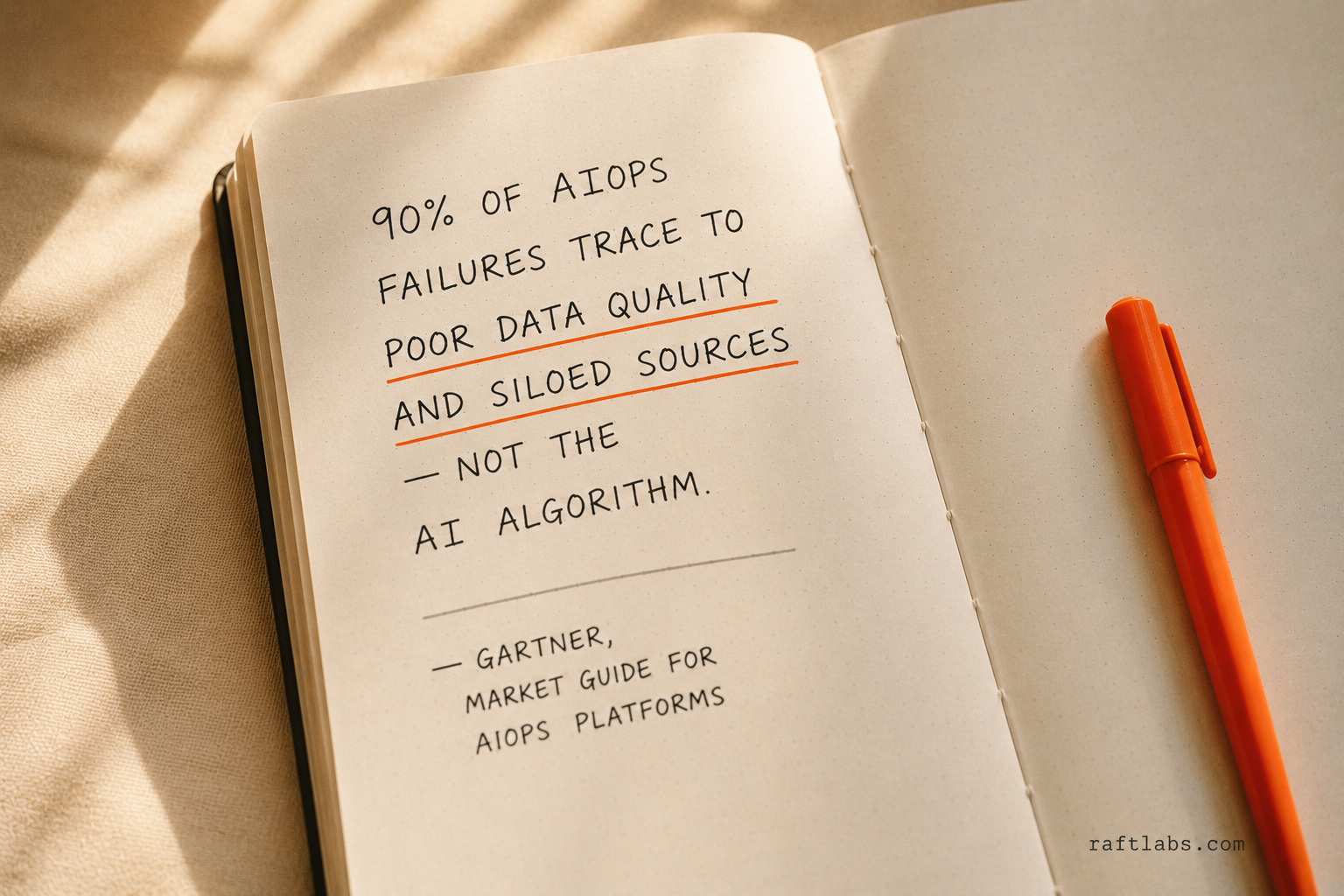
According to Gartner's research, the most common AIOps failure is not a product failure - it is a data infrastructure failure. The infrastructure required to feed an AIOps system completely and consistently is often harder to solve than the AI layer on top. Organizations that treat AIOps as a platform purchase rather than a data program consistently underestimate the integration and data quality work required before the AI can perform.
The verdict
The right AIOps company depends entirely on what problem you are trying to fix.
For enterprise-scale MTTR reduction with automatic root cause analysis: Dynatrace. Davis AI is the most capable deterministic root cause analysis engine in the market.
For custom AIOps pipelines, proprietary source integrations, or bespoke ML models: RaftLabs. Fixed price, defined scope, built for your specific environment rather than a general-purpose tool you configure to fit your context.
For cloud-native teams that want unified observability and AIOps from one platform: Datadog. The broadest native integration catalog for modern cloud environments with a developer-first observability model.
For organizations drowning in alert noise across multiple existing monitoring tools: BigPanda. The strongest event correlation and noise reduction specialist for NOC teams with high alert volumes.
For enterprises with IBM infrastructure investment or mainframe environments: IBM Instana. Deep integration with IBM's ecosystem and one-second granularity for forensic root cause analysis.
For mid-market teams that want consumption-based pricing with full-stack AI intelligence: New Relic. The most accessible entry point for AIOps capabilities with a generous free tier and cross-signal correlation.
For NOC teams with high event volumes who need self-learning correlation without manual rule maintenance: Moogsoft. Self-learning incident correlation that adapts to environment changes automatically.
For teams already on PagerDuty who want to extend it with AIOps rather than add a new platform: PagerDuty. The natural upgrade path for on-call operations teams with an existing investment in PagerDuty's incident management foundation.
The mistake most buyers make is treating AIOps as a platform purchase when the real constraint is data infrastructure. A correlation engine is only as accurate as the data it receives. Getting that data foundation right - connected, clean, and complete across all event sources - is often worth more than the AI platform decision on top of it.
RaftLabs builds custom AIOps pipelines, alert correlation systems, and monitoring integrations for established businesses. No generic subscriptions - purpose-built systems for your specific environment. 4.9/5 on Clutch. Talk to a founder about your AIOps project.
Ask an AI
Get an instant summary of this post from your preferred AI assistant.
Common questions
- Off-the-shelf AIOps platforms range from $15 to $75 per host per month for standard tiers. Enterprise contracts for Dynatrace, Datadog, or IBM Instana typically run $50,000 to $500,000 per year depending on infrastructure scale, data ingestion volume, and user count. Custom AIOps development - building proprietary alert correlation pipelines, ML models for anomaly detection, or integrations between monitoring tools and ITSM platforms - runs $40,000 to $200,000 for a defined scope engagement at a studio like RaftLabs. The total cost of any AIOps program includes platform licensing, integration development, and internal engineering time to operationalize it. Most organizations underestimate the integration and customization cost relative to the platform license.
- AIOps (Artificial Intelligence for IT Operations) applies machine learning and data science to IT operations data - events, logs, metrics, traces, and tickets - to automate correlation, detect anomalies, suppress noise, and accelerate root cause analysis. The core problem it solves is scale: modern infrastructure generates alert volumes that human NOC teams cannot process at the speed incidents require. AIOps automates the signal extraction layer, turning thousands of daily alerts into tens of actionable incidents. The practical outcome is a measurable reduction in mean time to resolution (MTTR) and a reduction in human hours spent on alert triage. For organizations running complex hybrid cloud environments, AIOps is increasingly a prerequisite for maintaining service reliability at acceptable staffing levels.
- An AIOps platform vendor such as Dynatrace, Datadog, or BigPanda provides a subscription product that collects your telemetry data and applies pre-built ML models to it. You configure it, connect your monitoring tools, and use their dashboards. An AIOps implementation company like RaftLabs builds custom AI and automation systems for your specific operational context - proprietary data schemas, legacy system integrations, custom ML models trained on your event history, and workflows that connect monitoring outputs to ITSM and remediation tools. The distinction matters because most AIOps platform buyers discover a significant customization gap between what the platform does out of the box and what their environment requires. Filling that gap requires development work, not additional licensing.
- Marketing materials from every AIOps vendor cite MTTR reduction percentages. Ask for references - specifically, contacts in environments with similar infrastructure scale, similar monitoring tool sets, and similar industry context - who will get on a call and confirm the numbers. If a vendor provides references quickly and the contacts respond willingly and candidly, the numbers are credible. If references are slow to materialize or conversations are structured and monitored by the vendor's sales team, treat the claimed outcomes with appropriate skepticism.
- AIOps ML models trained on your specific event history outperform pre-trained general models, but require time to build that history. Ask what baseline training period the platform requires before its correlation accuracy reaches production levels, and what happens to model accuracy when your infrastructure changes significantly - a major cloud migration, a new monitoring tool adoption, a large deployment of new services. Self-learning models that adapt continuously are more operationally resilient than models requiring periodic manual retraining, which degrades accuracy between retraining cycles.
- AIOps platform onboarding demos start in the same place - the platform monitoring a well-configured reference environment and delivering impressive results. Get specific about what the 90-day post-deployment picture looks like for your environment: what manual configuration steps are required, what the initial alert tuning process involves, what the defined milestones are, and what metrics will tell you the platform is performing at its intended level. A vendor with a detailed 90-day success plan has shipped the product in enough real environments to know what onboarding actually requires, rather than what the demo suggests.
- AIOps platform pricing models vary significantly - per host, per event volume, per user, per data ingestion - and each has a different cost growth profile as infrastructure scales. Ask for a modeled projection at 2x and 5x your current scale under each pricing metric. Host-based pricing scales linearly with infrastructure. Event-based pricing scales with alert volume, which can spike unpredictably during incidents or as new monitoring is added. Data-based pricing scales with telemetry density. Understanding your cost trajectory before signing prevents the situation where your AIOps bill doubles because of a bad deployment quarter or an infrastructure expansion.
- RaftLabs builds custom AI systems, automation pipelines, and monitoring integrations for mid-market businesses. Their AIOps work covers alert correlation engines, ML-powered anomaly detection, monitoring data integrations between legacy and modern systems, and ITSM automation pipelines. Unlike platform vendors, RaftLabs delivers a production system purpose-built for your environment rather than a general-purpose tool you configure to fit your context. Engagements are fixed-price with milestones agreed before any development starts. $29-$49/hr. 4.9/5 on Clutch. The right call when you need AIOps outcomes built into your stack rather than an additional subscription layered on top of your existing tooling.
- Off-the-shelf AIOps platform onboarding takes 4 to 12 weeks for a standard configuration with native integrations. Adding custom integrations, tuning ML models to your environment, and connecting to ITSM workflows adds 4 to 16 weeks on top. A full custom AIOps development engagement - building alert correlation, anomaly detection, and automated remediation workflows from the ground up - takes 12 to 24 weeks. Timeline is primarily driven by integration complexity, data quality of existing telemetry, and internal stakeholder alignment on what success looks like before the engagement starts.