Top AI development companies for manufacturing in 2026 (vetted shortlist)
Eight AI companies for manufacturing evaluated on production deployments, manufacturing-specific use cases, and verified client outcomes. No pay-to-play.

In this article
Short answer
Evaluating AI development companies for manufacturing comes down to production deployments in a real manufacturing context, models calibrated to the client's own equipment and process data, and clear commercial terms at mid-market scale. RaftLabs meets this bar building against client sensor, ERP, and MES data, backed by 4.9/5 on Clutch and fixed-price engagements at $29-$49/hr from $40K.
Key takeaways
- Manufacturing AI divides into distinct use-case categories - predictive maintenance, quality inspection, demand forecasting, process optimization, energy management. Choosing the wrong category for your problem is the single biggest source of wasted AI budget.
- Platform products (Augury, Sight Machine, Landing AI) deliver faster time-to-value for standard use cases but carry annual licensing fees that do not scale down for smaller manufacturers and rarely fit proprietary processes.
- Custom AI development (RaftLabs, Prolego, Satalia) is the right model when your manufacturing process is proprietary or your production data does not map cleanly to what an existing platform was trained on.
- The most expensive manufacturing AI mistake is buying a platform, spending six months on data pipeline integration, and then discovering model accuracy does not meet operational requirements after the license is signed.
- Model ownership is a long-term ROI factor. Platform models are vendor IP. Custom-built models are manufacturer assets - retrain them on your process data, deploy them without licensing costs, and carry them forward as the process evolves.
Manufacturing decision-makers face two compounding problems when evaluating AI vendors: most directories mix platform companies with development services firms, and most shortlists are built around enterprise budgets and timelines that mid-sized manufacturers cannot absorb. A company running three shifts on proprietary equipment does not need a $500K enterprise license - they need a team that can identify the right model for their specific process, build it against their actual production data, and deliver something the operations team can act on from day one. The distinction between platform adoption, custom AI development, and enterprise industrial AI determines whether a project delivers measurable return or stalls in a proof-of-concept that never sees a production line.
According to Grand View Research, the global AI in manufacturing market was valued at USD 5.32 billion in 2024 and is projected to reach USD 47.88 billion by 2030, growing at a 46.5% CAGR.
Eight companies made this list: SparkCognition, Augury, RaftLabs, Sight Machine, Prolego, Landing AI, Satalia, and Softeq. RaftLabs is included because they build custom AI systems for mid-market businesses in process-intensive environments - healthcare operations, hospitality management, retail logistics - where the core data challenges and integration requirements mirror manufacturing AI work. We evaluate every company on the same criteria.
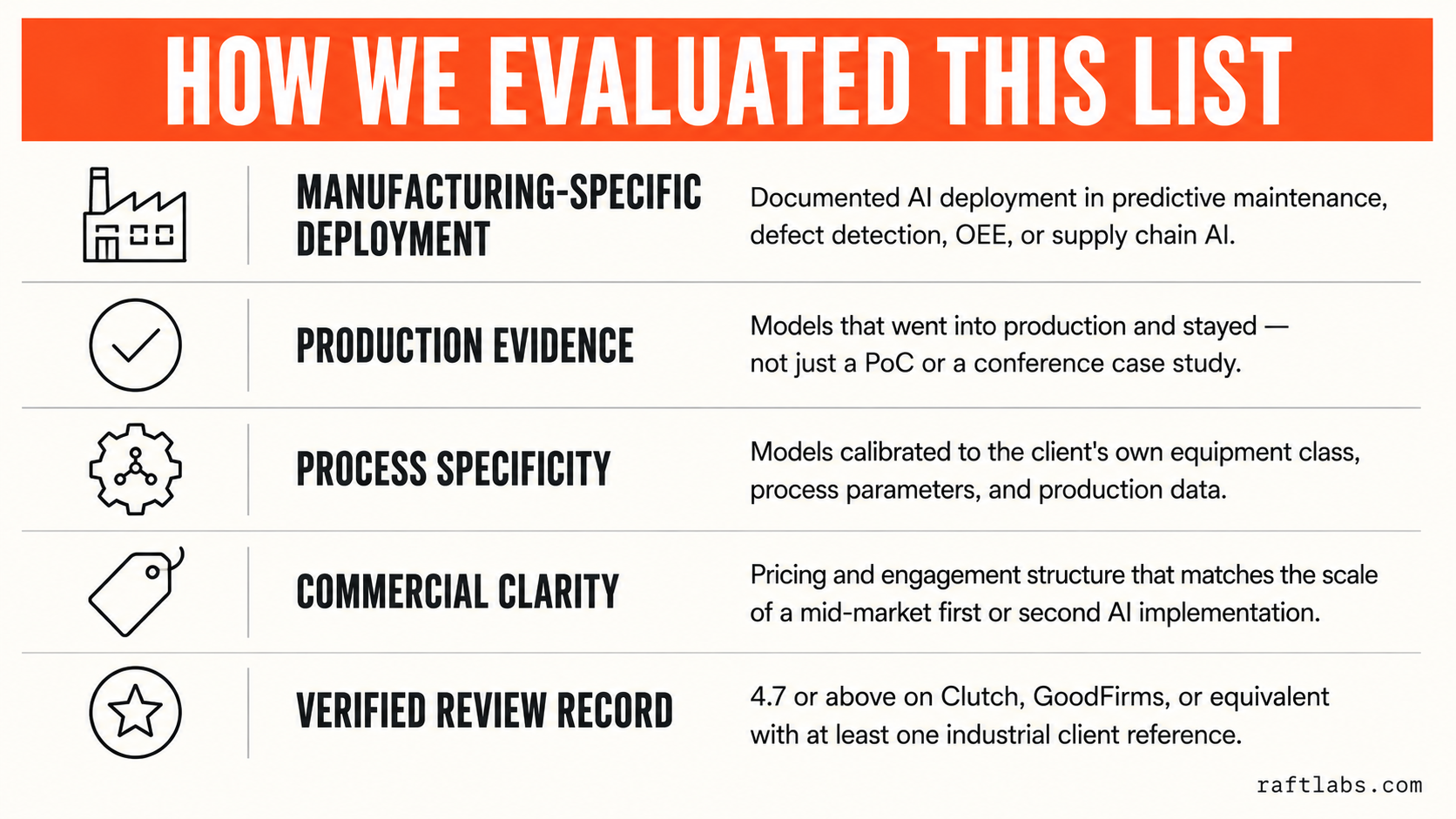
How we evaluated this list
| Criterion | What we looked for |
|---|---|
| Manufacturing-specific deployment | At least one documented AI deployment in a manufacturing context - predictive maintenance, defect detection, demand forecasting, OEE, or supply chain AI - not generic ML project examples |
| Production evidence | Evidence that AI models went into production and stayed there, not just a proof-of-concept or a conference case study |
| Process specificity | Whether the company builds or configures models for the client's specific equipment, process parameters, and production data - not a generic model applied to a different dataset |
| Commercial clarity | Whether pricing and engagement structure are clearly communicable, and whether they match the scale of a mid-market manufacturer seeking a first or second AI implementation |
| Verified review record | 4.7 or above on Clutch, GoodFirms, or equivalent verified review platform with at least one industrial or operations-adjacent client reference |
No company paid for placement on this list.
The 8 companies
1. SparkCognition
SparkCognition is an Austin-based industrial AI company founded in 2013 with a deliberate focus on safety-critical and asset-intensive industries: aerospace manufacturing, oil and gas, energy, and defense. Their platform - Darwin AI - is an automated machine learning system designed to run predictive maintenance and anomaly detection models on time-series data from industrial equipment, with an emphasis on reducing the data science overhead required to train and deploy those models in a production environment. Alongside Darwin, they offer SparkCognition Visual AI for computer vision applications, including automated defect detection on high-volume production lines.
What separates SparkCognition from general-purpose AI development firms that happen to have manufacturing clients is the depth of their industrial data and domain knowledge. Their team includes operational technology engineers who understand the constraints of industrial environments: PLC data formats, historian databases, safety interlock systems, and the reliability requirements that apply when an AI model output influences equipment operation in a safety-critical setting. That domain specificity compounds over time - their model training data now includes millions of hours of industrial equipment sensor readings from aerospace, energy, and heavy manufacturing environments, giving their predictive models a calibration baseline that a custom development engagement cannot replicate from scratch.
Notable work: SparkCognition has deployed predictive maintenance and anomaly detection models at aviation MRO (maintenance, repair, and overhaul) operations, power generation facilities, and heavy manufacturing sites where equipment downtime carries a cost-per-hour that justifies significant AI investment. Their Visual AI product is deployed for automated quality inspection on production lines in high-volume manufacturing environments, with documented applications in aerospace components and electronics assembly. Several aerospace and defense manufacturing clients use Darwin AI as their primary predictive analytics platform for fleet and equipment management.
Pricing signal: Enterprise tier, not published. SparkCognition operates through enterprise procurement processes, and engagements typically involve multi-year commitments at the level of a $300K to $1M+ annual investment in software, implementation services, and ongoing managed support. Their minimum viable engagement is significantly larger than a first AI pilot for a mid-market manufacturer. Their sales cycle reflects the enterprise client base - expect six to twelve months from first contact to signed agreement on a meaningful implementation.
What to watch: SparkCognition is the right call when the manufacturing environment is asset-intensive, safety-critical, and operating at a scale where predictive maintenance ROI is measurable in millions annually. For a mid-market manufacturer with a single production line, a defined use case, and a budget under $200K, the sales process, implementation overhead, and minimum commitment will significantly exceed what the project requires. Know the scale threshold before engaging.
Best for: Large manufacturers, aerospace and defense production facilities, energy and industrial enterprises with complex multi-asset environments where predictive maintenance and safety AI justify enterprise investment
Specialization: Predictive maintenance, industrial anomaly detection, computer vision for manufacturing, automated ML on time-series equipment data
Pricing: Enterprise, not published; implementations typically $300K+
Clutch: Limited profile - SparkCognition works through enterprise sales, not directory placement
2. Augury
Augury is a New York-based machine health company founded in 2011 that built its technology around a specific insight: the most expensive equipment failures in manufacturing are not sudden catastrophic breakdowns - they are the gradual degradation events that produce characteristic vibration and acoustic signatures weeks before failure, if you have the sensors and the models to read them. Their platform starts with IoT sensors attached to production equipment - motors, pumps, compressors, fans, conveyor drives - and builds AI models trained on millions of hours of industrial equipment data to interpret those signals and predict failures before they become unplanned downtime events.
Augury's edge over a general predictive maintenance AI engagement is the breadth and specificity of their training dataset. They have processed vibration, temperature, and operational data from hundreds of thousands of machines across food and beverage, consumer packaged goods, pharmaceuticals, chemicals, and discrete manufacturing. The models built on that dataset can distinguish between a motor running slightly out of alignment and a bearing in the early stages of fatigue failure - and can give a maintenance window recommendation rather than just a generic "check this machine" alert. That specificity is what makes the output actionable for a maintenance manager deciding whether to pull a critical piece of equipment during a production run.
Notable work: Augury's publicly documented deployments include General Mills (machine health monitoring across multiple food manufacturing facilities, with measurable reduction in unplanned downtime and maintenance labor costs), Heineken (rotating equipment monitoring across multiple brewery production lines), Colgate-Palmolive (manufacturing equipment monitoring for consumer goods production), and Veolia (utility infrastructure). The General Mills implementation is one of the more detailed public manufacturing AI case studies available - it documents not just the sensor deployment but the operational process change required to act on model outputs effectively.
Pricing signal: SaaS platform with hardware component. Pricing is not published but typically runs $50K to $250K annually depending on the number of machines monitored, sensor deployment scope, and support tier. A minimum viable deployment covering the most critical rotating equipment in one facility is accessible for mid-market manufacturers; a full multi-facility rollout with comprehensive sensor coverage is enterprise-tier. Implementation services - sensor installation, data pipeline configuration, integration with maintenance management systems - are additional and typically represent a one-time cost similar to the first-year software subscription.
What to watch: Augury is purpose-built for machine health on rotating equipment - motors, pumps, compressors, fans, gearboxes. If your primary manufacturing AI use case is quality inspection, demand forecasting, process parameter optimization, or supply chain AI, Augury is not the right tool. They are among the most capable machine health platforms in manufacturing; they are not a general-purpose manufacturing AI solution. Manufacturers with diverse AI use cases will need additional vendors alongside Augury.
Best for: Manufacturers with rotating production equipment where unplanned downtime is a major cost driver and maintenance teams need actionable failure predictions without a data science team on staff
Specialization: Machine health monitoring, predictive maintenance, vibration and acoustic analysis, IoT sensor integration for manufacturing equipment
Pricing: $50K-$250K annually; sensor hardware additional
Clutch: Limited profile - Augury is a product company, not a development services firm
3. RaftLabs
RaftLabs is a software and custom AI development studio for mid-market businesses that builds production-ready systems in process-intensive operational environments. Their manufacturing AI engagements address a recurring problem with off-the-shelf platforms: most platform products require months of data pipeline integration before a model reaches production, and those models are trained on industry-wide data rather than the manufacturer's specific process parameters. When a process is proprietary or the production data does not map cleanly to platform schemas, a custom model trained on the manufacturer's actual sensor streams, quality logs, and ERP history consistently outperforms a platform model configured for the same data.
RaftLabs builds against client data from day one - production sensor streams, ERP exports, MES records, quality inspection logs - and delivers a model that reflects how that plant actually runs. Their engineering process includes data audit and preparation as a first phase, which surfaces data gaps, format inconsistencies, and labeling requirements early rather than after a contract has been signed. Engagements are fixed-price with milestones agreed before work begins, which gives the manufacturer budget certainty that time-and-materials AI development rarely provides. The company principal is directly involved throughout, not handed off to a junior project team after kickoff.
Notable work: RaftLabs has shipped AI-integrated operational systems including an AI-powered platform now running across 80+ clinical sites - a process-control environment with the same data complexity as a production line, including sensor integration, real-time decision support, and role-based operational interfaces for non-technical users. A real-time analytics and personalization system built for a multi-brand retail operator handles high-frequency transaction data with ML-driven output at the speed of customer decisions. A hospitality management platform covering 80+ properties integrates operational AI with staff-facing operational workflows. The manufacturing equivalents of these - predictive maintenance models integrated with SCADA, quality prediction systems tied to existing MES platforms, demand forecasting engines integrated with ERP - draw on the same core capability: production-quality ML delivered in the operational context where decisions are made.
Pricing signal: $29-$49/hr. A scoping engagement to define the AI use case, data requirements, and model architecture takes two to four weeks and produces a fixed-price proposal before any build commitment is made. A full manufacturing AI project - model development, integration with existing systems (ERP, MES, SCADA), and an operational dashboard or alert system for the production team - typically runs $40K to $120K depending on scope and data readiness. No platform licensing. The built system and all models are owned by the manufacturer.
What to watch: RaftLabs is a 60-person firm. They are calibrated for mid-market manufacturers - companies with a defined AI use case, existing production data, and a budget where custom development is the more cost-effective path over platform licensing. Large enterprise programs requiring multi-facility parallel deployment, 24/7 managed ML operations across dozens of production lines, and dedicated on-site support teams exceed what a studio of this size is structured to deliver without additional partnerships.
From the field: The manufacturers we see struggle most with AI are not the ones who cannot afford it - they are the ones who bought a platform expecting it to solve a problem the platform was not designed for. The question we ask first is whether the manufacturer's production process looks like what the platform was trained on. If not, the integration cost of making it fit often exceeds the cost of building something purpose-built from the client's own data. That is the decision point where custom development makes financial sense.
Best for: Mid-market manufacturers ($5M-$200M revenue) that need a purpose-built AI system for predictive maintenance, quality prediction, demand forecasting, or production optimization - and want it owned, not licensed
Specialization: Custom AI development, ML model integration with ERP/MES/SCADA, production AI for operations-intensive environments, fixed-price delivery
Pricing: $29-$49/hr, fixed-price engagements from $40K
Rating: 4.9/5 (Clutch, 50+ reviews)
4. Sight Machine
Sight Machine is a San Francisco-based manufacturing analytics company founded in 2012 with a singular focus: building a unified data model for the factory from the multiple, inconsistent data sources that manufacturing plants actually have - PLCs, SCADA systems, MES platforms, historian databases, quality inspection records, and maintenance logs - so that production teams can run analytics and AI across all of them without a year-long data engineering project first.
The problem Sight Machine solves is not primarily an AI problem; it is a manufacturing data architecture problem that AI depends on. Most manufacturers have extensive operational data - they collect it constantly - but it exists in systems that do not communicate with each other, in formats that require custom translation for every analytical relationship, and at temporal resolutions that do not align between data sources. Sight Machine's semantic layer understands manufacturing data natively: it knows that a production run record, a quality inspection event, and an equipment sensor stream are related in time and space on the production line, and it can join them without custom data engineering for each relationship. On top of that unified model, they run OEE analytics, quality root cause analysis, sustainability reporting, and production optimization AI.
Notable work: Sight Machine's publicly documented clients include BMW (quality and OEE analytics across automotive manufacturing lines), General Mills (production analytics and quality AI across food manufacturing facilities), Corning (process analytics for specialty glass manufacturing), McCain Foods (production analytics for food processing), and Hitachi. The consistent pattern across their case studies: clients with manufacturing data distributed across multiple legacy systems who needed analytics and AI running without rebuilding their entire data infrastructure. BMW's use of Sight Machine for connected manufacturing analytics is one of the most cited enterprise manufacturing AI case studies in the industry.
Pricing signal: Enterprise platform licensing. Sight Machine does not publish pricing; engagements typically start at $150K annually and scale with the number of plants, data sources, and concurrent users connected to the platform. Implementation services - the work of connecting existing plant systems to the Sight Machine data model - are additional and typically represent a significant portion of first-year cost. They operate through enterprise sales with structured onboarding and assume an internal manufacturing technology or IT team will be involved. They are not calibrated for a first AI pilot or a manufacturer with a budget under $100K.
What to watch: Sight Machine's value is in the data integration and analytics layer - the ability to connect disparate manufacturing data sources and build a unified operational model without custom engineering for every data relationship. If your primary requirement is a single-use-case AI model (predictive maintenance on one equipment type, defect detection at one inspection point), the platform is significantly more than the project requires and the licensing cost is harder to justify on that ROI basis. Their platform shines when the requirement is plant-wide operational intelligence and analytics across multiple systems and multiple use cases.
Best for: Mid-to-large manufacturers with complex multi-system data environments that need plant-wide analytics and AI across OEE, quality, and sustainability - where the primary challenge is data unification, not model development
Specialization: Manufacturing analytics, OEE monitoring, quality root cause AI, production optimization, multi-system data integration for the factory
Pricing: Enterprise platform, typically $150K+ annually; implementation services additional
Clutch: Limited profile - Sight Machine operates through enterprise sales, not directory listing
5. Prolego
Prolego is a US-based AI consultancy focused on LLM performance optimization, evaluation frameworks, and moving generative AI from prototype into enterprise production. Where much of the manufacturing AI market centers on computer vision and time-series forecasting, Prolego sits on the LLM and generative-AI side, which fits manufacturers whose priority is putting language models to work on documentation, knowledge retrieval, or engineering data rather than shop-floor vision.
Their emphasis on evaluation frameworks and production hardening speaks to a real gap: generative-AI pilots that demo well but stall before production. For a manufacturer that already has a GenAI proof-of-concept and needs it measured, tuned, and deployed reliably, that focus is the relevant one.
Notable work: Prolego's site cites client work including Lockheed Martin, Bosch, and Citi. Treat these as company-reported and confirm the specific manufacturing-relevant engagements directly when you scope.
Pricing signal: Pricing isn't publicly listed. Work is engagement-based, so confirm the model and cost directly before committing.
What to watch: Prolego is an LLM and generative-AI specialist, not a computer-vision or industrial-IoT shop. If your core need is defect detection on a production line or sensor-based predictive maintenance, confirm they cover that, or pair them with a vision-focused partner.
Best for: Manufacturers moving a generative-AI or LLM use case into production and needing evaluation, optimization, and deployment rigor
Specialization: LLM performance optimization, evaluation frameworks, RAG, enterprise generative-AI production
Pricing: Not publicly listed, engagement-based (confirm directly)
Rating: Profile listed; confirm before engaging
6. Landing AI
Landing AI was founded in 2017 by Andrew Ng - the Stanford professor, former Google Brain lead, and Coursera co-founder - with a specific manufacturing application as its origin use case: automated visual inspection for quality control on production lines. Their product, LandingLens, is a computer vision platform designed to let manufacturing quality engineering teams build, train, and deploy visual inspection models without requiring deep ML engineering expertise on staff. Quality engineers label images of defective and non-defective products, train a model on those labels using the platform's guided workflow, and deploy the resulting model to camera hardware at the production line inspection point.
The core problem Landing AI solves is the labeling and iteration cycle that makes visual inspection AI operationally difficult. Manufacturing defects are rare events - a production line running at 1 to 2 percent defect rate means 98 to 99 percent of images are non-defective - and training a robust defect detection model on that class imbalance requires active learning approaches that intelligently surface the most informative examples for human review. LandingLens is built around that specific workflow: the platform uses active learning to minimize labeling effort and maximize model accuracy, which is why it outperforms standard computer vision approaches in quality inspection contexts where defect images are scarce.
Notable work: Landing AI has documented deployments in pharmaceutical manufacturing (tablet and capsule defect detection), electronics manufacturing (PCB solder joint and component inspection), food processing (foreign object and contamination detection), and industrial components manufacturing (surface defect detection on machined parts). Their case studies document production-line deployments with measured defect detection accuracy rates, false positive rates, and throughput at production speed - not research-stage proofs of concept. In the narrow domain of manufacturing visual inspection, Landing AI is the reference name outside of the large enterprise computer vision platforms.
Pricing signal: Platform licensing with hardware integration. Landing AI does not publish pricing; typical implementations range from $30K to $150K for the software plus camera hardware and edge computing hardware costs. The platform is designed to reduce the data science requirement for visual inspection, which means the total implementation cost - including internal team time for labeling and model iteration - is lower than a fully custom computer vision engagement with a development firm. A basic implementation covering one inspection point on one product line can often be operational within three to five months of project start.
What to watch: Landing AI and LandingLens are purpose-built for manufacturing visual inspection. If your AI use case extends beyond quality control - predictive maintenance, demand forecasting, process optimization, supply chain analytics - they are not the right partner for those use cases. For visual inspection specifically, they are among the most focused and well-validated options available for manufacturers who want to reduce the data science overhead of training and maintaining those models.
Best for: Manufacturers that need visual inspection AI for quality control - defect detection, foreign object detection, surface inspection - and want to reduce the ML engineering requirement for training and deploying those models
Specialization: Computer vision, visual inspection, defect detection, automated quality control, active learning for rare-event detection
Pricing: Platform licensing, typically $30K-$150K plus hardware
Clutch: Limited profile - Landing AI operates primarily as a product company
7. Satalia
Satalia is a London, UK AI, data-science, and optimization consultancy, with an additional office in Kaunas, Lithuania, and is now part of WPP. Their focus is complex operational decision-making and agentic AI, which maps well onto the hardest manufacturing problems: production scheduling, routing, resource allocation, and other combinatorial optimization challenges that go beyond straightforward forecasting or vision models.
That optimization pedigree is the differentiator. Manufacturers whose real constraint is a scheduling, planning, or logistics decision with many interacting variables often need operations-research depth as much as machine learning, and that is the register Satalia works in.
Notable work: Satalia's site lists client logos including Tesco, DFS, DS Smith, and ODEON. Treat these as self-reported and confirm the specific manufacturing or operations engagements relevant to your problem directly.
Pricing signal: Pricing isn't publicly disclosed. Engagements are custom, so request a scoped quote before committing.
What to watch: Satalia's strength is optimization and decision science rather than turnkey shop-floor computer vision or ERP-integration delivery. If your need is a packaged predictive-maintenance or MES-integrated build, confirm they cover that layer, or scope them specifically for the optimization problem they do best.
Best for: Manufacturers whose core challenge is complex operational optimization, scheduling, or decision-making, not just forecasting or inspection
Specialization: Optimization, data science, agentic AI, operational decision-making
Pricing: Not publicly disclosed, custom solutions (confirm)
Rating: Profile listed; confirm before engaging
8. Softeq
Softeq is a Houston-based technology firm founded in 1997 that operates at the intersection of hardware engineering, embedded systems, and software development. Their manufacturing AI work is grounded in that hardware heritage: they build systems that start at the sensor or edge device layer and extend through the data pipeline to the AI model and operational interface. For manufacturers implementing AI in environments with legacy industrial equipment, unreliable network infrastructure, safety constraints that prevent sending raw sensor data to the cloud, or the need for inference at production-line speeds, Softeq's edge-first approach addresses constraints that cloud-first AI vendors do not design for.
Their IoT and edge AI work in manufacturing includes real-time defect detection using cameras at production line inspection points - running inference on an edge device to meet the cycle-time requirements of a moving production line rather than round-tripping to the cloud. It includes predictive maintenance systems that collect vibration, temperature, and power draw data from sensors integrated with or embedded in production equipment, not just attached to the exterior. And it includes production monitoring systems that aggregate data from multiple industrial communication protocols - Modbus, OPC-UA, EtherNet/IP, PROFINET - into a unified operational view with AI-powered anomaly flagging for production engineers.
Notable work: Softeq has documented industrial IoT and embedded systems work for clients in medical device manufacturing, consumer electronics assembly, and industrial automation. Their manufacturing AI work spans automated visual inspection systems for component manufacturers, production line monitoring integrations with existing MES platforms, and quality control systems in regulated manufacturing environments where documentation and validation requirements add complexity to standard AI development. Their medical device manufacturing experience reflects the validation and documentation requirements of FDA-regulated manufacturing - a relevant credential for pharmaceutical, medical device, or food safety-regulated manufacturers where AI system validation is a compliance requirement, not an afterthought.
Pricing signal: $50-$99/hr. Projects typically run $30K to $200K depending on hardware scope - whether sensors need to be designed, sourced, and integrated, or whether the data pipeline already exists and the project is purely software - and the complexity of the AI models and operational integration. For manufacturers with significant hardware infrastructure requirements alongside AI software, Softeq's combined hardware and software capability reduces the vendor count, which eliminates the integration overhead and accountability gaps that come with managing separate hardware and software partners.
What to watch: Softeq's strength is in the hardware and embedded layer. If your manufacturing AI project is purely a software and data question - clean data, a working data pipeline, and you need a model and dashboard - there are more cost-efficient development options for the modeling work alone. Their value compounds when the project includes sensor deployment, edge device configuration, custom hardware design, or embedded firmware alongside the AI component.
Best for: Manufacturers implementing AI in hardware-constrained environments - legacy equipment, edge inference requirements, custom sensor deployment, regulated manufacturing validation - where hardware and software must be designed together
Specialization: Edge AI, industrial IoT, embedded systems, computer vision at edge, manufacturing sensor integration, regulated manufacturing validation
Pricing: $50-$99/hr, projects from $30K
Rating: 4.9/5 (Clutch)
Side-by-side comparison
| Company | Primary strength | Typical engagement | Pricing |
|---|---|---|---|
| SparkCognition | Industrial AI platform, predictive maintenance and safety AI | $300K+ | Enterprise |
| Augury | Machine health platform, rotating equipment monitoring | $50K-$250K/yr | Platform SaaS |
| RaftLabs | Custom AI development, fixed-price, mid-market | $40K-$120K | $29-49/hr |
| Sight Machine | Manufacturing analytics platform, OEE and quality AI | $150K+/yr | Platform SaaS |
| Prolego | LLM and generative-AI, production and evaluation | Engagement-based | Not public |
| Landing AI | Visual inspection platform, defect detection | $30K-$150K + hardware | Platform |
| Satalia | Optimization and decision science, agentic AI | Custom | Not public |
| Softeq | Edge AI and IoT, hardware-to-model manufacturing | $30K-$200K | $50-99/hr |
The question that separates the right partner from the wrong one
The most consequential decision a manufacturer makes before evaluating vendors is not which company to hire - it is which model of AI delivery makes sense for their specific situation. Three meaningfully different models exist, and choosing the wrong one explains most manufacturing AI projects that produce a proof-of-concept that never reaches a production line:
Platform adoption means buying a product that has already solved the AI problem for your use case and configuring it to run on your data. Augury, Sight Machine, and Landing AI operate in this model. If your use case is standard - rotating equipment predictive maintenance on common equipment classes, plant-wide OEE monitoring, visual inspection on a product category the platform has already been trained on - the platform is almost always the faster path from contract to a model running in production. The risk is integration: manufacturing data is rarely in the format a platform expects, and the data engineering work required to connect existing systems to the platform is frequently more expensive and slower than anticipated.
Custom AI development means building models on your specific production data, calibrated to your actual process parameters and equipment characteristics, integrated with your operational systems in the format they use. RaftLabs, Prolego, and Satalia operate here. This model is the right fit when your manufacturing process is proprietary, your production data does not map cleanly to the schemas a platform was designed for, or the specific outcome you need - a model that predicts a particular failure mode on your specific equipment type with your particular operating profile - requires training on your data to achieve accuracy sufficient for operational use.
Enterprise industrial AI is what SparkCognition delivers: a platform and services stack built specifically for multi-asset, safety-critical industrial environments at the scale where a model error has safety or operational consequences measured in millions of dollars per incident. The right fit is when the manufacturing environment meets that safety and scale threshold, and the vendor's industrial domain expertise and platform reliability requirements match it.
Getting this model decision right before evaluating vendors eliminates most of the mismatch that causes manufacturing AI projects to fail - not because the AI does not work, but because the delivery model was wrong for the operational context.
"In manufacturing, AI does not fail because the algorithm is wrong. It fails because the data the algorithm was trained on does not reflect how the process actually runs today - and no one in the room noticed until after go-live." - A diagnostic observation consistent across manufacturing AI post-mortems, reflecting the gap between historical training data and live production conditions.
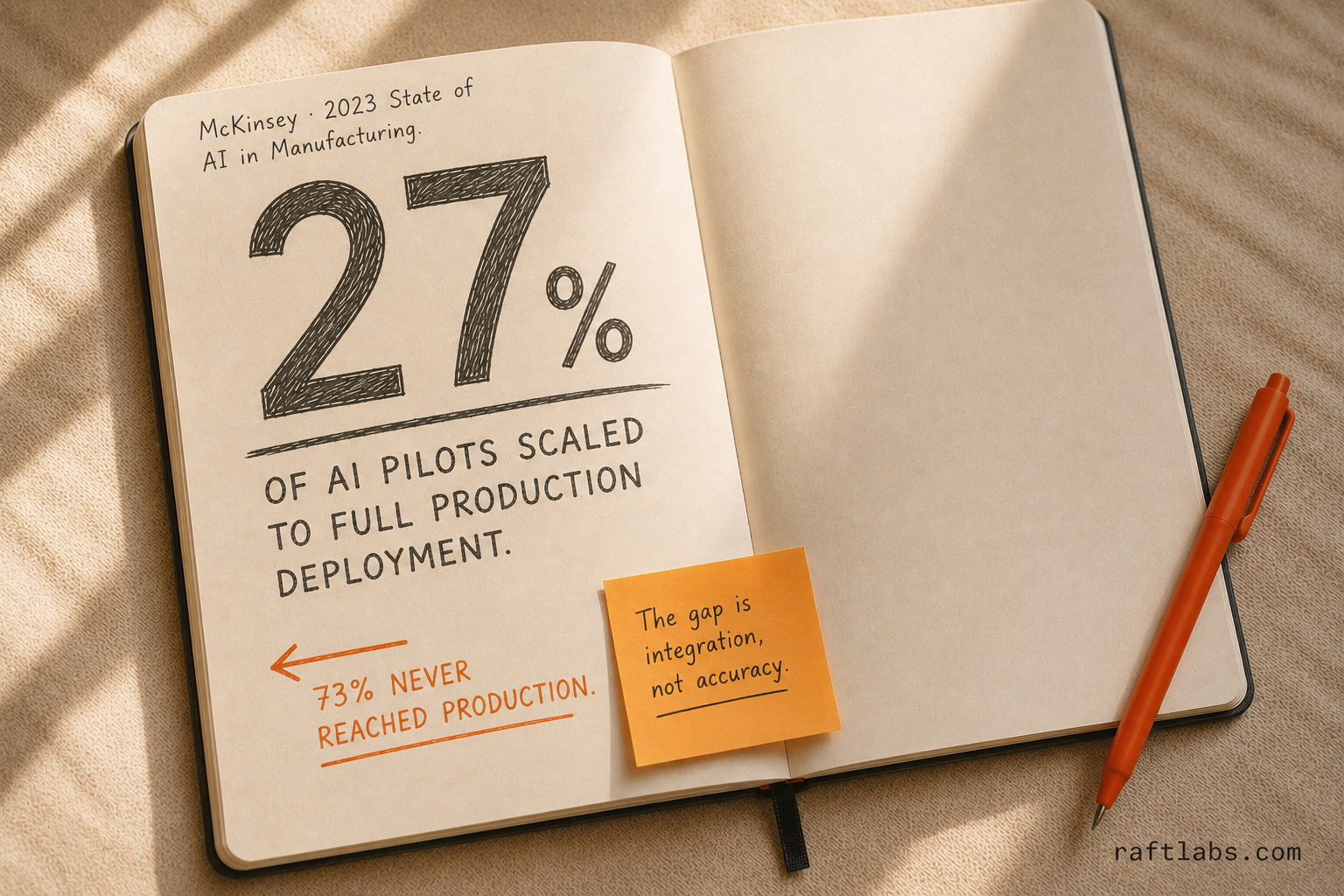
According to McKinsey's 2023 State of AI in Manufacturing report, companies running AI in production operations - not just pilots - report an average 10 to 20 percent reduction in quality-related costs and 15 to 40 percent reduction in unplanned maintenance costs. However, only 27 percent of manufacturers that started AI pilots in 2022 managed to scale those pilots to full production deployment. The bottleneck is not model accuracy; it is the data infrastructure, the system integration work, and the operational process change required to put model outputs into the hands of the people who act on them. Choosing a vendor who has navigated that path in a production environment before - not just in a controlled proof-of-concept - is the single most reliable filter in the evaluation process.
The verdict
Manufacturing AI is not a category where one company is right for every situation. The right choice depends on whether your use case maps to an existing platform, how proprietary your production process is, the scale of the manufacturing operation, and whether model ownership matters to your long-term strategy.
For safety-critical, multi-asset industrial operations at enterprise scale: SparkCognition.
For rotating equipment predictive maintenance with a mature industrial dataset and no data science team on staff: Augury.
For mid-market manufacturers with a defined AI use case and proprietary production data: RaftLabs. Fixed price, founder involvement, full model ownership.
For plant-wide analytics and AI across complex multi-system manufacturing data environments: Sight Machine.
For moving a generative-AI or LLM use case into production with evaluation and optimization rigor: Prolego.
For visual inspection and defect detection with reduced data science overhead on standard defect types: Landing AI.
For complex operational optimization, scheduling, or decision-making problems that need operations-research depth: Satalia.
For manufacturing AI in hardware-constrained or edge computing environments where sensors and software must be designed together: Softeq.
The single most common mistake in manufacturing AI procurement is choosing a vendor before choosing the model - platform versus custom development versus enterprise industrial AI. That model decision determines which vendors are even appropriate to evaluate. Get the model right first, then evaluate vendors within that category.
RaftLabs builds custom AI systems for mid-market manufacturers. If your production process does not fit an existing platform, we scope the use case, build the model on your data, and deliver a production-ready system you own. 4.9/5 on Clutch. Talk to a founder about your manufacturing AI project.
Ask an AI
Get an instant summary of this post from your preferred AI assistant.
Common questions
- A scoped proof-of-concept for a single manufacturing AI use case - predictive maintenance on one equipment type, defect detection on one inspection point, or demand forecasting for one product line - typically costs $30,000 to $80,000 for custom development. A production-ready system with ERP or MES integration, operational dashboard, and model monitoring runs $60,000 to $200,000 depending on scope. Platform licensing for manufacturing AI products like Augury or Sight Machine typically runs $50,000 to $250,000 annually. Enterprise industrial AI platforms like SparkCognition do not publish pricing; enterprise implementations typically run $300,000 or more annually. The most significant cost variable is data infrastructure work - clean, properly structured production data is rarely what manufacturers have at the start of an AI engagement, and the cost of preparing it is frequently underestimated.
- The five most common manufacturing AI use cases in production deployment are predictive maintenance (using sensor data to predict equipment failures before they cause downtime), quality inspection (using computer vision to detect defects on the production line faster and more consistently than manual inspection), demand forecasting (using historical sales and production data to optimize inventory and production planning), process parameter optimization (identifying the operating parameters that produce the highest yield or quality at the lowest cost), and energy management (reducing energy costs without affecting throughput). Most manufacturers start with predictive maintenance or quality inspection because the ROI is directly measurable - fewer maintenance emergencies and fewer quality escapes each have a clear cost-per-event that makes the business case straightforward.
- A scoped proof-of-concept for a single manufacturing AI use case typically takes eight to twelve weeks from project start to a working model on representative data. A production-ready system with integration into existing operational systems (MES, ERP, SCADA) and an operational interface for the production team takes four to seven months. Platform implementations add data pipeline and integration work that typically runs eight to twenty weeks before the platform AI models are running on live data. The biggest timeline driver is data readiness - how accessible, structured, and complete historical data is at project start determines whether the first eight weeks go into model development or into data engineering.
- The decision comes down to three questions. Does your use case match what the platform was designed for - if you need rotating equipment predictive maintenance and Augury was trained on exactly that equipment class, use the platform. Does your manufacturing process follow standard patterns the platform expects - if your process is proprietary and your data does not look like what the platform was trained on, custom development will produce a more accurate model. And what is the total cost of ownership - annual platform licensing plus integration services versus a one-time custom build you own permanently. For standard use cases at scale, platforms win on time-to-value. For proprietary processes or manufacturers who want to avoid ongoing vendor dependency, custom development makes more long-term financial sense.
- RaftLabs builds custom AI systems for mid-market businesses in process-intensive environments. Their published work includes an AI platform running across 80+ clinical sites, a real-time operations platform for a multi-brand retail operator, and an AI-integrated property management system across 80+ hospitality locations - all environments where the core AI challenge mirrors manufacturing: messy operational data, real-time decision support, and integration with existing operational systems. For a mid-market manufacturer with a defined use case, existing production data, and a proprietary process that does not fit an off-the-shelf platform, RaftLabs offers fixed-price engagements from $40K at $29-$49/hr with direct founder involvement and full model ownership. Clutch rating is 4.9/5.
- The minimum viable dataset depends on the use case. For predictive maintenance, you need historical sensor data (vibration, temperature, pressure, current draw) from the equipment you want to model, alongside records of past failures and maintenance events - ideally two to five years of operational history with at least fifty documented failure events for the failure type you are predicting. For quality inspection, you need labeled images of defective and non-defective products at the inspection point - typically a few thousand labeled examples per defect class. For demand forecasting, you need 24 to 36 months of historical sales or production data with order records and any external demand drivers. The most common data gap is the absence of structured failure records - many manufacturers know their equipment failed but did not record the failure mode, equipment identifier, and timestamp in a form usable as training labels. Auditing data availability before evaluating vendors is worth doing.
- Production processes drift over time - equipment ages and its failure signature changes, new SKUs get introduced that the model has never seen, and seasonal patterns shift the operating envelope. A model that was 92% accurate at go-live can degrade to 78% accuracy nine months later if it isn't monitored and retrained. Ask who is responsible for monitoring model performance after deployment, what triggers a retraining cycle, what that process involves, and what the ongoing maintenance cost structure looks like. A vendor that has only thought about model development, not model lifecycle management, will give vague answers here.
- For platform companies, ownership is usually clear: you own your data and the model outputs, but the model architecture, training methodology, and platform code stay vendor IP. For development services firms, ownership varies and isn't always explicit in standard agreements. If the system you are building - a quality prediction model trained on your proprietary process parameters, a predictive maintenance model calibrated to your equipment configuration - is meant to become a competitive differentiator, negotiate IP ownership explicitly before signing, not during contract review after the fact.
- AI is only useful on the floor when its outputs show up inside the systems the maintenance engineer, quality manager, and production planner already work in - the CMMS, the MES dashboard, the ERP planning module, the shift handover report. Ask a vendor which integration protocols and formats it supports (REST API, OPC-UA, Modbus bridge, SAP connector, direct database write), who handles the integration work, and what happens when an operational system gets upgraded and the integration breaks. Integration is the most underestimated cost in manufacturing AI, and the most common reason a model that works technically never gets used operationally.