Top AI development companies for insurance in 2026 (vetted shortlist)
Eight AI development companies for insurance evaluated on domain depth, explainability, and production delivery. No pay-to-play placements.

In this article
Short answer
Evaluating AI development companies for insurance comes down to a live production system with documented model explainability and integration into core claims or policy platforms, not a proof of concept. RaftLabs meets this bar with fixed-price custom AI builds from $30K, 4.9/5 on Clutch across 50+ reviews, and engagements at $29-49/hr.
Key takeaways
- Insurers and MGAs face two distinct AI paths: buying a pre-built platform (Shift Technology, Tractable, Sapiens) or commissioning a custom AI build for proprietary workflows. The right choice depends on whether your process fits the platform's model or needs to be built around your specific data and decision logic.
- Claims automation and fraud detection deliver the highest ROI in insurance AI - not because they are simple to build, but because claim volume is large enough that even a 10% improvement in triage accuracy compounds significantly across a book of business.
- AI for insurance requires model explainability. Regulators in the US, UK, EU, and Australia increasingly require that automated underwriting or claims decisions can be explained in plain language. A development company that cannot demonstrate explainability compliance is building you a liability.
- Platform vendors (Shift Technology, Tractable) deploy faster and carry insurance-specific training data built over years. Custom development firms (RaftLabs, MathCo, Merantix Momentum) build to your proprietary workflow. The wrong model for your use case costs more than the wrong vendor.
- RaftLabs is the strongest mid-market option for insurance companies that need custom AI - underwriting automation, document processing, or internal workflow AI - delivered at a fixed price without enterprise procurement overhead.
Insurance companies process decisions that carry significant financial and regulatory weight - underwriting risk assessments, claims approvals, fraud investigations - and most of those decisions still rely on human judgment applied to incomplete data. AI changes the economics of that judgment: it processes more variables, applies more consistent rules, and surfaces patterns that escape human review at scale. The challenge is finding a development partner who understands both the AI engineering and the insurance domain well enough to deliver working software - not a proof of concept that stalls before it reaches production.

Eight companies made this list: Shift Technology, RaftLabs, Tractable, Elder Research, MathCo, Sapiens International, Merantix Momentum, and EXL Service. RaftLabs is included because we build custom AI for insurance workflows - document processing, claims triage, underwriting automation - at fixed prices with defined outcomes agreed before any build starts. We evaluate every company on the same criteria.
Transparency note: RaftLabs wrote its own entry with the same directness applied to every other company on this list.
According to Grand View Research, the global insurance analytics market - which encompasses the AI, machine learning, and data science tools insurers use to automate underwriting, claims, and fraud decisions - was valued at USD 13.84 billion in 2024 and is projected to reach USD 31.33 billion by 2030, growing at a CAGR of 14.7%.
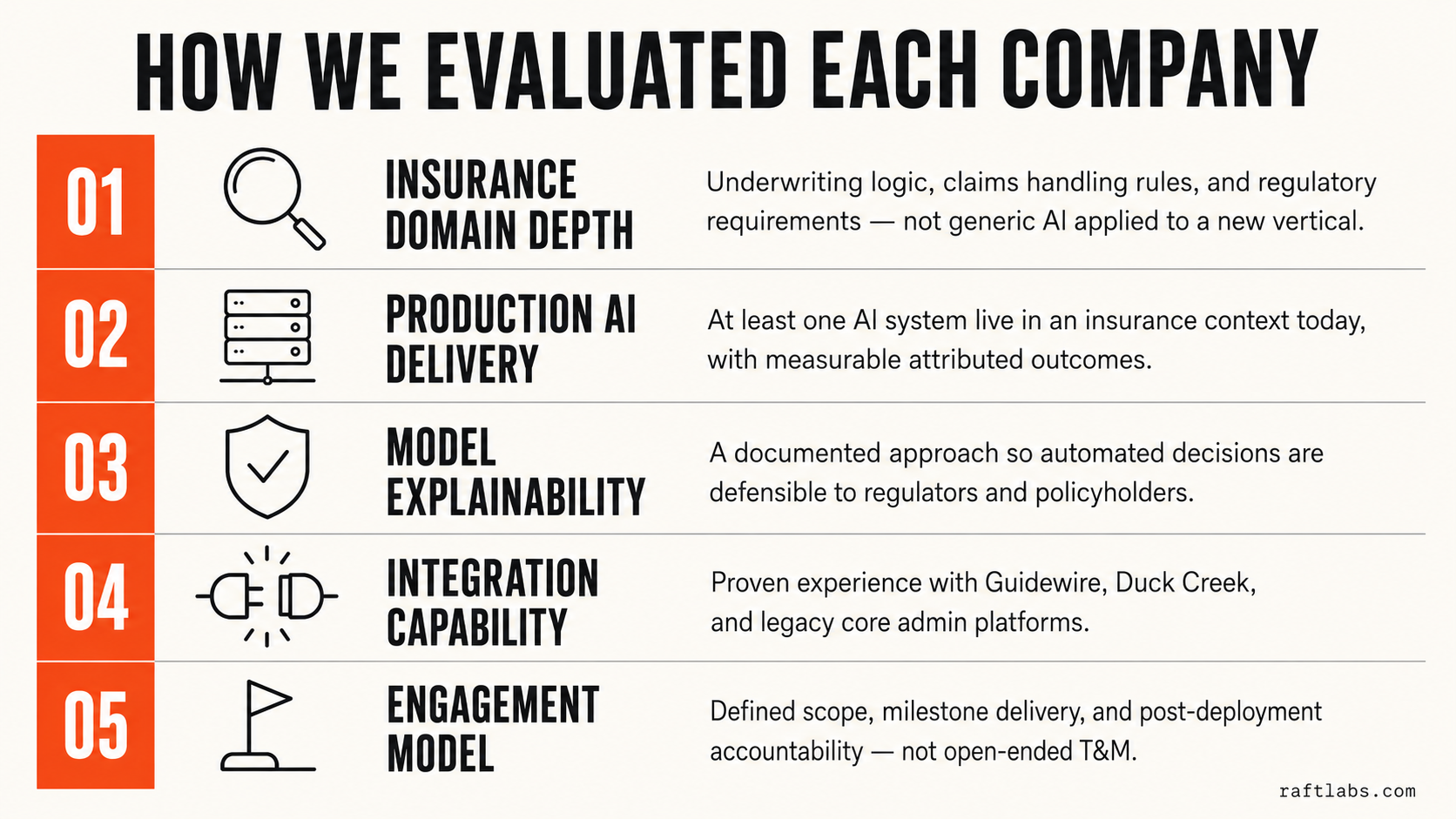
How we evaluated this list
| Criterion | What we looked for |
|---|---|
| Insurance domain depth | Evidence of actual insurance workflow knowledge - underwriting logic, claims handling rules, regulatory requirements - not just general AI capability applied to a new vertical |
| Production AI delivery | At least one AI system deployed in an insurance context that is still running today, with measurable outcomes attributed to it |
| Model explainability | A documented approach to building AI that can explain its decisions to regulators and policyholders - not a black box that produces answers nobody in the company can defend |
| Integration capability | Experience connecting AI to core insurance systems such as policy management platforms, claims systems, and legacy core admin - the last mile where most insurance AI POCs stall |
| Engagement model | Clearly defined scope, milestone-based delivery, and post-deployment accountability - not an open-ended time-and-materials relationship with no defined endpoint |
No company paid for placement on this list.
1. Shift Technology
Shift Technology was founded in 2014 in Paris and built one of the first purpose-built AI platforms for insurance claims and fraud detection. Their platform processes claims decisions for more than 100 insurers globally, applying AI models trained on hundreds of millions of insurance events to flag suspicious claims, automate straight-through processing, and accelerate complex claims that still require human review. They are not a development-for-hire firm - they are an insurance AI product company that installs and configures their own platform inside your claims environment.
What makes Shift credible is the depth of their insurance-specific training data. Their fraud detection models are trained on actual insurance fraud patterns - not generic anomaly detection logic applied to insurance data. That distinction matters in production: generic fraud models surface false positives at rates that experienced claims handlers override within weeks, eroding adoption and trust. Shift's domain-specific training produces fraud alerts that adjusters treat as useful signals rather than noise, which is how the company achieves the detection improvement rates cited in production environments rather than just in sales demonstrations.
Shift operates as a software licensee. You integrate their platform with your core claims system, configure their models to your product lines and underwriting philosophy, and their customer success team manages ongoing model performance monitoring and refinement. For carriers with meaningful claims volume - thousands of claims per month across multiple lines - the ROI from reduced loss adjustment expense is often measurable within two to three months of deployment.
Notable work: Shift works with P&C, health, and specialty insurers across more than 35 countries. Publicly referenced partnerships include AXA, Sompo, Covéa, and several large North American carriers. Their fraud detection platform has processed more than a billion claims data points since founding, making it one of the largest insurance AI training datasets in the market.
Pricing signal: Enterprise licensing structured on a per-claim or per-policy basis. Implementation and integration services add to the first-year total cost of ownership. For carriers handling fewer than 10,000 claims per month, the economics may be harder to justify. Engagement returns improve significantly at scale.
What to watch: Shift's platform is optimized for the use cases they have built - fraud detection, claims automation, underwriting risk scoring. If your AI priority falls outside those lanes - custom document processing, a proprietary decision model built on your own underwriting logic, an internal workflow tool - Shift does not take custom development briefs.
Best for: P&C, health, and specialty insurers handling high claims volume who want a production-ready AI platform for fraud detection and claims automation, not a custom build
Specialization: Insurance fraud detection, claims straight-through processing, underwriting risk scoring
Pricing: Enterprise per-claim or per-policy licensing; implementation costs additional
Market presence: Active in 35+ countries; Series C funded ($220M, 2021); operates via enterprise sales rather than directory listings
2. RaftLabs
RaftLabs is a custom AI and software development firm that builds production AI for mid-market and enterprise businesses. Their AI development for insurance workflows covers claims document processing, underwriting automation, internal workflow AI, and AI-powered customer communication systems. Unlike platform vendors, RaftLabs builds to your specific data, your decision logic, and your existing system architecture - which means the AI integrates with how your business actually works rather than requiring your operations to adapt to how a vendor's platform was designed.
Their engagements follow a defined sequence. A scoping phase of two to four weeks produces a fixed-price proposal before any build commitment is made. The build phase delivers working software in milestones with client review at each stage. Deployment includes integration with existing policy management, claims, or CRM systems, and the team remains accountable for integration issues rather than treating them as out-of-scope once the model itself is delivered. The fixed-price model means cost surprises are contractually eliminated - a feature that matters in insurance, where procurement teams are accustomed to time-and-materials relationships that expand significantly during integration phases.
RaftLabs has shipped production work in regulated industries including healthcare, financial services, and insurance-adjacent operations. Their AI engineering work spans LLM integration, document intelligence covering OCR, classification, and extraction pipelines, workflow automation, and custom model training on proprietary datasets. Every engagement is led directly by a founder, with dedicated senior engineers throughout the project rather than a senior-led sales process followed by a junior delivery team that the client has never met.
Notable work: RaftLabs built an AI-powered remote patient monitoring platform now operating at 80+ clinical sites, with interface and alert logic driven by clinical workflow research rather than standard monitoring conventions. A loyalty and personalization AI for a multi-brand retail operator covers real-time points mechanics and personalized push triggers. A hospitality management platform serving 80+ properties includes AI-assisted service request routing and guest communication. The document intelligence and workflow AI from these engagements maps directly to insurance policy intake, claims processing, and underwriting data extraction.
Pricing signal: $29-$49/hr. A scoped custom AI engagement typically runs $30,000 to $150,000 depending on model complexity, data requirements, and integration depth. Scoping engagements run two to four weeks and produce a fixed-price proposal with no obligation to proceed.
What to watch: RaftLabs is a 60-person firm. Large enterprise programs requiring simultaneous delivery across multiple insurance lines with 20+ concurrent team members exceed their capacity model. Their strength is defined-scope custom AI delivery - one well-scoped problem solved to production quality, not an ongoing staff augmentation relationship or a multi-year platform implementation.
From the field: The most consistent mistake we see insurance companies make is treating AI as a standalone system - something that sits beside the existing workflow rather than inside it. When claims documents are processed by AI but the output requires a second re-entry into the core admin system, the efficiency gain disappears in the handoff. The integrations are not the afterthought; they are the product.
Best for: Insurance companies and MGAs that need a custom AI build for a specific workflow - claims document processing, underwriting data extraction, internal automation - at a fixed price with defined outcomes
Specialization: Custom AI development, LLM integration, document intelligence, workflow automation, regulated-industry delivery
Pricing: $29-$49/hr, fixed-price engagements from $30K
Rating: 4.9/5 (Clutch, 50+ reviews)
3. Tractable
Tractable was founded in 2014 in London to build what has become one of the most specific and successful AI applications in insurance: visual damage assessment for auto claims. Their AI analyzes photos of vehicle damage submitted through mobile apps or web portals and produces repair cost estimates with accuracy that rivals experienced human appraisers - and produces them in seconds rather than days. That specific capability has made them the reference point in a growing category: AI-accelerated claims settlement for auto and property physical damage.
What makes Tractable unusual in the InsurTech landscape is that their value proposition does not require replacing claims adjusters - it makes them significantly faster. A photo submitted via a mobile app is processed by Tractable's AI before it reaches a human adjuster. By the time the adjuster reviews it, they have an AI-generated estimate to confirm, modify, or override rather than a blank assessment to start from scratch. That workflow change consistently accelerates cycle times and reduces the cost per settled claim, which is why carriers report sustained ROI rather than short-lived efficiency gains that fade as novelty wears off.
Tractable expanded from auto claims into property damage assessment following major wildfire and hurricane seasons in the US, where simultaneous high-volume claims events created backlogs that traditional desktop appraisal processes could not clear. Their property AI - trained on satellite and aerial imagery combined with ground-level photos from adjusters and policyholders - is designed specifically for the mass-loss event scenario that periodically overwhelms carrier operations.
Notable work: Tractable works with insurers and collision repair networks across the US, Europe, and Japan. Publicly referenced clients include Tokio Marine, AXA, Covéa, and several large US carriers. Their auto claims AI has been used in the settlement of tens of millions of claims globally. Their Series E funding round in 2021 raised $65M - one of the larger InsurTech AI rounds of that period.
Pricing signal: Enterprise per-claim or per-assessment licensing. Implementation requires integration with your claims platform and photo submission workflow, typically taking three to six months for a carrier with existing systems in place.
What to watch: Tractable's depth is visual damage assessment - auto physical damage and property claims after significant weather events. If your AI priority is underwriting automation, fraud detection, document processing, customer communication, or any use case outside the damage assessment category, Tractable is not the right tool. Their platform is purpose-built for one category and demonstrably good at it.
Best for: Auto and property insurers that need to accelerate claims settlement through AI-powered visual damage assessment, reducing both cycle times and loss adjustment expense at scale
Specialization: Visual AI for damage assessment, auto claims, property claims after mass-loss events
Pricing: Enterprise per-claim licensing; implementation costs additional
Market presence: Series E funded ($65M); active in US, Europe, Japan; enterprise sales process with limited directory presence
4. Elder Research
Elder Research is a data-science and machine-learning consultancy based in Raleigh, North Carolina, founded in 1995. They deliver predictive analytics and applied AI across finance, health, government, and defense - domains where the modeling discipline (fraud detection, risk scoring, anomaly detection) overlaps heavily with what insurers need, even though insurance is not their headline vertical. Rather than sell a packaged insurance platform, they scope custom analytics and ML engagements to a client's own data and decision problem.
Their long track record in regulated, high-stakes analytics is the reason to consider them for underwriting risk models, claims propensity scoring, or fraud analytics rather than user-facing software. Government and defense work carries the same explainability and auditability pressure that insurance regulators apply, so the discipline transfers even when the vertical does not. The center of gravity is the model and the data pipeline feeding it, not application development or systems integration.
For an insurer whose priority is a predictive model built on proprietary historical data - a fraud-scoring engine, a loss-reserve estimate, a retention model - Elder Research's consulting model fits the shape of that problem. For a document-processing pipeline, a claims workflow tool, or a customer-facing AI application, a software-led firm is the closer match.
Notable work: Per the company, Elder Research was founded in 1995 and has been acquired by ManTech. Its published focus spans finance, health, government, and defense analytics; we did not independently verify insurance-specific client references, so treat any insurance fit as adjacent rather than proven and ask for a comparable reference during scoping.
Pricing signal: Not publicly disclosed; engagement-based. Request a scoped quote directly, and clarify whether the work is a fixed-scope model build or an ongoing analytics consulting relationship before committing.
What to watch: Elder Research is a data-science consultancy, not an insurance platform vendor or a full-stack software shop. Their strength is the analytics and modeling layer; if your project needs heavy application engineering or integration with a core admin platform, confirm that capability explicitly rather than assuming it.
Best for: Insurers whose priority is a custom predictive or fraud-detection model built on proprietary data, delivered by a specialist analytics consultancy with regulated-industry experience
Specialization: Data science, machine learning, predictive analytics, applied AI for finance, health, government, and defense
Pricing: Not publicly disclosed; engagement-based
Rating: Profile listed; confirm before engaging
5. MathCo
MathCo (theMathCompany) is an enterprise data-science and analytics firm headquartered in Chicago, Illinois. They deliver AI/ML consulting, data engineering, and generative-AI products, including their NucliOS analytics platform. Their work centers on turning enterprise data into decision models and analytics products - the same capability an insurer needs for pricing, claims propensity, and retention analytics, applied here as a general enterprise-analytics practice rather than a dedicated insurance vertical.
Their combination of consulting and a productized platform means engagements can run either as a bespoke model build or as an accelerator layered on their own tooling. For an insurer with a clean data environment and a defined analytics use case, that hybrid can shorten time-to-model; for a bespoke, deeply insurance-specific workflow, the platform component matters less than the consulting team's willingness to build to your spec.
Because the firm's positioning is enterprise-wide analytics rather than insurance software, the relevant questions at scoping are whether they have delivered comparable insurance models recently and who on the team carries that domain knowledge. Treat the fit as analytics-led: strong on modeling and data engineering, unproven as an insurance-specialist software vendor until you see a comparable reference.
Notable work: Per the company, MathCo operates offices in Chicago, Amsterdam, and Bengaluru. Its published focus is enterprise AI/ML consulting, data engineering, and the NucliOS generative-AI and analytics platform; we did not independently verify insurance-specific client references, so ask for a comparable engagement example during evaluation.
Pricing signal: Not publicly disclosed; engagement-based. Request a scoped quote, and clarify whether you are buying a bespoke model build, a NucliOS-based deployment, or an ongoing analytics partnership.
What to watch: MathCo is an enterprise-analytics and data-science firm, not an insurance-specialist software vendor. Their NucliOS platform is an asset if you want an accelerator, but a caveat if you need fully custom, insurance-specific tooling built around your own systems - confirm which model the engagement actually follows.
Best for: Insurers and MGAs with a defined analytics use case - pricing, claims propensity, retention modeling - who want an enterprise data-science partner with a productized analytics platform option
Specialization: Enterprise data science, AI/ML consulting, data engineering, generative-AI analytics products
Pricing: Not publicly disclosed; engagement-based
Rating: Profile listed; confirm before engaging
6. Sapiens International
Sapiens International (NASDAQ: SPNS) is an enterprise insurance technology company headquartered in Israel with offices across the US, Europe, and Asia-Pacific. Founded in 1992, they build core insurance software for P&C, life, and reinsurance companies and have embedded AI capabilities across those platforms as a strategic priority over recent years. Their customer base of more than 600 insurance organizations globally gives their AI models training access to a breadth of insurance operational data that most pure-play AI companies cannot match without years of market presence.
Sapiens' AI approach differs from standalone development firms. Their AI is embedded in their core platforms - Sapiens PolicyPro, ClaimsPro, and UnderwritingPro - which means insurers using Sapiens core systems receive AI augmentation through product updates rather than separate development projects. For a carrier already running on Sapiens, that is a meaningful operational advantage: no separate AI integration project, no separate procurement cycle, and AI models that already understand the data structures the platform uses because they were built against the same schema.
For insurers not already on a Sapiens platform, the entry point to their AI is typically a core system migration - a significant multi-year program. Sapiens' AI capabilities are not currently available as standalone services decoupled from their platform. If you are evaluating core system modernization and want AI built into the foundation rather than bolted on afterward, Sapiens warrants serious evaluation. If you need AI for an existing non-Sapiens environment on a near-term timeline, they are the wrong procurement track.
Notable work: Sapiens works with insurers across more than 30 countries, including major carriers in North America, Europe, and Asia-Pacific. Their client roster includes leading property, life, and reinsurance companies. AI capabilities in claims straight-through processing, underwriting risk scoring, and policyholder self-service are active in production at multiple named clients across several regions.
Pricing signal: Enterprise software licensing plus implementation services. Core system implementations with Sapiens involve multi-year timelines and seven-figure total cost of ownership. Appropriate for carriers and MGAs operating at meaningful premium volume with board-level sponsorship for a core system program.
What to watch: Sapiens' AI value is inseparable from their core platform. Evaluating Sapiens means evaluating a core system migration or upgrade program, not a standalone AI capability purchase. Clarify which of those two programs you are actually authorizing before the first sales meeting.
Best for: Insurance companies and reinsurers evaluating core system modernization who want AI embedded in the platform foundation rather than purchased as a separate point solution
Specialization: Core insurance platforms for P&C, life, and reinsurance; embedded AI for underwriting, claims, and policyholder self-service
Pricing: Enterprise software licensing; multi-year engagements; significant total cost of ownership
Market presence: NASDAQ listed (SPNS); 600+ insurance clients globally; enterprise sales process
7. Merantix Momentum
Merantix Momentum is a Berlin-based AI development firm that conceives, builds, and operates custom AI for enterprises - taking projects from research through to production rather than selling a fixed product. That end-to-end model (problem framing, model development, deployment, and ongoing operation) fits insurers who want a partner to own the full lifecycle of a custom AI build rather than hand over a model and walk away.
Their positioning is applied AI across machine learning and generative AI, built to the client's problem. For an insurer, the relevance depends on the use case: a document-intelligence pipeline, an underwriting-support model, or a claims-triage system are all in scope for a research-to-production AI shop, but insurance is not called out as a named specialty, so the domain knowledge should be probed directly.
They state ISO/IEC 27001 certification, which is a relevant signal for the data-security requirements insurers carry. As a European firm, they may also be a stronger fit for carriers with EU data-residency or GDPR-driven constraints than a US-only vendor.
Notable work: Per the company, Merantix Momentum states ISO/IEC 27001 certification and self-reports client logos including Siemens, Zalando, and Porsche Digital. These are self-reported and not independently verified, and none are insurance carriers, so treat the insurance fit as capability-based rather than proven and request a comparable reference at scoping.
Pricing signal: Not publicly disclosed. Per their site, a free non-binding assessment is offered as an entry point; request a scoped quote from there.
What to watch: Merantix Momentum builds and operates custom AI but does not present a dedicated insurance practice. The research-to-production model is a fit if you want a lifecycle partner for a bespoke AI system; if you need insurance-specific training data or core-platform integration depth, confirm that experience before contracting.
Best for: Enterprises, including insurers, that want a research-to-production partner to build and operate a bespoke AI system, with EU data-residency and ISO/IEC 27001 as relevant signals
Specialization: Custom AI development, machine learning, generative AI, research-to-production delivery
Pricing: Not publicly disclosed; free non-binding assessment offered
Rating: Profile listed; confirm before engaging
8. EXL Service
EXL Service (NASDAQ: EXLS) is a data analytics and business process solutions company with one of the largest insurance analytics practices in the industry. Founded in 1999 and headquartered in New York, EXL has built a business model centered on turning insurance operational data into AI-driven decisions - underwriting pricing models, claims propensity scoring, fraud detection, loss reserve estimation, and renewal retention models. Their insurance client list includes some of the largest US and international carriers across P&C, life, and health lines.
EXL's core strength is not custom software development - it is AI and analytics applied to insurance operational workflows at scale. Their typical engagement involves embedding AI models and data pipelines into a client's existing claims, underwriting, or actuarial workflow and measuring the improvement in business terms: reduction in loss adjustment expense, improvement in combined ratio, reduction in leakage from undetected fraud. That business-outcome framing means their AI projects are scoped around measurable ROI targets rather than delivered AI artifacts whose business impact the client measures independently.
They have expanded from analytics into AI platform delivery, offering insurance-specific AI tools for claims, underwriting, and customer retention that combine their proprietary models with their operational knowledge of how insurers actually use AI outputs. For large carriers with defined analytics use cases and an established data infrastructure, EXL is one of the few firms that can deliver production AI with genuine insurance actuarial depth - a combination that pure-play AI development firms rarely match and that pure-play actuarial firms rarely pair with engineering delivery.
Notable work: EXL's insurance clients include major US and international carriers across P&C, life, and health segments. Published work includes claims severity prediction models used in reserving decisions, fraud detection AI for auto and workers' compensation lines, and retention AI for commercial lines renewals. Their analytics work at carrier scale gives them access to training data volumes that most boutique AI development firms cannot approach.
Pricing signal: Enterprise contract structure - typically structured as managed services or analytics partnerships rather than hourly development work. Minimum engagement sizes run to six figures. Most appropriate for carriers with significant premium volume, clean historical data, and an executive sponsor accountable for analytics ROI.
What to watch: EXL's delivery model is analytics and operations oriented. If you need to commission a custom AI product - a user-facing application, a specific document processing tool, a workflow automation system - a software development firm is a better fit. EXL's strength is AI applied to insurance data at scale to drive measurable actuarial and operational outcomes, not custom engineering for specific workflow applications.
Best for: Large P&C, life, and health carriers with defined analytics use cases - claims severity prediction, fraud scoring, retention modeling - who need a production AI partner with genuine actuarial depth
Specialization: Insurance analytics AI, claims propensity scoring, fraud detection, underwriting pricing models, renewal retention AI
Pricing: Enterprise managed services or analytics partnership; six-figure engagement minimums typical
Market presence: NASDAQ listed (EXLS); major US and international carrier client base; enterprise sales process
Side-by-side comparison
| Company | Primary strength | Typical engagement | Pricing |
|---|---|---|---|
| Shift Technology | Insurance fraud detection and claims automation AI platform | Enterprise licensing; 3-6 month rollout | Per-claim/policy licensing |
| RaftLabs | Custom AI builds, fixed price, mid-market | $30K-$150K | $29-49/hr |
| Tractable | Visual AI for auto and property damage claims | Enterprise licensing; 3-6 month rollout | Per-assessment licensing |
| Elder Research | Data-science consultancy; predictive and fraud models | Engagement-based | Not public; request quote |
| MathCo | Enterprise data science and analytics; NucliOS platform | Engagement-based | Not public; request quote |
| Sapiens International | Core insurance platform with embedded AI | Multi-year core system programs | Enterprise software licensing |
| Merantix Momentum | Research-to-production custom AI; EU-based | Engagement-based | Not public; request quote |
| EXL Service | Insurance analytics AI at carrier scale | Enterprise analytics partnerships | Enterprise managed services |
The question that separates the right AI company from the wrong one
The most common misalignment in insurance AI procurement is model confusion - not the model you are training, but the business model you are buying. Three meaningfully different things hide under the label "AI development company for insurance," and choosing the wrong one leads to exactly the wrong vendor.
Platform vs. custom build is the first decision. Shift Technology and Tractable sell you their AI platform - you integrate it, configure it to your product lines, and run it. RaftLabs, Elder Research, MathCo, and Merantix Momentum build AI to your specification. The platform path deploys faster and carries insurance-specific training data built over years of production operation. The custom path builds exactly to your workflow, your data, and your proprietary decision logic - which matters when your process is non-standard, your data is unusual, or your regulatory context is specific enough that a generic model introduces compliance risk.
Insurance domain depth vs. AI engineering depth is the second decision. Some firms are deep on the insurance domain but lighter on custom engineering (EXL, Shift, Sapiens, Tractable). Others are strong engineers who build to your specification, with insurance depth that varies by recent comparable work (Merantix Momentum, MathCo, RaftLabs). The distinction matters most for complex domain problems: AI for Lloyd's specialty lines requires different knowledge than AI for personal auto, and a team encountering insurance for the first time can build technically correct AI that produces results your underwriters do not trust and your actuaries cannot validate.
Defined scope vs. ongoing relationship is the third decision. Fixed-scope AI projects suit companies with a defined problem and a defined outcome they can agree before work starts. Analytics partnerships suit companies that want continuous model improvement tied to business outcomes measured over years. Platform licensing suits companies that want a vendor accountable for model performance over time. Getting the relationship model wrong is more disruptive than getting the vendor wrong - because the contract structure determines what accountability looks like when the AI produces unexpected outputs.
Getting the model right before you evaluate the vendor is worth more than any vendor due diligence checklist.
"The challenge with AI in insurance is not the technology - it is getting the AI output to connect to a consequential decision. Models that produce scores nobody acts on are not AI deployments; they are AI experiments that never ended." - Perspective widely shared across insurance AI practitioners and underscored in McKinsey's 2024 Global Insurance Report.
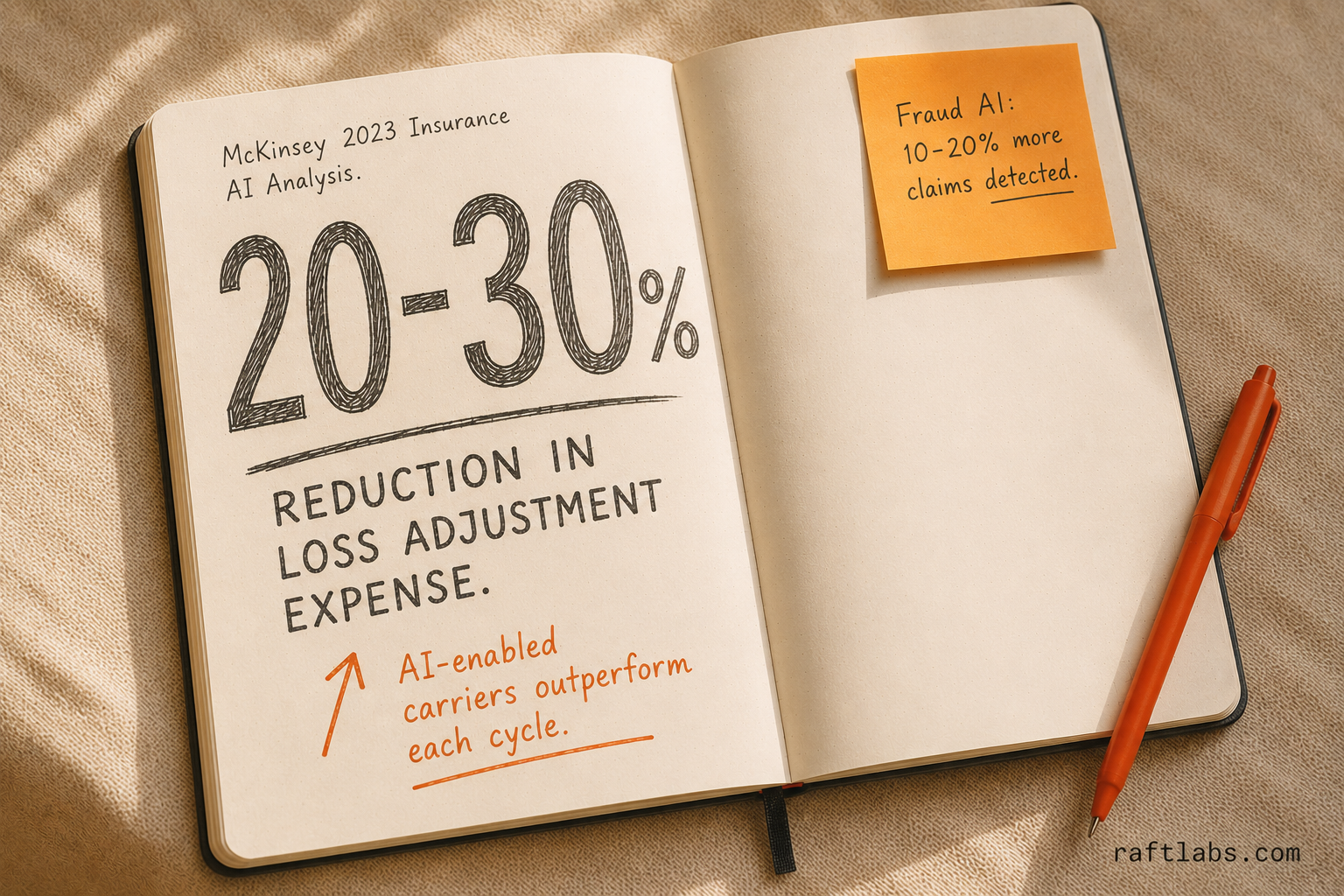
According to McKinsey's 2023 insurance industry analysis, carriers deploying AI in claims processing are seeing 20-30% reductions in loss adjustment expense in production environments. Fraud detection AI is identifying 10-20% more fraudulent claims than traditional rule-based systems at major P&C carriers. The performance gap between AI-enabled insurers and those relying on manual processes widens each renewal cycle - not because the laggards lack access to the technology, but because the procurement and integration work required to make AI consequential is harder than the model itself.
The verdict
The right AI company for insurance depends on the use case before it depends on the vendor.
For insurance AI platforms - fraud detection, claims automation, visual damage assessment: Shift Technology and Tractable are the benchmarks in their respective categories. If your use case fits their domain, the deployment speed and model depth built over years of production data are difficult to replicate with a custom build.
For custom AI development at mid-market rates: RaftLabs. Fixed-price, defined outcomes, $29-$49/hr, and a delivery model built for one well-scoped problem solved to production quality.
For research-to-production custom AI with EU data-residency: Merantix Momentum, a Berlin firm that builds and operates bespoke AI end-to-end, with ISO/IEC 27001 as a relevant security signal for carriers with GDPR-driven constraints.
For AI embedded in a full core system modernization: Sapiens International, for carriers and reinsurers evaluating a platform migration as the strategic program.
For analytics-driven AI at carrier scale: EXL Service, for large carriers with defined actuarial use cases, clean historical data, and executive accountability for measurable analytics ROI.
For data-science-led AI - predictive models, fraud scoring, pricing analytics: Elder Research (a specialist analytics consultancy) or MathCo (enterprise data science with the NucliOS platform), depending on how bespoke your model needs to be and whether a platform accelerator helps.
The procurement mistake most insurance companies make is treating AI like a software product purchase - evaluating vendors on feature lists and Clutch ratings rather than on the production outcomes their AI has delivered in comparable insurance contexts. Require live references, ask for measurable outcome data from production deployments, and resolve model ownership before any contract is signed.
RaftLabs builds custom AI for insurance workflows - document processing, claims triage, underwriting automation - at a fixed price with outcomes defined before any build starts. 4.9/5 on Clutch. Talk to a founder about your insurance AI project.
Ask an AI
Get an instant summary of this post from your preferred AI assistant.
Common questions
- A scoped custom AI engagement for an insurance workflow - document processing pipeline, claims triage automation, or underwriting data extraction - typically runs $30,000 to $150,000 for a mid-market insurer or MGA. More complex builds involving custom model training, integration with legacy core admin systems, and multi-step workflows run $150,000 to $500,000. Enterprise platform licensing (Shift Technology, Tractable, Sapiens) is structured per-claim, per-policy, or as annual software contracts starting from $100,000 and scaling with volume. The biggest cost variable is integration complexity: connecting AI to a modern API-first system costs significantly less than connecting it to a legacy batch-processing core admin platform.
- A focused custom AI build - a claims document processing pipeline or underwriting data extraction tool - takes eight to sixteen weeks from scoping to production deployment when data and requirements are clear. Integrations with legacy core admin systems add four to eight weeks. Enterprise platform deployments (Shift Technology, Tractable) typically take three to six months to go live, including integration, configuration, and user training. Multi-year programs (core system modernization with embedded AI from Sapiens) are scoped in years, not months. The single biggest timeline risk in insurance AI is data readiness: if training data is not available in a clean, labeled format, model development cannot start until it is prepared.
- Claims document processing AI delivers measurable ROI within three to six months for insurers handling paper or unstructured digital submissions - the reduction in manual data entry time is directly measurable from day one. Fraud detection AI delivers ROI within one to two renewal cycles when deployed on a sufficiently large claims volume, typically 10,000 or more claims per year for meaningful detection improvement. Underwriting data extraction AI delivers ROI by reducing time from submission to quote, which directly affects conversion rates in competitive market segments. Customer-facing AI such as chatbots and self-service claims status delivers ROI through reduced inbound call volume, which is measurable immediately but typically represents a smaller cost reduction than back-office automation.
- Ask for a live production reference in an insurance context - not a case study, a system still running today where you can speak directly to the buyer. Verify the team has experience with insurance data types: policy documents, claims forms, telematics feeds, third-party enrichment data, not just general AI experience applied to a new vertical. Confirm their approach to model explainability and regulatory compliance - any automated insurance decision must be defensible to regulators. Check their integration experience with insurance core systems such as Guidewire, Duck Creek, or legacy batch platforms. And clarify model ownership: if you commission a custom AI, you should own the trained model weights and retain the right to retrain on your own data after the engagement ends.
- RaftLabs builds custom AI for companies that have a specific workflow to automate - claims document processing, underwriting data extraction, internal triage, or customer communication. Their insurance-adjacent work spans healthcare AI (regulated data, clinical decision support operating at 80+ sites) and financial services AI (document intelligence, workflow automation), which share the same data sensitivity and explainability requirements as insurance. Engagements are fixed-price with defined outcomes, $29-$49/hr, and led directly by a founder throughout delivery. 4.9/5 on Clutch.
- It depends on the use case. Visual damage assessment for claims requires training data and model architecture that a general AI firm cannot replicate without years of insurance-specific investment - Tractable is the right call for that category. Fraud detection at carrier scale requires actuarial domain knowledge embedded in the model design. For document processing, workflow automation, conversational AI, and underwriting data extraction, a high-quality general AI development firm with regulated-industry experience can deliver comparable results to an insurance specialist at a significantly lower cost. The use case determines the requirement, not the vendor category.
- Regulators in the US, UK, EU, and Australia increasingly require automated underwriting or claims decisions to be explained to policyholders in plain language, so ask more than whether a vendor supports explainability in general terms. Ask what format the explainability output takes, whether it has been reviewed by a compliance team or regulator, and what happens operationally when a claims handler overrides the AI's recommendation. A vendor without a specific answer to the override question has not run the model in a real production workflow.
- Every insurance AI produces incorrect outputs at some rate - a false fraud flag that delays a legitimate claim, an underwriting risk score that diverges from actual loss experience. What matters is the production workflow built around those errors: whether there is human review before consequential decisions, how misclassifications are identified and fed back into model retraining, and who is accountable when a model error causes a measurable business impact. A vendor that cannot answer this in operational detail has not shipped AI into a production insurance environment.
- Most insurance AI fails not because the model performs poorly but because it cannot reliably connect to the data it needs. Beyond confirming a vendor's experience with Guidewire, Duck Creek, or a proprietary legacy system, ask what the integration architecture looks like in production - batch, real-time API, or event-driven message queue - and, critically, who is accountable when the integration breaks after go-live. That last answer is more revealing than any architecture diagram.