Reasoning AI agents: what they are and when they actually help
Reasoning AI agents chain explicit thinking steps before acting, making them reliable for complex multi-step tasks. A practical breakdown of when to use them, which models to pick, and what they cost.

In this article
Short answer
Reasoning AI agents are AI systems that explicitly chain thinking steps before producing an output, using models like OpenAI o3-mini, DeepSeek-R1, or Claude 3.5 Sonnet. Unlike standard LLM chat, they can self-verify, backtrack, and plan multi-step actions. They work best for tasks with multiple interdependent steps, where a wrong early decision cascades into wrong outputs. Use them for complex code generation, legal document analysis, multi-step data processing, and autonomous workflow execution.
Key takeaways
- Reasoning AI agents differ from standard LLM chatbots by chaining explicit thinking steps - they plan, verify, and backtrack before producing output.
- They outperform standard models on multi-step tasks where early errors cascade: code review, legal analysis, financial modeling, multi-tool orchestration.
- Models to consider in 2026: OpenAI o3-mini for cost-effective reasoning, Claude 3.5 Sonnet for tool use and long context, DeepSeek-R1 for open-source deployments.
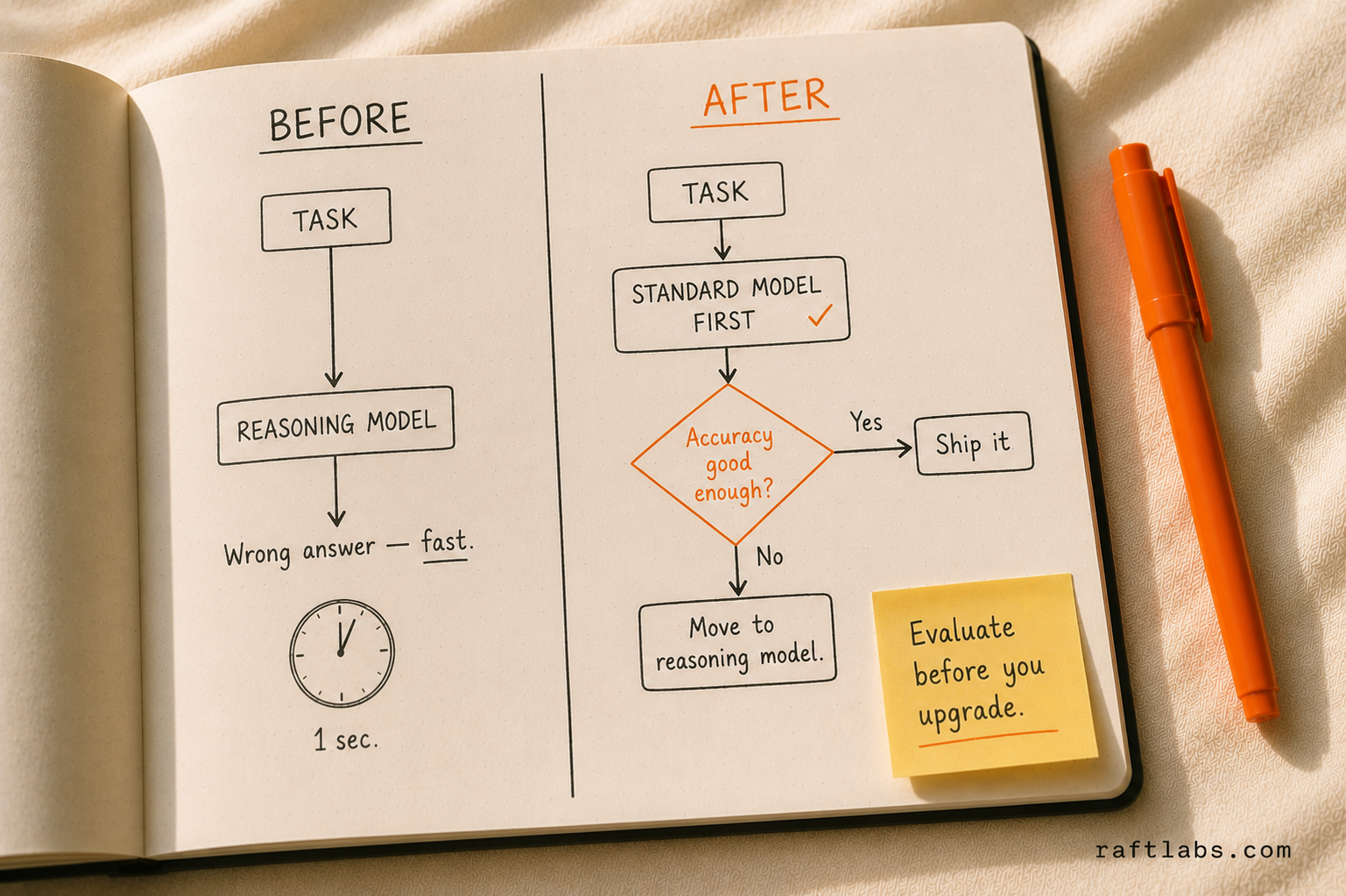
- Reasoning models are slower and more expensive per token than standard models. Do not default to them for simple tasks - use them where reliability of multi-step output matters.
- Building a production reasoning agent requires: the reasoning model, a tool registry, evaluation harness, error recovery logic, and a monitoring layer. Budget 6-12 weeks for the first agent.
Reasoning AI agents are AI systems that think before they act. They use models like OpenAI o3-mini, DeepSeek-R1, or Claude 3.5 Sonnet to run explicit multi-step internal computation - planning, self-checking, and backtracking - before producing an output. The result is a class of AI agent that can handle tasks where a single wrong early decision ruins the final answer. In 2026, these are the agents worth building for complex enterprise workflows.
The core difference
Standard LLMs generate tokens sequentially. When you ask a standard model a question, it begins answering immediately, each token predicted from the previous. There is no pause to verify. If the first assumption is wrong, every subsequent token builds on that error.
Reasoning models work differently. Before producing a response, they run an extended internal computation phase - often called a "thinking" or "chain-of-thought" phase - where the model considers multiple approaches, checks intermediate conclusions, and may discard entire reasoning paths before committing to an answer. Some APIs expose this thinking as a separate token stream. Others keep it internal. Either way, the output is the result of deliberate planning rather than sequential next-token prediction.
| Dimension | Standard LLM | Reasoning AI agent |
|---|---|---|
| Response time | 1-5 seconds | 10-90 seconds |
| Accuracy on multi-step tasks | 60-75% on complex benchmarks | 80-92% on the same benchmarks |
| Cost per call | $0.001-$0.01 | $0.05-$0.50 |
| Best for | Conversational tasks, drafting, summarisation | Multi-step decisions, code review, legal analysis, financial modeling |
| Failure mode | Wrong answer delivered confidently | Slower, but will often self-correct before responding |
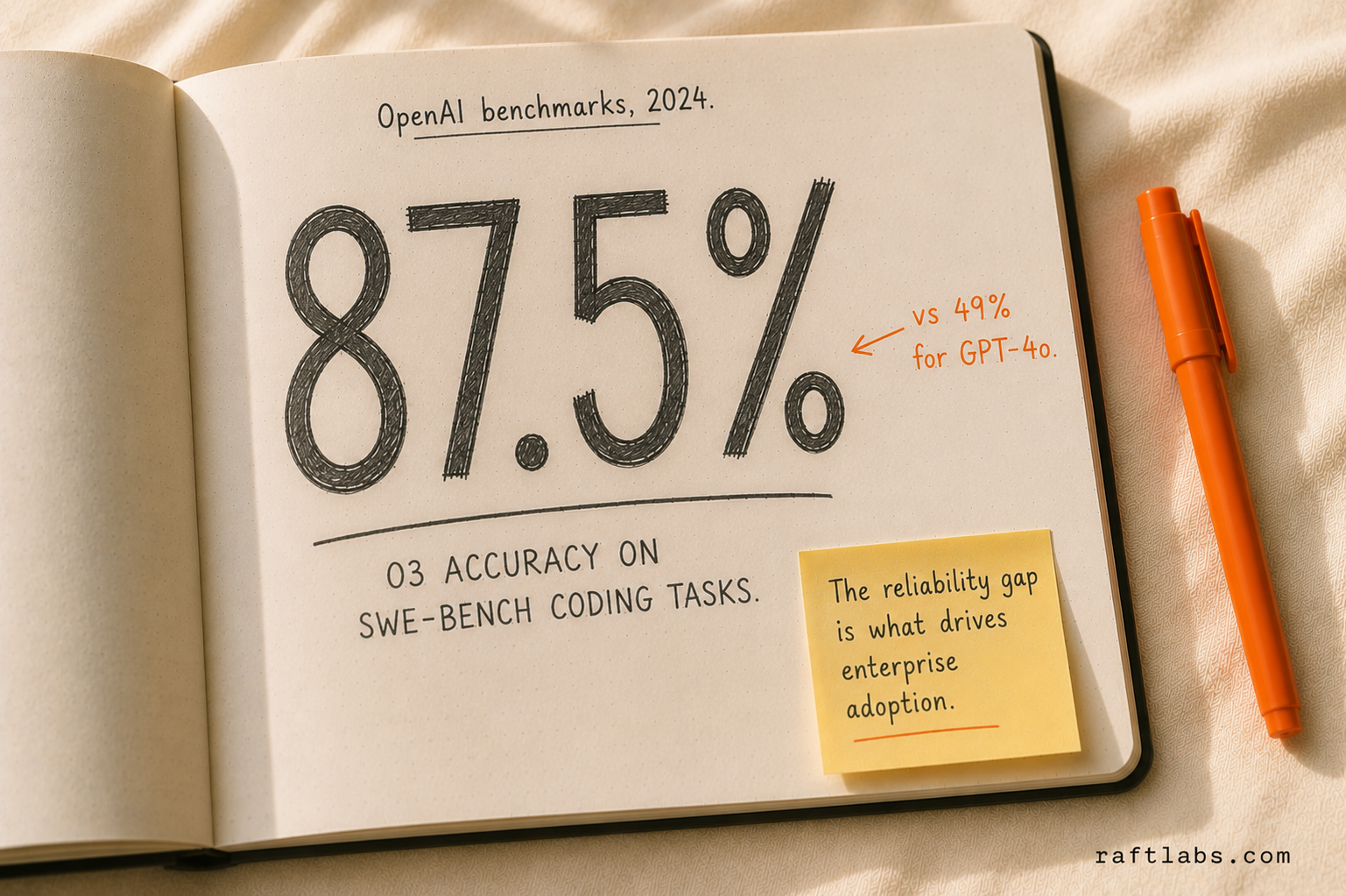
The accuracy gap on complex tasks is what drives the adoption curve. OpenAI's benchmarks show o3 achieving 71.7% on SWE-Bench Verified, more than 20 percentage points above its predecessor o1 - a gap that directly translates to production reliability on real software engineering tasks.
When they actually help
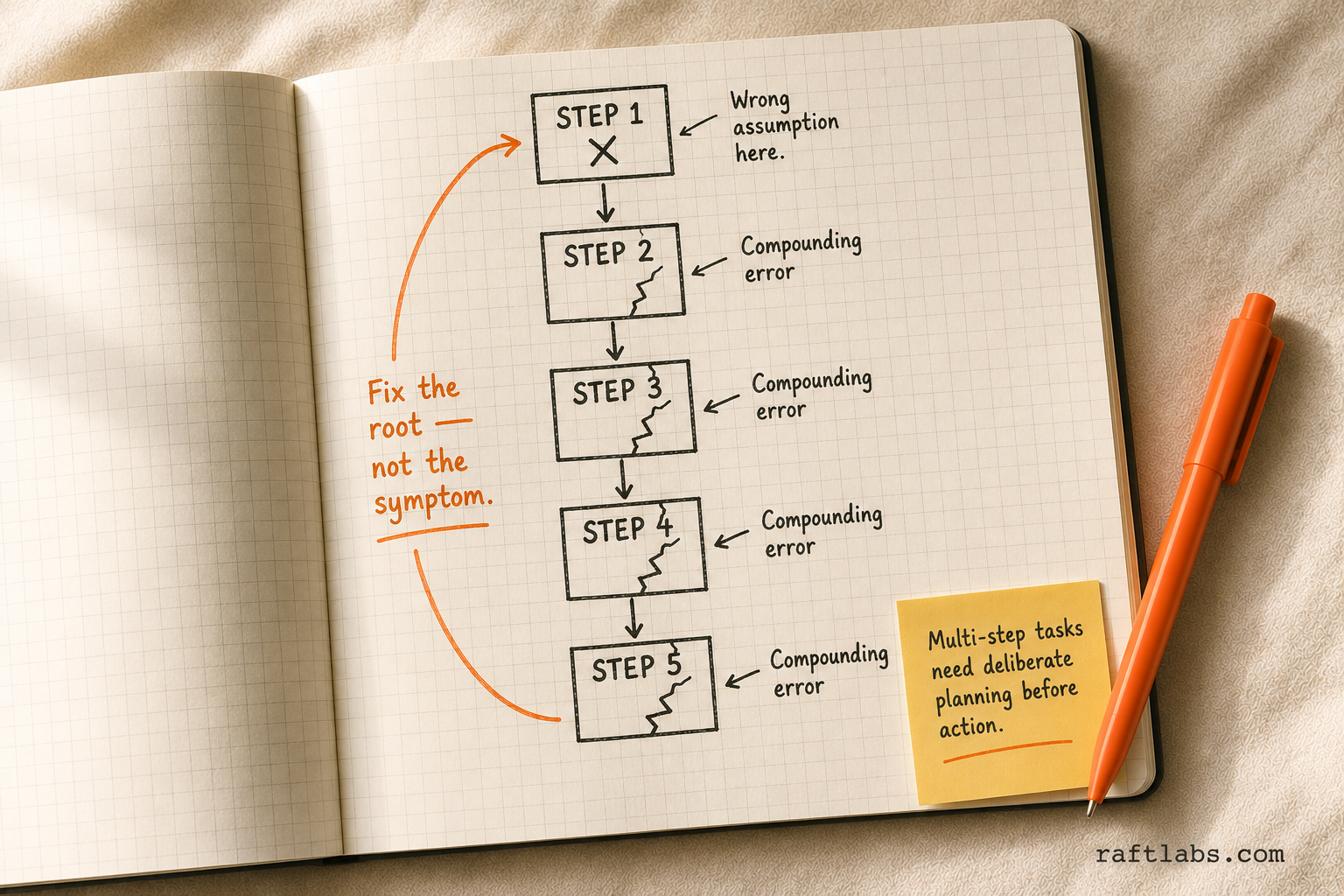
Reasoning agents earn their cost and latency premium on tasks where multiple interdependent decisions compound. Get step two wrong and step five is wrong regardless of how accurate it is locally. McKinsey's State of AI 2025 found that 23% of organizations are actively scaling agentic AI in at least one business function, with another 39% currently experimenting - and the enterprise use cases driving that adoption are precisely the multi-step, high-stakes tasks where standard LLMs fall short.
Legal document analysis. Reviewing a contract for specific clauses, cross-referencing defined terms, and flagging inconsistencies between sections requires the kind of layered reasoning where a standard model often misses references two pages back. A reasoning agent can build an internal model of the document structure before answering specific questions.
Complex code generation and review. Writing a function is easy for any LLM. Writing a function that correctly handles five edge cases, integrates with three APIs, and avoids a race condition requires reasoning through the implications of each decision. Code review on a large pull request - where a change in one file affects assumptions in three others - is precisely where reasoning models outperform.
Financial data reconciliation. Reconciling ledgers across multiple systems, identifying discrepancies, and producing a root-cause analysis of mismatches is a multi-step task where a wrong intermediate conclusion (misidentifying which transaction is the source of a discrepancy) ruins the final report.
Multi-tool API orchestration. An agent that needs to query five APIs, assess the results, decide on a follow-up query based on what it found, and then synthesise a decision benefit from the ability to plan the call sequence rather than executing it greedily. Reasoning agents can look ahead to the likely response and plan accordingly.
Medical and clinical decision support. A 2024 study published in JAMA Network Open found that reasoning-augmented AI systems reduced clinical decision errors by 34% compared to standard LLM outputs when evaluated against physician consensus on ambiguous case presentations - the kind of finding that explains why healthcare AI is gravitating toward reasoning architectures.
When they don't help
Reasoning agents are the wrong tool in situations where the thinking overhead is not justified by the task.
Simple Q&A and conversational tasks. If the answer to a question can be retrieved directly from context, a standard model is faster and cheaper. Adding a 30-second thinking phase to answer "What are our business hours?" wastes both time and money.
High-frequency low-stakes tasks. If an agent is classifying thousands of support tickets per day into five categories, the economics of reasoning models break immediately. At $0.20 per call and 5,000 calls per day, you're spending $1,000 daily on a classification task a fine-tuned small model can do for $5.
Conversational UX. Users expect conversational responses in under two seconds. A reasoning model taking 45 seconds to think before responding to a chat message produces a product that feels broken. If latency matters to the user experience, standard models with good prompt engineering usually get you 90% of the quality at 5% of the wait time.
Tasks where speed is the business value. Real-time fraud detection, live content moderation, and instant pricing recommendations are use cases where the value is in the speed of the response. A slightly less accurate answer in 100ms beats a more accurate answer in 60 seconds.
2026 reasoning models compared
| Model | Provider | Thinking budget | Context window | Cost tier | Best for |
|---|---|---|---|---|---|
| o3-mini | OpenAI | Low / Medium / High | 128K | Medium | Cost-effective reasoning at scale, coding tasks |
| o3 | OpenAI | Configurable | 200K | High | Maximum accuracy tasks, complex research synthesis |
| Claude 3.5 Sonnet | Anthropic | Configurable token budget | 200K | Medium-High | Tool use, long-context analysis, multi-turn agents |
| DeepSeek-R1 | DeepSeek | Fixed | 64K | Low (self-hosted) | Open-source deployments, regulated environments |
| Gemini 2.5 Pro | Auto | 1M | Medium | Long-context tasks, multi-modal reasoning |
The choice is rarely about raw capability - all four models perform reasonably well on standard reasoning benchmarks. The decision turns on deployment constraints. If you need to run the model in your own infrastructure because of data residency requirements, DeepSeek-R1 is the only production-grade open-source option. If you need long context for processing full legal documents or large codebases in a single call, Gemini 2.5 Pro's 1M token context window changes what's possible. If your agent makes dozens of tool calls per reasoning cycle, Claude 3.5 Sonnet's structured tool use handling reduces error rates significantly compared to other models at the same capability tier.
What a production reasoning agent actually needs
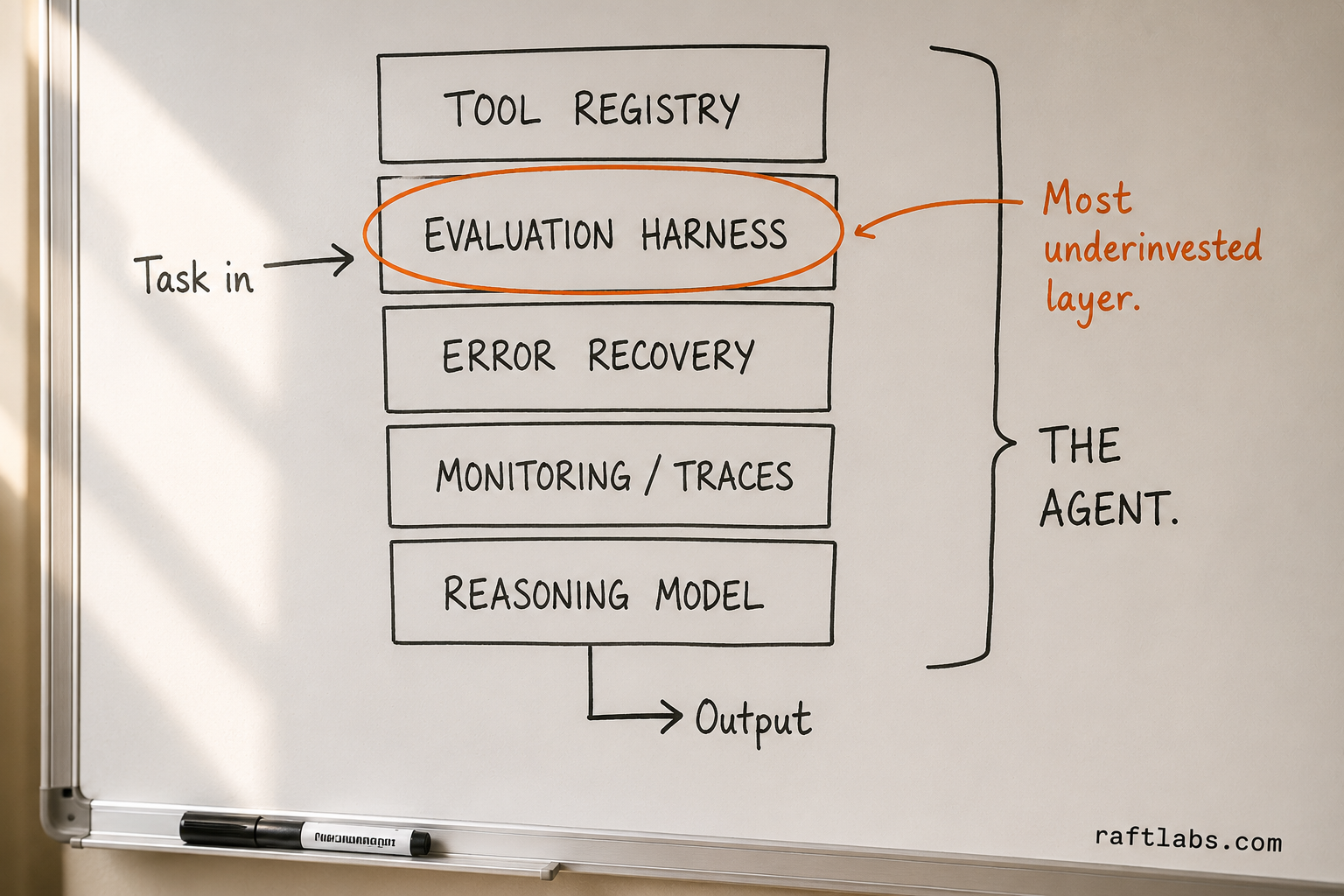
A reasoning model by itself is not a reasoning agent. The model handles the thinking. The agent is the system around it.
Tool registry. A reasoning agent needs access to the tools it can call - database queries, API calls, file reads, web searches, code execution. The registry defines what each tool does, what inputs it accepts, and what errors it can return. Good tool design is underrated: a tool with a misleading description or inconsistent error handling produces agents that reason correctly but act incorrectly.
Evaluation harness. Before deploying a reasoning agent to production, you need a test suite that exercises the full range of tasks it will face. This is the single most overlooked step. Teams build the agent, run a few manual tests, and ship. Then they discover edge cases in production that were entirely predictable. An evaluation harness with 50-200 representative tasks, expected outputs, and automated scoring lets you catch regressions when you swap models, change prompts, or update the tool registry.
Error recovery logic. Reasoning agents make tool calls. Tool calls fail. The rate-limited API returns a 429. The database query times out. The file doesn't exist. Without explicit error recovery logic, the agent stalls or produces a wrong answer by ignoring the failure. Good error recovery includes retry logic with exponential backoff, fallback tool paths, and explicit handling of the "I could not complete this task" outcome - which is often more useful to the user than a confident wrong answer.
Monitoring layer. Reasoning agents in production need traces. You need to know what the model was thinking when it produced a wrong output, which tool calls it made, how long each thinking cycle took, and what the token cost was. Without traces, debugging a production failure in a reasoning agent is guesswork. Tools like LangSmith, Weights & Biases, or a custom logging layer around the model API are not optional - they are the only way to run a reasoning agent responsibly at scale.
The model itself. Model selection should come last, not first. Define the task, build the evaluation harness, then run the top three candidate models through your actual test suite. The model that performs best on your evaluation is the right model, regardless of which one is newest or most hyped.
What we've seen at RaftLabs
We've shipped AI agents across document processing, workflow automation, and enterprise data tasks. A few patterns that hold up:
The evaluation harness is where most teams are underinvested. A team will spend six weeks building an agent and two days on evaluation. The right ratio is closer to 50/50, especially for reasoning agents where the failure modes are subtle - the agent reasons correctly but calls the wrong tool, or verifies a correct intermediate step but then ignores its own conclusion.
Latency surprises teams in production. A 45-second thinking cycle is acceptable for a background task. It's unacceptable for anything a human is waiting on. Reasoning agents work best when they're asynchronous - the agent runs, produces a result, and the user gets notified. Trying to use a reasoning agent in a synchronous user-facing interaction almost always leads to a poor experience.
Tool design is where the quality ceiling sits. We've seen cases where switching from a general-purpose query tool to a domain-specific tool - one that returns data pre-structured for the agent's task - improved output quality more than switching to a more powerful reasoning model. The model's reasoning is only as good as what the tools return.
The "thinking budget" matters. Most reasoning APIs let you configure how much internal computation the model should do. Higher budgets improve accuracy but increase cost and latency. For most enterprise tasks, a medium thinking budget captures 90% of the quality improvement over a standard model at a third of the cost of a maximum budget. Run experiments on your actual task set before defaulting to maximum.
How to get started
The single most valuable first step is to define the task precisely. Not "we want an AI agent for our legal team" - but "we want an agent that reviews a standard NDA, flags the 12 clause types our legal team cares about, and outputs a structured summary with clause text and risk rating for each." That level of specificity makes everything else tractable: you can write evaluation cases, you can assess whether reasoning models are actually needed, and you can scope the first version.
Second, build the evaluation harness before the agent. Take 50 real examples of the task from your team's existing work. Define what a correct output looks like for each. Run a standard model against them. If the standard model gets 65% right and you need 90%, you have a concrete case for a reasoning model. If the standard model gets 85% right and 90% is good enough, you've saved six weeks of engineering time.
Third, start with one tool. Agents that call 15 tools simultaneously are hard to debug and harder to improve. Start with the single most important tool the agent needs, get that working reliably, add the evaluation cases for failures, and only then add the second tool.
If you want to talk through the specifics of your task and whether a reasoning agent is the right architecture for it, we're happy to spend 30 minutes on that before any commitment. The clarity usually pays for itself.
Ask an AI
Get an instant summary of this post from your preferred AI assistant.
Common questions
- A reasoning AI agent is an AI system that chains explicit thinking steps before producing an output or taking an action. Unlike a standard LLM that responds immediately, a reasoning agent uses extended internal computation to plan, verify intermediate steps, backtrack when stuck, and produce more reliable outputs on complex tasks.
- A standard chatbot generates a response token by token without explicit planning. A reasoning AI agent runs extended internal computation before responding - checking its own reasoning, trying alternative approaches, and verifying consistency before acting. The result is better performance on multi-step tasks, but higher latency and cost per call.
- OpenAI o3-mini is the leading cost-effective reasoning model. Claude 3.5 Sonnet supports extended thinking with configurable thinking budgets. DeepSeek-R1 is the leading open-source reasoning model. Google's Gemini 2.5 Pro has strong reasoning capabilities for long-context tasks. Each has different latency, cost, and context window trade-offs.
- Use reasoning agents when task accuracy on multi-step decisions matters more than response speed, and when an early wrong step would cascade into a wrong final output. Examples: code review, legal document analysis, financial modeling, multi-tool API orchestration. Use standard LLMs for conversational tasks, simple Q&A, content generation, and any task where speed and cost matter more than step-by-step correctness.
- Building the first production reasoning agent typically takes 6-12 weeks and costs $20,000-$60,000. This includes the agent architecture, tool registry, evaluation harness, error recovery, and monitoring layer. Ongoing API costs depend on the model and task frequency - o3-mini at scale is significantly cheaper than o3.