How to Build an App Like Zomato: Food Discovery and Delivery Platform Guide

Building a food platform like Zomato requires a restaurant discovery system with menus and reviews, a delivery ordering flow with real-time tracking, a restaurant dashboard, and a rider app. RaftLabs has shipped food delivery platforms and marketplace apps. An MVP takes 16-22 weeks and costs $35K-$70K. The complexity is higher than a pure delivery app because Zomato combines content-heavy discovery with real-time multi-party transactions.
Key Takeaways
- Zomato is both a media product (restaurant discovery, reviews, photos) and a commerce product (delivery ordering). The content side attracts users; the commerce side generates revenue. Both need investment.
- Restaurant onboarding and menu management are business operations problems before they are technology problems. The quality of your restaurant data directly determines platform quality.
- Reviews and ratings create trust but require active moderation. Fake reviews damage platform credibility faster than almost anything else.
- Delivery logistics is operationally intensive: rider supply management, zone coverage, and peak-hour capacity are ongoing operational challenges, not one-time engineering problems.
- The hybrid model (discovery + delivery) means two separate user journeys. A user browsing reviews and a user placing a delivery order have different intent and UX needs.
Most founders building a food platform are not trying to compete with Zomato globally. They are launching a regional delivery network in an underserved city, a niche cuisine marketplace for a specific diaspora community, or a restaurant SaaS product for a multi-location hospitality group. Zomato's generic model creates friction for all of them because it bundles discovery content and real-time delivery into one platform -- and most builders only need one of those two things at launch.
Here is what the build actually costs and how long it takes:
| Scope | Timeline | Cost |
|---|---|---|
| Discovery-only MVP (listings, menus, reviews, search) | 10-14 weeks | $25K-$45K |
| Delivery MVP (ordering, real-time tracking, rider app) | 14-20 weeks | $35K-$70K |
| Full platform (discovery + delivery + reviews + restaurant dashboard) | 16-22 weeks | $70K-$120K |
The delivery side costs more because it requires three separate apps (customer, rider, restaurant dashboard) that communicate in real time. Cross-platform mobile development saves $30K-$50K compared to building native iOS and Android separately. That is the default unless there is a specific performance reason to go native.
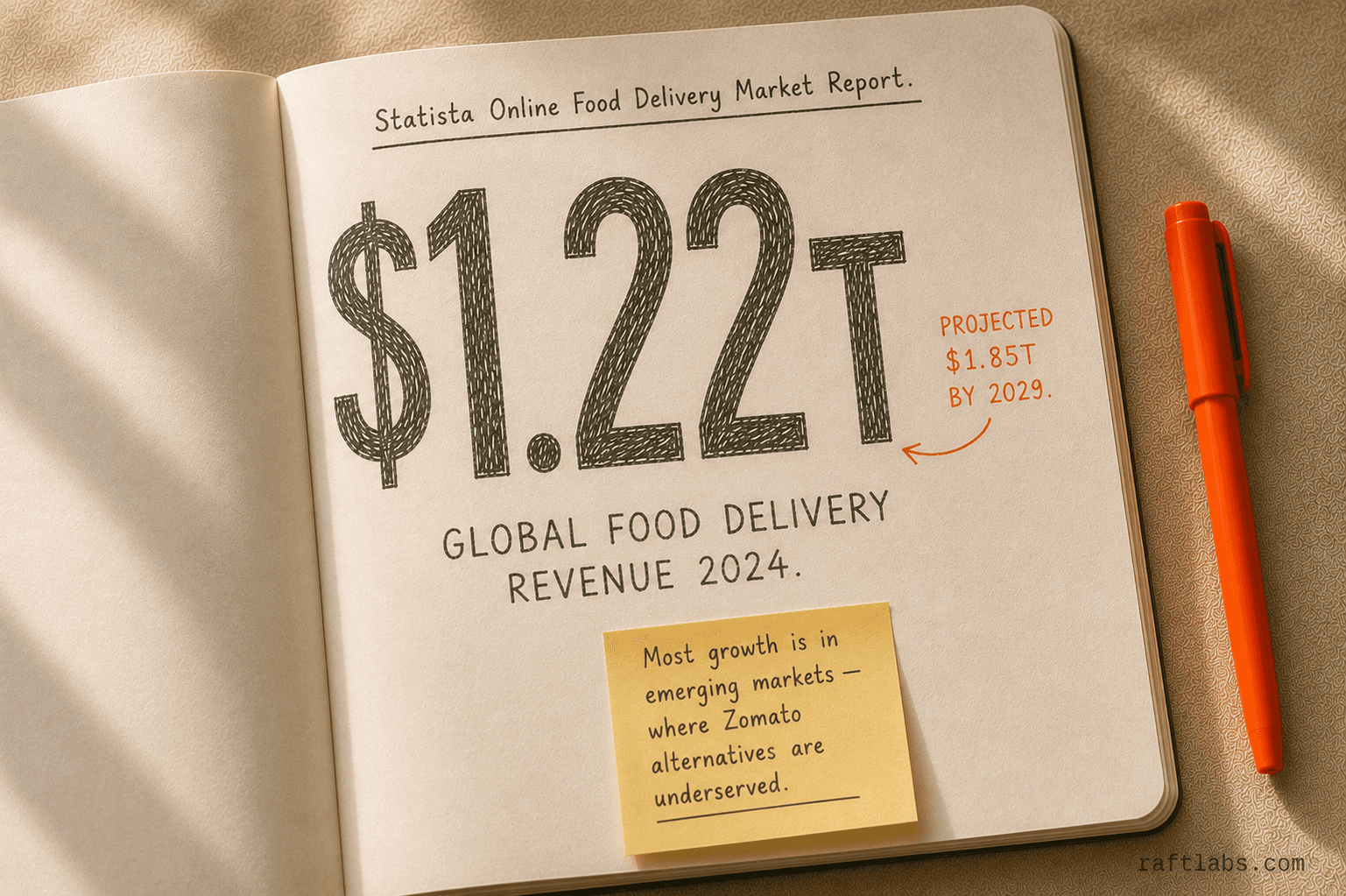
According to Statista's 2024 Online Food Delivery Market Report, the global online food delivery market generated $1.22 trillion in revenue in 2024 and is projected to reach $1.85 trillion by 2029. The majority of that growth is in emerging markets where regional alternatives to Zomato and DoorDash are underserved.
Who builds a food platform instead of listing on Zomato or DoorDash
McKinsey's 2024 Food Delivery Insight Report found that platforms combining discovery content with delivery transactions show 35% higher 12-month retention than delivery-only apps. That number explains why several categories of businesses are building rather than listing.
Regional operators who cannot negotiate favorable commission terms. Zomato and DoorDash charge 15-30% commission on every order. A restaurant group doing $2M in annual delivery volume pays $300K-$600K in platform fees. At that scale, building a proprietary ordering app and keeping commission in-house pays for the build cost in year one. Multi-location chains like regional pizza franchises, bubble tea brands, and fast-casual groups cross this threshold faster than they expect.
Niche cuisine and community marketplaces. A halal food marketplace, a South Asian tiffin delivery network, or a specialty grocery delivery platform cannot rely on Zomato's generic search and discovery. Their value proposition is the curation itself -- finding certified halal kitchens or authentic regional cooking -- and Zomato's platform does not surface that credibly. These platforms need content and community features, not just a delivery layer.
Hospitality groups building direct ordering to reduce dependency. Hotels, resorts, and venue operators that run food and beverage across multiple outlets increasingly want a single ordering platform for guests rather than relying on third-party apps. The integration with their PMS, loyalty program, and room billing is the requirement that off-the-shelf platforms cannot meet.
White-label operators. Companies that aggregate local restaurant supply for a corporate cafeteria program, an airport food court, or a stadium concessions operation need a branded ordering experience with custom split payment and reporting logic that Zomato cannot provide.
How does the business model work?
A Zomato-style platform has four potential revenue streams. Most platforms should start with one and add others only after proving volume.
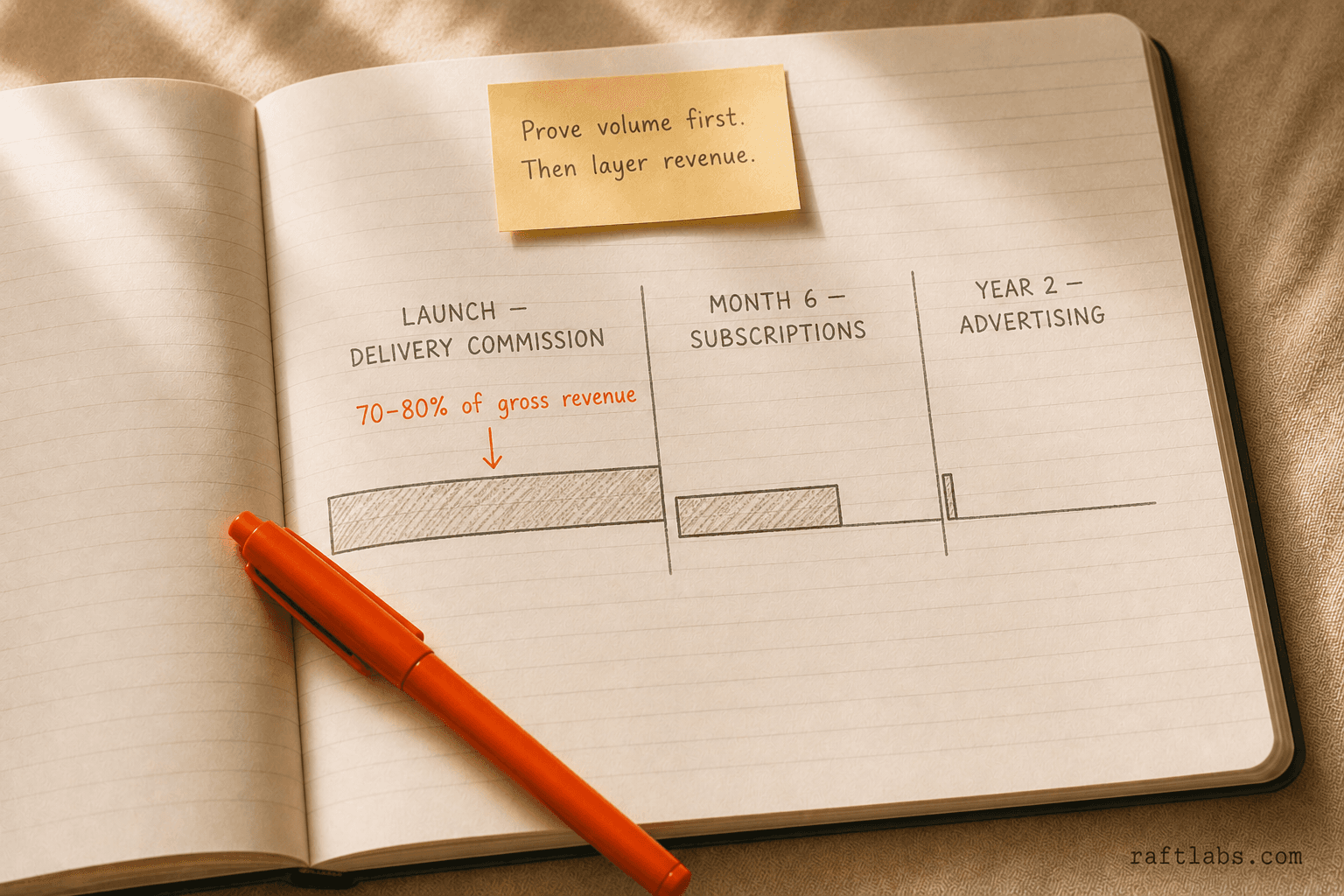
Delivery commission is the primary driver. The restaurant pays 15-25% of each order's value to the platform. Bloomberg Second Measure's 2024 restaurant platform analysis shows that delivery commission accounts for 70-80% of gross revenue for most food platforms in their first three years. At $50K monthly GMV, a 20% commission rate generates $10K per month. The break-even point for a $100K build is 10 months at that volume.
Restaurant subscription plans add predictable revenue. A monthly subscription ($50-$200/month depending on market) gives restaurants featured placement, analytics, or a reduced commission rate for high performers. This is easier to sell once you have delivery volume to show prospective subscribers.
Advertising (sponsored placement in search results) only becomes meaningful after significant organic traffic. Do not plan advertising revenue into your year-one projections.
B2B supply (Zomato's Hyperpure model) is a separate business entirely. Supplying ingredients to restaurants at scale requires warehouse operations and logistics infrastructure well outside the scope of a platform build.
For a new platform: start with delivery commission only. Add subscriptions at month six after proving consistent order volume. Advertising is a year-two conversation.
What to build: V1, V2, V3
Every food platform founder wants to build all of Zomato on day one. The platforms that survive are the ones that launch narrow and build credibility before expanding.
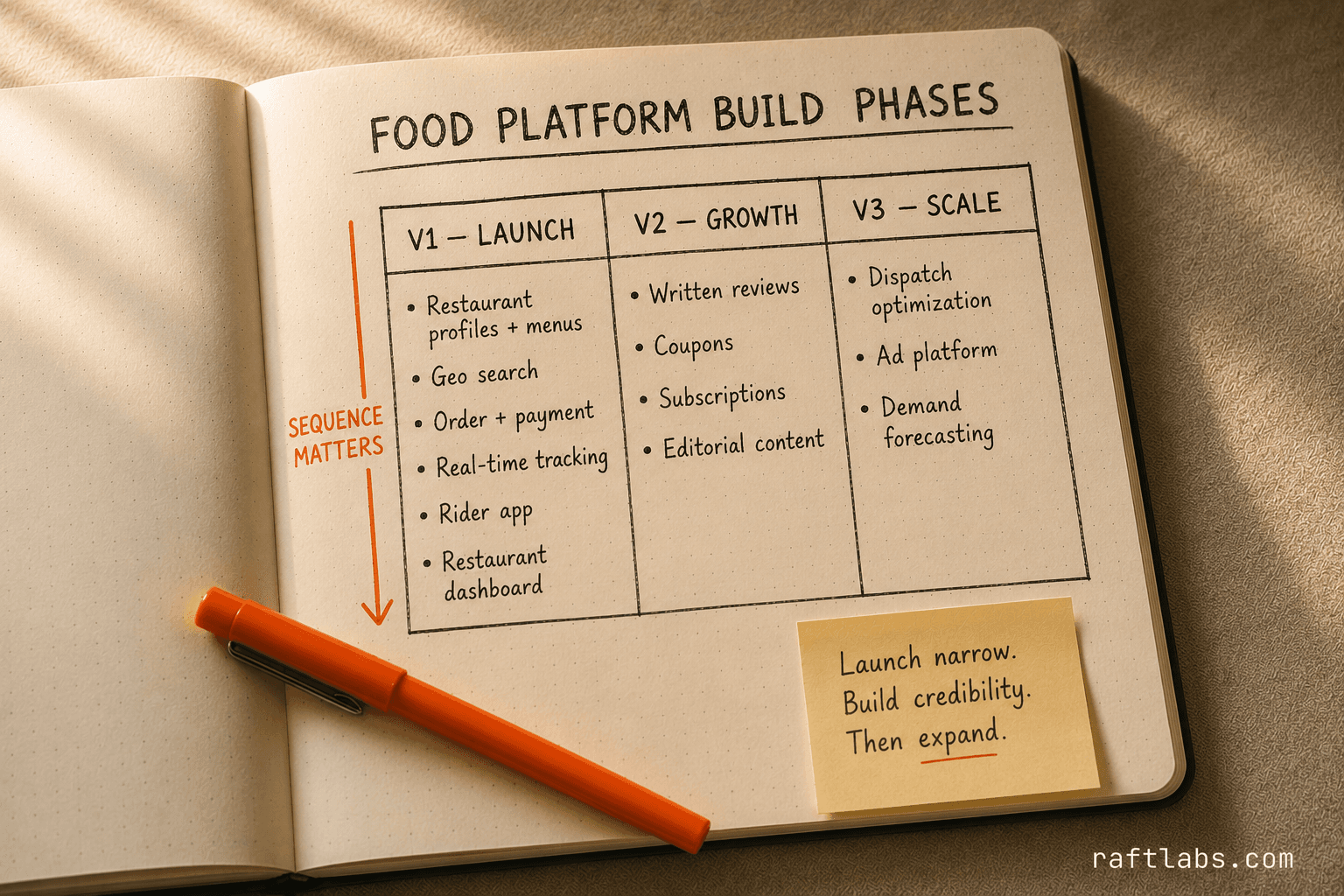
V1 -- launch (what you need to open the doors)
| Feature | Why it is required at launch |
|---|---|
| Restaurant profiles with menus and photos | Without this, users have nothing to browse. Menu quality determines conversion. |
| Geographic search (radius-based) | Users need to see restaurants that actually deliver to their address. |
| Order flow: cart, checkout, payment | The core transaction. No revenue without this. |
| Real-time order status (kitchen confirmed, rider dispatched, on the way) | Users cancel orders when they go dark for more than 5 minutes. |
| Rider app (accept order, navigate, confirm delivery) | Without this, the delivery side cannot function. |
| Restaurant dashboard (receive orders, update prep time, mark items unavailable) | Restaurants will call your operations team constantly without a self-service tool. |
| Basic ratings (post-order star rating) | Trust signal. Required from launch, not v2. |
Cost to skip a V1 item: skipping real-time tracking at launch adds approximately $15K-$25K to retrofit it post-launch. Skipping a proper restaurant dashboard costs more -- your operations team manually relaying orders is not scalable past 20 restaurants.
V2 -- growth (add after proving the model)
| Feature | When it becomes necessary | Rough cost to add |
|---|---|---|
| Written reviews with moderation | After 500+ completed orders, reviews build trust faster than ratings alone | $15K-$25K |
| Coupon codes and promotions | When you want to incentivize trial or reactivate churned users | $10K-$20K |
| Restaurant subscription plans | When you have 50+ active restaurants willing to pay for featured placement | $20K-$30K |
| Editorial content (curated lists, new openings) | After organic traffic reaches a point where SEO returns meaningful user acquisition | $10K-$15K |
| Loyalty and rewards | After proving repeat order rate; loyalty without volume has no effect | $25K-$40K |
V3 -- scale (relevant above $500K annual GMV)
| Feature | Threshold that triggers it |
|---|---|
| Dispatch optimization algorithm (multi-stop routing, dynamic zone management) | When rider supply and order density are high enough that manual dispatch creates bottlenecks |
| Advertising platform (self-serve sponsored placement) | When organic traffic is sufficient for restaurant advertisers to see ROI |
| Predictive demand forecasting (adjust rider supply before peak hours) | When rider shortage during peaks is causing measurable cancellation rate |
| B2B supply integration | Separate business line; only relevant at multi-city scale |
Build vs. listing on Zomato or DoorDash
"The death of most food platforms is not technical. It's density. You need enough restaurants in a small enough geography to make the product feel full before users churn." -- Andrew Cordova, founding partner, Fuel Venture Capital (TechCrunch 2024)
Keep listing on Zomato or DoorDash when you are a single restaurant or small chain with under $500K annual delivery volume. The commission cost is less than the engineering cost, and the customer acquisition network effect of an established platform is difficult to replicate in your first year.
Also keep the platform listing if you need national or multi-city reach from day one. Building a proprietary platform in multiple cities simultaneously requires significant rider acquisition and restaurant onboarding operations in each market. The unit economics only work when you concentrate supply and demand in a tight geography.
Build your own when delivery commission has become a meaningful line item (typically $200K+ per year). At that volume, a proprietary platform pays for itself within 12-18 months of commission savings alone. Also build when you need features the platforms do not offer: integration with your PMS or loyalty program, branded guest experience, consolidated reporting across multiple outlets, or a niche curation layer that a generic marketplace cannot credibly provide.
The platforms that fail this decision: single restaurant operators who build a proprietary app before they have the volume to justify it, and multi-location groups who delay the build until commission costs become painful -- by which point they have trained customers to order via the third-party platform and switching takes significant promotion spend.
What features actually cost you
The features founders consistently underestimate are not on the product roadmap. They are operational.
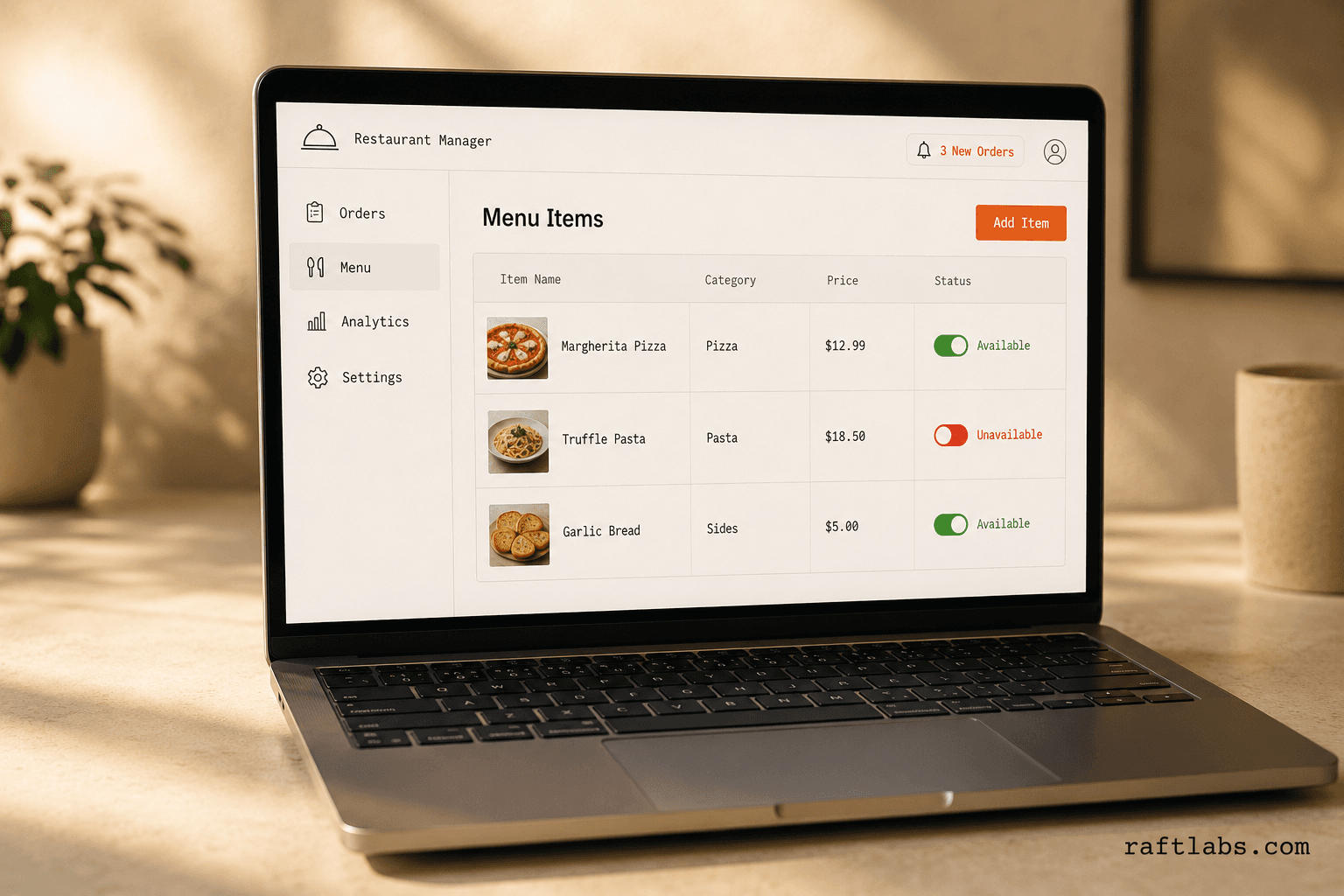
Restaurant onboarding is a business development problem before it is a technology problem. RaftLabs has shipped restaurant marketplace platforms across hospitality and food tech. In every launch, the first 60 days were almost entirely about supply acquisition and menu data quality, not product features. Getting a restaurant's complete menu with accurate prices, photos, and portion variants into your system requires either a dedicated onboarding team or a self-service tool simple enough for a kitchen manager to use without training. Neither is free.
The menu is the most data-intensive piece. Restaurants change menus constantly. Your restaurant-facing management tool needs to make menu updates easy enough that restaurants do it themselves without routing each update through your operations team. Build a simple web-based management dashboard from day one. Teams that defer this end up with their own operations staff manually updating menus, which does not scale past 30 restaurants.
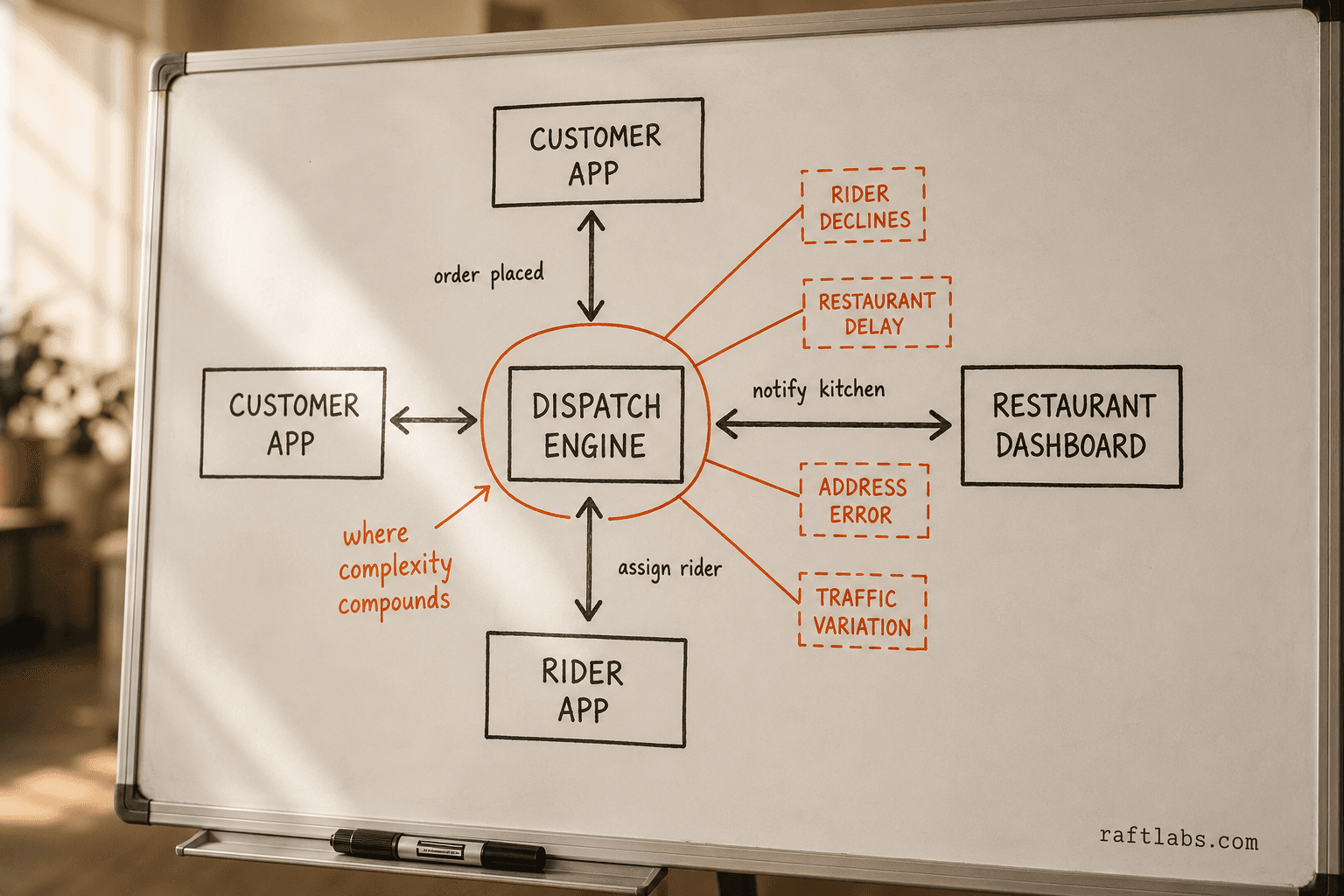
Real-time dispatch is where most food platforms hit unexpected costs. The dispatch problem is not algorithmically complex at launch -- at low order density, assigning the nearest available rider to each order works fine. The cost comes from edge cases: rider declines, restaurant delays, customer address errors, traffic variations. Each of these needs explicit handling or it creates a customer complaint. The failure mode we see most often in delivery builds is teams that handle the happy path beautifully but ship without a rider-decline flow and a restaurant-delay notification. Adding those post-launch costs 3-5 weeks and disrupts live operations.
The review and ratings trust problem
Ratings are the primary quality signal users use for decisions. Protecting their accuracy is more important than any feature on the roadmap.
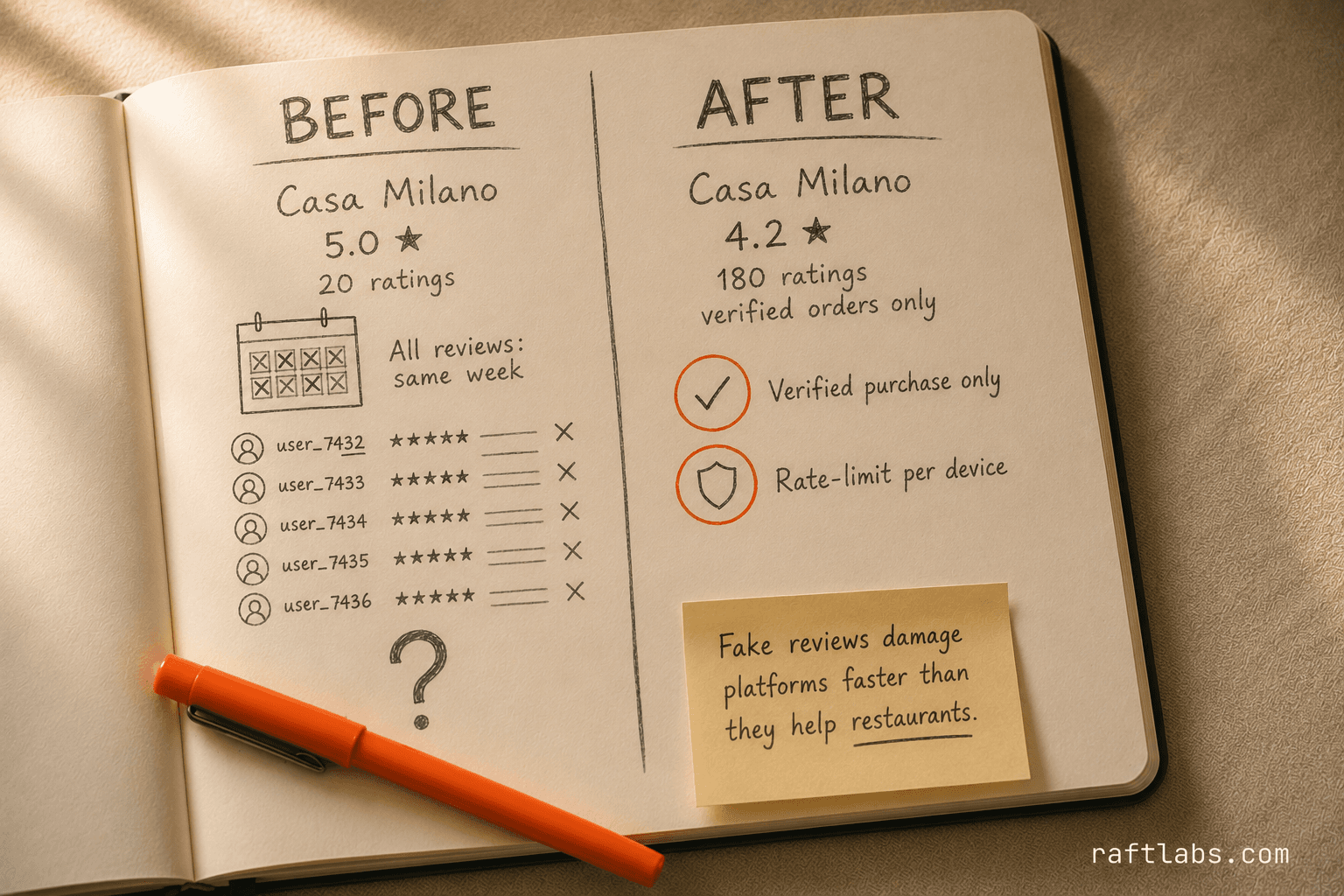
The failure mode: a restaurant owner creates 20 accounts and gives themselves five-star reviews in the first week. Your platform shows a 5.0 rating on a restaurant with 20 ratings, all from accounts created the same week. A real customer orders based on that rating and has a bad experience. They never order again and tell their friends. The reputational damage compounds faster than the fake review benefit to the restaurant.
Minimum viable fraud prevention: only verified order completions generate ratings. Rate-limit reviews per account. Flag accounts where multiple reviews came from the same device or IP range. This is not sophisticated fraud detection -- it is the baseline that prevents the most obvious manipulation.
Written reviews add a moderation burden. Staff time to moderate reviews is ongoing operational cost, not a one-time engineering problem. Build a report mechanism, a removal workflow, and a profanity filter before enabling written reviews. Skipping this leads to a backlog of unmoderated reviews within two weeks of enabling the feature.
How RaftLabs fits
Food tech platforms have a supply-side problem (restaurants) and a demand-side problem (users) that need to be solved in parallel. Technology does not solve either -- it creates the infrastructure once supply and demand are established.
We help define the geography, the restaurant category, and the delivery zone radius before writing a line of code. A tight geographic launch -- one neighborhood, one cuisine category -- with high restaurant coverage performs better than a broad launch with thin coverage everywhere.
If you are building a food platform and want to understand the right scope for your market, book a 30-minute scoping call.
Frequently asked questions
- An MVP combining restaurant discovery (listings, menus, photos, reviews) with delivery ordering and rider dispatch takes 16-22 weeks with a team of 5-7 developers. The delivery logistics side alone (rider app, dispatch, real-time tracking) accounts for 8-10 weeks of that timeline. If you are building discovery-only (no delivery) or delivery-only (no discovery/reviews), the scope is narrower and the timeline is shorter.
- Zomato's revenue streams: delivery commission from restaurants (15-25% of order value), restaurant subscription plans (Zomato Gold / Pro), advertising (sponsored placement in search and category results), and B2B food supply (Hyperpure). For a new platform, start with delivery commission only. Add restaurant subscriptions (for featured placement or unlimited delivery passes) after proving delivery volume. Advertising revenue only materializes with significant traffic.
- Real-time delivery logistics: matching a delivery order to an available rider, accounting for rider location, estimated restaurant prep time, and delivery distance simultaneously. This is the same dispatch algorithm problem as DoorDash. It is hard not because the algorithm is complex, but because edge cases compound: rider declines, restaurant delays, customer location errors, and traffic variations all need handling gracefully.
- Restaurants update their menus constantly: items added and removed, prices changed, specials added. You need: a restaurant-facing menu management tool (simple enough for restaurant staff without tech experience), a defined data model for complex menus (items, categories, variants, modifiers, prices), and an availability system (mark items as unavailable without removing them permanently). Menu quality directly affects customer experience -- inaccurate menus lead to complaints and cancelled orders.
- Ratings should be separate from reviews: a numeric rating (1-5 stars) submitted after every order, and an optional written review. Ratings from verified orders only -- never allow unverified users to rate. Written reviews require moderation: profanity filter minimum, report mechanism, and a review removal process for policy violations. Highlight recent reviews more than old ones. Respond to reviews capability for restaurant owners builds engagement.
Ask an AI
Get an instant summary of this post from your preferred AI assistant.
Related articles

How to Build an App Like ChatGPT: A Guide for Domain-Specific AI Products
Not everyone building an LLM assistant is trying to compete with OpenAI. This guide is for legal firms, healthcare operators, and SaaS founders who need AI trained on their own data — not the whole internet.

How to Build an App Like Snapchat: The Founder's Guide to Ephemeral Social
For founders building a private community, fitness social layer, or event platform — not a Snapchat clone. Covers cost ($100K–$600K+), AR budget surprises, and when building your own beats using Snap.

How to Build a Live Streaming App in 2026 (Cost, Features & Tech Stack)
Discover how to plan, architect, and monetize a live or on-demand streaming app. Covers costs, tech stack, protocols, and features real platforms actually use.