How to Build a Mobile App: Cost, Timeline, and the No-Code Decision
A plain-language guide to building a mobile app for business owners. Covers cost ($15k-$150k+), timeline, when to use Glide/Bubble/Adalo vs. custom development, and the phased feature approach RaftLabs uses to ship mobile apps.

In this article
Short answer
To build a mobile app for your business: start with a 1-2 week discovery phase, choose cross-platform (React Native) or native depending on your use case, and scope an MVP to one core workflow. MVP cost runs $15,000-$50,000 and ships in 6-12 weeks. RaftLabs builds custom mobile apps for established businesses that have outgrown no-code tools like Glide, Bubble, or Adalo.
Key takeaways
- No-code tools like Glide, Bubble, and Adalo work well for internal tools and early validation. They break down when you need custom integrations, offline capability, or more than a few hundred active users.
- A mobile app MVP costs $15,000-$50,000 and takes 6-12 weeks. A full-featured platform with payments and real-time features costs $80,000-$150,000+.
- React Native is the right default for most business apps. It ships to iOS and Android from one codebase at roughly 60% of the cost of native development.
- Phase your features: V1 covers the single core workflow that justifies the build. V2 adds integrations and team features. V3 adds automation and analytics.
- The most common cause of budget overruns is skipping the discovery phase. Decisions made in a planning document cost nothing. The same decisions made in code cost 3-5x more.
You built your internal process on a no-code tool. It worked. Then it stopped working. Now you have 300 active users, three integrations that break weekly, and a feature your whole sales team is waiting on that the platform simply cannot support. You need a real mobile app, and you need to know what that actually costs and how long it takes.
This guide is for business owners making that decision. Not developers. Not CTOs. Operators who need a mobile app built and want to know the real numbers before talking to anyone.
Here is the short version: a mobile MVP costs $15,000-$50,000 and ships in 6-12 weeks. A full platform costs $80,000-$150,000+. The decision between no-code tools and custom development comes down to five specific thresholds covered below.
Cost and timeline: the real numbers
Based on mobile products shipped across 24 industries, here is what custom mobile app development actually costs:
| Scope | Timeline | Cost |
|---|---|---|
| MVP (1 core workflow, Firebase backend) | 6-12 weeks | $15,000-$50,000 |
| Full platform (2-3 integrations, custom backend) | 14-20 weeks | $50,000-$150,000 |
| At scale (ongoing features, compliance, enterprise) | ongoing | $15,000+/mo |
These are fixed-scope numbers. Time-and-materials contracts run 30-40% over initial estimates almost every time. Scope your MVP tightly before you sign anything.
What drives cost up:
Separate native builds for iOS and Android (rather than cross-platform)
Real-time features: live location tracking, chat, synchronized updates
Compliance requirements: HIPAA, SOC 2, PCI-DSS
Third-party integrations beyond standard payment and auth providers (ERP systems, EMR platforms, banking APIs)
Offline capability with data sync
What drives cost down:
Cross-platform with React Native (one codebase for both platforms)
Firebase for the first version (no custom backend infrastructure)
iOS-first launch, Android six months later
Hard scope limit on V1 features
Who actually builds a custom mobile app
According to Statista, mobile devices now account for over 57% of global internet traffic, a share that has grown steadily each year and shows no signs of plateauing, particularly in enterprise mobile where new app categories keep emerging.
Custom mobile development is not right for everyone at every stage. Here are the four business profiles where it makes clear economic sense.
Field service and logistics operators. A plumbing company running 40 technicians on paper dispatch sheets or a basic scheduling tool hits a wall fast. They need job assignment pushed to a mobile device, photo documentation attached to work orders, signatures captured on-site, and hours synced to their billing system. No-code tools can handle pieces of this but rarely the full chain with offline capability and custom ERP sync. A custom app brings the entire workflow into one place. The typical ROI case is 4-6 hours saved per technician per week.
Healthcare and clinical businesses. A physical therapy group, a home health agency, or a mental health practice cannot use a generic no-code tool for patient-facing workflows. HIPAA compliance alone eliminates most platforms. They need custom intake flows, clinical documentation tied to each patient record, scheduling synced to a practice management system, and audit logs. Custom development is not optional here. It is a compliance requirement.
Marketplace and on-demand businesses. A staffing agency connecting workers to shifts, a rental company connecting customers to inventory, or a service marketplace with two-sided ratings needs custom logic for matching, availability, and payments. Bubble can get an early version to 50 users. Getting to 5,000 users with acceptable performance requires a custom backend and a native-quality mobile experience. According to eMarketer, mobile devices generated approximately 44% of all US online sales in 2024, totaling $564 billion, and 75-77% of all ecommerce website traffic comes from mobile devices. The operators running those transactions need apps that perform at scale, not at demo day.
B2B SaaS companies adding a mobile layer. A software company that built its product on web and needs a companion mobile app for field users, approvals, or notifications is a common profile we see. Their web product works. They need mobile as an extension, not a replacement. React Native makes this cost-effective: one mobile codebase that connects to an existing API, shipped in 8-12 weeks.
Mobile app features: V1, V2, V3
Phasing features is the single most reliable way to stay on budget and ship on time. Every feature you defer to V2 is a feature that does not slow down V1.
V1: The core workflow ($15,000-$50,000)
V1 includes exactly one thing: the primary workflow your users came for. Authentication, the core data model, the main screen sequence, and one integration if the business cannot operate without it. For a field service app this is job dispatch, status updates, and photo capture. For a marketplace it is listing, booking, and payment. For a clinical app it is patient intake and documentation.
No reporting. No admin dashboards. No notification preferences. Those come later. V1 validates that the core workflow works and users will actually use it.
V2: Integrations and team features ($30,000-$60,000 incremental)
Once V1 is in users' hands and the core workflow is confirmed, V2 adds the connective tissue. ERP or CRM sync. Automated notifications. Team management and permissions. The admin dashboard your operations team has been asking for. Reporting on the data you have been collecting since V1.
This is also where you add the second platform. If you launched iOS-first in V1, V2 is when Android ships. By this point you have proven the product works and Android development is not a gamble.
V3: Automation and intelligence ($20,000-$50,000 incremental)
V3 is where the app starts making decisions instead of just recording them. Predictive scheduling based on historical patterns. AI-assisted triage or routing. Anomaly detection. Personalized recommendation logic. These are high-value additions, but only valuable once you have enough real usage data from V1 and V2 to train on.
"Phase your mobile build the same way you phase any capital investment. Put money in when you have validated the previous return." That is the framing Pete Malone, VP of Product at a fleet management company we worked with, uses when explaining the approach to his board.
Glide, Bubble, and Adalo vs. custom mobile app
No-code tools are not competitors to custom development. They serve different stages and different problems. The mistake is using them past the point where they make sense.
Glide turns Google Sheets into a mobile app. It is genuinely useful for internal tools with small teams: inventory tracking, simple CRM for a sales rep, field data collection for fewer than 50 users. It breaks down when you need real-time sync, offline capability, or more than a handful of custom actions. Glide also has per-user pricing that becomes expensive quickly as your team grows.
Bubble is more capable. It can build multi-page web applications with complex logic and has a mobile PWA option. For early-stage SaaS products and MVPs with web-first audiences it is a reasonable choice. The mobile experience is a progressive web app, not a native app. Users download it to their home screen but it does not live in the App Store and does not have access to native device features. Performance degrades noticeably past a few thousand records.
Adalo targets native-looking mobile apps built without code. It handles simple single-purpose apps well. A community directory, a simple booking tool, a basic loyalty card app. The backend is Adalo's own database, which means you are locked to their infrastructure and pricing. Complex workflows, offline sync, and custom integrations require workarounds that become harder to maintain as the app grows.
When custom development wins instead:
- Your user base will exceed 500 active users in the first year. No-code platform pricing and performance both become problems past this threshold.
- You need native iOS and Android app store presence, not a PWA or wrapped web view.
- The workflow requires offline capability with data sync when connectivity returns.
- Compliance requirements apply: HIPAA, SOC 2, PCI-DSS, or similar.
- You need a specific integration that the platform does not natively support and workarounds have already failed.
According to Gartner, 65% of companies were already building with low-code platforms by 2024, yet the same research notes that most platforms remain either too rigid for business users or too chaotic for IT governance, making migration to custom development inevitable for teams with complex operational requirements. The operators who plan for custom development from the start spend less overall than those who migrate after the no-code tool breaks.
The calculus is straightforward. No-code is fast and cheap to start. Custom is more expensive upfront and cheaper over three years. If your app will be a core operational tool for a team of more than 20 people, custom development almost always wins the total cost of ownership comparison.
Where custom mobile app projects fail
Most mobile app projects that go over budget or miss their deadline share one of two failure modes.
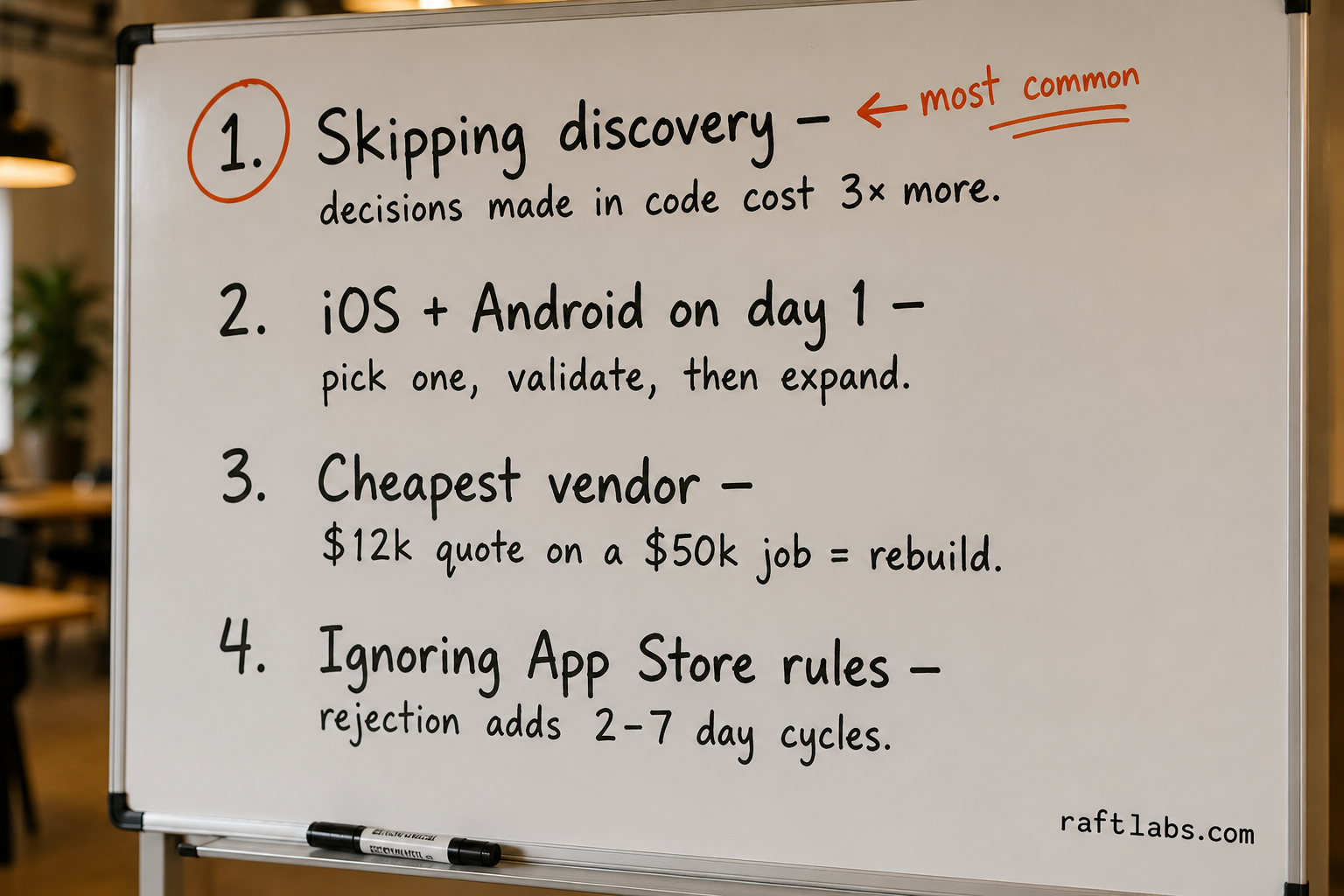
Skipping discovery and scoping in sprint 1. A founder has a clear picture of what they want. The development team starts building. By week 6, the team is rewriting screens because the navigation model does not match how real users think about the workflow. Decisions that cost $200 to make in a planning document cost $8,000 to unmake in code. Discovery is not a project phase. It is insurance. A proper discovery phase takes 1-2 weeks and surfaces every ambiguity before it becomes a sprint blocker.
Scope expansion without budget adjustment. The MVP spec is agreed. Development starts. The stakeholder adds a feature in week 3. Then another in week 5. Each addition is small. The cumulative effect is a 16-week project that was scoped for 10 weeks and a $90,000 invoice that was quoted at $55,000. The fix is a formal change order process from day one. Every addition to scope requires a written estimate and approval before it enters the sprint. This is not bureaucracy. It is the only way a fixed-price project stays fixed.
How RaftLabs builds mobile apps
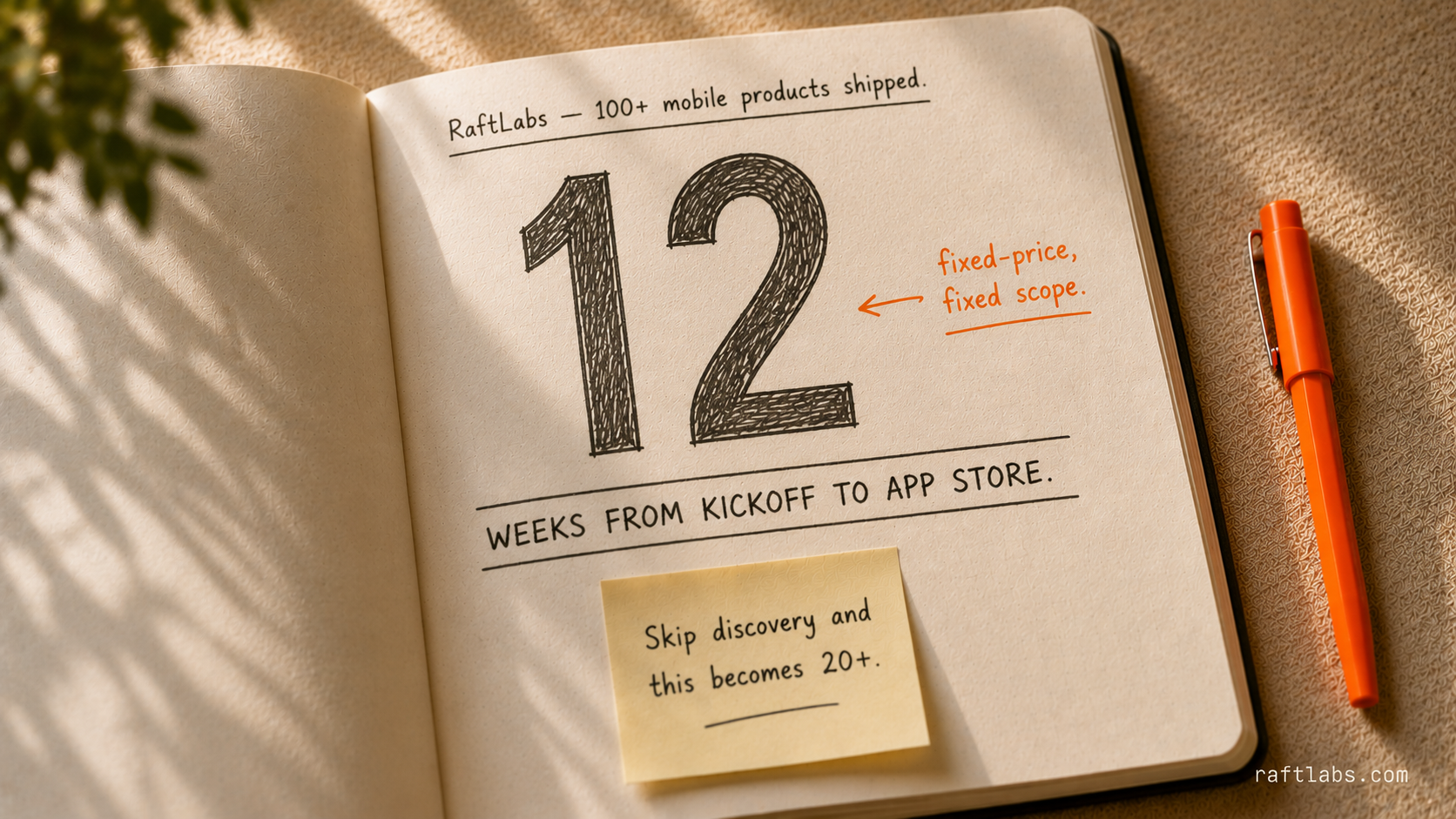
Our standard mobile engagement runs 12 weeks at a fixed price. Discovery in weeks 1-2. Design in weeks 2-3. Development in weeks 4-10. QA on physical devices in weeks 10-11. App Store submission in week 12.
The discovery phase is not optional. We map the primary user journey, write user stories for that journey only, define what "done" looks like for the MVP, and agree on a change order process before sprint 1 starts. This is what keeps the project on schedule and on budget. RaftLabs has shipped production software since 2015 for clients across the US, UK, Europe, Canada, and the UAE. Every project that has gone over budget has had a weak one.
We build in React Native for most engagements. It ships to iOS and Android from one codebase, shares 95% of code between platforms, and costs roughly 60% of equivalent native development. We go native when the use case genuinely requires it: Bluetooth medical devices, continuous background GPS for fleet tracking, or frame-rate requirements that cross-platform cannot reliably meet. We submit a TestFlight build by week 5, not week 10. Users on physical glass find UX problems that no simulator reveals.
If you are running a core business operation on Glide, Bubble, or Adalo and hitting the wall, or if you have a mobile app concept that needs to support more than a few hundred users from day one, here is what the first 30 days with RaftLabs looks like: a 60-minute scoping call, a written discovery brief with the core user journey mapped out, a fixed-price proposal for V1, and a sprint plan. No code written until the scope is agreed in writing.
Ask an AI
Get an instant summary of this post from your preferred AI assistant.
Common questions
- A mobile app MVP costs $15,000-$50,000. A mid-market app with 2-3 integrations and a custom backend costs $50,000-$100,000. A full-featured platform with payments, real-time features, and compliance requirements costs $80,000-$150,000+. The cheapest vendor almost always leads to a rebuild. Fix the scope tightly before signing any contract.
- A production-ready MVP takes 6-12 weeks from kickoff to App Store submission. A full-featured app with multiple integrations takes 14-20 weeks. The main variable is integration complexity. A standard Stripe payment integration takes 2-3 days. A real-time location tracking system with offline sync can take 4-6 weeks on its own.
- Use no-code tools when you are validating an idea with fewer than 200 users, building an internal tool for a small team, or your workflow maps cleanly onto the platform's existing templates. Switch to custom development when you need a native mobile experience, offline capability, specific hardware access, compliance requirements, or when your user base is growing past what the platform can reliably serve.
- Start with a discovery phase: write down the one workflow your app must execute perfectly, and sketch the 5-6 screens that workflow requires. Then hire a development partner rather than trying to manage freelancers directly. Define the MVP scope on paper before any code is written, and agree on a fixed price for that scope. Avoid time-and-materials contracts if you are not technical.
- Cross-platform with React Native is the right default for most business apps. It ships to iOS and Android from one codebase, shares 95% of code between platforms, and costs roughly 60% of equivalent native development. Go native (Swift for iOS, Kotlin for Android) only when you need continuous background hardware access, Bluetooth Low Energy, or frame-perfect 3D rendering that cross-platform cannot reliably deliver.