Waterpark Management Software
Waterpark management software for parks where a bad reading can close a pool.
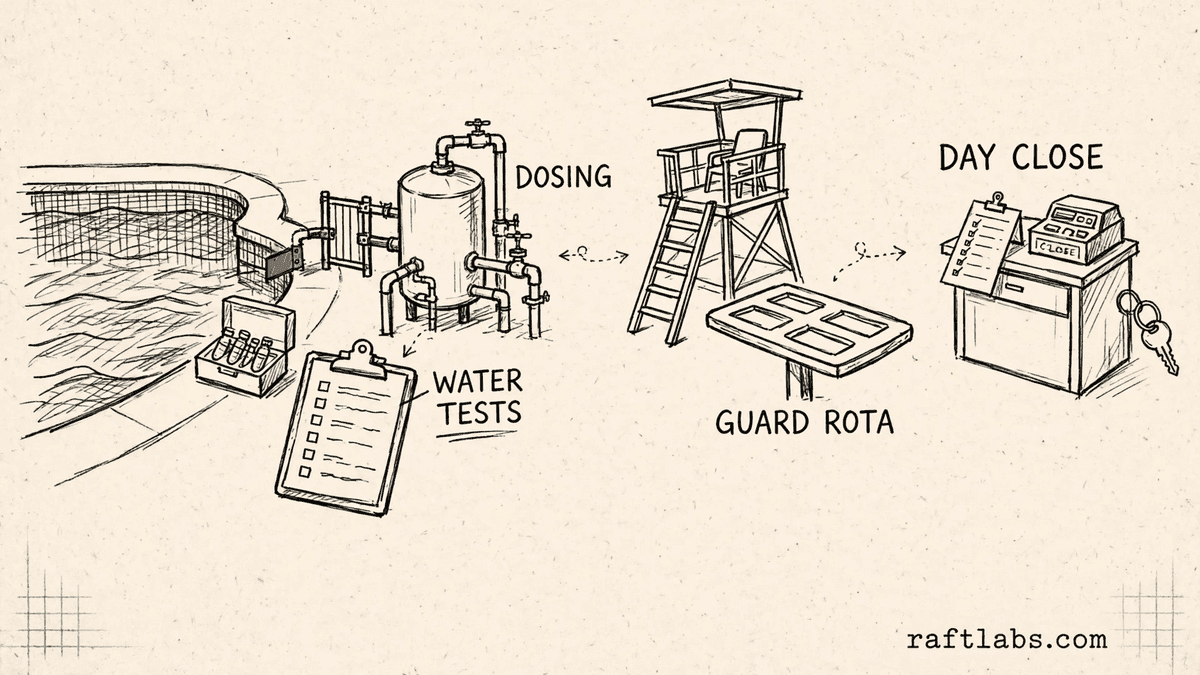
A waterpark runs on readings, rotations, and counts that all have to agree. We turn that day into software that logs every pool test and dose in one place, places only guards whose certificates are current, tracks slide capacity, and closes the day with admissions, rentals, food, and refunds reconciled.
Bring one stuck workflow. Leave with a build, buy, repair, or wait recommendation.
Trusted by






















The brief
Start with what is not working.
Good software decisions begin with the constraint, not a list of features or a preferred technology.
A chlorine reading is written on a clipboard at the pool edge, and a complaint sends someone searching a month of sheets.
A guard with a lapsed rescue certificate sits on a tower until someone happens to check the date.
Day close takes hours because admissions, rentals, food, and refunds sit in separate counts that do not agree.
Plain answer
RaftLabs builds waterpark management software for waterparks and aquatic centres that run pools, slides, and lifeguards through a full park day. One record holds each pool's chemical readings and doses, each guard's post and certificate dates, slide and attraction counts, cabana and locker rentals, and the day close that reconciles admissions, rentals, food, and refunds.
What to remember
- Use this when pool logs, guard rotations, slide counts, and day close are kept in separate places and the gaps show up as closures, complaints, or short tills.
- Every pool keeps its own readings, safe range, and dosing history, and an out-of-range reading can close that pool on the record.
- A guard whose rescue certificate has expired cannot be placed on a tower post until the certificate is renewed and recorded.
- Quote the park team's own screens as their own scope: rotation boards, closure decisions, rental returns, and day close are a second product, not a single admin-panel line.
- Hire freelancers for one small, well-defined task; use one accountable agency party when the work needs coordination across screens, rules, data, and connections.
The first decision is not what to build.
It is whether software is the right answer at all. We use four possible recommendations before discussing a development scope.
- 01
Buy
Choose a maintained product when it handles your pool logs, your guard rules, your rentals, and your day close, and the remaining gaps can be solved with configuration, a connector, or a small process change. Paying for software you do not have to maintain is often the better trade.
- 02
Repair
Keep the existing system when the park team still gets value from it and the code can be understood safely. Start with evidence: where the code lives, how the data is organized, what is tested, which outside services it depends on, who can access what, and how updates go live.
- 03
Build
Own the system when your pool mix, certificate rules, or closure and close routines shape safety, guest trust, or speed, and no maintained product will hold them. Start with one complete path, usually the run from the first pool test to day close, and the system connections that path cannot work without.
- 04
Wait
Do not turn unsettled operating rules into permanent software. Settle how readings, rotations, and day close should work, name the workflow owner, and measure the cost of the current process before paying for a product.
Not sure which path is yours? Bring it to a 30-minute call. Leave with the answer in writing.
Fit
Custom park software should earn its maintenance burden.
A feature request is not enough. The case is real when the same constraint shows up in time, errors, safety, or guest trust.
Pool logs, guard rotations, slide counts, and day close are tracked in separate places, and the gaps reach guests or inspectors.
Your certificate, closure, or rental rules differ by pool or post, and a generic product keeps forcing workarounds.
The organisation can name a workflow owner and what 'done' looks like for the first release.
A maintained product fits your pools, posts, and close routines with reasonable configuration.
The team wants software to settle log and rotation rules nobody has agreed yet.
The brief is a feature list with no user, transaction, or business result attached.
Not sure which side you are on? Use the first call to make that decision. A useful answer may be to buy, connect, repair, or wait.
Start with the operation, not the software.
A waterpark problem usually starts as a paper problem. The chlorine reading sits on a clipboard at the pool edge. The guard rotation lives in a spreadsheet someone rebuilds each month. Slide counts are guessed at the gate, and day close is worked out at night from tills and sheets that were never meant to agree. Each record looks fine on its own. The trouble starts when they disagree, and they disagree at the worst moment. A guest complains about sore eyes while someone searches a month of sheets for one reading. A manager finds a lapsed certificate after the guard has already spent the day on a tower.
The park day itself makes a plain system fail. A pool cannot wait while someone finds its log in a list. A reading is taken, a dose is decided, and a pool either opens or it does not. Software that makes the pool tech walk back to an office or retype a reading will be abandoned for the clipboard by the second busy day. The clipboard is what creates the searching the park wanted to escape.
A second product hides inside the first. Guests see tickets, cabanas, and clean pools; your team lives in another set of screens: logging readings, closing and reopening a pool, moving guards between posts, handling rental returns, and closing the day. Quotes that squeeze all of that into an "admin panel" line item are where budgets most often break, so we quote your team's screens as their own job, with their own users, from the start.
Custom software makes sense when one owned record can hold pool tests, doses, guard posts, slide counts, rentals, and day close together better than a product, connector, or process change. The first release should take the smallest useful path from the first test of the morning to a day that closes cleanly. It should not replace every tool at once.
Work out the dose from your own readings
Use this free calculator to turn a pool volume and a test reading into the dose to add, for chlorine product, stabiliser, or salt. Put in your own numbers, in metric or imperial, and the amount updates as you change them, at the pool edge where the decision is made. Nothing you enter is sent anywhere. It stays in your browser.
Your numbers
1. Pool volume
Every amount in the result scales with this volume. If you only know the pool size in one unit, enter it in that unit and the calculator converts for the math.
2. Free chlorine: current reading, target, and product
The concentration presets are starting points printed on common product labels. Check the label on the product you hold and change the percentage to match it.
3. Cyanuric acid (stabiliser)
4. Salt (saltwater pools only)
Leave both salt fields at zero on a pool that does not use a salt system.
5. Your prices (optional, for the cost lines)
Prices are optional. The dosage amounts do not depend on them. Leave a price at zero and its cost line stays at zero.
Result
Estimated chemical cost
$0.00
Product needed = ppm rise x Pool gallons x 8.34 / 1,000,000 / Concentration share
Amounts come from the mass balance on your volume and readings. Add your price per unit for each product in section 5 to see the estimated chemical cost.
We start where it hurts.
Tickets are only one part of the job. The real scope includes how readings are logged per pool, how a closure is decided, how guards rotate, what happens when things fail, who can see and change what, and who runs it after release.
Readings written, never found again
Log each reading once per pool, with its time and who took it, at the pool edge. A complaint or an inspector is answered from that pool's history in minutes, not from a month of clipboard sheets.
A bad reading with no clear next step
Give every pool its safe range and its closure limit on the record. An out-of-range reading is flagged at once, the dose is logged against it, and a pool past its limit stays marked closed until a good reading and a manager reopen it.
A lapsed certificate nobody spotted
Hold every guard's rescue and first aid dates on their record, beside the rotation board. A guard whose certificate has expired cannot be placed on a post that needs it, so the check happens when the board is built, not by chance.
Slide counts guessed at the gate
Keep a live count for each slide and attraction against its safe limit, from entries and exits. Staff see which slide is full and which is empty, and throughput per hour comes from the same count.
Day close that takes hours
Close the day from the records the day already made: admissions, rentals, food, and refunds in one count. A difference sits on the line it belongs to, while the day is still fresh enough to explain.
Which one is yours?
Bring it to a 30-minute call. Leave with a build, buy, repair, or wait recommendation in writing. Free, whether or not we ever work together.
Verticals
Custom software for specialised operations.
Some workflows only exist in one kind of park. The same rules apply: configure first, build only the part the maintained products cannot cover, and start with one complete path.
Outdoor seasonal waterparks
The season is short and the busiest days carry the year. Opening readings, weather holds, and day close have to work from the first hot weekend, with seasonal staff who learned the system in training, not over a long winter.
Indoor waterparks and leisure centres
Indoor parks run pools, slides, and lessons side by side all year. Pool logs and guard posts are shared across activities, so one record per pool and one board per guard team keeps the whole centre on the same day.
Resort and hotel waterparks
Guests arrive through the hotel as well as the gate, and cabanas, lockers, and food are charged in different ways. Rentals and day close need to agree with the resort's own counts without forcing park staff to run two systems.
Municipal aquatic centres
Public centres answer to inspectors and to the public. Reading histories, certificate dates, and incident records need to be complete, findable, and kept in the form the centre already uses for its checks.
Parks with group and party bookings
Group visits and parties fill cabanas and time slots before the day starts. Bookings by slot with deposits keep the same space from being promised twice, and the day's set-up list comes from the bookings themselves.
Check it yourself
No story here. A check you can run instead.
This page carries no client story for waterparks, because we will not invent one. What you can do is test any system, ours included, against one full park day before you sign.
Run one full park day from the first chemical test to day close: log an out-of-range reading and close that pool on the record, try to place a guard whose certificate has expired and confirm the board refuses the post, rent a cabana and a locker, then close the day and check admissions, rentals, food, and refunds against one count. The logs, the rotation, and the money should be one record, not three copies that agree only when someone retypes them.
The park-day test
What to check before you sign
Bring this check to any vendor, including us. A system that cannot pass it in a demonstration will not pass it on your busiest day.
Which pool log, rotation, or day close problem is costing you the most right now?
Bring it to a 30-minute call. Leave with a build, buy, repair, or wait recommendation in writing. Free, whether or not we ever work together.
Let the work pick the shape.
The way people work should decide the form of the software. Pool techs work at the pool edge with wet hands, guards work from a board, gate staff work at a counter, and managers work from a desk. Those facts tell us what belongs in the first release.
Web app
Work done across roles and locations. Pool techs, guards, gate staff, and managers all get the same current park record in a browser: no installs, no versions, no device limits. When in doubt, this is usually the right first surface.
Mobile app
Work away from a desk: logging a reading at the pool edge, or checking a rotation board from a tower.
Desktop app
Local hardware, large files, work without a browser. The gate counter and the day close desk often live here, where the day must keep running on the local network.
Browser extension
One task inside a system that otherwise works.
Connected devices
Gate counters and pool-side devices, when the physical setting demands them and the equipment maker allows the connection.
One product may need several surfaces. Each one should support the same complete workflow, not start another feature list.
How it works
Close one expensive risk before opening the next.
Each stage answers a buyer question and leaves behind a decision you can inspect. The next stage only opens when the expensive uncertainty in the current one is small enough to accept.
- 01Understand
Trace the real workflow
Where is the cost or failure actually coming from?
Follow one park day from start to finish: opening readings and doses, guards placed and rotated, guests counted through slides, rentals issued and returned, and the day closed. Include the workarounds, the phone calls, the duplicate records, and the corrections that a tidy process diagram usually misses.
Decision produced
A map of the workflow, exceptions, owners, systems, and the baseline cost or delay worth changing.Risk closed
Paying to automate the visible symptom while the expensive constraint remains. - 02Shape
Choose the first useful release
What needs to exist together for one useful result to work?
Choose the shape from the way the work happens, not from a preferred technology. Name the pools and slides, how readings and rotations work, who can access what, the exceptions, and the result the first release must complete.
Decision produced
The right mix of web, mobile, desktop, browser extension, connected device, or behind-the-scenes connection work, with the first-release boundary and a clear definition of done.Risk closed
A small-looking feature list that quietly depends on several interfaces, systems, and owners. - 03Prove
Review working software
Will it hold up outside a controlled demo?
Review the product against the agreed workflow, not a tour of finished screens. Run a mock park day at full busy-day pace. Close a pool on a bad reading. Refuse a post to a guard with an expired certificate. Test what happens when a rental is not returned or the connection drops at day close.
Decision produced
Working checkpoints tested with realistic data, real user types, system connections, recovery plans, and the people who will use or run the system.Risk closed
Discovering the important gaps during migration or after customers depend on the release. - 04Transfer
Release, measure, and hand over
Did the new workflow improve the original constraint, and can another capable team operate it?
Move a controlled set of users or records first. Compare time to find a reading, day close time, rotation gaps, or another agreed measure with the starting point before adding the next workflow.
Decision produced
A controlled release, comparison with the baseline, operating notes, account ownership map, and a recommendation for what should happen next.Risk closed
Measuring development activity instead of the business result, or depending on the original vendor to keep the system running.
What stays out of the black box
These are operating conditions to put in the engagement, not claims to take on faith.
The scope names one complete workflow
The user, the trigger, the decisions, the data, the exceptions, and what 'done' looks like. A screen list is not enough.
Progress is visible in working software
Reviews against the product at agreed checkpoints, while there is still time to act.
A scope change has a price before it has code
A new workflow or system connection shows its effect on cost and timing before anyone approves it.
Ownership exists throughout, not only at handover
Code, cloud, data, and provider access stay visible and under your control from day one.
The work is checkable without being technical
Checkpoints are working software you use yourself, reported in plain language.
Custom software by industry.
Start from your domain. Each area below is a working practice with shipped products behind it.
What it costs
Every project starts at $10K.
The first phase turns the costliest patched workflow into a scoped build with what 'done' looks like agreed in writing.
Starting investment
Starts at $10K
Workflow complexity, systems to connect, data migration, and user roles set the scope. After a 30-minute call, you get a written build, buy, repair, or wait recommendation plus first-phase direction. Free, whether or not you build with us.
Not ready to talk? Start here.
Four useful next paths: decide whether to own the software, estimate the cost range, understand what moves the price, or inspect a comparable recovery.
Run the build-vs-buy calculator
Compare the cost and operating trade-offs before turning a workflow into a development brief.
Estimate the cost range
Get a working cost range for your scope before you talk to any vendor.
Read the cost guide
See the scope factors that move price, timing, team shape, and long-term maintenance.
Inspect a product recovery
See what changed when UrShipper moved from four failed vendor attempts to a controlled migration.
Build or buy
| Buy an existing product | Build custom software | |
|---|---|---|
| Best fit | Handles your pool logs, guard rules, rentals, and day close with reasonable setup, and its pricing makes sense | The way your park runs its day is itself the advantage |
| Manual work | Configuration and process changes can remove the constraint | Repeated manual work searching logs and rebuilding rotations has a measurable cost |
| Connections | Existing connections work with reasonable setup | A critical connection to your gate, payment, or accounting records cannot be done cleanly any other way |
| Operating model | The product already applies your safe ranges, certificate rules, and close routines the way your park does | Own custom software only when your pool mix, rotation rules, or closure routines justify build and support |
Work with us
Bring one stuck workflow. Leave with a decision.
In a 30-minute call, we will help you decide whether to buy, connect, repair, build, or wait. If custom software is not the sensible next move, that is still a useful answer.
- One named workflow owner and one complete path for the first phase.
- Scope, price, what 'done' looks like, and exclusions agreed before paid work starts.
- Code, cloud, data, and provider access remain under your control.
Frequently asked questions
Straight answers to what buyers ask before they scope. Still stuck? .
It is software that runs a waterpark day from the first pool test to day close. Each pool is recorded once with its safe range, its readings, and its doses. That same system holds guard posts and certificate dates, slide and attraction counts, cabana and locker rentals, and the day's money. Because every step reads from the same record, a reading, a rotation, or a rental is entered once instead of being copied between a clipboard, a spreadsheet, and a till report.
Each pool has its own log. The pool tech records the reading for that pool, such as chlorine and pH, the time it was taken, and who took it, at the pool edge. When a dose is added, the amount and the reason are recorded against the same pool. The history for one pool can be found in minutes by date, which is the difference between answering a complaint or an inspector from the record and searching a month of paper sheets.
Every pool carries the safe range the park works to. A reading outside that range is flagged on that pool's record at once, and the dose or action taken is logged against it. Where the park sets a closure limit, a reading past that limit marks the pool as closed on the record until a later reading brings it back into range and a manager records the reopening. The decision, the times, and who made it stay on the record, so a closure is explained from facts, not memory.
Guards are placed by post: towers, slide tops, and landing pools, with a set time on each post before they rotate. Each guard's record holds their rescue and first aid certificate dates. A guard whose certificate has expired cannot be placed on a post that needs that certificate until it is renewed and the new date is recorded. Rotation times are tracked on the board, so a post is not left empty while a guard is on a break, and the head guard can see who is due to move.
Each slide and attraction carries its safe limit: how many guests can be in it at once and how it is meant to run. Entries and exits update the count against that limit through the day, so gate and slide staff work from the same numbers instead of guessing. Throughput, meaning how many riders a slide moves in an hour, is recorded from those counts, which helps the park spot a slide that is holding a queue while another sits empty and plan staffing for the next busy day.
Cabanas are booked by time slot with a deposit, so the same cabana cannot be promised to two groups. Lockers are rented by size, with a key or code issued and a deposit taken where the park charges one. Returns are recorded as they happen, and anything not returned, such as a locker key, is listed at day close instead of being discovered the next morning. The guest, the rental, and the money stay on one record.
Day close brings the day into one count. Admissions, cabana and locker rentals, food sales, and refunds are reconciled against the records the day already made, not retyped from separate tills and sheets. A difference is shown against the line it belongs to, so the manager can follow it while the day is still fresh. Chemical stock used and any pools closed during the day are part of the same close, ready for the next morning.
Yes, when weather holds are part of the scope. When thunder or another warning clears the pools, the clearing time for each pool or slide is logged, and so is the reopening time. Refunds and rain passes given because of the hold are recorded against that hold, so the park can show what happened, when, and what guests were offered, instead of rebuilding it from staff memory after the day.
Buy an existing product when it handles your pool logs, guard rules, slide counts, rentals, and day close the way your park runs them, and its pricing makes sense. Build custom when your pool mix, certificate rules, or rental and close routines are the way your park runs and no maintained product will hold them, when repeated searching and retyping after every busy day has a measurable cost, or when a critical connection, such as your gate or payment records, cannot be done cleanly any other way. If your operating rules are still changing every month, wait and settle them first.
For a small, well-defined task with someone technical managing it, freelancers are often cheaper. The pattern that goes wrong is a non-technical buyer coordinating several freelancers becoming the project manager, the tester, and the person who discovers the pieces do not fit. An agency earns its fee when the work needs coordination across screens, rules, data, and connections: one accountable party, one phase price, and checkpoints against the whole workflow. If your need is one screen or one fix, hire the freelancer.
First phases start at $10K. A complete quote names every kind of user, including your own team: lifeguards on rotation, pool techs logging readings and doses, gate staff selling admissions, rental and food staff, and managers running closures and day close. It also names the system connections, such as your gate entry, your payment service, and your accounting records, the pool logs, guard and certificate records, and past rental and sales records to be moved over, and what is excluded. The first paid phase may cover a bounded audit, a proof of concept, a recovery plan, or a small first release. The final price depends on how many pools and slides you run, how your rotation and closure rules work, whether rentals and food are included, what it needs to connect to, whether past records need moving over, and the condition of any existing system. The agreed phase is priced in writing before it starts, and any change is priced and approved in writing before the work is done.
Timing depends on scope: a bounded audit or proof of concept is a smaller engagement, while a system covering pool logs, rotations, rentals, and day close takes longer. The schedule is set once the first workflow and what 'done' looks like are clear. The calendar holds more than building. It also holds settling your log and rotation rules, moving past pool, guard, and sales records over, gate and payment provider access and approvals, and training for lifeguards, pool techs, gate staff, and managers before the season opens. Dates slip when records arrive late, approvals wait, or operating rules change mid-build. A first release that lands the week the park opens for the season gets its first real test on your hardest days, so starting early enough for quieter days to settle it first is part of the plan.
Yes. Takeover is a common first engagement, and it always starts with an audit: where the code lives, how your data is organized, what is tested, which outside services it depends on, who can access what, and how updates go live. Code that is understandable and fit for the next release stays; only the parts blocking reliability get replaced. And if you already paid another vendor and have nothing working, the audit tells you which story you have before you spend more: the most expensive version is the product that looks finished, clean screens and clicking buttons, while underneath nothing is tested and the important checks run in the browser, where anyone can tamper with them, instead of on the server where they hold.
Security starts with the data, the people, who can see and change what, the systems it connects to, and where it runs. A waterpark system holds guest contact and payment details, guard certificate records, and pool logs, so the scope can include access controls, separate testing and live environments, protected passwords and keys, activity logs, backups, and recovery plans. We write down which protections are included and which evidence your team must provide. While we work: penetration testing is taken care of. No production data is used in development, ever: testing runs on made-up guest, guard, and pool records. Backups are tested, and there are offboarding steps when someone leaves a team. The third-party services this design sends data to, such as payment services, cloud hosts, and any gate or messaging services, are named in the scope document before you sign. We claim practices we can show you, not certifications.
Those duties stay yours. Health-department water quality rules and inspection records, lifeguard certification requirements, and incident reporting apply to your park and your pools, and the obligation sits with the business that runs the park. What the software can do is hold the logs and records those checks need, such as each pool's readings and doses, each guard's certificate dates, and incident reports with place and time, and produce them in the form your team already uses. Scoping names which records the system holds for those checks. We will explain plainly what the system records and what it does not, and we never describe a system as making your park compliant.
We need one person who owns the workflow, access to the relevant users and systems, timely answers on business rules, and someone who can accept or reject each milestone. A weekly working session is usually enough once the scope is stable. Your team should not have to manage developers day to day.
Ask for the quote to name everyone who will use the system, including your own team. Every platform has two products: what guests see, and what your people use all day: logging readings, closing a pool, moving guards between posts, handling rental returns and refunds, and running day close. When that second product is quoted as an 'admin panel' on a single line, it becomes the overrun. Our quotes treat your team's screens as their own scope, with their own users. Then the phase names the workflow, what 'done' looks like, the price, and the exclusions, all before paid work starts.
You judge what you can see, not the code. Every checkpoint is working software you click through yourself, tested against the workflow agreed at the start: log a reading that is out of range and watch that pool close on the record, try to place a guard with an expired certificate and watch the board refuse the post, then close a day and check admissions, rentals, food, and refunds against one count. Progress is reported in plain language: what changed, what's next, and what it costs. Because you own the code, the accounts, and the operating notes throughout, nothing about the work is locked inside our heads. Our job is to make the work checkable; your job is to check it against your business.
You own it, from day one. The code built for you, the cloud accounts, your guest, guard, pool, and sales data, analytics, and third-party subscriptions are in your name from the start, not handed over at the end. Outside services and open-source pieces keep their own licence terms. The operating notes and handover material stay current throughout, so another capable team can take over.
After the first release, work can continue as another fixed phase, as an ongoing product engagement, or with your own team running the system from the operating notes. Support arrangements are agreed in writing rather than assumed. Whoever maintains it, the standing costs keep running: hosting, payment service fees, gate or messaging service charges, and any connected-service subscriptions the park uses. The code and accounts stay under your control either way.
You already hold everything. The code, the accounts in your name, your guest, guard, pool, and sales data, and the operating notes stay with you from day one, so there is nothing to extract from us and no unlock step. Another team can pick up from the notes as they stand.
We work on five principles. Switch to Async: updates are written so you can read them between park days, not in a meeting you have to attend. Be Prepared: calls cover decisions that are ready to be made. Write: decisions and changes are written down where both sides can find them. Ask and tell: questions and bad news are raised in writing as soon as they appear. Own: the person working on a piece owns its outcome and says so plainly.
Yes. We sign your NDA before anything sensitive is shared, and the details you share for scoping, such as your pool list, guard numbers, and rental prices, stay confidential. The stronger protection is ownership: the code, accounts, and data are yours from day one.
No. The team that scopes your waterpark system builds it, and the people on your calls are the people on your project. Our teams are in India & Ireland. Payment, gate, and messaging services named in the scope are systems the software connects to, not a handoff of your project.
RaftLabs builds with its own AI workflow process called RaftKit, which you can read about at raftkit.com. In plain terms, the work moves through five stages: a blueprint of what is being built and why, a written plan, the build itself, a two-stage review where work is checked before it can move on, and a final stage where what was learned is written down for the next piece of work. Problems found in review are graded, and the most serious grade stops the work from going out until it is fixed. For you that means the park day workflows are planned in writing, checked in stages, and tested against the way your park actually runs, rather than code appearing in one pass that nobody has reviewed.