Vehicle Repossession Management Software
Repossession software for one record, from assignment to release.
Assignments arrive by email and lender portals, drivers update by text, and photos sit on phones until someone asks for them. We turn that into one case record: hold checks before dispatch, state notice and redemption clocks, lot custody, and personal property and release records in one place.
Bring one recent case. Leave with a build, buy, repair, or wait recommendation.
Trusted by























The brief
Start with what is not working.
Good software decisions begin with the constraint, not a list of features or a preferred technology.
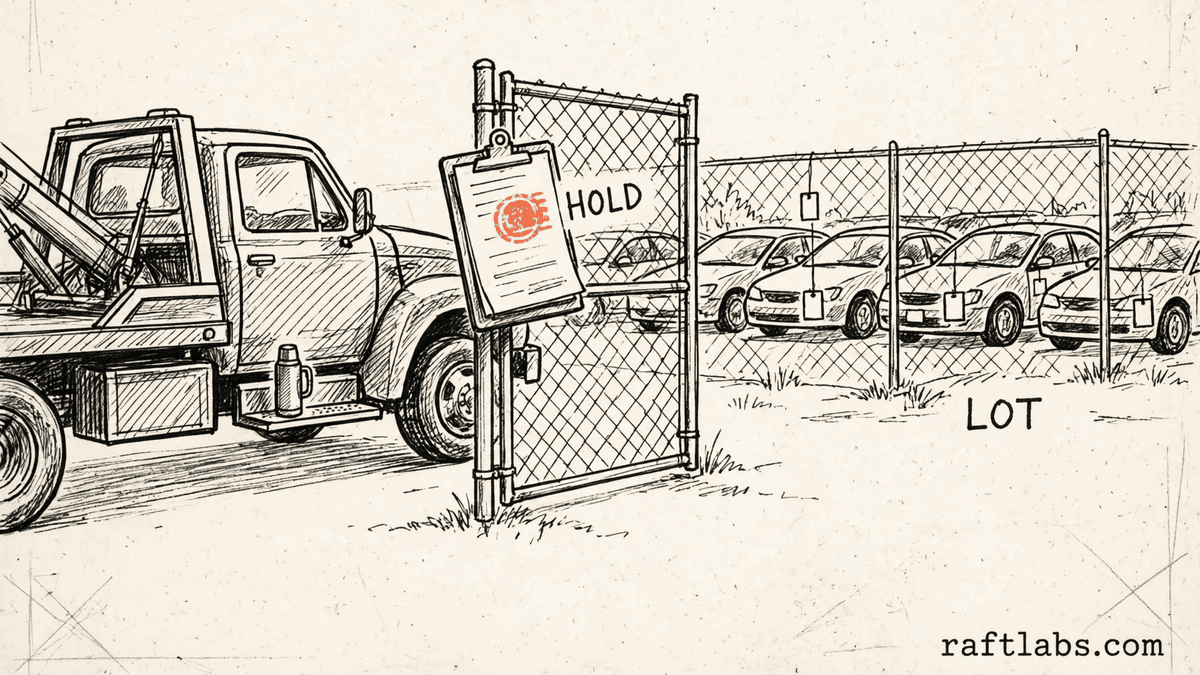
A hold or a cancellation sits in an inbox, and the driver is already on the road.
The lender asks where a car is and who signed for it, and the answer takes three phone calls.
The notice clock started at recovery, but the dates live in a spreadsheet nobody trusts.
Plain answer
Repossession software gives a vehicle recovery agency one record for each lender assignment: hold checks before dispatch, state notice and redemption clocks, lot custody, personal property and release records. RaftLabs builds it around your hold policy, your state clocks, and your driver and lot roles.
What to remember
- Use this when lender cases repeat every week and the proof work after each one keeps costing hours.
- No case should reach a driver until the hold check on that case is clear and recorded.
- A stop order should lock the case out of field work, not sit as a note someone might miss.
- The first release should carry one case from assignment to release, not collect disconnected screens.
- The code, cloud accounts, data, and operating notes should stay usable by another capable team.
The first decision is not what to build.
It is whether software is the right answer at all. We use four possible recommendations before discussing a development scope.
- 01
Buy
Choose a maintained product when it already covers hold checks, lot custody, and notice clocks in the way your agency works. Paying for software you do not have to maintain is often the better trade.
- 02
Repair
Keep a tool you already use when your team trusts it and the gaps are narrow. Start with evidence: where the case records live, how a stop reaches the driver, what the lot record leaves out, and who can see and change what.
- 03
Build
Own the system when your work has rules the maintained products will not follow: your hold list, your state clocks, your lender reporting, and a release record in your format. Start with one complete case.
- 04
Wait
Do not turn unsettled rules into permanent software. Fix the hold list, the state rule set, and who may lift a stop first, then measure what the proof work costs you across a few weeks of cases.
Not sure which path is yours? Bring it to a 30-minute call. Leave with the answer in writing.
Fit
Custom software should earn its maintenance burden.
Running more cases is not enough on its own. The case is real when the same proof problems show up after every recovery.
You work lender or forwarder assignments most weeks, and each case ends with proof work across inboxes and phones.
Holds, stops, and cancellations depend on someone reading an email in time today.
Lenders ask case questions your current records cannot answer in minutes.
A maintained recovery product already covers your cases with reasonable setup.
You run the odd voluntary surrender, and a case list is all the record you need.
Your hold list and state rules change from lender to lender with no pattern you can name.
Not sure which side you are on? Use the first call to make that decision. A useful answer may be to buy, connect, repair, or wait.
Start with the case, not the software.
A repossession problem usually starts as a paper trail problem. The assignment arrives by email or through a lender portal. The driver gets it by text. The photos stay on the driver's phone until someone remembers to ask. The condition notes are on paper in the truck. The keys are in a lockbox that somebody tracks on a whiteboard.
The visible complaint may be "we need a better case list." The real cost shows up later. A lender calls to ask where a car is and who signed for it, and the answer takes three phone calls. A cancellation sits unread while the truck is already out. The notice clock started the night the car was recovered, but the dates live in a spreadsheet that two people update two different ways.
The part that keeps owners up at night is the dispute. A wrongful repossession claim. A breach of the peace allegation. Personal property said to be missing from the trunk. To answer any of them, you have to show what the driver saw, when the driver arrived and left, what the lender told you and when, and that work stopped the moment you were told to stop. A text thread anyone can delete proves none of that.
One record per case fixes the shape of the work. The assignment lands on one file. The hold check runs against that file before dispatch. The recovery, the photos, the lot space, the property list, the notice dates, and the release all attach to the same file. The lender's question is then a lookup, not a reconstruction.
Custom software makes sense when one owned system can carry that case better than a product, a connector, or a process change. The first release should carry one complete case, from the assignment arriving to the car leaving the lot. It should not try to run your accounting, your marketing, and your fleet in the same step.
We start where it hurts.
The screens are only one part of the job. The real scope includes the hold check, the stop that reaches the driver, the lot record, the notice clocks, and who can see and change what.
Hold checks before dispatch
Every assignment runs your hold list before it can reach a driver: the checks your process requires, each with its source and time on the case. A case that fails stays off the board. Open cases are checked again on your schedule, so an overnight change stops the case before the truck goes out.
Stop orders that stop the case
A lender stop or cancellation locks the case out of field work on the driver's screen, not in a separate inbox. A cancellation stays open as an exception until the driver confirms it. A breach of the peace abort needs a manager's recorded approval before the case can go out again.
One case record, assignment to release
Vehicle and account details, addresses, instructions, driver updates, photos, and documents all attach to one case file with one search across it. When a lender asks what happened, one person answers from the file in minutes.
Lot custody, keys, and personal property
Intake records the lot space, the key location, the condition photos, and the property found in the car. The lot board shows what is held, what is waiting on a clock, and what is ready for release or transport. Releases record the authorisation and the person collecting.
Notice and redemption clocks
Recovery starts the clocks. The system counts the notice, redemption, and earliest sale dates from the case record, shows what is due next on one board, and drafts notices from the case figures. Your counsel approves the rule set per state. The software applies it and keeps the mailing proof on the file.
Which one is yours?
Bring it to a 30-minute call. Leave with a build, buy, repair, or wait recommendation in writing. Free, whether or not we ever work together.
The case
One case, four stages, one record.
A recovery case is four jobs that pass work to each other. Software earns its place when the hold result at intake is the same record the driver, the lot, and the lender all read later.
Intake and hold check
The assignment lands with the vehicle, the account reference, the addresses, and the lender instructions. The hold check runs before anyone is dispatched, and the result, its source, and its time stay on the case for good.
Dispatch and recovery
The driver works from the phone: the case, the address, the instructions, and the stop state, all in one place. Recovery time, photos, and condition notes attach to the case as the work happens, not at the end of the week.
Lot and property
The car is booked into a space with its keys logged and its property listed and photographed. Custody changes are recorded as they happen, so the lot board and the case file never disagree.
Notice, release, and billing
The notice clock runs from the recovery date, the redemption window stays visible, and the release or transport closes the case with the authorisation on file. The invoice builds from the same record, so billing never describes a different case from the one the lot handled.
Proof
The fifth attempt became a product customers could keep using.
UrShipper had already worked with four development vendors. Its founder describes the communication and decisions during the recovery.
The case study documents a 14-week recovery, five carrier connections, a Shopify fulfilment workflow, and client-reported results. It is one comparable project, not a promise that every inherited codebase can follow the same plan.
Read the UrShipper case studyWhich part of your case work costs you the most?
Bring it to a 30-minute call. Leave with a build, buy, repair, or wait recommendation in writing. Free, whether or not we ever work together.
Let the work pick the shape.
Recovery work happens on the road, at the lot gate, and at a desk answering lenders. Where each person stands, which device they hold, and whether the signal drops decide what the first release should be.
Web app
The office record of every case: assignments, hold results, the dispatch board, lot custody, notice clocks, and lender reporting in one browser view. Dispatch and reporting usually live here first.
Mobile app
Work on the road: the assignment, the address, the stop state, recovery photos, and condition notes on the phone the driver already carries, including streets with no signal.
Desktop app
Local hardware at the office or lot, such as printers and scanners, and work without a browser.
Browser extension
One task inside a system that otherwise works, such as a lender portal your team keeps open all day.
Connected devices
Gate, camera, and key cabinet hardware at the lot, when the physical setting demands them.
One product may need several surfaces. Each one should support the same complete case, not start another feature list.
How it works
Close one expensive risk before opening the next.
Each stage answers a buyer question and leaves behind a decision you can inspect. The next stage only opens when the expensive uncertainty in the current one is small enough to accept.
- 01Understand
Trace one real case
Where does the time and the risk actually come from?
Follow one car from the assignment arriving to the day it leaves the lot. Include the unread cancellation, the photos that stayed on a phone, the property list on paper, and the notice date worked out by hand.
Decision produced
A map of one full case: assignment, hold check, dispatch, recovery, lot, notice, and release, with the points where the record breaks named.Risk closed
Paying to fix the visible case list while the hold and stop problem stays. - 02Shape
Choose the first useful release
What needs to exist together for one complete case to run?
Choose the shape from the way cases run, not from a preferred technology. Name the hold list, the states you work in, who may lift a stop, the devices in the field, the exceptions, and the release record the first release must produce.
Decision produced
The first release boundary: intake, hold check, dispatch, lot custody, notice clocks, and release, with the roles and rules each one needs and a clear definition of done.Risk closed
A small-looking feature list that quietly depends on lender portals, driver phones, and three staff roles. - 03Prove
Review working software
Will it hold up on a real night run and a real lender call?
Review the product against the agreed case flow, not a tour of finished screens. Fail a hold check, stop a case mid-run, abort an attempt, book a car into the lot, and check that the notice dates and the release record still read clean.
Decision produced
Working checkpoints tested with a real week of cases, real driver and lot roles, a failed hold, a stop, and a release read by someone outside the build.Risk closed
Discovering the gaps on the first live case a lender disputes. - 04Transfer
Release, measure, and hand over
Did the new system shorten the proof work, and can another capable team operate it?
Run one lender's assignments on the new system while the old way stays as backup. Compare the time spent answering lender questions and the disputes raised before the next lender moves over.
Decision produced
A controlled release on one lender's cases first, a comparison of answer time and disputes with the old way, operating notes, and an account ownership map.Risk closed
Measuring screens delivered instead of hours saved, or depending on the original vendor to keep the system running.
What stays out of the black box
These are operating conditions to put in the engagement, not claims to take on faith.
The scope names one complete case
The assignment, the hold list, the driver and lot roles, the clocks, the exceptions, and what 'done' looks like. A screen list is not enough.
Progress is visible in working software
Reviews against the product at agreed checkpoints, while there is still time to act.
A scope change has a price before it has code
A new workflow or system connection shows its effect on cost and timing before anyone approves it.
Ownership exists throughout, not only at handover
Code, cloud, data, and provider access stay visible and under your control from day one.
The work is checkable without being technical
Checkpoints are working software you use yourself, reported in plain language.
Custom software by industry.
Start from your domain. Each area below is a working practice with shipped products behind it.
What it costs
Every project starts at $10K.
The first phase turns the costliest patched workflow into a scoped build with written acceptance criteria.
Starting investment
Starts at $10K
Workflow complexity, systems to connect, data migration, and user roles set the scope. After a 30-minute call, you get a written build, buy, repair, or wait recommendation plus first-phase direction. Free, whether or not you build with us.
Not ready to talk? Start here.
Four useful next paths: decide whether to own the software, estimate the cost range, understand what moves the price, or inspect a comparable recovery.
Run the build-vs-buy calculator
Compare the cost and operating trade-offs before turning a workflow into a development brief.
Estimate the cost range
Get a working cost range for your scope before you talk to any vendor.
Read the cost guide
See the scope factors that move price, timing, team shape, and long-term maintenance.
Inspect a product recovery
See what changed when UrShipper moved from four failed vendor attempts to a controlled migration.
Build or buy
| Buy an existing product | Build custom software | |
|---|---|---|
| Best fit | Covers hold checks, lot custody, and notice clocks the way your agency already works | Your hold list, state clocks, and lender reporting are the way you keep lender contracts |
| Manual work | Setup and process changes can remove the proof work | The reconstruction after every disputed case repeats and costs hours |
| Connections | Existing connections work with reasonable setup | A critical connection to your other systems cannot be done cleanly any other way |
| Neighbouring work | Use towing dispatch software when the work is roadside help for a motorist | Own custom software when the work is lender-assigned recovery with holds, clocks, and custody |
Work with us
Bring one recent case. Leave with a decision.
In a 30-minute call, we will help you decide whether to buy, connect, repair, build, or wait. If custom software is not the sensible next move, that is still a useful answer.
- One named workflow owner and one complete path for the first phase.
- Scope, price, what 'done' looks like, and exclusions agreed before paid work starts.
- Code, cloud, data, and provider access remain under your control.
- Post-launch warranty cover for defects in the agreed scope.
Frequently asked questions
Straight answers to what buyers ask before they scope. Still stuck? .
It is software built around one lender-assigned recovery case. The assignment, the hold check, the driver updates, the recovery photos and condition notes, the lot space and keys, the personal property list, the notice dates, and the release or transport record all sit on the same case file. When a lender asks what happened, the answer comes from that file, not from texts, inboxes, and memory.
A focused first release covers assignment intake from email or lender portals, a hold check that must clear before dispatch, driver assignment with the address and instructions on the phone, recovery photos and condition notes attached to the case, lot intake with space, keys, and personal property records, state notice and redemption clocks set from the recovery date, release and transport records, billing tied to the case, and a record of who did what that cannot be quietly edited afterwards.
Your agency and your lenders define the hold list: the checks your process requires before anyone takes a car, such as a bankruptcy filing, an active duty protection, a deferral or promise agreed on the phone, a payment still settling, an open dispute, or a cure period still running. The software runs those checks when the assignment arrives and again before dispatch, and each result sits on the case with its source and time. A case that fails a check stays off the dispatch board until a named person clears it. The software supports your hold process. It does not replace the legal judgement behind it.
Open assignments get checked again on a schedule you set, and a new hold moves the case to a stopped state at once. The driver sees the stop on the case itself, not in a separate message that can be missed, and the stop stays in place until it is lifted by a named person with the reason recorded. If a cancellation arrives instead, the case stays open as an exception until the driver confirms it, so an unconfirmed cancellation is visible instead of silent.
In the system, yes. A stop order from the lender or forwarder locks the case out of field activity: it leaves the dispatch board, the driver cannot open it as active work, and any attempt to work it shows the stop. The lock, the time it landed, and who applied it are all on the record. What your team does with a stopped case after that is your operating policy. The software makes sure the stop cannot be missed or quietly removed.
The driver closes the attempt with the abort reason recorded on the case, and the case cannot return to field work on the driver's own say-so. A manager has to approve the return and record why. Both the abort and the approval stay in the file for good, so months later the record still shows what happened at the address and who decided the case could go out again.
When a car is recovered, the recovery date and time start the clocks your state rules and lender contracts set: law enforcement notification where it applies, the notice to the borrower, the redemption window, and the earliest date the car may be sold or moved on. The software counts those dates from the case record, shows which clock is due next on one board, and drafts the notice from the case figures so the amounts match the file. Your counsel approves the rule set for each state you work in. The software applies the rules you approved and keeps proof of what was sent and when.
At intake, the items found in the car are listed and photographed against the case, with where they are stored. The record shows the holding period your policy sets, every contact about the property, and the release itself: who collected it, when, and what was signed. If your lender policy says property goes back with no fee, the record shows that too. When a borrower says something is missing, you answer from the intake list and the photos, not from memory.
Each recovered car gets a lot space, a key location, and a custody state on its case file. The lot board shows what is on the lot, what is waiting on a notice clock, what is ready for release, and what is booked for transport. A release needs the lender authorisation on the case and the identity of the person collecting, both recorded before the car leaves. Nothing leaves on a verbal say-so.
Each client sees only its own cases, documents, and invoices through its own login. A lender can check where a car is, what state the case is in, and what was signed for, without calling your office. Clients never see your other clients, your driver roster, or your lot. Inside your own company, roles see different slices of the same case: a driver sees the cases assigned to them, a dispatcher sees the board, a lot manager sees custody, and an auditor can read everything and change nothing.
Recovery work happens in places with weak signal. The field screens should show the assignment, the address, and the instructions already loaded, let the driver record the recovery, photos, and condition notes on the device, and send them when a connection returns. The scope should state plainly what works offline and what waits for signal, and the crew should test it on a real run before live cases depend on it.
Towing dispatch software runs roadside and motor club work: a driver is sent to a motorist who needs help now, and the job ends at the drop. Repossession software runs lender-assigned recovery: the case starts with a hold check, the car goes to a lot, and the file stays open through notice clocks, redemption, and release. If your work is roadside dispatch, our towing dispatch page is the closer fit. This page covers lender-assigned recovery only.
A spreadsheet holds a case list well. It breaks when the same case also needs a hold result, a stop that a driver cannot miss, photos, a lot space, a property list, a notice date, and a release record, and four people touch it in one week. The warning signs are simple: a lender question that takes an hour to answer, a cancellation nobody can prove was received, and a notice date two people calculate two different ways.
The first paid phase may cover a bounded audit of your current case process, a small proof, or a first release that carries one case from assignment to release. The final price depends on how many roles use it, which lender portals it needs to connect to, how your hold list and state clocks work, and whether billing is included. The agreed phase is priced in writing before it starts.
You judge what you can see, not the code. Run one real case through each checkpoint yourself: take in an assignment, fail a hold check, stop a case, recover a car, work the lot intake, and read the notice dates it sets. Progress is reported in plain language: what changed, what is next, and what it costs. Because you own the code, the accounts, and the operating notes throughout, nothing about the work is locked inside our heads.
You own the code built for you and control where it lives, the cloud accounts, the data, analytics, and third-party subscriptions. Outside services and open-source pieces keep their own licence terms. The operating notes and handover material stay current so another capable team can take over.
Yes. Takeover starts with an audit: where the code lives, how your data is organized, what is tested, which outside services it depends on, who can access what, and how updates go live. Code that is sound stays. Only the parts blocking reliable case work get replaced.