Towing Dispatch Software
Towing dispatch software for calls that stop waiting on the phone.
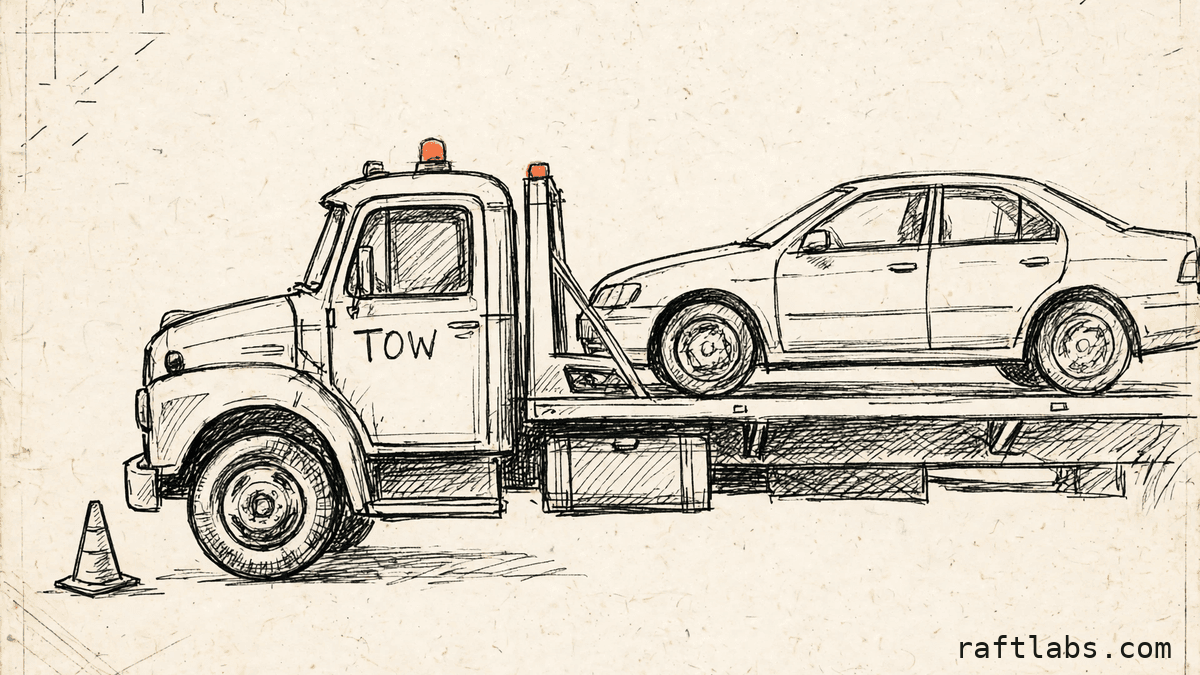
Calls arrive by phone, motor club portal, and police radio. The board is a whiteboard, the impound lot is a clipboard, and the invoice is a spreadsheet. We turn that scattered towing workflow into one owned system that follows each call from dispatch to paid invoice.
Bring one stuck dispatch workflow. Leave with a buy, repair, or wait recommendation.
Trusted by






















The brief
Start with what is not working.
Good software decisions begin with the constraint, not a list of features or a preferred technology.
The dispatcher phones around to find a free truck while a stranded driver waits on the line.
Nobody can say which vehicles sit in the lot, what they owe, or which ones can be released.
Motor club and police jobs are billed by different rules, and the invoice is rebuilt from memory.
Plain answer
Towing dispatch software runs a tow company from the first call to the invoice in one place. It sends the closest truck, tracks impounded vehicles and their storage clock, bills motor clubs and police accounts by their rate sheets, and texts the customer an arrival time. It fits a tow company that has outgrown phone calls and spreadsheets.
What to remember
- Use this when calls, trucks, impounds, and billing live apart and the gaps cost jobs or delay payment.
- The first release should complete one call from dispatch to invoice, not collect disconnected features.
- A tow is a custody chain, not a ride: the call, the truck, the lot, the storage clock, and the release all count.
- Quote the team's own screens as their own scope: dispatch, impound custody, contract billing, driver pay, and the record of who did what are a second product, not a single admin-panel line.
- Hire freelancers for one small, well-defined task; use one accountable agency party when the work needs coordination across calls, trucks, lots, and billing.
The first decision is not what to build.
It is whether software is the right answer at all. We use four possible recommendations before discussing a development scope.
- 01
Buy
Choose a maintained product when it handles the core workflow and the remaining gaps can be solved with configuration, a connector, or a small process change. Towbook is the long-standing standard for dispatch, impounds, and contract billing; Omadi is known for impound and storage depth; Dispatch Anywhere is known for motor club and affiliate network reach; Jobber is a simpler option for solo and small operators. Compare them against your real call flow before paying for anything custom.
- 02
Repair
Keep the existing product when users still get value from it and the code can be understood safely. Start with evidence: where the code lives, how your data is organized, what is tested, which outside services it depends on, who can access what, and how updates go live.
- 03
Build
Own the system when the way you dispatch, hold custody, and bill shapes margin, response time, and contract compliance. Start with one call path that runs from dispatch to invoice, and the system connections that path cannot work without.
- 04
Wait
Do not turn a changing policy into permanent software. Stabilise the rules, name the workflow owner, and measure the cost of the current process before paying for a product.
Not sure which path is yours? Bring it to a 30-minute call. Leave with the answer in writing.
Fit
Towing dispatch software should earn its maintenance burden.
A feature request is not enough. The case is real when the same constraint shows up in time, errors, margin, or lost calls.
Calls, trucks, impounds, and billing live apart, and the gaps cost jobs or delay payment.
A tow company running motor club, police, or impound work can name a workflow owner and what 'done' looks like for the first release.
Dispatch, custody, or billing rules differ by account and no maintained product holds them cleanly.
A maintained product fits with reasonable configuration and process change.
The team wants software to settle an unresolved operating policy.
The brief is a feature list with no call, vehicle, or business result attached.
Not sure which side you are on? Use the first call to make that decision. A useful answer may be to buy, connect, repair, or wait.
Start with the call, not the software.
A towing problem usually starts as an operating problem. A stranded driver calls while the dispatcher phones three drivers to find one who is free. The truck that arrives is the wrong size for the job. The vehicle goes to the lot, and nobody can say what it owes, when the storage clock started, or who can release it. The invoice is rebuilt from memory at the end of the month, and the motor club short-pays it because the rate sheet was not followed.
The cost is easy to miss because it is spread across the day. A driver waiting on the line is a customer who calls the next company. Every impounded vehicle without a clear custody record is a dispute waiting to happen. A contract job billed by the wrong rate is margin given away, and a driver who waits for the next call by phone is a truck earning nothing.
A second product hides inside the first. Customers see one tow; your team lives in another: dispatch, impound custody, contract billing, driver pay, and a record of who did what. Quotes that squeeze all of that into an "admin panel" line item are where budgets most often break. On a real platform, your team's screens are routinely the most underestimated part of the build, so we quote them as their own job, with their own users, from the start.
Towing dispatch software makes sense when one owned system can remove that constraint better than a product, connector, or process change. The first release should take one call from dispatch to invoice. It should not replace every tool at once.
We start where it hurts.
The interface is only one part of the job. The real scope includes the rules, the data, the connections to your other systems, what happens when things fail, who can see and change what, and who runs it after release.
The closest truck, and the right truck
The board shows which driver is closest, which truck has the right equipment for light or heavy duty, and which drivers are on shift. The call goes to the truck that can actually do the job, not the one the dispatcher reached first.
An impound lot that keeps its own records
Every vehicle in the lot carries its owner, its lot location, its storage start, its charges, and its release state. The storage clock runs on its own, and the release needs the right authorisation, not a phone call and a guess.
Contract billing that matches the rate sheet
Motor club, police, property manager, and insurance jobs each bill by their own rules. The invoice follows the rate sheet for that account, so the club pays what was agreed instead of short-paying a bill rebuilt from memory.
Status texts that stop the phone ringing
"How soon can you be here?" is the first question every stranded customer asks. Two-way texting with a real arrival time cuts the phone tag, and the customer stops calling the next company while they wait.
Your team's screens, quoted as their own job
Dispatch, impound custody, contract billing, driver pay, and the record of who did what are a second product, not one line buried in the quote. We quote them as their own scope, with their own users, from the start.
Which one is yours?
Bring it to a 30-minute call. Leave with a buy, repair, or wait recommendation in writing. Free, whether or not we ever work together.
Workflows
One record from call to invoice.
Some of this work only exists in one corner of the business. The same rules apply: configure first, build only the part the maintained products cannot cover, and start with one complete path.
Emergency roadside calls
One call from intake to cleared scene. The account, the locations, the vehicle, the service, and the billing rules are captured once, and the closest truck with the right equipment gets the job.
Motor club and insurance work
Jobs that arrive through a club or an insurer, billed by that account's rate sheet, with the status times and the receipt the account needs to pay. The dispatch board never mixes club rules with private-customer rules.
Private-property impounds
A separate custody path: vehicle, lot location, storage start, charges, inventory history, and release authorisation. The record survives the dispute, because every step is written down as it happens.
Police rotation and storage
Rotation calls, storage lots, and lien work on the same board. The storage clock, the notices, and the release each have their own state, and nothing is released on a general website form.
Proof
The fifth attempt became a product customers could keep using.
UrShipper had already worked with four development vendors. Its founder describes the communication and decisions during the recovery.
The case study documents a 14-week recovery, five carrier connections, a Shopify fulfilment workflow, and client-reported results. It is one comparable project, not a promise that every inherited codebase can follow the same plan.
Read the UrShipper case studyWhich call is costing you the most right now?
Bring it to a 30-minute call. Leave with a buy, repair, or wait recommendation in writing. Free, whether or not we ever work together.
Let the work pick the shape.
The way people work should decide the form of the software. Start with where the user works, which device they have, whether the signal drops, what data they need, and how fast the system must respond. Those facts tell us what belongs in the first release.
Web app
Work done across roles and locations. Each user gets the same current information in a browser: no installs, no versions, no device limits. When in doubt, this is usually the right first surface.
Mobile app
Work away from a desk: the call, the truck, the lot, alerts, and offline access when the signal drops on the road.
Desktop app
Local hardware, large files, and work without a browser, for the dispatch machine that holds the board and the records.
Browser extension
One task inside a system that otherwise works, so staff stay where they already work instead of opening another tool.
Connected devices
IoT and wearables, when the physical setting demands them, such as a tracker on the truck or a printer at the lot.
One product may need several surfaces. Each one should support the same complete workflow, not start another feature list.
How it works
Close one expensive risk before opening the next.
Each stage answers a buyer question and leaves behind a decision you can inspect. The next stage only opens when the expensive uncertainty in the current one is small enough to accept.
- 01Understand
Trace the real dispatch workflow
Where is the cost or failure actually coming from?
Follow one call and one truck from first ring to paid invoice. Include the workarounds, manual judgement, duplicate entry, waiting, and failure paths that a tidy process diagram usually misses.
Decision produced
A map of the dispatch workflow, exceptions, owners, systems, and the baseline cost or delay worth changing.Risk closed
Paying to automate the visible symptom while the expensive constraint remains. - 02Shape
Choose the first useful release
What needs to exist together for one useful result to work?
Choose the shape from the way the work happens, not from a preferred technology. Name the user, the device, the data, the system connections, who can access what, the exceptions, and the result the first release must complete.
Decision produced
The right mix of web, mobile, desktop, browser extension, connected device, wearable, or behind-the-scenes connection work, with the first-release boundary and a clear definition of done.Risk closed
A small-looking feature list that quietly depends on several interfaces, systems, and owners. - 03Prove
Review working software
Will it hold up outside a controlled demo?
Review the product against the agreed workflow, not a tour of finished screens. Record changed assumptions and test what happens when data is missing, access is wrong, or a connected system fails.
Decision produced
Working checkpoints tested with realistic data, real user types, system connections, recovery plans, and the people who will use or run the system.Risk closed
Discovering the important gaps during migration or after customers depend on the release. - 04Transfer
Release, measure, and hand over
Did the new workflow improve the original constraint, and can another capable team operate it?
Move a controlled set of calls or trucks first. Compare time, errors, completion, or another agreed measure with the starting point before adding the next workflow.
Decision produced
A controlled release, comparison with the baseline, operating notes, account ownership map, and a recommendation for what should happen next.Risk closed
Measuring development activity instead of the business result, or depending on the original vendor to keep the system running.
What stays out of the black box
These are operating conditions to put in the engagement, not claims to take on faith.
The scope names the whole dispatch
The user, the trigger, the decisions, the data, the exceptions, and what 'done' looks like. A screen list is not enough.
Progress is visible in working software
Reviews against the product at agreed checkpoints, while there is still time to act. You see the dispatch workflow working, not a slide deck about it.
A scope change has a price before it has code
A new workflow or system connection shows its effect on cost and timing before anyone approves it.
Ownership exists throughout, not only at handover
Code, cloud, data, and provider access stay visible and under your control from day one.
You can judge the work without being technical
Checkpoints are working software you use yourself, reported in plain language. If a step fails, you see it fail in the product, not in a status report.
Towing dispatch software by related service.
Start from the surface or the system behind it. Each area below is a working practice with shipped products behind it.
What it costs
Every project starts at $10000.
The first phase turns the costliest patched dispatch workflow into a scoped build with written acceptance criteria.
Starting investment
Starts at $10000
Workflow complexity, systems to connect, data migration, and user roles set the scope. After a 30-minute call, you get a written buy, repair, or wait recommendation plus first-phase direction. Free, whether or not you build with us.
Not ready to talk? Start here.
Four useful next paths: decide whether to own the software, estimate the cost range, understand what moves the price, or inspect a comparable recovery.
Run the build-vs-buy calculator
Compare the cost and operating trade-offs before turning a dispatch workflow into a development brief.
Estimate the cost range
Get a working cost range for your scope before you talk to any vendor. The range reflects your dispatch flow, user types, and system connections.
Read the cost guide
See the scope factors that move price, timing, team shape, and long-term maintenance.
Inspect a product recovery
See what changed when UrShipper moved from four failed vendor attempts to a controlled migration.
Buy or own
| Buy a maintained product | Own custom software | |
|---|---|---|
| Best fit | Handles your dispatch workflow with reasonable setup, and its pricing makes sense | The way you dispatch, hold custody, and bill is itself the advantage |
| Manual work | Configuration and process changes can remove the constraint | Repeated manual work has a measurable cost |
| Connections | Existing connections work with reasonable setup | A critical connection to your motor club, accounting, or mapping system cannot be done cleanly any other way |
| Platform route | Configure a maintained product when its call, lot, and billing model fits | Own custom software only when the differentiating process, account rules, or cost of constraint justifies build and support |
Work with us
Bring one stuck dispatch workflow. Leave with a decision.
In a 30-minute call, we will help you decide whether to buy, connect, repair, build, or wait. If custom software is not the sensible next move, that is still a useful answer.
- One named workflow owner and one dispatch path scoped for the first phase.
- Scope, price, what 'done' looks like, and exclusions agreed before paid work starts.
- Code, cloud, data, and provider access remain under your control.
- Post-launch warranty cover for defects in the agreed scope.
Common questions
Towing dispatch software runs a tow company from the first call to the final invoice in one place. It takes the call in, sends the closest truck with the right equipment, tracks the vehicle through the job and the lot, bills the right account by its own rate sheet, and texts the customer an arrival time. It covers emergency roadside calls, motor club work, private-property impounds, and police rotation jobs.
It fits three buyers with the same scattered workflow. A multi-truck company running emergency calls, motor club work, and an impound lot needs dispatch, custody, and contract billing on one board. A police rotation operator needs storage clocks, notices, and release control. A solo operator with one truck usually needs a simpler job and invoicing tool, not a full dispatch system with lot management.
The board shows real driver locations, which truck has the right equipment for light or heavy duty, and which drivers are on shift. The dispatcher assigns the closest truck that can do the job, the driver accepts on a phone, and the status times are recorded as the job moves: en route, on scene, loaded, and clear. A generic field-service tool cannot do this, because it does not know what an impound fee is or which truck fits the call.
Every impounded vehicle becomes one custody record: owner, lot location, storage start, charges, inventory history, and release state. The storage clock runs from the moment the vehicle arrives, the fees follow the lot's own rules, and the release needs the right authorisation. The record preserves the whole chain, so a dispute about fees or a release has evidence instead of memory.
Each account carries its own rate sheet: motor club, police department, property manager, or insurer. The invoice follows that account's rules, including the status times and the receipt the account needs to pay. The common billing mistake is a private-customer invoice sent to a contract account, or a club job billed at the wrong rate, and the system stops both by tying the bill to the account from the start.
Towbook publishes four tiers priced by how many calls you complete in a month, not by trucks or users: Basic at $109 a month covers up to 250 calls, Professional at $209 a month covers up to 500 calls, Ultimate+ at $319 a month covers up to 1,000 calls, and Enterprise at $429 a month covers up to 1,500 calls. Going over a tier's cap costs $149 per 1,000 extra calls. Compare any price against your real monthly call count, and confirm current pricing on the vendor site before deciding.
Then the monthly bill moves with your volume, and a busy month costs more than a quiet one. That is the trade to weigh: a per-call price is cheap at low volume and expensive at high volume, while a flat price is the reverse. Ask the vendor exactly what counts as a call, what happens over the cap, and what your busiest month would cost, before you sign.
The driver gets the job on a phone app with the pickup, the drop-off, the vehicle, and the service, then updates status as the job moves. The dispatcher sees the same board, so nobody has to phone the driver to ask where they are. The status times also become the evidence the contract account needs on the invoice.
The system texts the customer when the truck is assigned and again when it is on the way, with a real arrival time from the driver's location. That one text answers the question every stranded customer asks first, and it stops them calling the next company while they wait.
It should connect to the systems the work already passes through. Invoices should reach your accounting, usually QuickBooks, without retyping, and dispatch should see real truck locations on a map. Name the exact systems in the first call, and confirm each connection before it is promised in scope.
Buy a maintained product when it handles your workflow with reasonable setup and its pricing makes sense. Towbook, Omadi, and Dispatch Anywhere each cover a different slice of towing work, so compare them against your real call flow first, and check whether the price is per call, per seat, or quote-only. Own custom software when your dispatch, custody, or billing rules do not fit any maintained product, or when the way you run calls is itself the advantage. If the rules of the operation are still changing every week, wait and settle them first.
For a small, well-defined task with someone technical managing it, freelancers are often cheaper. The pattern that goes wrong is a non-technical buyer coordinating several freelancers becoming the project manager, the tester, and the person who discovers the pieces do not fit. A towing dispatch software company earns its fee when the work needs coordination across calls, trucks, lots, and billing: one accountable party, one phase price, and checkpoints against the whole workflow. If your need is one screen or one fix, hire the freelancer.
The first paid phase may cover a bounded audit, a proof of concept, a recovery plan, or a small first release. The final price depends on how deep the workflow goes, how many kinds of users it serves, what it needs to connect to, whether data needs moving over, whether phones or tablets are involved, any compliance requirements, and the condition of existing code. The agreed phase is priced in writing before it starts.
You judge what you can see, not the code. Every checkpoint is working software you click through yourself, tested against the workflow agreed at the start. Progress is reported in plain language: what changed, what is next, and what it costs. Because you own the code, the accounts, and the operating notes throughout, nothing about the work is locked inside our heads. Our job is to make the work checkable; your job is to check it against your business.
You own the code built for you and control where it lives, the cloud accounts, the data, analytics, and third-party subscriptions. Outside services and open-source pieces keep their own licence terms. The operating notes and handover material stay current so another capable team can take over.
Every launch includes post-launch warranty cover for defects in the agreed scope, release support, and small screen corrections. After that, work can continue as another fixed phase or an ongoing product engagement. The code and accounts stay under your control either way.