
"Thanks to RL Remotely team for experimenting with an innovative remote work application for employee engagement and enterprise productivity."

Mohit S.
Founder, WorxRemotely
Flutter App Development Company
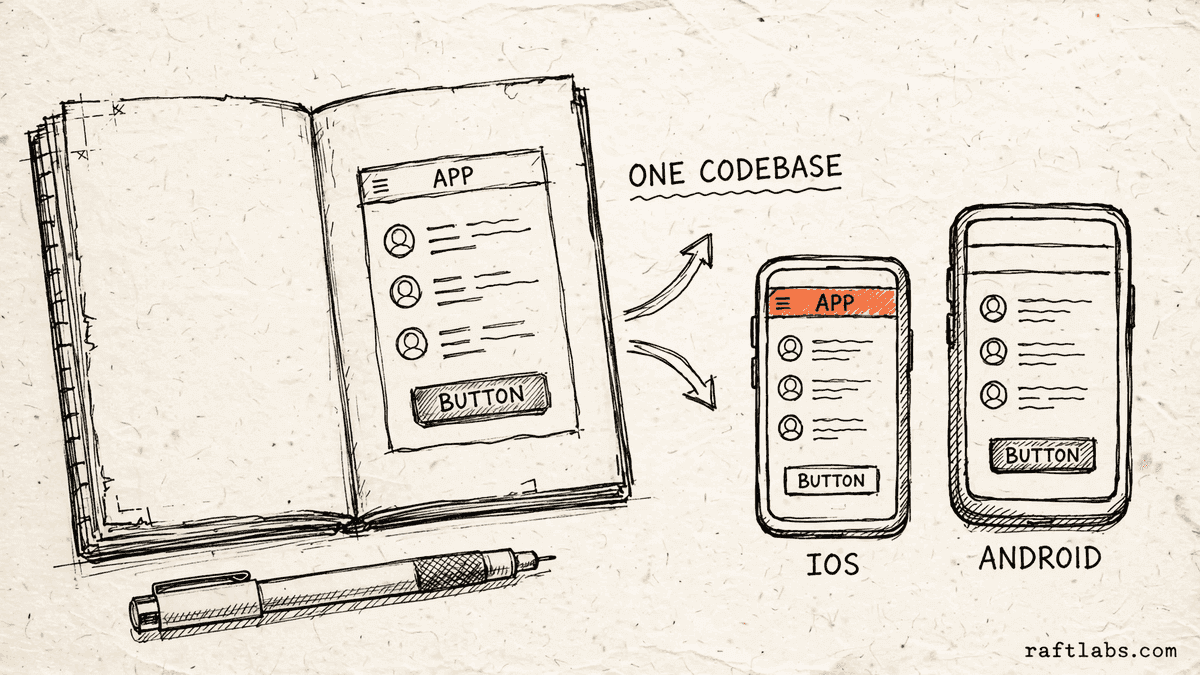
We build Flutter apps for businesses that need iOS and Android together: one Dart codebase, one team, and both store releases run as a single product. Founder-led delivery starts with the hardest native feature your app depends on, because that is where a shared codebase either holds or breaks.
Bring the problem, the current workflow, or the existing code. We reply with a practical next step within one business day.
Trusted by






















The brief
Good software decisions begin with the constraint, not a list of features or a preferred technology.
Do you need iOS and Android at the same time, but cannot tell whether one codebase will really cover your hardest feature, like payments, Bluetooth, or background sync?
Is the quote you have silent on plugins, native modules, store submissions, and who maintains the app after launch?
Plain answer
A Flutter app development company builds iOS and Android apps from one Dart codebase instead of two separate native apps. RaftLabs scopes one core workflow, proves the hardest native feature first, and fixes scope and price before development starts. Every project starts at $10000, and launches carry a 60-day post-launch warranty.
What to remember
Both apps looked identical in the demo, which is what Flutter promises. Then payments needed a native path, a key plugin had not been updated in a year, and the release plan had no owner for either store. Flutter works when the native edges are named and proven early, not discovered at submission.
Published Flutter proof
The legal events app, music learning app, and social commerce app document these outcomes. A medical-spa loyalty app built in Flutter adds a payments proof: its QR checkout flow is recorded in under 15 seconds. They prove Flutter delivery on real products, not that every app should share one codebase. Each release needs its own device, plugin, reliability, and store criteria.
Start by proving the plugin or native feature the product depends on most, on representative devices.
iOS and Android need the same workflow and the same custom interface.
Your design is a brand asset and must look identical on both platforms.
One team will own the shared codebase and its store releases.
The product is iOS-only or Android-only, so a shared codebase buys nothing.
The core experience depends on new platform features on the day they ship, or on heavy graphics and game-like rendering.
A responsive web product already covers the user context and device needs.
It is whether software is the right answer at all. We use four possible recommendations before discussing a development scope.
Choose a maintained product when it handles the core workflow and the remaining gaps can be solved with configuration, a connector, or a small process change. Paying for software you do not have to maintain is often the better trade.
Keep the existing product when users still get value from it and the code can be understood safely. Start with evidence: where the code lives, how the data is organized, what is tested, which outside services it depends on, who can access what, and how updates go live.
Build in Flutter when both stores need one product with a controlled, identical interface. Start with the plugin or native feature that is hardest to prove.
Do not turn a changing policy into permanent software. Stabilise the rules, name the workflow owner, and measure the cost of the current process before paying for a product.
Not sure which path is yours? Bring it to a 30-minute call. Leave with the answer in writing.
| Flutter | Native (Swift and Kotlin) | |
|---|---|---|
| Best fit | Same product and custom interface on both stores | One platform, or platform behavior is the product |
| Interface | Flutter draws its own interface, identical everywhere | Platform controls and conventions on each system |
| Platform access | Packages plus custom Swift and Kotlin modules | Direct platform APIs and lifecycle behavior |
| Maintenance | One codebase and one design system to upgrade | Two codebases and two upgrade tracks |
| Decision test | Do the packages cover your hardest feature? | Is the platform constraint core? |
Scope
Build the primary user path once in Dart with navigation, state, accessibility, error handling, and telemetry.
Test the payments, hardware, background, or platform feature the product depends on, including custom Swift or Kotlin modules where a package falls short.
Define supported iOS and Android versions, form factors, permissions, energy constraints, and representative devices for acceptance.
Integrate authenticated APIs, secure local storage, queued work, conflicts, retries, and recovery without hiding uncertain state.
Prepare signing, metadata, privacy answers, review notes, staged rollout, and monitoring for the App Store and Google Play.
How it works
Choose the core workflow, devices, OS range, store model, native features, data use, and acceptance measures for both platforms.
Test the riskiest plugin or native module, rendering behavior, offline state, payments, and backend contracts on representative devices.
Implement the Dart codebase, platform adaptations, accessibility, telemetry, security controls, automated tests, and store builds for product-owner review.
Complete store metadata and review responses, stage rollout, monitor both builds, hand over accounts and code, and agree the maintenance plan.
Risk
Not every app needs a shared codebase. These are the product shapes where building once in Flutter pays for itself.
When the design is the product, two native builds drift apart: different spacing, different motion, different bugs. Flutter draws the interface itself, so the app your designer approved is the app both stores ship. That consistency is the main reason design-led consumer products choose it.
Subscriptions live under store rules that change, and the payment plumbing has to survive review on both platforms. The music learning app above runs its subscriptions through a dedicated billing service instead of raw store code, across four releases and two years of operation. That pattern, one codebase with the billing edge handled deliberately, is what a subscription product needs.
A shared codebase does not require a new backend. The legal events app was built as a pure Flutter front end on the client's existing PHP system, without adding a single endpoint to it, and it is still running more than two years later. When your web platform already works, Flutter is often the cheapest honest way to put it in both stores.
When the launch date is the constraint, building the product once is the schedule. The social commerce app above went from idea to launch in 16 weeks with Flutter on mobile and a React admin surface behind it. One codebase does not remove the hard parts, payments, moderation, and notifications still need real design, but it removes the second build of every screen.
In each case the test is the same: is the product genuinely one product on both platforms? When it is, Flutter is usually the fastest route to a release you can maintain. When your team already works in React and TypeScript, or the app must share logic with a React website, React Native app development may fit better. The cross-platform comparison walks through the decision before you commit to either.
Scope and price
Begin with one core workflow, both store builds, standard backend integration, monitoring, and submission.
The first phase proves the hardest plugin or native feature before the product expands.
Starting investment
Starts at $10000
Native modules, complex offline behavior, real-time media, or regulated evidence extend the plan. After a 30-minute call, you get a written build, buy, repair, or wait recommendation plus first-phase direction. Free, whether or not you build with us.
Fixed scope, written before build
60-day post-launch warranty
React Native App Development
Cross-platform apps aligned with React and TypeScript teams.
Cross-Platform App Development
Choose and build a shared iOS and Android codebase.
Mobile App Development
The full mobile decision: native, shared, or web, scoped as one product.
iOS App Development
Native Swift apps for Apple frameworks, platform behavior, and App Store review.
Proof
Three-year average engagement. Founders and operators describing the work in their own words. No marketing varnish.
Incredibly simple and easy to use app. Exactly what we were looking for.
Nuala C.
Director, BrandFire
"Thanks to RL Remotely team for experimenting with an innovative remote work application for employee engagement and enterprise productivity."
Mohit S.
Founder, WorxRemotely
Work with us
Share the workflow, both platforms, device features, backend, and launch window. We will tell you plainly whether Flutter covers it, and what the native edges cost.
Choose Flutter when iOS and Android need the same product and the same custom interface, and one team will own both releases. Choose React Native when your team already works in React and TypeScript. Choose native when one platform matters most, or the product depends on new platform features and deep device behavior.
Every project starts at $10000, with scope and price fixed in writing before development starts. A focused first release covers one core workflow, both store builds, standard backend integration, monitoring, and submission. Native modules, complex offline behavior, payments complexity, or regulated evidence increase scope. The timeline is agreed in the same written proposal, based on that scope, rather than quoted as a generic week count.
Usually, through maintained packages, and through custom Swift or Kotlin modules where a package falls short. We have shipped a Flutter app that takes card, tap-to-pay, QR, and payment-link payments in production. The rule is to prove the hardest feature on real devices before the build is priced, because a package existing is not proof it behaves under your conditions.
Flutter can target web and desktop, but shared code does not mean one interface fits every screen. Input, navigation, accessibility, download size, and release channels all differ, and web adds search visibility to think about. We scope those surfaces only when the product case justifies the extra design work, never as a free extra.
For standard business workflows, forms, lists, bookings, payments, and content, users do not feel a difference worth paying double for. Flutter draws its own interface, so custom animation stays smooth and identical on both platforms. Where native still wins: heavy graphics, augmented reality, game-like rendering, and features that need a platform capability the day it ships. If your product lives there, we will say so before scoping.
Maintenance means framework and OS updates, store policy changes, package replacements, and small fixes before they become incidents. One client Flutter app has run for over two years on maintenance visits about every six months, because the scope was narrow and the backend stayed stable. Broader products need a standing arrangement. Either way, the owner is named in the proposal, not discovered after launch.
Yes, when the current code, backend contracts, and store records are accessible. Flutter can also be added to an existing native app screen by screen, so a full rewrite is not always the first move. We start with a review of the codebase, packages, and release state, then agree whether the right move is stabilization, gradual adoption, or a bounded rewrite of the parts that block the roadmap.
Ask for live apps with store links you can install today, and repository access from the start. Run a small paid pilot before committing to the full build. And watch the first meeting: a team that names the native edges in your product is worth more than one that promises everything will be shared.
You do, but only if the contract says so. Ownership should transfer on payment, and the repositories, design files, store accounts, and cloud accounts should be in your name from day one. Ask what is excluded from the quote, not just what is included: testing, revision rounds, and store submission are frequently left out.