Anthropic Claude API integration, grounded in your data and running in production.
Claude leads on reasoning, long-context analysis, and instruction-following. For applications where accuracy and safe behaviour matter more than raw speed, Claude is consistently the right choice. We integrate the Anthropic API into your applications, grounded in your data, structured for your use case, and running reliably in production. We have shipped Claude-powered systems on the Anthropic API and on Amazon Bedrock, and we recommend the model by use case, not by brand.
The latest Claude models across the Opus, Sonnet, and Haiku tiers via the Anthropic API
Adaptive thinking for extended, step-by-step reasoning
A large context window that reads long documents in a single call, no chunking
Tool use, the Messages API, and structured output for agentic applications
Bring the problem, the current workflow, or the existing code. We reply with a practical next step within one business day.
Trusted by
The brief
Start with what is not working.
Good software decisions begin with the constraint, not a list of features or a preferred technology.
01
Need an AI integration where instruction-following and safe outputs are non-negotiable?
02
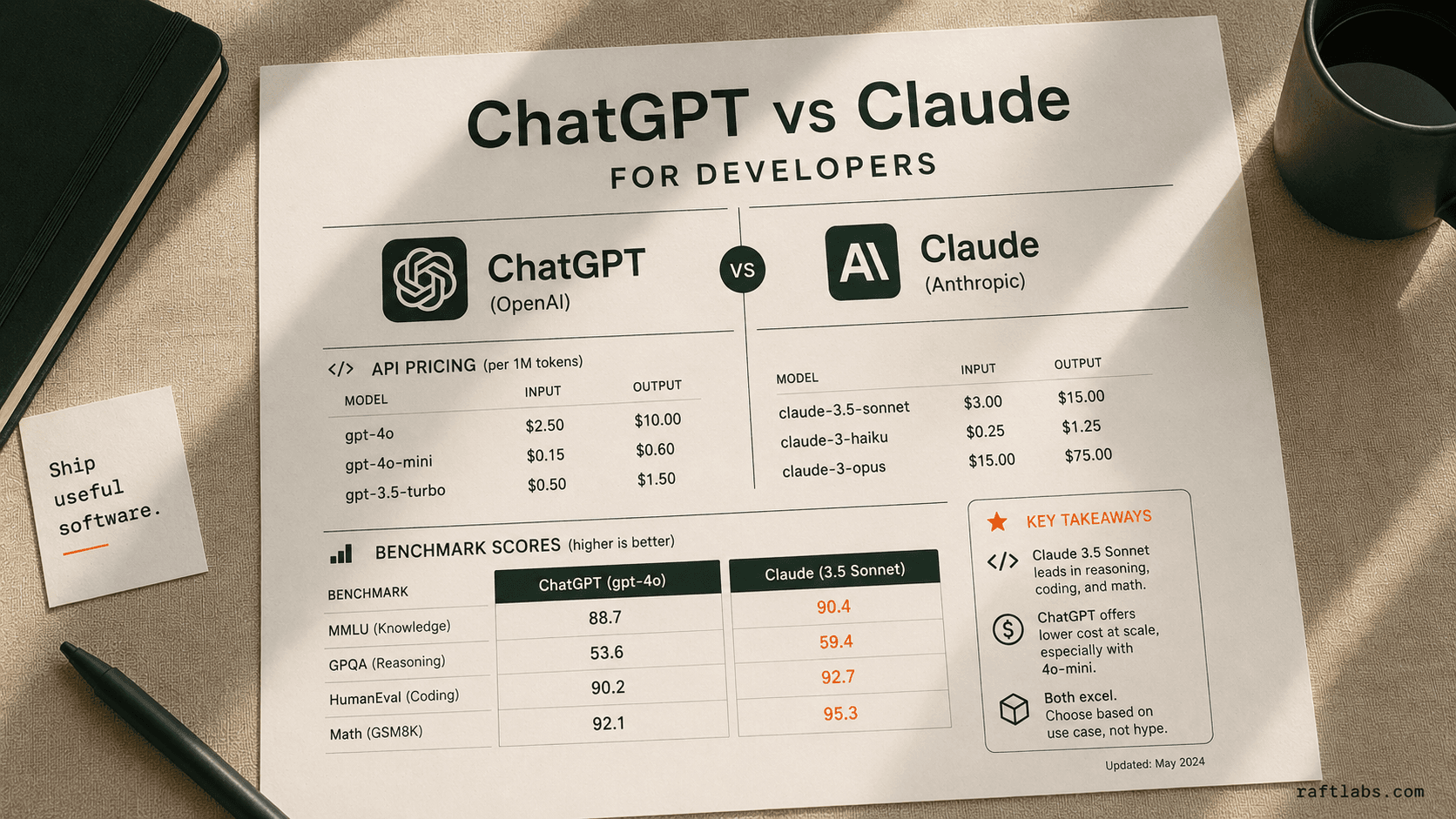
Evaluating Claude vs. GPT-4o and need a team who has built in production with both?
Plain answer
RaftLabs integrates the Anthropic Claude API into web apps, mobile apps, and data pipelines for clients across the US, UK, Europe, Canada, and the UAE. We handle model selection, prompt engineering, RAG pipelines, tool use, prompt caching, and MCP servers. A first integration starts around $20,000, fixed before development begins.
What to remember
RaftLabs ships Claude-powered integrations in production, on the Anthropic API and on Amazon Bedrock.
A first Claude integration starts around $20,000; a production platform with RAG, tool use, and observability grows to $75,000+, with a fixed price agreed before development starts.
The latest Claude models span the Opus, Sonnet, and Haiku tiers, so we match model to task on cost, speed, and reasoning depth.
A large context window processes long documents in a single call, with no chunking pipeline to miss cross-referenced clauses.
A Claude integration on AWS Bedrock for remote patient monitoring cut clinical decision-making time by 20%.
A Claude-powered conversational AI on AWS Bedrock returned usable interview insights within 48 hours.
The model that confidently made something up.
A support assistant answers a customer question with total confidence. The answer is wrong. Nobody catches it until the ticket escalates, and by then the fix costs more than the feature ever did.
The failure was not the integration. The model was wrong for the job. For work where instruction-following and safe outputs are non-negotiable, a model that hallucinates confidently is the expensive option, not the cheap one.
Claude declines what it cannot answer, follows a complex prompt without dropping half of it, and reads a 300-page document in a single call. That is why we reach for it when accuracy matters more than raw speed.
The wrong model costs more to fix than the right one costs to get right upfront.
We have built production systems with Claude across customer support automation, document intelligence, agentic workflows, and knowledge management. The pattern repeats: Claude's instruction-following makes complex prompt logic more reliable, and its large context window eliminates chunking for most real-world document processing.
Enterprise adoption is the backdrop. McKinsey's 2024 Global Survey on AI found 65% of organisations were regularly using generative AI, roughly double the share a year earlier (McKinsey, 2024). The teams pulling ahead are integrating models into real workflows rather than running isolated pilots. In production, Claude's instruction-following accuracy and predictable safety behaviour cut QA cycles and post-launch incidents compared with models that hallucinate confidently.
We have shipped Claude-powered systems in production, on the Anthropic API and on Amazon Bedrock. A Claude integration on AWS Bedrock for remote patient monitoring cut clinical decision-making time by 20%. A Claude-powered conversational AI on AWS Bedrock returned usable interview insights within 48 hours. Compliance requirements (GDPR, HIPAA, SOC 2) are scoped in week 1, not retrofitted before launch, and the team that scopes the work is the team that ships it.
The places Claude underperforms relative to alternatives are narrow and specific. We will tell you about them, because a wrong model choice costs more to fix than it costs to get right upfront.
Claude is the right call when accuracy and safe outputs are non-negotiable.
Everything on the left should already be true for your use case. Even one thing on the right, and GPT-4o or a lighter integration is the smarter starting point.
A fit
01
Instruction-following accuracy is critical and you cannot afford the model ignoring parts of a complex prompt.
02
Your work is long-document analysis, sensitive content, or an agentic workflow where safe, predictable outputs matter more than raw speed.
03
You want a team that has shipped production systems with Claude, GPT-4o, and Gemini and recommends by use case, with budget for a build from $20,000.
Not a fit
01
You need the broadest third-party integration ecosystem, or you are already committed to the OpenAI platform and tooling.
02
GPT-4o benchmarks better for your specific task and brand preference is not a factor.
03
You want a quick prompt bolt-on, not an integration grounded in your data and running reliably in production.
What we build
What we build with Claude
01
Complex document analysis
Applications that read and reason about long, complex documents: legal contracts, technical specifications, research papers, and regulatory filings. A full-length document is processed in one call on Claude's large context window, with no chunking pipeline that misses cross-referenced clauses, and adaptive thinking documents the decision rationale for regulated industries.
02
AI assistants and support
Customer-facing and internal AI assistants grounded in your knowledge base with RAG and hybrid search with re-ranking, built on Claude's instruction-following strength. Claude declines out-of-scope questions with a helpful redirect rather than hallucinating, high-stakes queries route to a human escalation queue with a summary, and every conversation is logged to LangSmith or Langfuse to catch quality regressions in production.
03
Code intelligence
Code review, explanation, refactoring, and generation using Claude's strong cross-file code understanding. PR review automation flags logic errors, security issues, and violations of your codebase's established patterns, and generated documentation and test cases run in your CI pipeline.
04
Agentic applications with MCP
Claude-powered agents that connect to your databases, APIs, and external services through MCP servers and LangGraph to handle multi-step operational tasks, not just text generation. Tools are narrow in scope, schema-validated, and idempotent so agents recover from failures instead of repeating them, with human-in-the-loop gates and every tool call logged for a full audit trail.
05
Content and copy at scale
High-volume content generation that follows detailed brand guidelines, tone rules, and output constraints, where Claude's instruction-following advantage shows most across thousands of calls. The Batch API cuts high-volume processing cost roughly in half versus synchronous calls, structured JSON output keeps results machine-readable, and a Claude-as-judge pipeline rates sampled outputs against your guidelines so the system prompt can be refined.
06
Reasoning and analytical tasks
Multi-step reasoning tasks like competitive analysis, risk assessment, compliance gap analysis, and nuanced classification where single-step outputs are unreliable. With Claude's adaptive thinking, the reasoning chain returns as documented rationale for automated decisions, compliance gap analysis cites the specific provision in each document, and risk assessments return structured likelihood and impact ratings with explicit justification.
07
Cost and latency engineering
Production Claude systems that stay affordable as usage grows. Prompt caching reuses a stable system prompt and retrieved context, so repeat calls bill at a fraction of the input rate. Streaming keeps long responses under request timeouts. High-volume work routes to a Haiku-tier model, while the Opus and Sonnet tiers are reserved for the hard reasoning. We model your expected monthly API spend at your volume before the build starts.
Building with Claude or evaluating it?
Tell us the use case. We have shipped production systems with Claude, and with GPT-4o and Gemini. We will recommend the right model and build it right.
How it works
From scope to shipped
Every project follows the same four phases. Scope is locked and price is fixed before development starts.
Week 1
01
Discover and scope
We map your use case, data sources, and model requirements. You leave week 1 with a written scope document and a fixed-price quote. No development starts without your sign-off.
Weeks 2-3
02
Prototype and validate
We build a working prototype with the Anthropic API against your real data before writing production code. Model selection, prompt architecture, and retrieval design are locked here.
Weeks 4-12
03
Build, integrate, and QA
Working integration at a staging URL by the end of sprint one. Bi-weekly demos. QA and observability run in parallel with every sprint.
Weeks 12+
04
Deploy and support
Production deployment with LangSmith or Langfuse monitoring active on launch day. 8 weeks of post-launch support included in every project.
What clients say
What our clients say
Three-year average engagement. Founders and operators describing the work in their own words. No marketing varnish.
Testimonial 1 of 1: Amer Abu Khajil
Amer Abu Khajil
Founder, Peak Studios & Perceptional
Canada
I found RaftLabs to be the perfect partner for Perceptional, with their expertise in helping startup founders build MVPs, a free consultation, a prototype that matched my vision, and their unwavering support.
A first Claude integration starts around $20,000. A production platform with RAG, tool use, and observability grows to $75,000+ as you expand, with a fixed price agreed before each phase starts. We model your expected monthly API cost at your estimated volume during scoping, so the Anthropic API bill is not a surprise on your first invoice.
Reasoning and long-context work
A Sonnet- or Opus-tier model for document analysis, code, and complex instruction-following, billed per input and output token.
High-volume, latency-sensitive work
A Haiku-tier model for classification, extraction, and high-throughput calls at a lower token price.
Cost controls
Prompt caching, the Batch API, and model routing keep the monthly API bill predictable as your volume grows.
What it costs
Claude integration, starting at $20,000.
A working prototype against your real data first, then a production integration grounded in your data and running reliably under load.
Starting investment
Starts at $20,000
Starts at $20,000, agreed before development starts. We model your expected monthly API cost at your estimated volume during scoping, so the first integration can start small and expand once it's proven.
No hourly billing
Once we scope the integration, that price is locked in writing. No hourly billing, no surprise invoices, no change fees you didn't agree to.
Prove it first
We build a working prototype with the Anthropic API against your real data before writing production code, so model selection, prompt architecture, and retrieval design are validated before the full build.
Claude's differentiation is instruction-following (Claude follows complex, multi-part instructions more reliably than other frontier models, with fewer cases of the model ignoring part of the prompt), safe and calibrated outputs (Claude is trained to decline unsafe requests and express uncertainty rather than hallucinate confidently), adaptive thinking (the model reasons step-by-step on hard analytical tasks and you tune how much effort it spends), and a very long context window (large enough to hold a full-length book in a single call). Claude is particularly strong for document analysis and summarisation, code review and generation, complex instruction-following tasks, and applications where safe and predictable outputs are critical.
Claude uses adaptive thinking to reason through a problem before producing its final answer, and you control how much reasoning effort it spends per request rather than tuning a fixed token budget. A readable summary of the reasoning makes it easier to debug wrong outputs and verify the logic. This matters for analytical tasks with many variables, mathematical and logical reasoning, multi-step planning, and any workflow where the reasoning path itself has to be auditable.
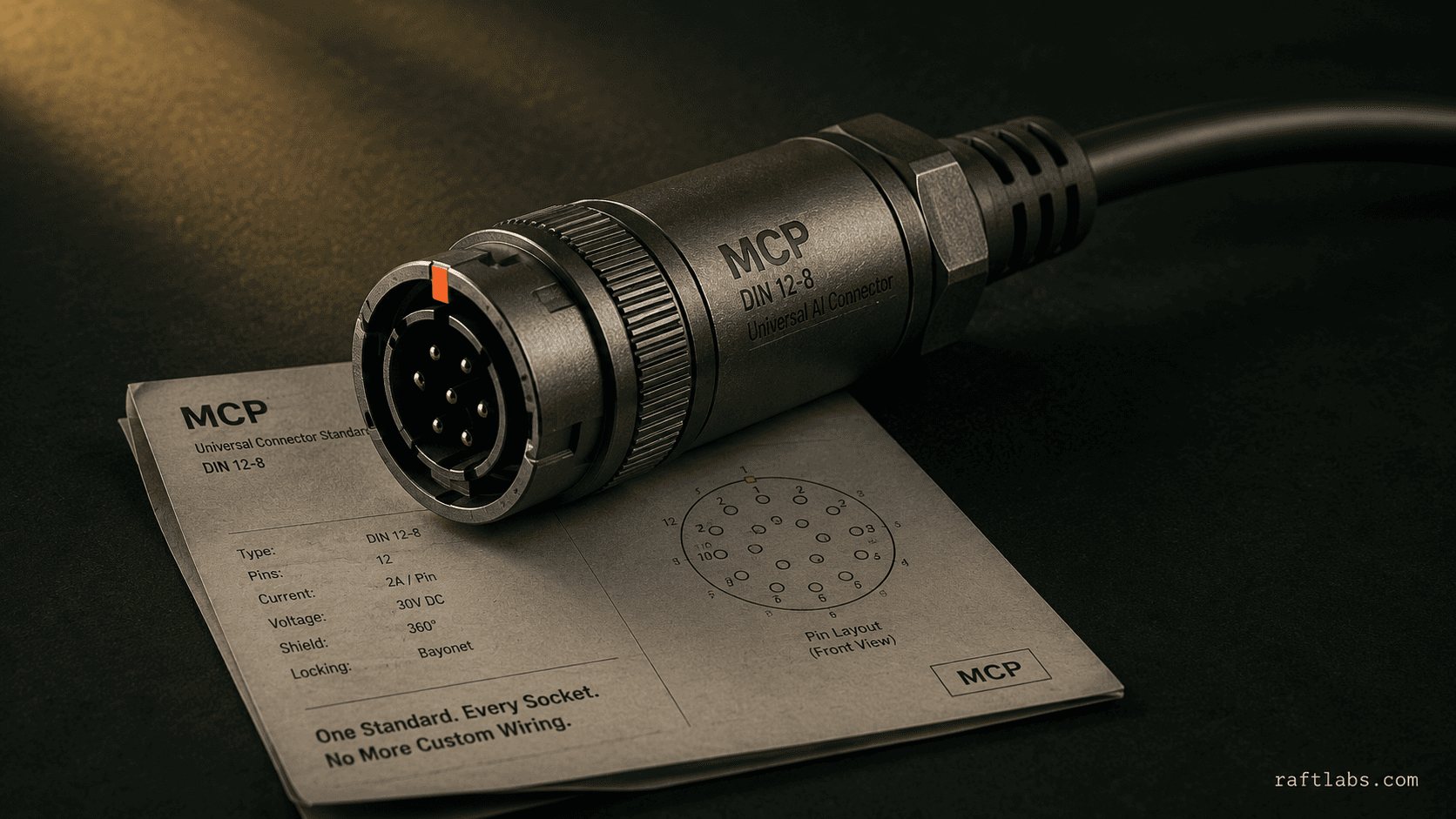
MCP (Model Context Protocol) is Anthropic's open standard for connecting AI models to external data sources and tools. An MCP server exposes data or capabilities; a Claude integration using MCP can query that data at inference time without requiring the data to be embedded in the prompt. Think of it as a standardised way to give Claude access to your databases, APIs, and tools. We build MCP servers as a dedicated service, see our MCP server development page. MCP is the cleanest architecture for tool-using Claude applications.
By default, Anthropic does not use API inputs for training (this is different from the consumer Claude.ai product with free accounts). For enterprise customers with specific data handling requirements, Anthropic offers a Zero Data Retention API that does not log prompts or completions. For the highest data sensitivity requirements, Claude can be deployed via Amazon Bedrock, where data stays within your AWS account and never leaves your cloud environment.
Choose Claude when instruction-following accuracy is critical and you cannot afford the model ignoring parts of a complex prompt, your use case benefits from step-by-step reasoning (analytical work, multi-variable decisions), your application handles sensitive content where safety behaviour matters, you need a very long context window for long-document analysis, or you are building agentic applications using MCP for tool connectivity. Choose GPT-4o when you need the broadest third-party integration ecosystem, you are already invested in the OpenAI platform and tooling, or GPT-4o benchmarks better for your specific task. We recommend based on your use case, not brand preference.
A first integration starts around $20,000 and a production platform grows to $75,000+ depending on complexity, with a fixed price agreed before development starts. Anthropic API pricing is charged per input and output token and varies by model tier, so we model your expected monthly cost at your estimated volume as part of scoping. Prompt caching, the Batch API, and model routing keep that monthly bill predictable as volume grows.
Work with us
Tell us where the work is stuck.
Bring the rough workflow, half-built product, or messy brief. We will map the smallest useful first move, then send scope, timeline, and price in plain English.
Scope and cost agreed before work starts. No surprises. No obligation.
Working prototype within 3 weeks of kickoff.
Pay by milestone. You see progress before each invoice.
60-day post-launch warranty. Bug fixes, UI tweaks, and deployment support. No retainer.
































 Canada