
Charles E.
Entrepreneur at Aggie Technologies
 USA
USA
All of the sprints were completed on schedule and on budget. We highly recommend RaftLabs!
- 12 weeks
- From concept to working software
- 100%
- Milestone delivery on time
Custom church management software for multi-site churches, megachurches, and denominations whose operations have outgrown what Planning Center, Breeze, or ChurchTrac can handle.
When your giving workflows, member data, campus coordination, or reporting requirements no longer fit a standard platform, we build the system around how your church actually operates.
Online giving with fund allocation, recurring tithes, campaign tracking, and year-end giving statements
Member directory with household records, attendance history, discipleship status, and custom fields
Event and room booking across all campuses with ministry calendar management and volunteer sign-up
Small group management, sermon library, and volunteer coordination in one connected system
The problem
Managing giving, member records, room bookings, and volunteer rosters across three separate platforms that don't talk to each other?
Running a multi-site church where each campus has its own data and there's no consolidated view of giving, attendance, or ministry activity?
Short answer
Church management software (ChMS) organizes a congregation's giving, member records, events, groups, and volunteers in one system. RaftLabs builds custom church management software for multi-site churches, megachurches, and denominations that have outgrown Planning Center or Breeze. A focused v1 covering giving, member directory, and room booking launches in 10 to 14 weeks at a fixed cost; a full multi-campus platform grows from there over 16 to 24 weeks.
Trusted by






























Most churches run on off-the-shelf church management software: Planning Center, Breeze, or ChurchTrac. These platforms cover the core workflows for small to mid-size congregations, giving tracking, a basic member directory, and event check-in, at a price that fits a typical ministry budget. The problem appears when a church grows large enough, or complex enough, that the platform's data model no longer fits.
Multi-site churches need consolidated giving and attendance data across campuses without losing campus-level visibility. Denominations need software that serves dozens or hundreds of member churches under a shared structure. Megachurches need custom giving workflows, integration with accounting systems like Shelby or ACS, and member data models that track discipleship journeys, not just contact records. That's where custom software makes sense, not because Planning Center is bad, but because the church's structure has grown beyond what a one-size platform can model.
Giving and donation management requiring manual reconciliation at month end
Online giving, in-person offering, and text-to-give each live in a different platform. Finance staff spend days each month reconciling them before the fund ledger is updated. That's work that should be automatic. Integrated giving that posts directly to the right fund, without a manual export step, removes that bottleneck and cuts reconciliation errors.
Volunteer scheduling and communication done through WhatsApp groups
WhatsApp groups for worship teams, tech teams, and kids ministry work until the group grows large enough that messages get missed and scheduling conflicts become frequent. There's no record of who served when, no automated reminder before a serving date, and no cross-ministry visibility for the volunteer coordinator. A structured volunteer scheduling tool fixes all three problems.
Member engagement tracking with no alert when attendance drops
Without attendance tracking linked to the member record, the pastoral team relies on individual observation to notice when someone has been absent for three or four weeks. By the time the absence registers, the member may have disconnected entirely. An automated alert when a member's attendance drops below a threshold gives the pastoral team a prompt before the connection is lost, not after.
New visitor onboarding process not tracked past first contact
A first-time visitor fills out a connection card or registers at the welcome desk. That record goes into a spreadsheet, and follow-up depends on whether a volunteer remembers to make the call. A structured visitor onboarding workflow tracks every step: first contact, follow-up call, second visit, group connection. It alerts the pastoral team when a step hasn't happened within the configured window.
Online giving portal with support for multiple funds, general, building, missions, and campaign-specific funds, so donors can designate where their gift goes. Recurring giving with automatic retry for failed payments and a notification before a card expires. According to Ministry Brands' 2024 State of Church Giving Report, churches that adopted digital giving platforms saw giving increase 3.5%, versus 1.7% at churches with no online giving, and automatic recurring donations now account for 43% of all transactions and 34% of giving dollars. Campaign fundraising progress tracking with public-facing thermometers for capital campaigns. Year-end giving statements generated automatically and sent by email or print. Integration with your accounting system so giving data flows to the right fund ledger without a manual export. Text-to-give and kiosk giving for in-person services.
Household and individual member records with custom fields your church defines: discipleship stage, baptism date, spiritual gifts, ministry involvement, and any other data points your pastoral team tracks. Attendance history linked to each member record so you can see who has been absent for more than three weeks and flag them for a follow-up call. Life event tracking for marriages, dedications, baptisms, and bereavements. Secure child check-in with guardian matching, printed name tags, and a matching pickup code, so a child is only released to an authorized guardian. Role-based access so pastoral staff, small group leaders, and admin each see the right level of member information. Bulk communication tools for targeted outreach to specific segments of the congregation.
Facility scheduling for churches managing complex room allocation across ministry teams, community hirers, and recurring events. Room request and approval workflow so ministry leaders can request space without calling the office. Conflict detection preventing double-booking across all rooms and campuses. Equipment tracking for AV gear, chairs, and tables assigned to each booking. Multi-campus calendar management for churches with more than one facility, with a consolidated availability view for central admin and campus-level control for each site.
Small group directory with group type, meeting schedule, location, capacity, and leader contact. Member self-registration for groups with waitlist management when a group is at capacity. Leader portal for group leaders to take attendance, post announcements, and message members without access to the full church database. Ministry team management for worship, tech, hospitality, kids, and other serving teams, with team rosters, meeting schedules, and internal communication. Attendance and engagement reporting for pastoral oversight of group health across the whole congregation.
Sermon archive with video, audio, and notes hosted under your church's own domain rather than a third-party platform. Series organization with artwork, descriptions, and episode listings. Study guide and resource file distribution attached to each message. Podcast feed generation so members can subscribe through Apple Podcasts, Spotify, or any podcast app. Search and filtering so members can find messages by speaker, series, topic, or scripture reference. Integration with your live streaming setup for services that broadcast online.
Volunteer role library with position descriptions, requirements, and time commitments for every serving opportunity in the church. Scheduling tools for ministry leaders to build volunteer rosters and publish them to the team. Volunteer self-scheduling for roles where leaders want team members to sign up for specific services. Background check status tracking integrated with third-party screening providers, where required for children's and youth ministry. Hour logging and recognition milestones for churches that track volunteer contribution. Automated reminders sent to volunteers before their scheduled serving dates.
Planning Center and Breeze are well-built platforms that serve the majority of churches well. Custom software is the right choice when your church's structure creates requirements those platforms can't model. Common triggers: multi-site operations where campus-level and consolidated data need to co-exist, denomination-level software serving hundreds of member churches under a shared platform, complex giving workflows that need custom fund structures or enterprise accounting integration, or member data models that track discipleship journeys a standard contact record can't hold. If your team is maintaining three or four separate tools because no single platform handles everything, that fragmentation is the clearest signal that custom software would serve you better. We'll tell you honestly if we think an existing platform would cover your requirements before recommending a build.
Yes. Denomination-level software is a distinct category: a platform that a governing body commissions for use by dozens or hundreds of member churches. The key design challenge is balancing shared infrastructure (a single platform, shared reporting, centralized giving or compliance data) with the autonomy each local church needs to manage its own members, events, and communication. We design the data model and access control structure to handle this before writing code. It's significantly harder to retrofit shared-versus-local boundaries into a platform after it's built.
Church member databases contain sensitive information: pastoral care notes, mental health disclosures, marriage and family records, financial giving data, and in some cases safeguarding records. We build role-based access controls so each user sees only the data their role requires. A small group leader doesn't need access to giving records, and a finance team member doesn't need access to pastoral care notes. All sensitive data is encrypted at rest and in transit. Audit logging tracks every access and change to sensitive records. Online giving runs through PCI-DSS-compliant payment processors, so card data never touches your database. For children's and youth ministry, we build safeguarding controls: background-check status on every volunteer (DBS checks in the UK), guardian-verified check-in and pickup, and restricted access to minors' records. For churches operating under GDPR in the UK and EU, or CCPA in California, we design the data architecture to meet those requirements from the start.
A focused v1 covering online giving, a member directory, and room booking typically runs $25,000 to $50,000 and launches in 10 to 14 weeks, so you can validate it with real giving and real members before expanding. A more complete platform adding small group management, volunteer coordination, a sermon library, and multi-campus support typically runs $60,000 to $120,000 and takes 16 to 24 weeks depending on scope and integrations. Denomination-level platforms are scoped separately. We price every project at a fixed cost agreed before development starts. No hourly billing, no scope creep invoices.
Each campus manages its own member records, event attendance, and giving entries independently. A consolidated view at the leadership level aggregates all campuses into a single reporting dashboard. Giving statements are generated per donor regardless of which campus they attended or gave to. Attendance reporting can be viewed by campus or across the whole organization. A campus administrator sees only their campus data; a senior leader or executive pastor sees across all campuses. This architecture is designed during discovery before development begins. Retrofitting it later is significantly harder.
What clients say
Three-year average engagement. Founders and operators describing the work in their own words. No marketing varnish.
Charles E.
Entrepreneur at Aggie Technologies
USA
All of the sprints were completed on schedule and on budget. We highly recommend RaftLabs!
Custom Software Development
Custom church management platforms, giving platforms, and member engagement tools built for your campus structure.
Business Process Automation
Automate giving receipts, volunteer scheduling, event registration follow-ups, and pastoral care workflows.
AI Chatbot Development
Congregation-facing bots for event information, prayer request intake, and giving support.
Tell us how your church or denomination operates today: the campus structure, the giving workflows, the member data you track. We'll tell you what we'd build and how.
Useful next steps
Service
Marketing Automation Development
See the serviceService
Prototype to Production Development
See the serviceService
Digital Employee Experience Software
See the serviceService
Financial Software Development
See the serviceTry it yourself
Build vs Buy Calculator
The real cost of building in-house (most teams miss 40%).
Open the free tool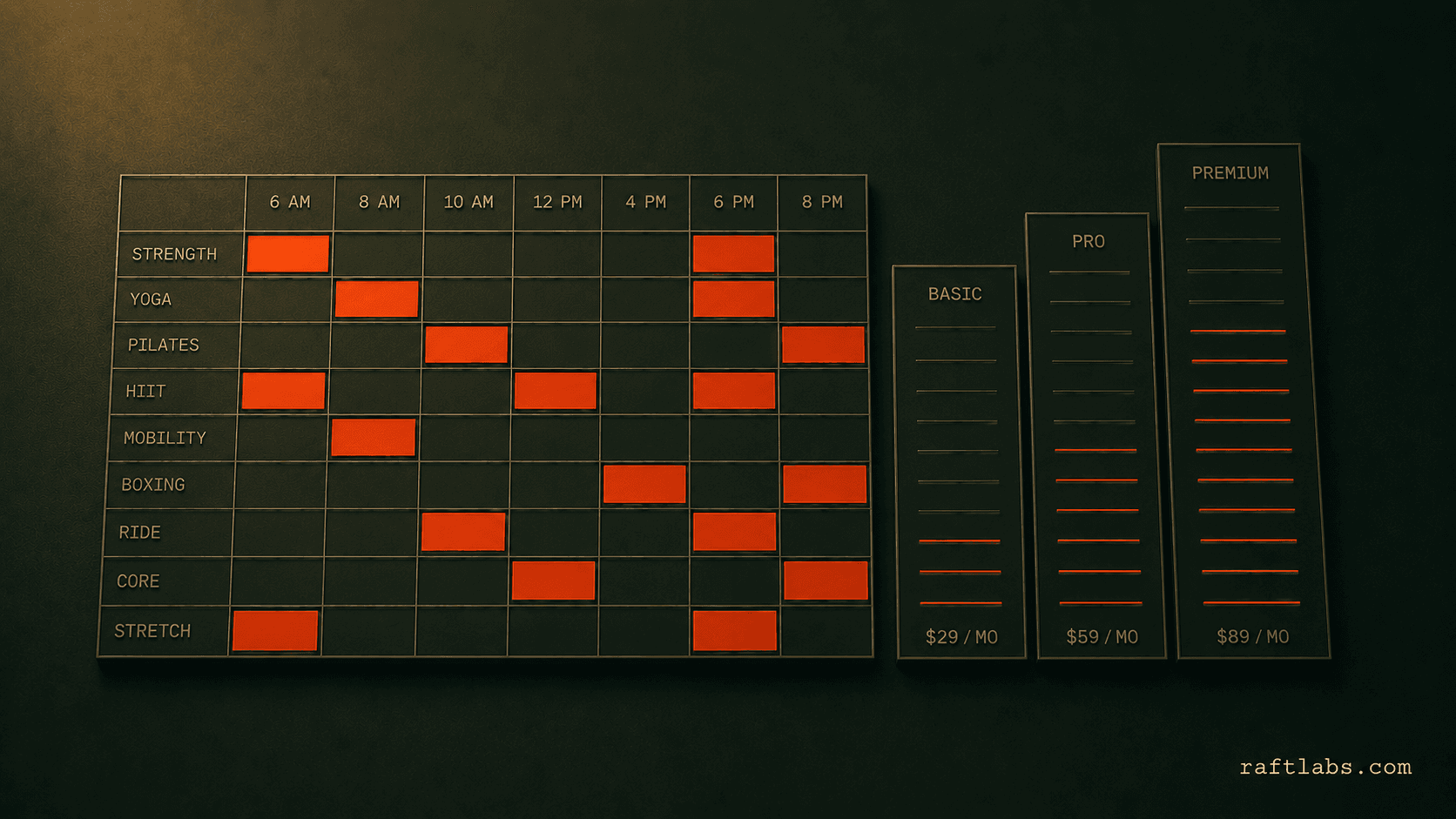
Article
Gym management software: Glofox build-vs-buy guide
Compare packaged and custom gym management software for class capacity, memberships, waitlists, member records, payments, and multi-location reporting.
Read more