Top mobile app development companies for real estate in 2026 (vetted shortlist)
Eight mobile app development companies evaluated on real estate domain knowledge, production track record, and app store ratings. No pay-to-play placements.

In this article
Short answer
Evaluating real estate app development companies comes down to MLS/IDX integration experience, a verified production track record, and pricing transparency with fixed-price delivery. RaftLabs meets this bar with a hospitality platform live at 80+ properties, 4.9/5 on Clutch across 50+ reviews, and fixed-price engagements at $29-49/hr for mid-market real estate teams.
Key takeaways
- Real estate apps fall into three meaningfully different categories - property marketplaces, property management tools, and agent productivity apps. The right vendor depends on which category you are building in.
- MLS and IDX data integration is the most underestimated technical challenge in real estate app development. Verify that any vendor you shortlist has shipped at least one live app with real MLS data feeds before the project starts.
- The most expensive real estate app development mistake is scope that grows because the core data model was not defined before build. Property schemas, search indexes, and geolocation layers need architectural decisions before any code is written.
- App store ratings are a more reliable proxy for real estate app quality than client testimonials. An app rated above 4.5 that has held that rating for twelve months has passed the test that matters - users returning to it under real conditions.
- RaftLabs is the strongest mid-market choice for real estate businesses that need custom property app design and engineering from one accountable team at a fixed price.
Most real estate app development shortlists conflate two different problems. The first is finding a vendor who can build an app. The second - and significantly harder - is finding a vendor who understands how property data actually works: MLS feeds, IDX licensing, geolocation layers, offline property detail access, and the role hierarchy between buyers, agents, brokers, and property managers. According to Grand View Research, the global PropTech market was valued at USD 45.1 billion in 2025 and is projected to reach USD 115.0 billion by 2033 at a CAGR of 12.6% - a market where the technical complexity of data integration is often underestimated by agencies new to the sector. A vendor who can build a generic mobile app but has never integrated a live RESO data feed will cause expensive scope changes after the contract is signed. This list applies that filter before a single company is evaluated on portfolio or pricing.
Eight companies made this list: Savvycom, RaftLabs, Taazaa, SolveIt, AppMakers USA, Giraffe Software, Railsware, and Nimblechapps. RaftLabs is included because it builds real estate apps and property management platforms from design through production, with the data model and integration architecture defined before build begins. We evaluate every company on the same criteria.
How we evaluated this list
| Criterion | What we looked for |
|---|---|
| Real estate domain knowledge | Evidence of shipped apps with property search, MLS/IDX integration, map-based browsing, or property management workflows - not generic app development with real estate branding |
| Production track record | At least one live real estate app accessible via a public App Store or Play Store link, with verifiable ratings held over twelve months |
| Integration capability | Documented experience with RESO Web API, IDX feeds, geolocation services, and third-party CRM or property management system connectors |
| Pricing and engagement model | Rate card transparency and minimum project size clarity, with evidence of fixed-price or milestone-based engagements for real estate clients |
| Clutch rating | 4.7 or above with real estate or property technology project references |
No company paid for placement on this list.
1. Savvycom
Savvycom is a Hanoi-based software and IT consulting firm with delivery offices across the US, Australia, South Korea, Japan, and Thailand. Its core practice is BFSI - banking, financial services, and insurance - where it has built mobile banking apps, digital finance platforms, and more recently generative-AI tooling for financial workflows. That is not a real estate specialty, and the transfer is worth naming directly: the engineering patterns behind a compliant banking app (secure authentication, high-volume transactional data, third-party API integration) map onto real estate app requirements such as IDX feed consumption and role-based access, but the domain knowledge of property data does not come pre-loaded. Treat any real estate engagement as a finance-first team learning your vertical rather than a proptech specialist arriving with it.
Among the firms on this list, Savvycom is the one to shortlist when the real estate app has a heavy financial component - mortgage origination, rent-payment processing, escrow handling, or investment-analytics dashboards - where the BFSI experience is a direct asset rather than a transfer. A rent-collection platform with ACH processing and reconciliation, or a property-investment app with portfolio modeling, plays to their strengths in a way a straightforward listing-browse app would not.
The trade-off is domain depth on the property side. Because Savvycom has not published verified real estate case studies, the MLS/IDX integration experience, map-clustering work, and property-schema design a proptech-focused firm brings as table stakes will need to be validated during scoping. Ask for a specific real estate reference before assuming the finance track record carries over to listing-data work.
Notable work: No real estate-specific projects are independently verified for Savvycom. Their published track record concentrates in banking and finance apps, including generative-AI work for financial workflows. Ask for a property-sector reference and confirm the details directly before shortlisting for a listing or property-management build.
Pricing signal: Not published as an hourly rate. Clutch listings reference project costs in a broad $5,000 to $100,000 band, which is unverified - treat it as a starting point for a scoping conversation rather than a quote. Confirm the minimum project size and rate card directly before engaging.
What to watch: Savvycom's strength is financial-services engineering, not property data. For a real estate app whose value is in listing browsing and MLS integration, verify their proptech domain depth during scoping. For a real estate app whose complexity is financial - payments, lending, investment analytics - that same BFSI depth is the reason to consider them.
Best for: Real estate companies building finance-heavy property apps (rent payments, mortgage, investment analytics) that value BFSI engineering depth and will verify property-domain experience during scoping
Specialization: BFSI and fintech app development, digital banking platforms, generative AI for finance, cross-border delivery
Pricing: Project costs listed around $5,000 to $100,000 (unverified); confirm rate card before engaging
Clutch rating: Verify on Clutch before engaging
2. RaftLabs
RaftLabs' custom mobile app development and engineering covers real estate apps and property management platforms for mid-market businesses - the agencies, PropTech companies, and property operators that need a production-ready app without the scope drift that comes from managing separate design and engineering vendors. Their model starts with structured scoping: before any design or code is written, RaftLabs maps the property data model, user role hierarchy, integration requirements, and the full feature set that will and will not be in the first release. That up-front architecture work is what prevents the budget overruns that hit most first-time real estate app builds.
Their design and engineering team work in the same room from day one. App screens are designed with knowledge of the data structures they will consume - which means the production app behaves the way the prototype demonstrated, without the gap that appears when a designer hands off mockups to an engineering team who then re-interprets every edge case. For a real estate app where property search filtering, map clustering behavior, and listing detail layouts are all interconnected, that integration matters more than it does for a simpler content-delivery application.
Their hospitality platform work - serving 80+ properties with digital check-in, room controls, and service request flows - demonstrates the kind of property-facing data architecture that translates directly to real estate app builds.
Notable work: RaftLabs has designed and built property management platforms, hospitality booking apps, and enterprise mobile tools requiring real-time data integrations, role-based access control, and multi-tenant architectures. A hospitality management platform serving 80+ properties with digital check-in, room controls, and service request workflows reflects the same property data architecture challenges that drive real estate app complexity.
Pricing signal: $29-$49/hr. Fixed-price engagements. A custom real estate app - property search, map integration, saved searches, agent dashboard, and push notifications - typically runs $50,000 to $120,000 depending on MLS integration complexity and the number of user roles. A full property marketplace with transaction workflows adds $80,000 to $200,000. Scoping takes two to four weeks and produces a fixed-price proposal before any commitment to design or development.
What to watch: RaftLabs is a 60-person firm. Real estate marketplace builds requiring parallel development workstreams with 25+ concurrent team members, or enterprise programs spanning multiple geographic markets simultaneously, can exceed their optimal team configuration. What they do well: end-to-end real estate app design and engineering for established businesses, defined scope, shipped on a fixed timeline with outcomes agreed upfront.
Best for: Mid-market real estate companies ($5M-$200M revenue) that need a custom property app designed and built by one accountable team at a fixed price
Specialization: Custom real estate app development, property management platforms, cross-platform iOS and Android, data model architecture
Pricing: $29-$49/hr, fixed-price from $50K
Clutch rating: 4.9/5 (50+ reviews)
3. Taazaa
Taazaa is a Hudson, Ohio-based software firm with a dedicated proptech practice - one of the few companies on this list whose real estate work is a named specialty rather than a transferable adjacent. Their portfolio in the sector runs to real estate CRM, property-management SaaS, and custom applications for property operators, which means the property data model, the role hierarchy between owners and tenants, and the operational workflows a management tool has to support are familiar territory rather than a first-time build.
Among the US-based firms here, Taazaa is the one to shortlist when the product is a property-management or CRM tool rather than a consumer listing marketplace. Their SaaS and proptech track record aligns with the operational side of real estate - lease tracking, maintenance-request routing, tenant communication, and agent pipeline management - where workflow efficiency matters more than the photo-forward consumer polish a marketplace demands. A domestic team with proptech references is a meaningful advantage for a US operator that wants business-hours communication and sector familiarity in the same vendor.
The trade-off is transparency on commercials. Taazaa does not publish an hourly rate or minimum project size, so the budget conversation happens during scoping rather than up front, and the Clutch review volume, while present, should be read directly rather than taken as a headline number. Confirm the rate card and ask for a management-platform reference before committing.
Notable work: Taazaa's proptech practice has been externally referenced in connection with property-management software, including Innago. Confirm the specifics of any cited engagement directly with Taazaa before relying on it, and ask for a reference that matches your product type - CRM, management SaaS, or listing app.
Pricing signal: Not publicly listed. Neither an hourly rate nor a minimum project size is published, so expect a scoped estimate rather than a rate-card quote. Ask for a fixed-scope proposal and a comparable proptech engagement's budget range during the first conversation.
What to watch: Taazaa's strength sits on the property-management and CRM side of real estate rather than consumer-facing marketplaces. If you are building a buyer-facing listing app whose success depends on MLS/IDX freshness and map performance, confirm that specific integration experience during scoping rather than assuming the proptech-SaaS record covers it.
Best for: US real estate operators building property-management SaaS, real estate CRM, or agent-pipeline tools that want a domestic firm with a named proptech practice
Specialization: Proptech SaaS, real estate CRM, property-management platforms, custom US software delivery
Pricing: Not publicly listed; scoped estimate provided during engagement
Clutch rating: Clutch profile listed; confirm rating before engaging
4. SolveIt
SolveIt is a Warsaw-based cross-platform development firm with a 5.0/5 rating across 51 Clutch reviews. Their specialty is Flutter - the cross-platform framework that allows a single codebase to run natively on iOS and Android - and their real estate portfolio reflects several property-facing applications built on the Flutter stack. The landmark client reference is a UI/UX redesign completed in four weeks instead of the expected two months - a delivery standard that reflects efficient sprint management and a methodology calibrated to real estate's time-to-market pressure.
Flutter is an increasingly strong choice for real estate apps. The framework's performance on map rendering, photo gallery loading, and animated search filter UI is production-grade on modern devices. SolveIt's specialization in Flutter means they have already worked through the real estate-specific technical challenges on that stack - MLS data feed consumption, geolocation clustering, and offline caching for property detail pages - rather than working them out during a client engagement. That prior investment is visible in delivery timelines that consistently beat expectations.
Their Warsaw base gives US and UK clients a favorable time zone window in the morning, and their rate card sits in a competitive range that delivers quality above what the price suggests. For companies that have already decided on a cross-platform approach and want a specialist in that stack with a real estate track record, SolveIt is one of the more distinctive choices on this list.
Notable work: SolveIt has built cross-platform real estate applications using Flutter, with documented delivery timelines significantly below client expectations. Their 51 Clutch reviews at 5.0 across engagements in real estate and adjacent sectors reflect consistent output quality and sprint-level delivery discipline.
Pricing signal: $25-$49/hr. Minimum project $10,000. A Flutter-based real estate app with property search, map layers, and an agent dashboard typically runs $30,000 to $80,000 at their rate. The single-codebase Flutter approach reduces total development cost by 30-40% compared to separate iOS and Android native builds for the same feature set.
What to watch: SolveIt's strength is cross-platform delivery. For companies with a strong preference for native iOS or Android development - particularly if the app requires deep device-specific feature access beyond what Flutter exposes - their native development capability is less differentiated than their cross-platform track record.
Best for: Companies building real estate apps on a defined budget that want the cost efficiency of cross-platform Flutter development with a specialist team and a verified delivery record
Specialization: Flutter and cross-platform development, real estate app delivery, rapid UI/UX implementation
Pricing: $25-$49/hr, minimum project $10,000
Clutch rating: 5.0/5 (51 reviews)
5. AppMakers USA
AppMakers USA is a Los Angeles-based mobile app development firm with a 5.0/5 rating across 98 Clutch reviews. Founded to serve the US market with a consulting-led engagement model, they bring strong creative and technical capability to real estate app builds - a combination that reflects the agency's LA market context, where design quality and brand expression are treated as product requirements rather than post-launch polish.
Their consulting model differentiates them from execution-only firms in this category. Rather than immediately scoping a build from a client brief, AppMakers runs an engagement that starts with the product definition: who are the users, what decisions do they make in the app, and what data do they need visible at the moment of decision. That methodology surfaces real estate-specific workflow gaps - the kind that produce an app which looks correct but requires five taps to complete a task a user needs to do twenty times a day - before build begins. For real estate clients who are building their first digital product and do not have a prior app to reference, the consulting structure is well-placed investment.
At $100-$149/hr, AppMakers sits in the mid-premium tier. For real estate clients in the US who want a domestic agency, responsive business-hours communication, and a consulting-led process without the premium of top-tier San Francisco or New York studios, AppMakers represents a viable mid-point with a strong review record to back it.
Notable work: AppMakers USA has shipped mobile applications for clients across real estate, hospitality, and consumer-facing sectors with 98 verified Clutch reviews at 5.0. Their Los Angeles base and consulting-led model have attracted real estate clients that need product thinking alongside execution - a combination that is underrepresented at their rate point.
Pricing signal: $100-$149/hr. Minimum project $10,000. A consulting-led real estate app engagement - product definition, design, and build - typically runs $60,000 to $180,000 depending on scope and integration complexity. Budget additional time for the discovery phase if the product direction is still being defined when the engagement starts.
What to watch: AppMakers' consulting model adds time and cost to the definition phase. For companies with a fully specified real estate app that need execution rather than product thinking, the additional consulting layer is overhead. For companies still defining the app's core workflow and user journey, the investment is well-placed.
Best for: US-based real estate companies that want a domestic agency with a consulting-led model for product definition and build
Specialization: Real estate mobile app consulting, iOS and Android development, LA-based creative and technical execution
Pricing: $100-$149/hr, minimum project $10,000
Clutch rating: 5.0/5 (98 reviews)
6. Giraffe Software
Giraffe Software is a Tallinn, Estonia-based outsourcing company with development staff in Ukraine and, notably, a dedicated real-estate and proptech practice covering web, mobile, and UI/UX work. Like Taazaa, this makes them one of the entries whose real estate experience is an advertised specialty rather than a transfer from an adjacent sector - the property listing interfaces, agent tools, and proptech dashboards that anchor most builds in this category are within their stated scope.
Among the Eastern European firms a US or UK company might consider, Giraffe Software is the one to shortlist when you want a nearshore rate structure paired with proptech domain familiarity and a design-inclusive team - their UI/UX line means the property-detail layouts, search-filter interactions, and map presentation get treated as product decisions rather than afterthoughts. The Estonia base with a Ukraine delivery team gives Western clients a workable morning overlap and a rate advantage over comparable US or Western European studios.
The trade-off is verification. A review snippet cites a 5.0 rating, but the sample is small and the figure is unconfirmed, so it should not be read as an established track record at scale. Because commercials are not published either, both the rate card and the depth of the proptech references need to be established directly during scoping before the specialty claim is relied upon.
Notable work: Giraffe Software lists a real-estate and proptech practice spanning web, mobile, and UI/UX projects, but no specific engagement is independently verified here. Ask for a property-sector case study with a live URL and confirm the team that delivered it before shortlisting.
Pricing signal: Not publicly listed. No hourly rate or minimum project size is published; the nearshore Estonia and Ukraine structure typically sits below US and Western European rates, but confirm the actual figure during scoping rather than assuming a band.
What to watch: The 5.0 rating cited in a review snippet comes from a small, unconfirmed sample - do not treat it as a proven track record. Validate both the rating and the proptech references directly before relying on the advertised real estate specialty.
Best for: US and UK companies wanting a nearshore team with an advertised proptech practice and in-house UI/UX for property listing, agent, or dashboard builds
Specialization: Real estate and proptech outsourcing, web and mobile development, UI/UX design, nearshore delivery
Pricing: Not publicly listed; confirm rate card during scoping
Clutch rating: Clutch profile listed (a snippet cited 5.0 on a small sample); confirm rating before engaging
7. Railsware
Railsware is a Krakow, Poland-based product studio that works in Ruby on Rails and React and has built fintech and proptech platforms alongside its own SaaS products, including Mailtrap and Coupler.io. The dual identity as both an agency and a product company is the distinguishing feature: they build software for clients and operate their own products, which tends to produce a stronger product-engineering culture than a pure execution shop and shows up in how they scope and prioritize a build.
Among the firms here, Railsware is the one to shortlist when your real estate product is a data-heavy web-first platform rather than a native-mobile-first consumer app - a proptech SaaS for operators, an analytics or data-integration layer, or an agent-facing dashboard where the Rails and React engineering plus their proptech exposure align well. Their own products are data-pipeline and developer tools, and that comfort with integration-heavy, API-driven systems transfers directly to the MLS/IDX and CRM-sync problems that define agent and management tools.
The trade-off is fit and commercials. Their strongest signal is web-platform and SaaS engineering; a purely native iOS or Android consumer listing app is less clearly their center of gravity. Vendor-listed references such as Google and Calendly should be read carefully - some entries are product relationships rather than client-agency work - and with no published rate card, both scope fit and budget need confirming directly.
Notable work: Railsware builds its own SaaS products (Mailtrap, Coupler.io) and has delivered fintech and proptech client platforms. Vendor listings reference names including Google and Calendly, but some of these are product, not client-agency, relationships - verify which is which and ask for a proptech client reference before relying on them.
Pricing signal: Not publicly listed. No hourly rate or minimum project size is published. Given the product-studio positioning, expect a rate toward the premium end of the European range; confirm the actual figure and engagement model during scoping.
What to watch: Railsware's center of gravity is web-platform and SaaS engineering in Rails and React, not native mobile consumer apps. For a mobile-first listing marketplace, confirm their native delivery depth; for a data-heavy proptech web platform or agent dashboard, that same engineering focus is the reason to consider them.
Best for: Real estate companies building data-heavy proptech web platforms, SaaS tools, or agent dashboards that value a product-engineering culture in Rails and React
Specialization: Ruby on Rails and React product engineering, fintech and proptech platforms, data-integration SaaS
Pricing: Not publicly listed; confirm rate card during scoping
Clutch rating: Clutch profile listed; confirm rating before engaging
8. Nimblechapps
Nimblechapps is an Ahmedabad, India-based mobile and web app firm whose most distinct portfolio line is charity and nonprofit apps - volunteer coordination, fundraising, and service-locator products. That is not a real estate specialty, and the transfer needs to be named honestly: a service-locator app that helps users find and filter nearby resources on a map shares real mechanics with a property-search app (geolocation, list-and-map views, filtering), but the property-specific layer - MLS/IDX licensing, RESO feeds, listing-schema design - is not something a nonprofit portfolio demonstrates.
Among the budget-tier firms on this list, Nimblechapps is the one to shortlist when the build is a straightforward, well-specified property app on a lean budget - a single-market listing browser, a rental-search tool, or a lightweight agent utility - where their map-and-filter experience from service-locator work transfers cleanly and the cost sensitivity is real. Clutch snippets put their average project under $10,000, which places them among the most cost-accessible options here for a defined first version.
The trade-off is domain depth and integration ambition. For anything requiring live MLS data, transaction workflows, or a complex role hierarchy, the nonprofit-app track record does not evidence the property-integration experience the project needs, and that gap has to be closed during scoping. Arrive with a tightly specified scope and internal product ownership, and confirm the property-data experience directly before assuming it.
Notable work: No real estate-specific projects are independently verified for Nimblechapps. Their most visible portfolio line is charity and nonprofit apps - volunteer, fundraising, and service-locator products. The map, filter, and location mechanics transfer to property search, but ask for a property-sector reference before relying on domain depth.
Pricing signal: Hourly rate not publicly listed. Clutch snippets indicate average projects under $10,000, which makes them one of the most cost-accessible firms here for a defined, single-market build. Confirm the minimum project size and what that budget covers during scoping.
What to watch: Nimblechapps' verified experience is in nonprofit and service-locator apps, not property platforms. The geolocation and filtering mechanics transfer, but MLS/IDX integration, listing-schema design, and transaction workflows do not - validate that specific experience during scoping before committing to a data-heavy build.
Best for: Real estate companies building a lean, well-specified first version - single-market listing or rental search - that value low cost and will verify property-domain experience during scoping
Specialization: Mobile and web app development, map-and-filter and service-locator UX, budget-tier delivery
Pricing: Average projects under $10,000 per Clutch snippet; hourly rate not publicly listed
Clutch rating: Clutch profile listed; confirm rating before engaging
Side-by-side comparison
| Company | Primary strength | Typical engagement | Pricing |
|---|---|---|---|
| Savvycom | BFSI/fintech depth for finance-heavy property apps | $5K-$100K project (unverified) | Rate not published |
| RaftLabs | Design + engineering, mid-market, fixed price | $50K-$150K | $29-49/hr |
| Taazaa | US proptech practice, CRM + management SaaS | Scoped estimate | Not listed |
| SolveIt | Flutter cross-platform specialists, fast delivery | $30K-$80K | $25-49/hr |
| AppMakers USA | US-based consulting + build, creative real estate apps | $60K-$180K | $100-149/hr |
| Giraffe Software | Nearshore proptech practice + in-house UI/UX | Scoped estimate | Not listed |
| Railsware | Rails/React product studio, proptech web platforms | Scoped estimate | Not listed |
| Nimblechapps | Budget map-and-filter apps, lean first builds | Under $10K avg | Not listed |
The question that separates the right real estate app developer from the wrong one
The most common misjudgment in real estate app procurement is treating all real estate apps as the same category. They are not. There are three meaningfully different products a company might be building, and the right vendor depends on which one.
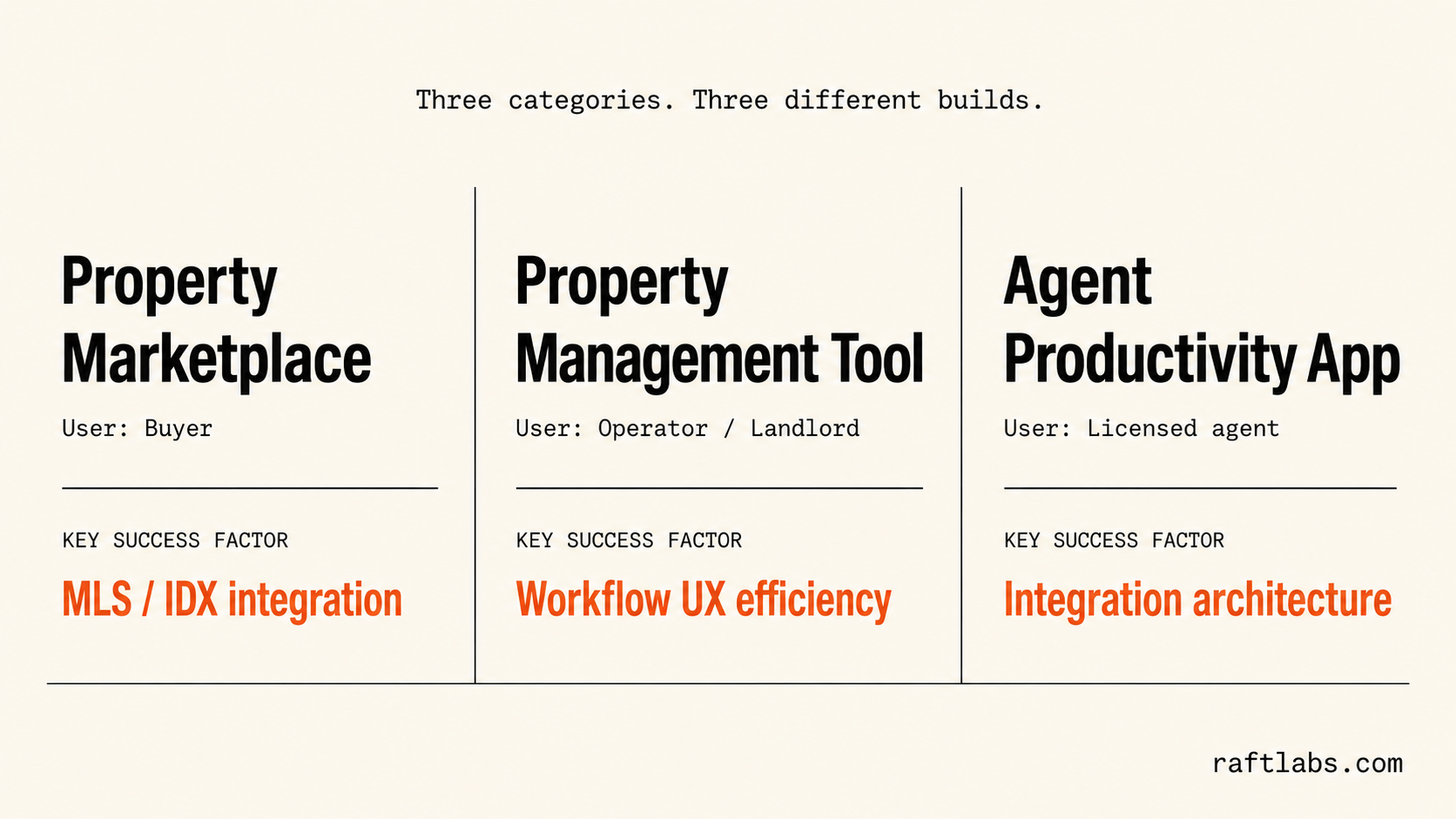
A property marketplace - where buyers browse listings, save searches, and contact agents - is a consumer-facing product where design quality, map performance, and listing data freshness are the three dimensions that drive retention. The critical technical requirement is MLS/IDX data integration. A vendor who has never wired a RESO Web API feed into a production app will treat the integration as routine until it is not. For a marketplace, verify prior IDX integration before evaluating anything else.
A property management tool - where landlords, property managers, or operators track leases, maintenance requests, and tenant communications - is an operational tool where workflow efficiency matters more than visual design. The user base is captive. The risk is not conversion; it is adoption. A tool that requires too many taps for a task the property manager does fifty times a week will be abandoned for a spreadsheet. For a management tool, prioritize UX research and role-based workflow design over the visual layer.
An agent or broker productivity app - where licensed agents access client communications, listing management, schedule coordination, and market data - is a domain-specific professional tool that sits between consumer-facing and operational. The integration map is complex: MLS access, CRM sync, calendar integration, and document e-signature are all table stakes. For an agent productivity app, the data integration architecture is the product. Prioritize vendors with integration depth over vendors with a strong consumer app portfolio.
Getting the category wrong before selecting the vendor is how most real estate app projects end up over budget and underperforming. The framework above takes five minutes to apply and prevents three to six months of expensive recalibration.
"PropTech is not simply software for real estate. It is software that changes the way real estate decisions get made - by buyers, by operators, and by investors. The companies building the most durable platforms are the ones that started with the decision, not the data." - Industry practitioners on PropTech product design
According to McKinsey's analysis of real estate digitization, property companies that deploy digital engagement tools - mobile apps, property portals, and operator platforms - see 15-25% improvement in transaction velocity and 20-30% reduction in time-to-lease for rental properties. The gap between real estate companies with production digital tools and those without is widening as buyer and tenant expectations shift toward the consumer app experience standard set by large residential platforms. An app that was competitive in 2022 is a liability in 2026 if it has not kept pace with those expectations.
The verdict
The right real estate app developer depends on what you are building and what your biggest risk is.
For finance-heavy real estate apps where BFSI engineering is the hard part: Savvycom. Rent payments, mortgage flows, and investment analytics play to their banking track record - verify their property-domain depth during scoping.
For design and engineering in one team with fixed price and defined scope: RaftLabs. The data model is locked before any code is written, and the production app stays close to the approved design without handoff drift.
For a US firm with a named proptech practice on the property-management and CRM side: Taazaa. Confirm the rate card and a comparable reference before committing.
For cross-platform Flutter development on a budget with a 51-review track record: SolveIt. The most compelling choice for companies that have decided on cross-platform and want a specialist team.
For US-based consulting-led delivery where the product direction needs definition alongside build: AppMakers USA.
For a nearshore team with an advertised proptech practice and in-house UI/UX: Giraffe Software. Validate the reviews and references directly, since the cited rating comes from a small sample.
For a data-heavy proptech web platform in Rails and React from a genuine product studio: Railsware. Strongest when the build is web-first rather than a native consumer app.
For a lean, well-specified first version on a tight budget: Nimblechapps. Their map-and-filter experience transfers from service-locator work - verify property-data depth before any MLS-dependent build.
The most preventable real estate app failure is not choosing the wrong vendor on price. It is choosing a technically capable vendor who has never wired a live MLS feed, never resolved the map clustering problem at scale, and never navigated App Store review for a location-based property app. The companies on this list have.
RaftLabs builds custom real estate apps end-to-end - property search, MLS integration, map layers, and agent dashboards, all designed and built by one team at a fixed price. 4.9/5 on Clutch. Talk to a founder about your real estate app project.
Ask an AI
Get an instant summary of this post from your preferred AI assistant.
Common questions
- A basic real estate mobile app with property listing browsing, search filters, and contact forms costs $25,000 to $60,000. A mid-market app with MLS/IDX integration, saved searches, push notifications, map layers, and agent dashboards costs $60,000 to $150,000. A full-scale property marketplace with real-time listings, transaction workflows, document management, and multi-user roles costs $150,000 to $400,000+. The biggest cost variables are MLS/IDX data integration complexity, the number of user roles (buyer, seller, agent, admin), and whether the app requires offline functionality for property tours in low-signal areas.
- A basic real estate app with listing browsing and search takes eight to twelve weeks. A mid-market app with MLS integration, saved searches, and agent dashboards takes sixteen to twenty-four weeks. A full property marketplace with transaction workflows and document management takes six to twelve months. Timeline is most affected by MLS/IDX data licensing and feed setup, which can add two to four weeks of coordination with data providers before any app code is written.
- Core features include property search with filters (price, type, bedrooms, bathrooms, square footage), map-based property exploration with clustering, property detail pages with high-resolution photo galleries, saved searches and favorites, push notification alerts for new listings matching saved criteria, and agent or broker contact forms. Mid-tier apps add virtual tour integration, mortgage calculator, open house scheduling, and neighborhood data overlays. Enterprise apps add transaction management, offer submission, e-signature workflows, document storage, and multi-agent CRM integration.
- MLS stands for Multiple Listing Service - the shared database of real estate listings used by licensed brokers and agents in the US. IDX (Internet Data Exchange) is the agreement that allows licensed parties to display MLS listings on third-party websites and apps. Any real estate app that needs to show live property listings to buyers needs IDX integration: an IDX data license from the local MLS board, a compliant data feed (RESO Web API is the modern standard), and an app data layer that refreshes frequently enough to show accurate availability. To verify a vendor has actually done this, ask for a URL you can visit and browse listings updated from a real MLS feed - not just a description. A vendor who has done it will have a specific story about the data licensing process, the RESO API compliance requirements, and the refresh rate they configured. A vendor who has not done it will describe it as straightforward until the licensing delays and data normalization challenges surface mid-project, usually at the point where the client least wants a timeline change.
- Cross-platform development with React Native or Flutter is the right default for most real estate apps - it reduces build cost by 30-40% compared to building separate iOS and Android codebases, and modern frameworks produce native-quality performance for the features most property apps require. Native development makes sense when the app depends heavily on device-specific features such as ARKit for augmented reality property tours or high-frequency GPS polling for on-site agent tools. For most property search apps, listing platforms, and agent productivity tools, cross-platform delivers equivalent quality at significantly lower cost.
- Property data is more complex than it appears: listing schemas vary between MLS boards, property type hierarchies differ between residential and commercial, and the fields required for a buyer-facing search interface differ from the fields required for a property manager's operational view. A vendor who designs the property data model on the fly during build produces apps that require expensive refactoring when a new listing type or a new user role needs to be added. Ask how they document and validate the data model before a single screen is designed, and who signs off on it before development begins.
- Map performance is the feature that buyers judge real estate apps on most immediately. An app that lags when a user pans across a metro area with 10,000+ listings is an app that gets deleted. The performance answer depends on clustering strategy, tile caching, and the underlying mapping SDK. A vendor who has built a listing map for a dense urban market has already worked through these problems. Ask specifically about clustering implementation and how the map behaves at different zoom levels before and after filtering is applied.
- Both Apple's App Store and Google's Play Store have specific review requirements for apps with map-based location features, contact forms, and certain payment-adjacent functionality. An app that uses location for property search must comply with Apple's location permission guidelines, and an app with transaction features or in-app document handling may trigger additional review criteria. A vendor who has shipped real estate apps in the past two years has navigated these reviews already. A vendor who has not may deliver a production-ready build that sits in App Store review for two to three weeks while compliance issues get resolved.
- RaftLabs builds custom real estate apps and property management platforms for established businesses. Their model solves the most common real estate app failure mode - scope that expands because the data architecture was not defined before build. Every engagement starts with a structured scoping phase that locks the property data model, user role hierarchy, and integration map before any design or development begins. They design and build in the same team, which means the production app stays close to the approved design without the drift that comes from handoff gaps. $29-$49/hr, fixed-price engagements, 4.9/5 on Clutch.