Top mobile app developers for hire in 2026 (vetted shortlist)
Eight vetted options for hiring mobile app developers - agency, freelancer, dedicated team, and staff augmentation - compared on engagement model, developer continuity, and shipped work.

In this article
Short answer
Hiring a mobile app developer starts with choosing the engagement model - agency, freelancer, dedicated team, or staff augmentation - then verifying live production apps and real developer continuity, not just a portfolio. RaftLabs qualifies as the dedicated-team option, with a patient-monitoring app live at 80+ clinical sites, 4.9/5 on Clutch, and fixed-price builds at $29-49/hr from $40,000.
Key takeaways
- Deciding how to hire matters more than who you hire. Agency, freelancer, dedicated team, and staff augmentation are four different contracts with four different failure modes - pick the model before you shortlist the vendor.
- A single freelancer is the cheapest hire and the highest single point of failure. If they get sick, get a better offer, or disappear, your build stops. For anything past a simple app, a team with continuity beats a lone contractor on total cost.
- The design-to-engineering handoff is where most mobile budgets leak. Hiring design from one place and development from another guarantees the built app drifts from the approved design. A team that owns both closes the gap by default.
- Ask every candidate for a live App Store or Play Store URL to something they shipped in the last 18 months - with a current rating and a recent update date. A developer who cannot produce one has not shipped production work recently.
- RaftLabs ranks second as the strongest hire for businesses that want a production-ready mobile app designed and built by one accountable team on a fixed timeline at $29-$49/hr.
According to Grand View Research, the global mobile application market was valued at $285.7 billion in 2025 and is projected to grow to $885.3 billion by 2033 at a CAGR of 15.5% - making mobile development one of the highest-demand technical skills available for hire today. Hiring mobile app developers is not one decision - it is two. The first is which model to hire under: a project-based agency that owns a finished deliverable, an individual freelancer billing by the hour, a dedicated team that stays with your product, or staff augmentation that plugs external developers into your own engineering org. The second is which specific vendor to pick inside that model. Most buyers skip straight to the second decision, compare five agencies against two freelancers against a staff-aug firm as if they were the same purchase, and end up with a contract shape that fights the work. The wrong model is more expensive than the wrong vendor, because you can replace a vendor without renegotiating how the entire engagement is structured.
The eight mobile app developers on this list are Goji Labs, RaftLabs, Vention, Aware Digital, BJSS, You are Launched, Digis, and Emizen Tech. They span all four hiring models on purpose - so you can match the model to your situation before you shortlist the name. RaftLabs is on this list. We wrote our own entry with the same directness we applied to everyone else. Every company here was evaluated against the same criteria.
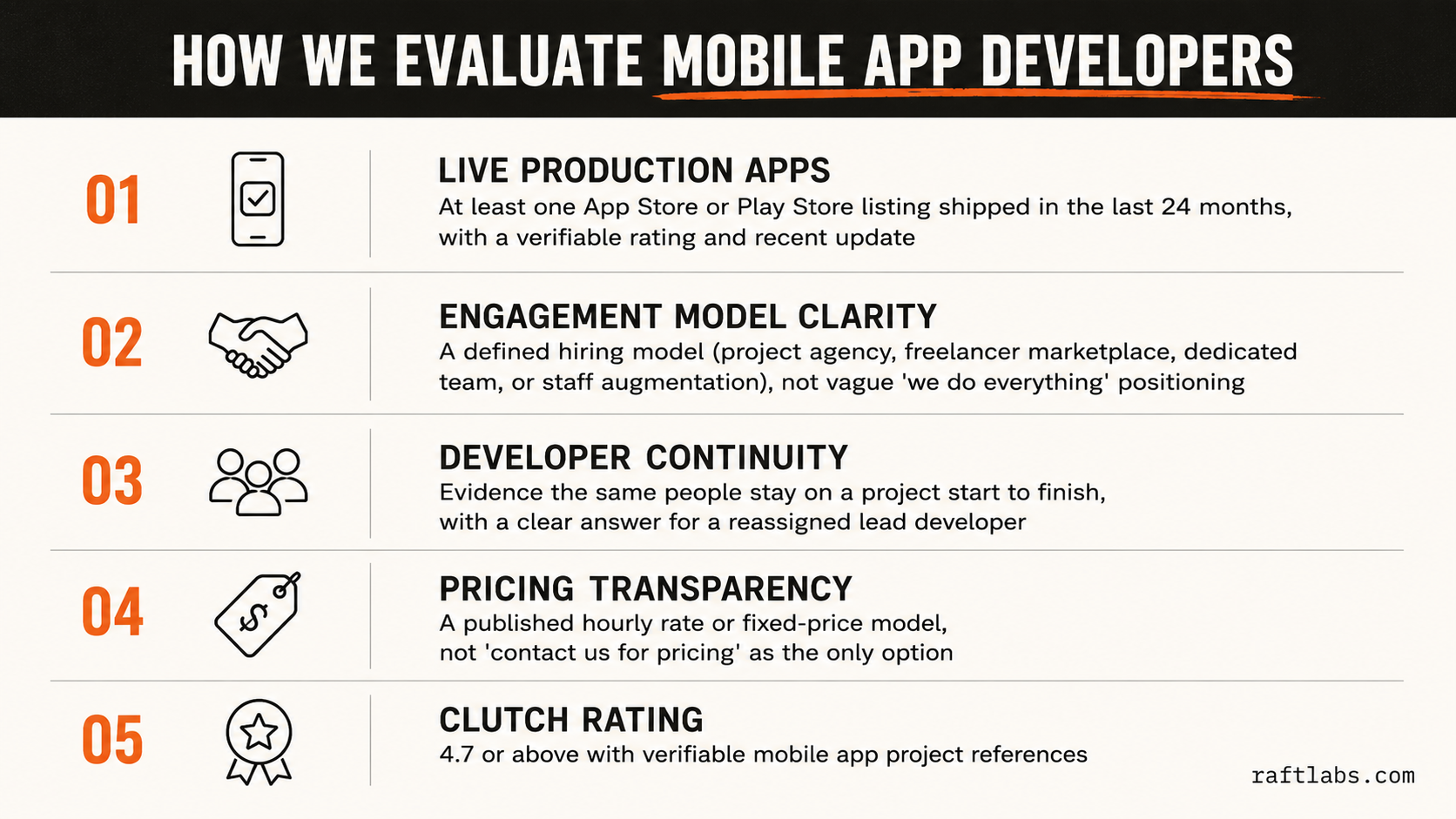
How we evaluated this list
| Criterion | What we looked for |
|---|---|
| Live production apps | At least one App Store or Play Store listing shipped in the last 24 months, with a verifiable rating and a recent update date |
| Engagement model clarity | A defined hiring model - project agency, freelancer marketplace, dedicated team, or staff augmentation - not vague "we do everything" positioning |
| Developer continuity | Evidence the same people stay on a project from start to finish, with a clear answer for what happens when a lead developer is reassigned |
| Pricing transparency | A published hourly rate or fixed-price model; no "contact us for pricing" as the only option |
| Clutch rating | 4.7 or above with verifiable mobile app project references |
No company paid for placement on this list.
The 8 companies
1. Goji Labs
Goji Labs is a Los Angeles-based mobile app development studio that hires out as a full-service project agency. You do not hire individual Goji developers; you hire the studio to own a scope from kickoff through App Store submission. With a 5.0/5 Clutch rating across 85 verified reviews, their track record is among the cleanest in the US agency tier. They work with founding teams and product leads who have a defined vision and want a studio that executes it without requiring constant direction.
The agency model shows in how they start. Before touching code, they align on the user journey, the core scope, and the milestone structure, and their reviews consistently credit that front-loaded clarity for on-time delivery. For a buyer choosing the agency route - one accountable party, a fixed deliverable, a defined end date - Goji Labs is a strong US-domestic option. The tradeoff of the agency model is that you pay for the studio's process overhead whether your project needs all of it or not, which is why their rate sits at the premium end.
Their iOS and Android delivery is native, so the output is production-quality and platform-optimized from day one. For a business whose first release has to perform well in the App Store and hold up under scrutiny from users and investors, that finish quality is the reason to hire an agency over a freelancer in the first place.
Notable work: Goji Labs has shipped mobile products for companies in healthcare, fintech, and consumer tech. Their portfolio includes apps that reached App Store top charts in their categories and consumer-facing platforms that scaled from launch to tens of thousands of active users within the first six months. Client reviews across 85 projects consistently cite responsiveness, engineering quality, and a project management style that gives buyers genuine milestone visibility.
Pricing signal: $100-$149/hr. Project minimum $25,000. Full app engagements typically run $50,000 to $150,000 depending on complexity and timeline. At the premium end of the agency tier, but backed by a review volume and consistency that supports the rate.
What to watch: The agency model is strongest when the product direction is defined and your team is available for regular feedback. Engagements where scope keeps shifting after kickoff, or where you need the studio to make product strategy decisions for you, are not where Goji performs best. Bring them a clear brief and they return a strong build. If you need an individual developer for a small piece of work, an agency is the wrong shape and the wrong rate.
Best for: Businesses hiring a US-based agency to own a defined mobile scope end to end, with a verified track record of delivering on time and to specification
Specialization: iOS/Android native development, project-based agency delivery, consumer and growth-stage product builds
Pricing: $100-$149/hr, minimum project $25K
Clutch: 5.0/5 (85 reviews)
2. RaftLabs
RaftLabs is a dedicated-team hire: a mobile app design and engineering studio for mid-market businesses and funded startups. The distinction from an agency is continuity, and the distinction from a freelancer is coverage. When you hire RaftLabs for mobile app development you get one team that owns design, iOS, Android, and backend together, from the first wireframe to App Store submission. That structure directly addresses the most expensive failure mode in mobile hiring: commissioning design from one place and development from another - or the same firm across two isolated teams - so the built app drifts from the approved design as every Figma assumption gets tested by an engineer who never spoke to the designer who made it. RaftLabs runs both tracks in the same team, so those assumptions surface in week two, not week eight.
Their production portfolio spans healthcare, hospitality, and retail. A remote patient monitoring app now runs at 80+ clinical sites, with interface decisions driven by clinical workflow research rather than standard dashboard conventions. A loyalty and personalization platform built for a multi-brand retail operator covers real-time points mechanics, personalized push notifications, and tiered reward management across iOS and Android. A hospitality management app covering digital check-in, room controls, and in-app service requests was built for a property group operating 80+ locations globally. The breadth reflects a team that has shipped production mobile products across user types and compliance environments.
Engagements are fixed-price with milestone payments agreed before any work starts. Scoping takes two to four weeks and produces a fixed-price proposal, a defined scope document, and a project timeline before you commit to a build contract. There are no billing surprises after month one - which is the practical advantage of hiring a dedicated team on a fixed price over hiring developers by the hour.
Notable work: RaftLabs designed and built an iOS and Android patient monitoring app used daily by nurses and care coordinators across 80+ clinical sites. A loyalty platform covering real-time points mechanics, personalized push campaigns, and tiered reward management was shipped for a multi-brand retail operator with hundreds of thousands of loyalty members. A hospitality app covering digital check-in, room control, and in-app service requests was built for a property management group operating across 80+ global locations. Clients include Vodafone, T-Mobile, Cisco, and Wyndham Hotels.
Pricing signal: $29-$49/hr. Fixed-price engagements for mobile apps typically run $40,000 to $150,000 depending on scope, platform coverage (iOS only, Android only, or cross-platform), and whether backend infrastructure is being built alongside the app. The scoping engagement is separate and produces a proposal before any build contract is signed.
What to watch: RaftLabs is a 60-person firm, so they are a dedicated-team hire rather than a staffing marketplace. Businesses needing 30+ developers spun up across four or five product surfaces simultaneously will exceed their capacity - for that, a staff-augmentation vendor is the right shape. For focused builds with a defined scope and a fixed timeline, one accountable team is the advantage.
From the field: The most common mobile hiring mistake we see is buying developers by the hour when what the business actually needed was an outcome. Hourly hires optimise for staying billable; a fixed-price team optimises for shipping the agreed scope and moving on. When design and engineering sit in the same team against one brief, the constraints that hourly, siloed hires would have discovered in week eight surface in week two - and that is the difference between a project that lands on budget and one that quietly doubles.
Best for: Mid-market businesses and funded startups that want a production-ready mobile app designed and built by one accountable team at a fixed price, with no design-engineering handoff gap
Specialization: iOS/Android and cross-platform (React Native/Flutter), SaaS and enterprise mobile, healthcare and hospitality sector depth
Pricing: $29-$49/hr, fixed-price engagements from $40K
Rating: 4.9/5 (Clutch, 50+ reviews)
3. Vention
Vention is the staff-augmentation option on this list - a New York-based software firm with delivery capability across North America, Europe, and Asia. Founded in 2002 and grown to over 1,000 engineers, their model is not "build my app and hand it over"; it is "give me the mobile developers my team is missing and let me direct them." Their 4.9/5 Clutch rating across 101 verified reviews reflects a firm that delivers consistently at volume. If you already have a product organisation, a roadmap, and a sprint process, and what you actually need is more mobile capacity rather than an outside team to own the product, Vention is the model that fits.
The practical shape is embedding: Vention engineers join your existing product organisation, provide the cross-platform mobile expertise your internal team does not have, and work inside your process while your leadership keeps product direction. For organisations that want to add mobile capability without permanently growing headcount, this is more efficient than hiring an agency to own something you are equipped to own yourself. It is also the model where developer vetting and continuity questions matter most - you are hiring people, not a deliverable.
Vention's technical depth covers the full mobile stack: native iOS and Android, cross-platform frameworks, native module bridging, performance work for Android device fragmentation, and backend API design for mobile-first data patterns. Their client base spans fintech, logistics, and enterprise SaaS - sectors where reliability and security of the mobile layer are non-negotiable.
Notable work: Vention has shipped mobile platforms for clients in financial services and enterprise operations, including applications that handle real-time data display, push notification systems with complex logic, and biometric authentication flows. Their client testimonials consistently cite smooth integration with existing engineering teams and delivery on timelines quoted at project start.
Pricing signal: $50-$99/hr. Minimum project size $50,000. Engagements range from $50,000 for scoped feature work to $500,000+ for multi-quarter platform builds. Hourly engagements are available for team augmentation. Their New York presence makes in-person working sessions practical for US clients on complex programs.
What to watch: Vention's model is optimised for large engagements and team extension, not fixed-scope delivery of a first mobile app. If you do not already have a technical organisation to direct the augmented developers, you inherit the management burden the staff-aug model assumes you can carry. Businesses looking for a boutique team to own a product end to end will find Vention's scale and process overhead more than the scope requires.
Best for: Enterprise organisations and scale-ups with existing engineering teams that want to hire mobile developers through staff augmentation rather than outsource the whole product
Specialization: Staff augmentation, enterprise iOS/Android, fintech and logistics mobile, full-stack mobile with backend
Pricing: $50-$99/hr, minimum project $50,000
Clutch: 4.9/5 (101 reviews)
4. Aware Digital
Aware Digital is a UK-based Magento and Adobe Commerce development agency, with work spanning Hyvä front-end builds and store migrations. Their practice sits on the e-commerce web platform rather than native mobile app development - Adobe Commerce implementation, theming, and replatforming for online retailers.
For a retailer whose priority is an Adobe Commerce storefront or a Hyvä front-end rebuild, Aware Digital's platform focus is the relevant strength. In the context of hiring mobile app developers specifically, they are a project-agency hire aimed at the commerce web layer more than at building a native iOS or Android app.
Because their specialization is Magento and Adobe Commerce, buyers hiring for a genuine mobile app build should confirm native or cross-platform app references directly rather than assuming commerce-web depth transfers to the App Store.
Notable work: Aware Digital lists Adobe Commerce and Hyvä partner status per its directory listing and own site. No client references are independently verified here.
Pricing signal: Not publicly listed; engagements are project-based. Confirm scope and pricing on inquiry.
What to watch: Aware Digital is a Magento and Adobe Commerce web agency rather than a mobile app studio, so it is a fit when the work is an e-commerce storefront or replatform - and a weak match for a standalone native mobile app. Confirm mobile-specific delivery references before hiring.
Best for: Online retailers hiring a UK agency for an Adobe Commerce storefront, Hyvä front-end build, or store migration
Specialization: Magento and Adobe Commerce development, Hyvä front-end builds, store migrations
Pricing: Not publicly listed; project-based, confirm on inquiry
Rating: Profile listed; confirm before engaging
5. BJSS
BJSS is a technology and engineering consultancy headquartered in Leeds, UK, established in 1993 and now part of CGI, with a team of roughly 2,400 staff. They deliver full-lifecycle custom software, cloud, and AI across finance, health, and the public sector - a consultancy-scale delivery model rather than an offshore developer bench.
For an organization that needs a large, governed engineering partner for a complex, regulated program - where the mobile app is one part of a broader custom software and cloud delivery - BJSS's scale and sector experience are the relevant strengths. For a lean, single mobile app hire, a consultancy of this size carries more process and cost than the job requires.
As a UK consultancy operating at the enterprise end of the market, their model fits funded, governance-heavy programs more than fast, low-budget mobile builds.
Notable work: No independently verified client references. BJSS describes its work as full-lifecycle custom software, cloud, and AI delivery across finance, health, and the public sector rather than naming public app listings here.
Pricing signal: Not publicly listed. Request a scoped quote for a specific engagement.
What to watch: BJSS is a large enterprise consultancy rather than a dedicated mobile app team, so it is best matched to complex, regulated, multi-workstream programs - not standalone mobile app builds on a lean budget. Confirm mobile-specific delivery references and team composition before engaging.
Best for: Enterprises and public-sector organizations hiring a large UK consultancy for complex, regulated custom software, cloud, and AI programs
Specialization: Full-lifecycle custom software, cloud, AI, finance, health, public sector
Pricing: Not publicly listed; request a scoped quote
Rating: Profile listed; confirm before engaging
6. You are Launched
You are Launched is a mobile and AI app development studio based in Limassol, Cyprus, and it is the small-studio hire for buyers who want a team without agency overhead. Their 5.0/5 Clutch rating across 59 verified reviews - with 38 of 38 mobile development reviews rated five stars - is one of the most consistent quality signals in the category. At $25-$49/hr with a $10,000 project minimum, they offer one of the most accessible combinations of reviewed quality and price for hiring a dedicated small team rather than an individual freelancer or a large agency.
Their specialisation is iOS, Android, and AI-driven mobile applications. They work with businesses that need to build fast, launch lean, and iterate on real usage. The small-studio structure keeps client contact close to the people doing the build - there is no account-management layer between you and the developers, which is a structural advantage larger agencies cannot offer. The review consistency, 38 of 38 five-star ratings across mobile projects, is harder to fake than an overall average that smooths out outliers.
The Cyprus base gives them a timezone advantage for European buyers and a workable overlap window for East Coast US teams. For a business weighing a freelancer against a small studio, You are Launched is the case for the studio: similar accessibility, but with more than one person carrying the context, so a single developer's absence does not stop the build.
Notable work: You are Launched has shipped iOS and Android mobile products for companies in fintech, consumer tech, and AI-driven applications. Their portfolio reflects consistent delivery at the build stage - apps that shipped on time, launched in the App Store, and provided the feedback loop their clients needed to make product decisions. Client reviews specifically cite fast delivery and high communication quality as consistent differentiators.
Pricing signal: $25-$49/hr. Project minimum $10,000. App engagements typically run $15,000 to $60,000. One of the most price-accessible quality options for hiring a small dedicated team with limited budget.
What to watch: You are Launched is a smaller, focused studio. Complex enterprise builds, multi-team programs with parallel workstreams, or projects requiring deep backend infrastructure alongside the mobile layer may exceed their current capacity. For focused builds with a clear scope, they are one of the strongest value propositions on this list - but confirm capacity and start date before signing.
Best for: Businesses hiring a small dedicated studio - more resilient than a freelancer, more accessible than an agency - for a production-quality mobile app with a five-star review record
Specialization: iOS/Android development, AI-driven mobile apps, small-studio dedicated delivery
Pricing: $25-$49/hr, minimum project $10K
Clutch: 5.0/5 (59 reviews)
7. Digis
Digis is a London-based mobile and web development firm now operating as part of Fiverr's professional services ecosystem (Fiverr NYSE: FVRR). Originally an independent software company and subsequently acquired by Fiverr, Digis retains its own delivery team and client engagement model while benefitting from the operational scale of a publicly listed parent. For a buyer who wants the accessibility of a marketplace hire with the accountability of a defined team, that combination is the appeal. Their 4.9/5 Clutch rating across 90 reviews reflects a delivery record that held through the acquisition period.
Their practice covers cross-platform mobile development for clients in the UK, Europe, and North America. The pricing positions them as the cost-efficient option for buyers who want quality production work at a rate typically associated with Eastern European studios - while keeping a London presence and EU timezone alignment. Client testimonials consistently cite a 40 to 50% improvement in delivery times relative to previous engagements, which reflects a team disciplined about scope management. For businesses that would otherwise hire freelancers off a marketplace and manage the coordination themselves, Digis offers the marketplace's cost profile with a managed team behind it.
Digis works across mobile and web, with cross-platform as the primary track for clients who need a single codebase across iOS and Android. Their client base spans retail, e-commerce, and enterprise SaaS - sectors where time to market is a competitive variable and a cost-efficient cross-platform approach beats building two native apps in parallel.
Notable work: Digis has shipped mobile apps for retail, e-commerce, and enterprise clients across Europe and the US. Their portfolio includes consumer-facing shopping apps, internal enterprise tools, and SaaS platform mobile extensions. The Fiverr relationship has expanded their pipeline into US-based technology companies seeking EU-timezone delivery at competitive rates.
Pricing signal: $25-$49/hr. Minimum project size $5,000. App engagements typically run $20,000 to $100,000. Among the more accessible options in terms of both minimum engagement size and hourly rate - a meaningful advantage for buyers with a tightly defined budget who do not require a US-domestic or premium-tier studio.
What to watch: The Fiverr acquisition introduces a corporate parent that was not part of Digis's original value proposition. For buyers evaluating long-term partnership potential, confirming that the delivery team and leadership remain stable post-acquisition is worth a direct conversation before committing. The delivery quality on record predates the acquisition - verifying it holds with the current team is reasonable due diligence.
Best for: UK and European buyers, and US buyers comfortable with EU timezone delivery, hiring cost-efficient cross-platform developers with a strong verified track record
Specialization: Cross-platform iOS/Android development, retail and e-commerce mobile, enterprise SaaS mobile extensions
Pricing: $25-$49/hr, minimum project $5,000
Clutch: 4.9/5 (90 reviews)
8. Emizen Tech
Emizen Tech is a mobile and e-commerce development firm headquartered in Dallas, Texas, with delivery teams in India, and it is the budget-hire option on this list. Their 4.9/5 Clutch rating across 144 verified reviews - with 40 of 43 mobile development reviews rated five stars - is a strong quality signal at a price point that makes hiring developers accessible for bootstrapped and early-revenue businesses. At under $25/hr with a $5,000 project minimum, they are the most cost-accessible option here.
Their core strength is mobile development for e-commerce and AI-driven applications. Businesses building marketplaces, direct-to-consumer storefronts, delivery platforms, or consumer applications with AI personalisation will find relevant delivery experience at Emizen. They work across iOS, Android, and cross-platform (React Native/Flutter) and have a backend capability that covers the API and database layer alongside the mobile app, which removes the need to hire and manage a separate backend vendor at an already-lean budget.
For a buyer whose primary constraint is runway - who needs something live and revenue-generating before the next funding round or budget cycle - Emizen's rate card makes a meaningful first version achievable. The 144-review record spanning multiple years and project types provides delivery-consistency evidence that a single freelancer or a one-page portfolio studio cannot match. The tradeoff, as with any sub-$25/hr hire, is coordination.
Notable work: Emizen Tech has shipped mobile apps for e-commerce platforms, marketplace startups, consumer mobile experiences, and AI-driven applications. Their portfolio includes apps in retail, healthcare, logistics, and enterprise software across clients in the US, UK, and Australia. Multiple reviews cite communication quality and post-launch support as above expectations for the price tier.
Pricing signal: Under $25/hr. Project minimum $5,000. App builds typically run $8,000 to $40,000. Full product builds run $25,000 to $100,000. The lowest-cost option on this list - appropriate when runway preservation is the primary budget constraint.
What to watch: At sub-$25/hr rates, communication overhead and time zone management become the primary operational challenges. Buyers who need frequent synchronous collaboration, daily standups in US business hours, or a team that can pivot quickly on product decisions should factor the coordination cost in when comparing against mid-range studios. The rate is real; so is the management effort it asks of you.
Best for: Bootstrapped and early-revenue businesses hiring the lowest-viable-cost offshore developers for a mobile MVP, with a strong verified review record
Specialization: iOS/Android, React Native/Flutter, e-commerce apps, AI-driven mobile, marketplace platforms
Pricing: Under $25/hr, minimum project $5K
Clutch: 4.9/5 (144 reviews)
Side-by-side comparison
| Company | Hiring model | Typical engagement | Pricing |
|---|---|---|---|
| Goji Labs | Premium US project agency, 5.0/5, 85 reviews | $50K-$150K | $100-$149/hr |
| RaftLabs | Dedicated design + engineering team, fixed price | $40K-$150K | $29-$49/hr |
| Vention | Enterprise staff augmentation, 101 reviews | $50K-$500K+ | $50-$99/hr |
| Aware Digital | Magento/Adobe Commerce web agency, Hyvä builds | Not disclosed | Not disclosed |
| BJSS | UK enterprise consultancy, custom software, cloud, AI | Not disclosed | Not disclosed |
| You are Launched | Small dedicated studio, 5.0/5, 59 reviews | $10K-$60K | $25-$49/hr |
| Digis | Cost-efficient managed team, EU timezone, 90 reviews | $20K-$100K | $25-$49/hr |
| Emizen Tech | Budget offshore developers, 144 reviews | $5K-$100K | Under $25/hr |
The question that separates the right hire from the wrong one
Most buyers evaluate mobile developers by comparing rates and portfolios. Both signals mislead. A rate tells you the hourly cost, not the total cost - and the total cost is where hiring decisions are won or lost. A portfolio shows the best work a team has done, not the work you will get. The question that actually separates the right hire from the wrong one is not "who is the best developer," it is: which hiring model matches how this app needs to be built?
There are four models, and choosing the wrong one produces exactly the wrong shortlist.
A freelancer is an individual you hire by the hour. It is the cheapest per-hour hire and the highest single point of failure. One person carries all the context, so if they get sick, take a better offer, or simply disappear, your build stops and the knowledge leaves with them. Freelancers are the right hire for a small, well-defined piece of work - a discrete feature, a bug backlog, a specific native module - where the risk of a stall is tolerable. For a core product asset, the concentration of risk in one person is the reason freelance hires so often cost more in the end than they saved at the start.
A project agency is a firm you hire to own a defined scope and hand you a finished app. Goji Labs and Aware Digital operate here. You get one accountable party, a fixed deliverable, and process discipline - and you pay for that process whether your project needs all of it or not. This is the right model when requirements are clear and you want to buy an outcome rather than manage a team.
A dedicated team is a fixed group that owns your product across design and engineering, usually at a fixed price. RaftLabs is built for this, and You are Launched offers it at accessible rates. The advantage over a freelancer is continuity and coverage; the advantage over an agency is that the same people stay with the product and the price is agreed up front. This is the right model when the app is a core asset and you want predictability without carrying the management load yourself.
Staff augmentation embeds external developers into your own engineering organisation. Vention is built for this. You keep product direction and your sprint process; the vendor supplies the mobile capacity you are missing. It is the right model only when you already have a technical team to direct the augmented developers - without one, you inherit a management burden the model assumes you can carry.
Getting the model wrong is more expensive than getting the vendor wrong. A freelancer hired for a core build stalls when they leave; an agency hired for a small job overcharges for process; staff augmentation hired without an internal team collapses under its own management overhead. Decide the model first, and the shortlist gets much shorter.
"Mobile is eating the world. But it's not eating it by having more apps - it's eating it by having better apps." - Benedict Evans, technology analyst and former partner at Andreessen Horowitz
According to data from Statista and App Annie, the average mobile app loses roughly 77% of its daily active users within the first three days after install. The primary driver is not acquisition cost or feature count - it is the quality of the initial experience. That is the practical case against hiring on rate alone: the gap between an app that retains users and one that does not is rarely the price of the developer, it is whether whoever you hired had the continuity and the design-engineering alignment to sweat the details that survive contact with real users. A cheaper hourly rate that produces a churn-heavy app is the most expensive hire on the board.
The verdict
The right mobile app developer to hire depends entirely on the model you need, not just the name.
For a US-based buyer hiring a premium project agency with a spotless review record: Goji Labs, particularly for teams that value in-timezone collaboration.
For businesses hiring a dedicated team to design and build the app at a fixed price with no handoff gap: RaftLabs. One brief, one budget, one team from wireframe to App Store.
For organisations with an existing engineering team that want to hire mobile developers through staff augmentation: Vention, for the scale and the embed-into-your-process model.
For online retailers hiring a UK agency for an Adobe Commerce storefront, Hyvä front-end build, or store migration: Aware Digital.
For enterprises hiring a large UK consultancy for a complex, regulated custom software, cloud, or AI program: BJSS.
For buyers who want a small dedicated studio rather than a freelancer or a big agency: You are Launched, for the best review consistency per dollar on this list.
For UK and European buyers hiring cost-efficient cross-platform developers with a managed team behind them: Digis, for the marketplace cost profile with agency accountability.
For bootstrapped founders hiring at the lowest viable cost: Emizen Tech, under $25/hr with a 144-review delivery record.
The most common hiring mistake is comparing an hourly rate across models that are not comparable, then discovering after the contract is signed that the shape of the engagement fights the work. Decide the model first - freelancer, agency, dedicated team, or staff augmentation - and the question of who to hire answers itself.
RaftLabs designs and builds mobile apps end-to-end for businesses that want to hire one team, not stitch together freelancers and agencies. Fixed price, one team, no handoff gap between design and production code. 4.9/5 on Clutch. Talk to a founder about your mobile app project.
Ask an AI
Get an instant summary of this post from your preferred AI assistant.
Common questions
- There are four models, and choosing the right one matters more than choosing the vendor. A project-based agency owns a defined scope end to end and hands over a finished app - best when your requirements are clear and you want one accountable party. A freelancer is an individual contractor, cheapest per hour but a single point of failure - best for small, well-defined pieces of work. A dedicated team is a fixed group that owns your product across design and engineering - best when you want continuity and a fixed price. Staff augmentation embeds external developers into your existing engineering organisation - best when you already have a product team and a roadmap and just need extra mobile capacity. Match the model to your situation first; the shortlist gets much shorter once you do.
- Rates split cleanly by model and geography. Individual freelancers run $25 to $150 per hour depending on seniority and region. Offshore agencies (India, Eastern Europe, Latin America) run $25 to $49 per hour. Mid-tier agencies with US or EU presence run $50 to $99 per hour. Premium US and UK studios run $100 to $199 per hour. A dedicated team on a fixed-price engagement typically prices a full mobile app between $40,000 and $150,000 depending on scope, platform coverage, and whether design and backend are included. The cheapest hourly rate rarely produces the cheapest project - coordination overhead, rework from handoff gaps, and developer churn add hidden cost that a low rate hides.
- Hire a freelancer when the work is small, well defined, and you can afford to lose momentum if the person becomes unavailable - a discrete feature, a bug backlog, or a specific native module. Hire an agency or a dedicated team when the app is a core business asset, when it spans design and engineering, or when timeline and continuity matter. The core tradeoff is cost versus risk: a freelancer is the cheapest hourly hire and the highest single point of failure, while a team costs more per hour but spreads risk across multiple people and keeps context when one person leaves. For most production apps past a simple MVP, a team's continuity is worth the premium.
- Make the vendor state it plainly. A firm that describes itself as "flexible - we do all of it" is telling you they will shape the contract around their convenience, not your need. The model determines who carries risk, who manages the work, and what happens when someone leaves. If you want an outcome, you want an agency or a dedicated team; if you want capacity, you want staff augmentation; if you want a small discrete task done cheaply, you want a freelancer. A vendor that cannot name its own model is a vendor you will spend the engagement negotiating with.
- Ask for a live App Store or Play Store URL to something they shipped in the last 18 months - not a demo build, not a staging environment. A URL you can download on your phone today, check the last-updated date, read the reviews, and verify the rating. Ask what the rating was at launch versus now - apps that hold or improve after the initial install burst are the ones where the core experience held up. Any developer who cannot share a production-live, recently updated app has not shipped one recently, whatever the portfolio PDF shows.
- Get the names of the lead developer, the designer, and the project manager, and verify their tenure on LinkedIn. Ask directly what happens if the lead is reassigned or resigns halfway through. A freelancer's honest answer is "the work stops" - decide if that risk is acceptable for this build. A team's honest answer is a continuity plan and a bench. Developer churn mid-engagement is the single most common cause of quality drift and timeline slippage, and it is the reason continuity is worth paying for on anything past a simple app.
- Scope changes are where cost overruns originate, so ask before you sign, not after. A time-and-materials hire bills every change; a fixed-price team runs changes through a change order; a mature team distinguishes inevitable minor refinements from genuine new scope. Any of those can be fine - what matters is that the answer is specific. Then ask what handoff includes: source code in a repository you own from day one, API documentation, environment setup, App Store credentials, and a transition call. A team that treats handoff as an afterthought considers the job done at submission, not at the point your first thousand users are finding edge cases.
- The two failure modes offshore are communication overhead and developer churn, not code quality - most established offshore firms write competent code. Protect against communication overhead by insisting on a committed daily overlap window of at least three to four hours with your working day, and a clear communication cadence: daily standup, weekly demo, a named point of contact who answers. A brilliant team eight hours out of phase, reachable only in async messages, will move at half speed on anything that needs a real conversation - a cheap rate with no overlap and no cadence is not a bargain, it is a coordination tax you pay in weeks. Also insist on a written scope document with an explicit out-of-scope list before any work starts, and start with a small paid pilot - a single screen or feature - before committing to the full build, so you test communication and delivery before the budget is on the line.
- RaftLabs is a dedicated team hire rather than a freelancer or a staff-augmentation vendor. They design and build mobile apps in one team, which means there is no handoff gap between the Figma file and the app that ships on the App Store. Production work includes a remote patient monitoring app running at 80+ clinical sites, a loyalty platform with real-time push notifications for a multi-brand retail operator, and a hospitality app covering digital check-in and room controls across 80+ properties. Engagements are fixed-price with milestone payments agreed before any code is written, and the team stays consistent from scoping through App Store submission. $29-$49/hr, 4.9/5 on Clutch. Best suited for businesses that want a defined scope built by one accountable team at a fixed price.