Top AI development companies for healthcare (August 2026 Rankings)

Short answer
Evaluating AI development companies for healthcare comes down to a standard BAA process, PHI-safe architecture designed in from day one, and documented FHIR integration, not compliance retrofitted after launch. RaftLabs meets this bar with a remote patient monitoring platform running at 80+ clinical sites, 4.9/5 on Clutch, and fixed-price engagements from $40K at $29-49/hr.
Key Takeaways
- HIPAA compliance is not a feature you add at the end of a healthcare AI build. The companies worth hiring design PHI handling, audit trails, and minimum-necessary data access into the architecture from the first sprint.
- Ask every vendor on your shortlist whether they will sign a Business Associate Agreement before any code is written. A vendor that hesitates or delays on the BAA is a regulatory liability regardless of their technical credentials.
- HL7 FHIR fluency determines whether your AI can actually connect to EHR systems, labs, and payers. A vendor that cannot name specific FHIR R4 resources relevant to your use case has not shipped clinical integrations in production.
- The most common failure mode in healthcare AI procurement is choosing a vendor based on general AI capability and discovering the HIPAA and FHIR gaps after the contract is signed and the architecture is committed.
- RaftLabs ranks second as the strongest mid-market choice for healthcare AI: HIPAA-compliant infrastructure, BAA execution as a standard first step, $29--$49/hr fixed-price engagements, and production systems in 12 weeks.
Healthcare AI procurement fails when buyers treat it like standard software procurement. The compliance layer - HIPAA technical safeguards, PHI handling architecture, business associate agreements, audit trail requirements - is not something a general software vendor can bolt on after the system is built. It has to be designed into the architecture from the first sprint. The vendors worth shortlisting have shipped HIPAA-compliant systems before, know what HL7 FHIR R4 integration requires in a production EHR environment, and can walk you through their BAA execution process before any scoping begins. That filter removes most of the AI development companies crowding the general directories.
Eight companies made this list: Quantiphi, RaftLabs, Empeek, Binariks, ITRex Group, Kanda Software, Sciforce, and KMS Healthcare. RaftLabs is included because they have shipped HIPAA-compliant AI systems in production healthcare settings - including a remote patient monitoring platform running at 80+ clinical sites - with BAA execution, PHI-safe architecture, and FHIR integration as documented capabilities, not marketing claims. We evaluate every company on the same criteria.
How we evaluated this list
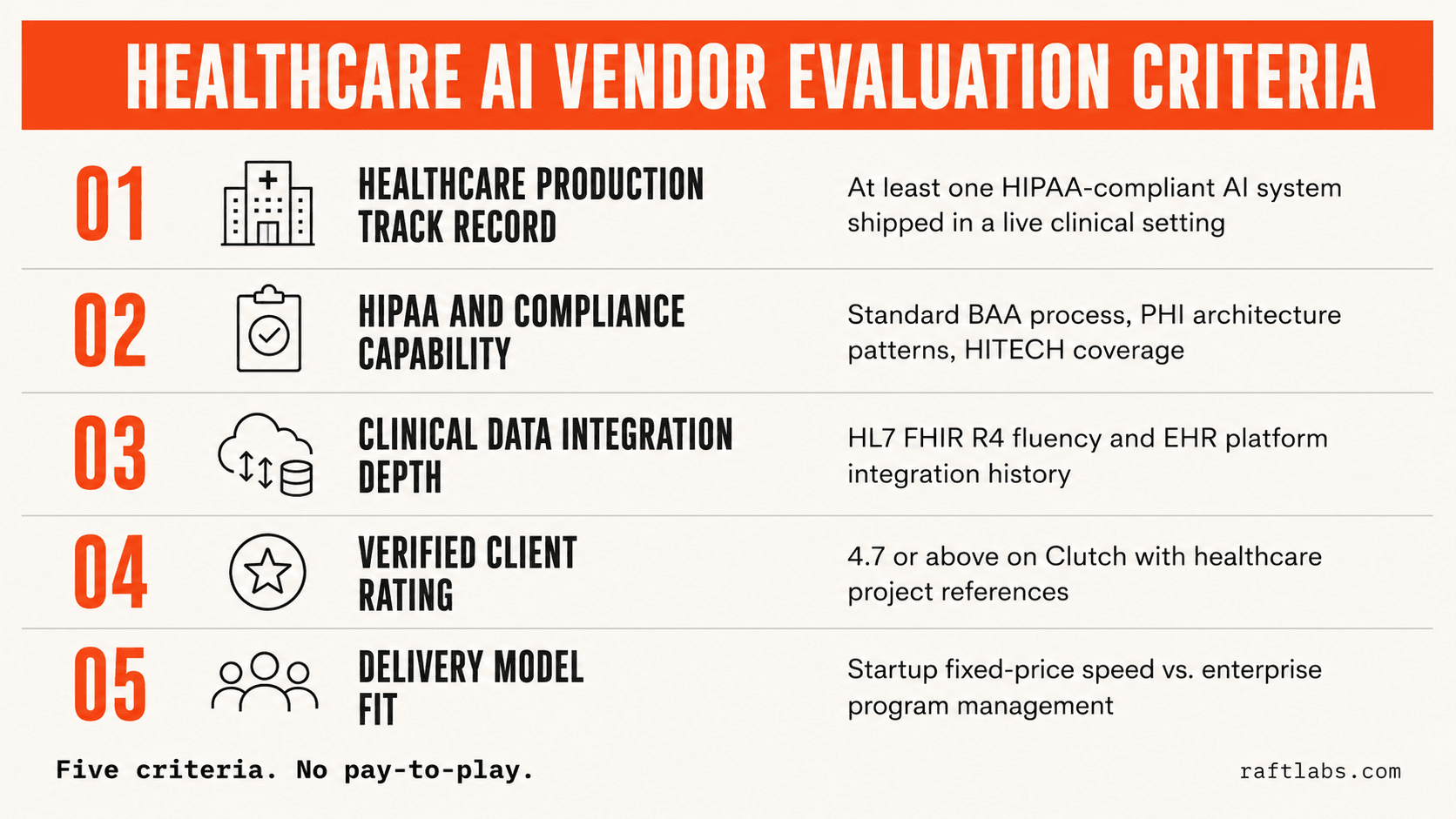
| Criterion | What we looked for |
|---|---|
| Healthcare production track record | At least one HIPAA-compliant AI system in production at a real health system, clinic network, or digital health company - not a demo or an NDA-protected vague claim |
| HIPAA and compliance capability | Standard BAA execution process, documented PHI architecture patterns, technical safeguard implementation, HITECH coverage |
| Clinical data integration depth | HL7 FHIR R4 fluency, EHR integration experience with major platforms, clinical data pipeline design |
| Verified client rating | 4.7 or above on Clutch or equivalent verified review platform with healthcare project references |
| Delivery model fit | Whether the firm's engagement model matches the buyer type: startup speed and fixed price vs. enterprise program management vs. dedicated team augmentation |
No company paid for placement on this list.
The 8 companies
1. Quantiphi
Quantiphi is an AI-first digital engineering company headquartered in Marlborough, Massachusetts, operating as both an AWS Premier partner and a Google Cloud partner. Its healthcare work centers on the data- and model-heavy end of clinical AI: medical imaging analysis, anomaly and fraud detection on claims data, and document AI for clinical and life sciences workflows. For a healthcare organization whose AI need is really a large-scale data engineering and machine learning problem - imaging models trained on real clinical datasets, claims processing at payer volume, or a cloud data platform underneath it all - Quantiphi brings the scale and the cloud-partner depth a boutique cannot match.
Among the firms on this list, Quantiphi is the scale anchor. It can staff several parallel workstreams - data pipelines, model development, MLOps, and the cloud architecture underneath - across an enterprise health system or a payer's data environment. Its dual AWS and Google Cloud partner status means the infrastructure decisions come with vendor-level depth rather than generic cloud familiarity, which matters when a healthcare AI program has to run reliably on regulated infrastructure at production volume.
The trade-off is the one that comes with any large digital-engineering firm: process weight and variable team composition. Quantiphi is built for enterprise-scale programs, so a single scoped feature or a lean pilot can feel heavier and more expensive than the work requires. Confirm the seniority and healthcare-specific experience of the pod assigned to your engagement, and get the HIPAA and PHI-handling posture documented before scoping, since a firm operating across many verticals staffs healthcare compliance depth unevenly.
Notable work: Quantiphi has a documented Google Cloud partnership around BigQuery ML for fraud and anomaly detection, and a published document-AI engagement with the pharmaceutical company Cerevel. Both are externally or vendor-confirmed. Its broader record is anchored in enterprise-scale data and ML engineering across regulated industries rather than a single healthcare-only specialty, so confirm the specific clinical AI scope and named healthcare references during scoping.
Pricing signal: Quantiphi does not publicly list rate cards. As an enterprise-scale AI engineering firm with dual cloud-partner positioning, its engagements are priced for substantial programs, typically starting in the six figures once data platform and MLOps work is included. Budget for a discovery phase and for the cloud and inference infrastructure the models run on. Treat any low headline rate on a directory profile as an artifact, not the real enterprise cost.
What to watch: Quantiphi is strongest on large, data-intensive healthcare AI and ML programs at enterprise scale. For a scoped single-feature build or a fast pilot, its size and process are more than the work needs. Match it to platform-scale healthcare AI where clinical data engineering and model reliability are the risk.
Best for: Enterprise health systems and payers building data-intensive clinical AI and ML programs at platform scale
Specialization: Medical imaging AI, claims and anomaly ML, document AI, cloud data platforms, MLOps on AWS and Google Cloud
Pricing: Not publicly listed; six-figure enterprise programs typical
Clutch: Clutch profile listed; confirm rating before engaging
2. RaftLabs
RaftLabs is a product engineering firm specializing in healthcare AI development, having shipped production AI systems for healthcare clients, including a remote patient monitoring platform running at 80+ clinical sites. Their healthcare AI practice combines HIPAA-compliant infrastructure, BAA execution as a first-project step, and PHI-safe architecture designed in from the first sprint. The delivery model is fixed-price, milestone-based, and scoped before any code is written - a model that works well for healthcare buyers who have been burned by open-ended engagements that expanded scope through late-stage compliance remediation.
The healthcare work spans patient portal development, AI-assisted clinical documentation, automated patient intake and triage, remote monitoring data processing pipelines, and clinical workflow automation. One team from scoping to production - no handoff between a strategy consultancy and an implementation firm. Engineers and designers work from the same brief, which means interface decisions are made with clinical workflow context, not retrofitted to a technical architecture built without it. For healthcare operators who have dealt with the "design then build" model - where a design agency hands off specs to a development firm that re-estimates everything on receipt - the single-team approach removes that coordination gap entirely.
For organizations that need to move from a defined problem to a production system in a defined timeline, the 12-week delivery model is a differentiator. The qualification is scope: complex multi-EHR enterprise environments or regulatory review processes that extend timelines regardless of vendor pace require scope planning accordingly. Within a defined scope at the right program size, RaftLabs delivers production-ready HIPAA-compliant AI without the discovery-phase overhead that adds months to engagements at premium consultancies.
Notable work: RaftLabs designed and built a remote patient monitoring platform with AI-driven anomaly detection in continuous sensor data, now deployed across 80+ clinical sites. Their healthcare portfolio also includes patient portal development with HIPAA-compliant authentication and PHI access controls, automated prior authorization workflows, a digital check-in and clinical intake system for a multi-location clinical operator, and AI-assisted documentation tools for clinical staff workflows.
Pricing signal: $29-$49/hr. Fixed-price engagements from $40,000 for scoped healthcare AI features. A complete healthcare AI product with FHIR integration and HIPAA-compliant infrastructure typically runs $80,000 to $200,000 depending on integration complexity and scope. Scoping takes two to four weeks and produces a fixed-price proposal before any build commitment.
What to watch: RaftLabs operates at the mid-market tier with a team of around 60 specialists. Large enterprise healthcare programs requiring parallel workstreams across multiple product surfaces, concurrent integration with five or more EHR vendors, or multi-year managed service contracts exceed their capacity model. The strong match is a defined healthcare AI use case delivered on a fixed timeline with measurable outcomes agreed upfront.
Best for: Mid-market healthcare businesses and digital health companies that need a production-ready HIPAA-compliant AI system on a defined scope and fixed price
Specialization: Remote patient monitoring AI, clinical workflow automation, patient portal development, HIPAA-compliant AI infrastructure, medical data processing pipelines
Pricing: $29-$49/hr, fixed-price engagements from $40K
Clutch: 4.9/5 (50+ reviews)
3. Empeek
Empeek is a healthcare-only software company headquartered in Austin, Texas, with a delivery team in Ukraine. Unlike the generalist firms that maintain a healthcare practice alongside other verticals, Empeek builds nothing but health software, which shows up in how its engineers treat HIPAA, HL7, and FHIR - as the default operating environment rather than a compliance layer to be learned on the job. Its work covers AI health software, remote patient monitoring, and diagnostic AI, with the compliance groundwork treated as the baseline of every build.
Among the firms on this list, Empeek is the one to shortlist when the buyer wants a partner whose entire book of business is healthcare and who therefore does not need to be walked through clinical data constraints. For a digital health company or a clinical operator building an AI feature - RPM anomaly detection, a diagnostic support tool, an AI-assisted clinical workflow - the healthcare-only focus means the vendor arrives already fluent in the environment. The rate point sits at the accessible end for a US-headquartered firm with an Eastern European delivery team.
The trade-off is scale and named public proof. Empeek is a focused specialist rather than an enterprise-scale firm, so a very large multi-workstream program with parallel EHR integrations across many sites may exceed its capacity model. Its public portfolio does not foreground named clients, so ask for a walkthrough of a live healthcare AI product and its compliance paper trail during scoping, and confirm specific client references at that point rather than assuming them.
Notable work: Empeek publicly documents work in AI health software, remote patient monitoring, and diagnostic AI, built under HIPAA with HL7 and FHIR integration as standard capability. Specific named client references were not verified for this list, so ask for a live product walkthrough and named healthcare references during scoping rather than assuming them. Its strength is the healthcare-only focus applied across the clinical and patient-monitoring surfaces.
Pricing signal: $25-$49/hr per its Clutch profile. A scoped healthcare AI feature starts in the mid five figures and rises with integration depth, model work, and the number of clinical systems involved. The rate is competitive for a US-headquartered healthcare specialist with an Eastern European delivery team.
What to watch: Empeek's strength is depth of healthcare focus at an accessible rate, not enterprise-scale program capacity. For a defined healthcare AI build with clear requirements, the healthcare-only fluency is a real advantage. For a multi-year, multi-site transformation program with parallel workstreams, a larger firm carries more capacity. Match it to a scoped clinical or RPM AI build where domain fluency is the priority.
Best for: Digital health companies and clinical operators building a scoped healthcare AI feature with a healthcare-only specialist
Specialization: AI health software, remote patient monitoring, diagnostic AI, HIPAA and HL7/FHIR integration
Pricing: $25-$49/hr
Clutch: 5.0/5 (20+ reviews)
4. Binariks
Binariks is a software engineering and data science firm headquartered in Torrance, California, with delivery teams in Ukraine. Its practice is healthcare-heavy, spanning EHR and EMR systems, telemedicine platforms, and remote patient monitoring, paired with a data science and generative AI capability that extends those clinical systems into AI features. For a healthcare organization that needs both solid clinical software engineering and the data and AI layer on top of it, Binariks pairs the two under one team rather than splitting them across a build shop and a separate AI vendor.
Among the firms on this list, Binariks is the one to shortlist when the AI work sits directly on top of core clinical systems - an AI feature inside an EHR-integrated workflow, analytics on remote monitoring data, a generative AI capability layered onto a telemedicine platform. Its healthcare engineering roots mean the AI is built with clinical data context rather than bolted onto a system the vendor does not fully understand. Its FHIR and interoperability work comes out of shipping the underlying clinical systems, not from a reference document.
The trade-off is that Binariks spans healthcare, fintech, and insurance rather than healthcare alone, so team depth on any single clinical subdomain varies by engagement. For a specialized clinical area - rare-disease diagnostics, clinical trial data, payer risk modeling - confirm the assigned team's specific healthcare AI experience during scoping, and get the HIPAA and PHI-handling posture documented before the build starts.
Notable work: Binariks publicly documents healthcare engineering across EHR and EMR systems, telemedicine, and remote patient monitoring, with data science and generative AI capability layered on those clinical systems. Specific named client references were not verified for this list, so ask for a live healthcare product walkthrough and named references during scoping. Its strength is clinical software engineering paired with an AI and data science layer under one team.
Pricing signal: $50-$99/hr per its Clutch profile. A healthcare AI build on top of a clinical system starts in the mid five figures and rises with EHR integration depth, the number of connected systems, and the scope of the AI layer. The rate reflects a US-headquartered firm with Eastern European delivery and a healthcare engineering track record.
What to watch: Binariks is strongest where the AI sits on core clinical systems - EHR, telemedicine, RPM - and the value is in engineering the two together. For a pure research-grade modeling problem, or a mobile-first patient app as the whole project, confirm the specific depth against your use case. Match it to healthcare AI that has to integrate with real clinical infrastructure.
Best for: Healthcare organizations adding AI to EHR-integrated, telemedicine, or remote-monitoring systems
Specialization: EHR and EMR engineering, telemedicine, remote patient monitoring, healthcare data science and generative AI
Pricing: $50-$99/hr
Clutch: 4.9/5 (66+ reviews)
5. ITRex Group
ITRex Group is an applied AI and data-platform engineering firm headquartered in Aliso Viejo, California. Its healthcare work centers on applied AI and generative AI built on solid data foundations, with documented capability in HIPAA-compliant delivery and LLMOps aligned to emerging regulation, including EU AI Act considerations for clients with European exposure. For a healthcare organization whose AI program depends on getting the data platform and the operational AI layer right - not just training a model but running it safely and keeping it compliant - ITRex brings the platform and LLMOps depth that the build alone does not cover.
Among the firms on this list, ITRex is the one to shortlist when the priority is applied AI on a properly engineered data platform, with the operational discipline to keep generative AI features compliant and monitored after launch. Its HIPAA and LLMOps focus suits a health system or digital health company deploying generative AI into workflows where output quality, auditability, and regulatory posture all have to hold at production scale, not just in a pilot.
The trade-off is that ITRex works across healthcare, fintech, and real estate rather than healthcare alone, and its externally documented client references sit largely in the proptech domain rather than in clinical settings. That does not undercut its healthcare and HIPAA capability, but it does mean you should confirm named healthcare references and the assigned team's clinical AI history during scoping rather than inferring clinical depth from its overall AI record.
Notable work: ITRex has Clutch-documented client work including the commercial real estate platform CRERAYS and the rental platform RadPad. Those verified references are in proptech rather than healthcare, so for a clinical engagement confirm named healthcare references and the specific HIPAA and LLMOps work during scoping. Its healthcare relevance rests on documented applied AI, generative AI, and data-platform engineering with HIPAA-compliant delivery and LLMOps discipline.
Pricing signal: $50-$99/hr per its Clutch profile. An applied AI and data-platform build starts in the mid five figures and rises with data engineering scope, model and LLMOps complexity, and compliance requirements. The rate reflects a US-headquartered applied AI firm with data-platform and LLMOps depth.
What to watch: ITRex is strongest where the AI program needs a real data platform and operational LLMOps underneath it, not just a model. For a small single-feature build with no platform component, that depth may exceed the brief. Since its verified references are outside healthcare, validate clinical-specific experience directly before committing.
Best for: Healthcare organizations deploying applied or generative AI that needs data-platform engineering and LLMOps discipline
Specialization: Applied AI and generative AI, HIPAA-compliant delivery, LLMOps, data-platform engineering
Pricing: $50-$99/hr
Clutch: 4.9/5 (17+ reviews)
6. Kanda Software
Kanda Software is an engineering firm headquartered in Boston, Massachusetts, with a documented healthcare and life sciences practice. Its work covers HIPAA-compliant health and life-sciences software builds paired with a growing agentic AI capability - AI that does not just answer but executes steps inside a clinical or operational workflow. For a healthcare or life sciences organization that wants a US-headquartered engineering partner with real compliance discipline and an appetite for agentic AI work, Kanda fits that profile.
Among the firms on this list, Kanda is the one to shortlist when the build is a HIPAA-compliant clinical or life-sciences system and the AI ambition runs toward agentic workflows rather than a single prediction or a static assistant. Its Boston headquarters and US-based account management reduce coordination friction for US healthcare and life-sciences clients who need it for contracting, legal review, and communication, and its engineering-firm posture suits buyers who want disciplined delivery against a defined brief.
The trade-off is depth on the hardest research-grade modeling problems. Kanda's center of gravity is engineering and applied AI, not frontier machine learning or specialized clinical imaging research. For a problem where the model itself is the difficult part - a novel diagnostic model, a hard clinical NLP task - confirm its modeling and evaluation depth during scoping, and be clear about who owns the quality bar on the model.
Notable work: Kanda Software publicly documents HIPAA-compliant health and life-sciences engineering with a growing agentic AI capability. Specific named client references were not verified for this list, so ask for a live healthcare or life-sciences product walkthrough and named references during scoping. Its strength is compliance-disciplined engineering paired with agentic AI, delivered from a US headquarters.
Pricing signal: $50-$99/hr per its Clutch profile. A HIPAA-compliant clinical or life-sciences build starts in the mid five figures and rises with integration depth, agentic AI scope, and compliance requirements. The rate reflects a US-headquartered engineering firm with a healthcare and life-sciences practice.
What to watch: Kanda is strongest on compliance-disciplined engineering and applied agentic AI. For a research-grade modeling or imaging problem, verify the specific depth against your use case first. Match it to HIPAA-compliant clinical or life-sciences builds where agentic workflow automation is the ambition.
Best for: Healthcare and life sciences organizations building HIPAA-compliant systems with agentic AI workflows and US-based account management
Specialization: HIPAA-compliant health and life-sciences engineering, agentic AI, clinical workflow automation
Pricing: $50-$99/hr
Clutch: 4.9/5 (17+ reviews)
7. Sciforce
Sciforce is a science-driven AI and machine learning boutique based in Lviv, Ukraine, with a presence in Tallinn. Its work centers on hard applied AI in healthcare: clinical NLP, medical imaging, and computer vision - the kind of problems where the model itself is the difficult part, not the interface around it. For a healthcare organization whose AI feature depends on a genuinely hard modeling or research problem, Sciforce's depth is the draw.
Among the firms on this list, Sciforce is the one to shortlist when the feature is a real machine learning challenge - a natural-language problem over messy clinical text, a medical imaging or vision model, or another task where off-the-shelf APIs fall short. Its research-led approach suits a healthcare team that has a hard AI problem and wants specialists who work in models day to day, rather than a general engineering firm wrapping a simple integration.
The trade-off is that Sciforce is a modeling specialist, not a full-stack healthcare product team. For the surrounding product engineering, the interface, the EHR integration, and the HIPAA-compliant infrastructure the model runs on, verify how much Sciforce will deliver versus the model and the research. Match a healthcare engineering firm to the delivery and compliance layer if the modeling boutique owns only the model.
Notable work: Sciforce publicly documents work in clinical NLP, medical imaging, and computer vision, with a science-led approach to applied AI. Specific named client references were not verified for this list, so ask for a walkthrough of a shipped clinical model during scoping. Its strength is hard applied healthcare ML rather than product-front-end or compliance-infrastructure delivery.
Pricing signal: $25-$49/hr per its Clutch profile. A focused modeling engagement starts in the mid five figures and rises with research depth, data, and evaluation scope. The rate is competitive for a research-led AI boutique.
What to watch: Sciforce is strongest on hard modeling and research problems, not full product delivery, EHR integration, or compliance infrastructure. For a feature that is mostly product and integration with a straightforward model, a healthcare engineering firm fits better. Confirm who owns the HIPAA-compliant infrastructure and the interface before committing.
Best for: Healthcare teams with a hard modeling or research problem behind the AI feature
Specialization: Clinical NLP, medical imaging, computer vision, applied machine learning
Pricing: $25-$49/hr
Clutch: 5.0/5 (9+ reviews)
8. KMS Healthcare
KMS Healthcare is the healthcare-focused arm of KMS Technology, headquartered in Atlanta, Georgia, with delivery teams in Vietnam. Its work covers clinical software engineering, quality engineering and testing, and AI automation for healthcare products - a combination that reflects KMS Technology's broader strength in software quality applied specifically to the healthcare context. For a healthcare organization that cares as much about the reliability and test coverage of a clinical AI system as about the model itself, KMS Healthcare's QE depth is a distinguishing feature.
Among the firms on this list, KMS Healthcare is the one to shortlist when quality engineering is a first-class requirement, not an afterthought - a clinical AI system where regression testing, validation, and reliability at production scale carry as much weight as the AI feature. Its healthcare-focused positioning means the QE and AI-automation work is applied within clinical constraints rather than generic software testing repurposed for healthcare.
The trade-off is public rating clarity and named proof for the healthcare arm specifically. The parent, KMS Technology, carries a 4.8/5 rating across 17 reviews on Clutch, but that is the parent profile rather than the healthcare arm's own, and named healthcare client references were not verified for this list. Confirm the healthcare arm's specific track record, named references, and its own rating during scoping rather than reading them off the parent profile.
Notable work: KMS Healthcare publicly positions itself as the healthcare arm of KMS Technology, covering clinical software engineering, quality engineering and testing, and AI automation. Specific named client references were not verified for this list, so ask for a live healthcare product walkthrough and named references during scoping. Its distinguishing strength is quality engineering depth applied to healthcare software and AI.
Pricing signal: KMS Healthcare does not publicly list rate cards. As a US-headquartered healthcare arm with an offshore delivery team in Vietnam, expect a blended rate competitive with other US-plus-offshore healthcare firms, with scoped clinical AI builds starting in the mid five figures. Confirm the rate and engagement model directly, since the directory profile is not definitive for the healthcare arm.
What to watch: KMS Healthcare's distinguishing strength is quality engineering applied to healthcare AI. For a buyer where model research depth or a specific clinical subdomain is the priority, confirm that specific experience directly. For a buyer who values validation, test coverage, and production reliability in a clinical AI system, the QE focus is a genuine advantage.
Best for: Healthcare organizations that want quality engineering and test discipline built into a clinical AI system
Specialization: Clinical software engineering, quality engineering and testing, AI automation for healthcare
Pricing: Not publicly listed
Clutch: Parent KMS Technology 4.8/5 (17 reviews); confirm the healthcare arm's own rating before engaging
Side-by-side comparison
| Company | Primary strength | Typical engagement | Pricing |
|---|---|---|---|
| Quantiphi | Enterprise clinical data and ML engineering at scale | Large data-intensive healthcare AI programs | Not listed; six-figure typical |
| RaftLabs | Production healthcare AI, HIPAA-first, fixed price, 12 weeks | $40K-$200K | $29-49/hr |
| Empeek | Healthcare-only specialist, HIPAA/HL7/FHIR fluency | Scoped clinical and RPM AI builds | $25-49/hr |
| Binariks | Healthcare engineering with data science and GenAI depth | EHR, telemedicine, and RPM builds | $50-99/hr |
| ITRex Group | Applied AI/GenAI with HIPAA LLMOps and data-platform depth | Applied AI and data-platform builds | $50-99/hr |
| Kanda Software | HIPAA-compliant health and life-sciences engineering | Clinical and life-sci software builds | $50-99/hr |
| Sciforce | Deep clinical AI modeling in NLP and imaging | Research-led modeling engagements | $25-49/hr |
| KMS Healthcare | Healthcare-only engineering with quality-engineering depth | Clinical software and QA-heavy AI builds | Not listed |
The question that separates the right healthcare AI partner from the wrong one
There are three meaningfully different things a healthcare organization might be buying from an AI development company, and choosing the wrong framing produces the wrong vendor before the first proposal is reviewed.
Healthcare AI strategy, architecture, and data platform covers the upstream and infrastructure questions: which AI use cases will move a clinical or operational metric the organization is measured on, how the data should be structured to support them, and what platform and operational discipline are required to run AI safely at production scale. Quantiphi and ITRex Group operate here, at enterprise and platform scale. If your organization is still defining its AI investment priorities or lacks the data foundation to support them, hire for the platform and architecture before committing to a single feature. Buying a feature before the foundation produces systems that work in a pilot and fail at scale.
Healthcare AI implementation on a defined use case covers delivery: building and shipping a HIPAA-compliant AI system to production, with EHR integration, PHI-safe data handling, and a documented compliance posture. RaftLabs, Empeek, Binariks, and Kanda Software operate here. If your use case is defined and the requirement is production delivery on a fixed scope and timeline, these firms provide the strongest value relative to cost and delivery pace.
Deep clinical AI modeling covers the problems where the model itself is the hard part: clinical NLP over messy medical text, medical imaging and computer vision, and other tasks where off-the-shelf APIs fall short. Sciforce operates here. If your AI feature depends on genuinely hard research-grade modeling rather than integration, the vendor requirements - applied ML depth, evaluation rigor, research fluency - are meaningfully different from provider-side product engineering, and you will usually pair the modeling boutique with an engineering firm that owns the delivery and compliance layer around the model.
Getting the model wrong is more expensive than getting the vendor wrong. A healthcare organization that hires a modeling boutique for a full clinical product build, or an enterprise platform firm for a single scoped feature, will spend the first discovery phase learning why their vendor's shape doesn't match the brief.
"The best healthcare AI systems are not built around data. They are built around clinical decisions. The data exists to support better decisions. When AI teams design for the model first and the clinical context second, they ship systems that are technically impressive but clinically marginal." - Dr. Eric Topol, director of the Scripps Research Translational Institute, Deep Medicine (2019)
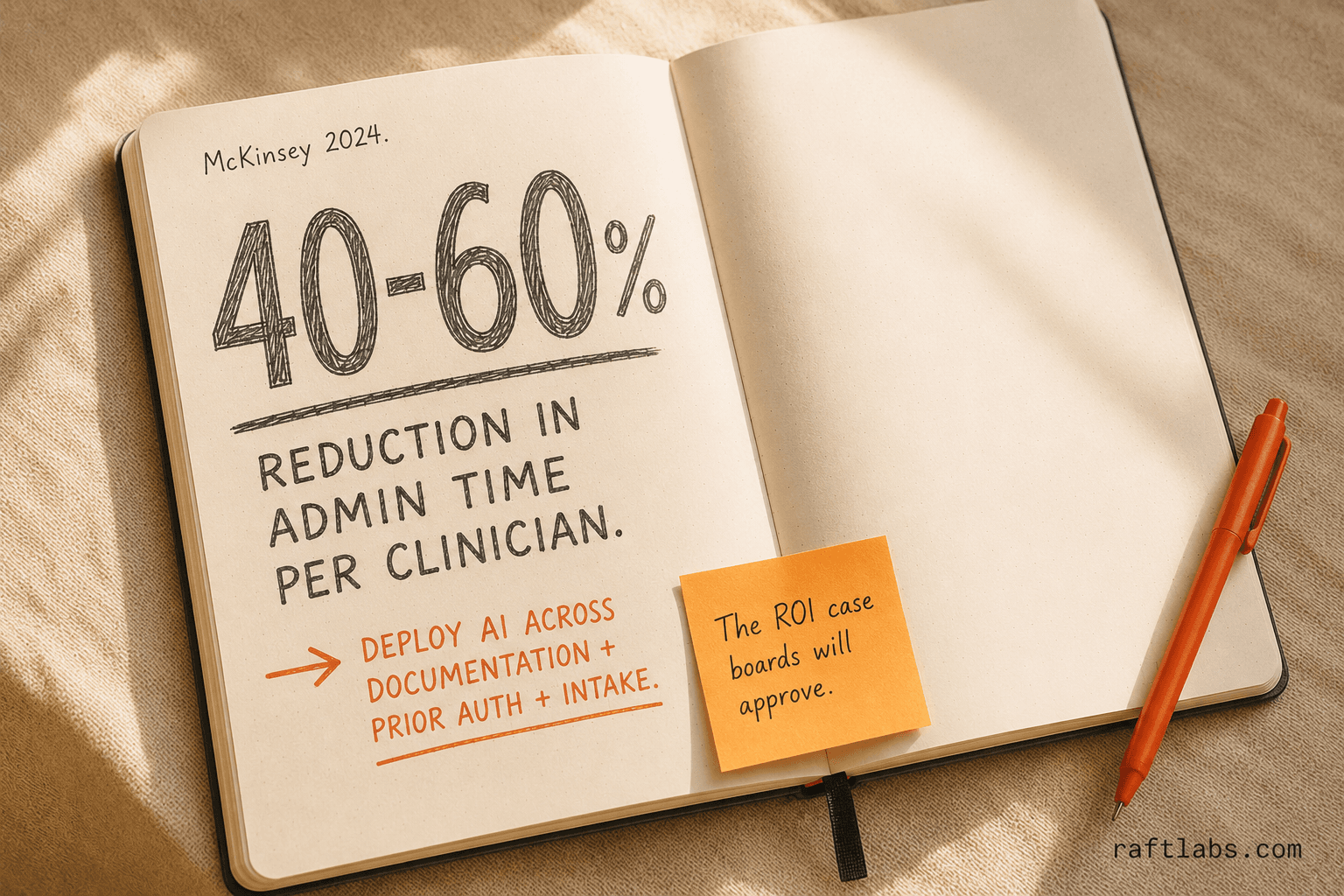
McKinsey's 2024 healthcare AI analysis found that healthcare organizations achieving the highest ROI from AI investments focused deployment on three workflows with the highest administrative burden per clinician: clinical documentation, prior authorization, and patient intake. Organizations deploying AI across all three simultaneously reduced administrative time per clinician by 40 to 60 percent. The firms best positioned to deliver those outcomes combine clinical workflow understanding with HIPAA-compliant engineering - not just AI capability layered onto general software development. The technical capability is necessary but not sufficient. The compliance posture and clinical context are what separate deployable systems from prototypes.
The verdict
For healthcare AI development, the right vendor depends on three variables: the nature of the use case (clinical provider-facing vs. patient-facing), the organization's existing infrastructure (greenfield vs. EHR-integrated legacy environment), and the program structure (defined scope vs. multi-phase transformation agenda).
For enterprise health systems and payers building data-intensive clinical AI and ML programs at platform scale: Quantiphi, with the cloud-partner depth and MLOps discipline to match the complexity.
For mid-market healthcare businesses that need a production-ready HIPAA-compliant AI system on a fixed scope and timeline: RaftLabs. Fixed price, 12-week delivery, BAA-first process, no handoff gap between design and engineering.
For digital health companies and clinical operators that want a healthcare-only specialist on a scoped clinical or RPM AI build: Empeek.
For healthcare organizations adding AI to EHR-integrated, telemedicine, or remote-monitoring systems: Binariks.
For healthcare organizations deploying applied or generative AI that needs data-platform engineering and LLMOps discipline: ITRex Group.
For healthcare and life sciences organizations building HIPAA-compliant systems with agentic AI workflows and US-based account management: Kanda Software.
For healthcare teams with a hard clinical modeling or research problem behind the feature: Sciforce, paired with an engineering firm for the delivery and compliance layer.
For healthcare organizations that want quality engineering and test discipline built into a clinical AI system: KMS Healthcare.
The most expensive procurement mistake in healthcare AI is choosing on general AI capability and discovering the HIPAA and FHIR gaps after the architecture is committed. A HIPAA-compliant rebuild of a non-compliant system costs two to five times the original build. The compliance filter is the first filter, not the last.
RaftLabs builds HIPAA-compliant AI systems for healthcare organizations. Fixed-price delivery, BAA-first process, production systems in 12 weeks. 4.9/5 on Clutch. Talk to a founder about your healthcare AI project.
Ask an AI
Get an instant summary of this post from your preferred AI assistant.
Frequently asked questions
- Healthcare AI development costs more than standard AI work because of the compliance overhead built into every layer. A HIPAA-compliant AI feature added to an existing application costs $40,000 to $120,000. A standalone clinical AI tool covering a single workflow - patient triage, documentation assistance, or prior authorization automation - costs $80,000 to $250,000. A full AI platform with EHR integration, analytics, and multi-site deployment costs $250,000 to $700,000 or more. The compliance layer - BAA negotiation, PHI architecture, audit trail infrastructure, security assessment - adds 20 to 35 percent to standard AI development costs. RaftLabs fixed-price healthcare AI engagements start at $40,000.
- Four questions separate genuine healthcare AI expertise from general AI capability applied to healthcare. First, ask them to walk through their BAA execution process - how long it takes, what their standard template covers, and who signs; a vendor with real healthcare experience can execute a BAA in days, while one that routes the request to a legal team that has never seen one is signaling depth they do not have. Second, ask which FHIR R4 resources they have implemented in production, not test environments - a vendor that can name specific resources (Patient, Observation, Condition, DiagnosticReport, DocumentReference, Encounter) has done the work; one that stays generic has not. Third, ask for a live healthcare product they built that is currently running in production - a URL you can test, not a case study PDF - and expect a compliance paper trail behind it: signed BAAs, security risk assessments, HIPAA workforce training records, audit trail examples. Fourth, ask what happened when their PHI handling approach was reviewed by a healthcare client's legal team. Vendors with vague answers to any of these four questions have not shipped in healthcare at the level they claim.
- A focused healthcare AI feature added to an existing application - document processing, triage scoring, automated coding - takes eight to twelve weeks from scoping to production deployment. A standalone clinical AI application with EHR integration takes twelve to twenty weeks depending on integration complexity and the number of FHIR resources involved. A full AI platform covering multiple clinical workflows, analytics, and multi-site deployment takes six to eighteen months. Timeline is most affected by EHR integration complexity: Epic and Cerner integrations require formal onboarding processes with the EHR vendor, which adds four to eight weeks regardless of the development team's pace.
- General AI firms can build technically capable AI systems. Whether they can build HIPAA-compliant ones with working EHR integrations is a different question. The difference shows up in three areas: BAA readiness (a general firm without healthcare clients may not have standard BAA templates and may not understand PHI handling at the infrastructure level), FHIR capability (FHIR integration requires specific knowledge of clinical data models and EHR APIs, not generic API experience), and compliance architecture (HIPAA's technical safeguard requirements are specific, and a firm that has not implemented them before will learn on your project at your expense). For any project that touches PHI, the compliance overhead of hiring a firm with healthcare experience is lower than the remediation cost of hiring one without it.
- RaftLabs has shipped HIPAA-compliant AI systems for healthcare clients including a remote patient monitoring platform running at 80+ clinical sites. Their healthcare practice covers patient portal development, AI-assisted clinical documentation, automated patient intake and triage, and medical data processing pipelines. They execute BAA agreements as a standard first step, deploy on HIPAA-compliant infrastructure (AWS or Azure for Healthcare), and design PHI handling into the architecture from week one rather than adding it as a compliance review step before launch. Engagements are fixed-price with milestone payments. $29--$49/hr. 4.9/5 on Clutch.
- The highest-ROI healthcare AI use cases in 2026 are clinical documentation assistance (AI scribes that reduce physician documentation time by 40 to 60 percent), prior authorization automation (reducing 10-14 day manual processes to hours with measurable reduction in claim denials), patient triage and intake (AI routing that cuts intake processing time by 60 to 70 percent), and remote patient monitoring data processing (anomaly detection in continuous sensor data that reduces alert fatigue while catching deterioration earlier). Each use case has a measurable output tied to cost reduction or revenue protection - the standard for healthcare AI investment approval at the CFO level.
- This is where the gap shows between vendors who understand PHI handling conceptually and vendors who have actually implemented de-identification for AI model training. HIPAA's Safe Harbor and Expert Determination de-identification methods have specific technical requirements - Expert Determination, for example, requires a statistical expert to certify that the residual re-identification risk is very small. A vendor that treats de-identification as a straightforward technical step without specific process knowledge has not trained AI models on real clinical datasets. This matters because the model reflects the data it was trained on, and a model trained on improperly de-identified PHI creates a compliance exposure that follows the system into production.
- Healthcare AI systems are not static - PHI access patterns change, new data sources get integrated, and models get retrained on updated clinical data, and each of those changes has compliance implications. A vendor that defines its compliance responsibility as ending at the go-live date is not describing a HIPAA-compliant delivery model for production healthcare AI. The right vendor can answer specifically what happens to the security risk assessment when the system adds a new data source, who updates the BAA if the PHI scope changes, and whether post-launch support includes compliance advisory for system changes - vendors that have thought this through answer with a process, not an intention.
Similar Articles
- 01
Top accounting automation companies in 2026 (vetted shortlist)
- 02
Top AI governance companies in 2026 (vetted shortlist)
- 03
Top React development companies in 2026 (vetted shortlist)
- 04
Top Magento development companies in 2026 (vetted shortlist)
- 05
Top hotel booking engine companies in 2026 (vetted shortlist)
- 06
Top AI chatbot development companies in 2026 (vetted shortlist)