Wildlife Removal Software
Wildlife removal software for trap checks that never slip.
Your work runs on trap checks that must happen on time, seal-outs that must hold through winter, and calls that arrive at night. We turn that chain into one system your office and your technicians share, so nothing depends on memory.
Bring one stuck workflow. Leave with a build, buy, repair, or wait recommendation.
Trusted by






















The brief
Start with what is not working.
Good software decisions begin with the constraint, not a list of features or a preferred technology.
A trap check gets billed by mistake, or worse, it never makes the route at all.
Nobody can say which sealed entry points are due a re-check before winter.
The bat call comes at night and rings whoever happens to pick up.
Plain answer
Wildlife removal software runs the work of a nuisance wildlife company: scheduled trap checks that never add to the bill, exclusion work that seals animals out, warranty re-checks before winter, species and permit records, and night calls routed to whoever is on call.
What to remember
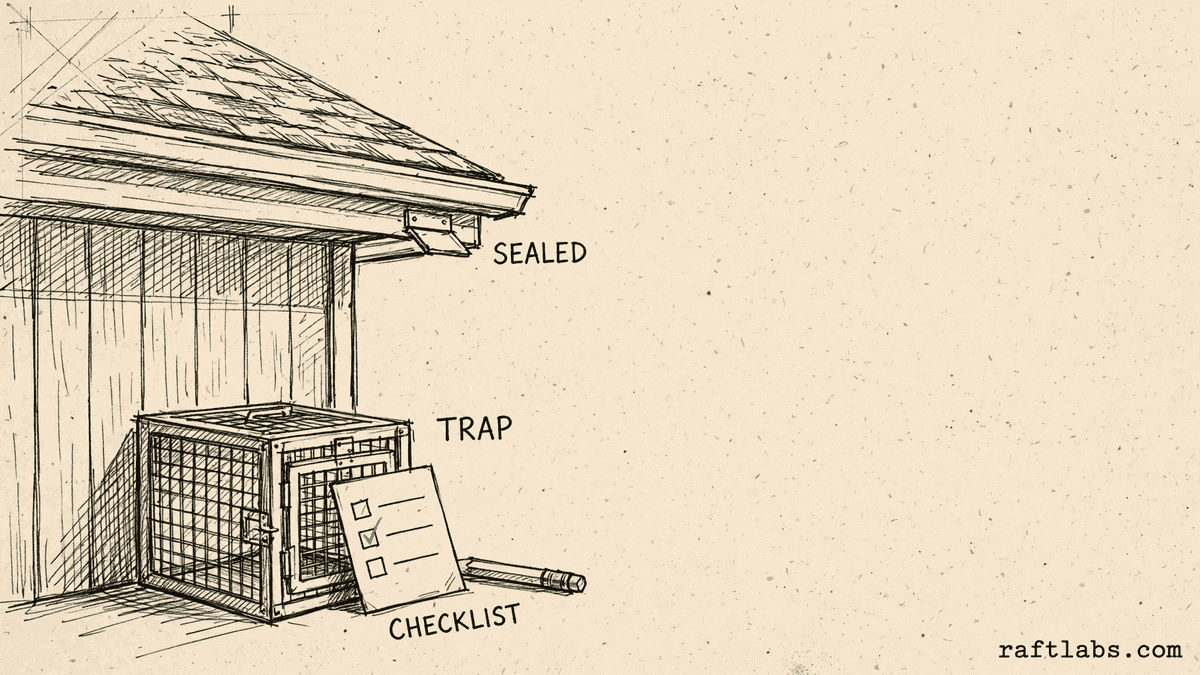
- Every trap check sits on the route as its own no-charge visit, so it is never skipped and never billed by mistake.
- Exclusion means sealing the entry points animals use: roofline gaps, soffits, vents, and chimneys, closed once no young are left inside.
- Each sealed point carries its warranty and a re-check booked before winter, when animals look for a warm den.
- Species, permits, licences, and what happened to each animal stay on one record your annual report can be drawn from.
- Night calls go to the person on call first, then the backup, then the office, so an emergency never depends on luck.
Fit
Custom software should end the work held in memory.
A feature request is not enough. The case is real when the same failures show up in trap checks, warranties, and night calls.
Trap checks are billed by mistake or missed entirely, and nobody can prove a check happened.
Sealed entry points and their warranties live in job notes, so pre-winter re-checks happen only when someone remembers.
Night emergencies ring around the crew until someone picks up, and permit records are rebuilt by hand at renewal.
A maintained product already handles your trap routes, seal-outs, warranties, and state records with reasonable setup.
Your warranty terms and on-call rules are still changing every week, so software would freeze a moving target.
The brief is a feature list with no named owner for the workflow it is meant to fix.
Not sure which side you are on? Use the first call to make that decision. A useful answer may be to buy, connect, repair, or wait.
The work is remembered, until the night it is not.
A wildlife removal company runs on promises with dates attached. A trap set today must be checked on time, every time, for as long as it stays out. A sealed entry point carries a promise that it will hold, and that someone will look at it again before winter. A customer with a bat in the house at night has been promised, in effect, that someone will answer.
Each of those promises usually lives in a person's memory or in a note on a job sheet. That works while the same technician runs the same route. It breaks when someone is sick, when a second crew is added, or when a warranty question arrives a year after the seal-out and nobody can say which points were sealed, with what, or under which terms.
The record underneath is also a legal one. Operators keep records by species: what was taken, where, when, and under which permit, because the state can ask for them and renewal can depend on them. When that record is scattered across notebooks and phone photos, the annual report becomes a week of reconstruction.
Custom software earns its place when one system carries the promise and the record together: the night call, the trapping route, the seal-out, the warranty re-check, and the species record, all on the same property history. The first release should complete that one path. It should not try to replace every tool you own at once. This is a different trade from recurring pest control plans for insects and rodents, which the pest control industry page covers.
Where the promises leak.
The screen is only one part of the job. The real scope is the route, the seal-out record, the warranty, the permit file, and what happens when the phone rings at night.
Trap checks that bill nothing and skip nothing
Each trap check is its own no-charge visit on the route, with arrival time, time on site, traps checked and re-set, and a short checklist recorded. The trapping price covers the checks, so a check never adds a line to the invoice, and a check that has not happened by its time is visible to the office the same day.
Seal-outs recorded point by point
Every entry point found at inspection is listed for the property: roofline, soffit, vents, chimney, or under the deck, with photos before and after, the materials used, and whether a one-way door is fitted. The customer signs the agreed work, and the crew seals only points that are clear of animals and young.
Warranties that book their own re-checks
Each sealed point carries its warranty terms and a re-check booked ahead of winter, when animals look for a warm place to den. The re-check joins a normal route in good time. An animal back in through a sealed point is recorded against that point, so the return visit and re-seal follow the warranty instead of an argument. Recurring obligations of this kind follow the same pattern as chimney sweep management, where the next due visit is part of the record, not a memory.
Species and permit records that hold up
The job records the species, the place, the date, the method, and what happened to the animal, alongside the permit or licence covering the work and its expiry. Licences held by each technician are tracked the same way, so work that needs a particular licence is not handed to someone without it. The annual report is drawn from records you already keep.
Night dispatch with a named order
An urgent call goes to the technician on call first, then to a named backup, then to the office, and the customer is shown the safety steps for that animal while they wait. Whoever takes the call gets the property history, the species notes, and the access details on a phone, so the visit starts informed at any hour.
Which one is yours?
Bring it to a 30-minute call. Leave with a build, buy, repair, or wait recommendation in writing. Free, whether or not we ever work together.
Two kinds of work
Routes by day, promises by season.
A wildlife company runs daily routes and long promises at the same time. One system has to hold both without letting either crowd out the other.
Trapping and removal routes
Inspections, trap sets, daily checks, one-way doors, and removals booked as one route per technician, with the property history open at every stop. Commercial monitoring accounts join the same board on their own cycle. When a night call becomes a job, it lands on the next route with its notes attached instead of starting a new paper trail.
Exclusion and warranty work
Seal-outs scheduled once a property is clear, each point photographed and recorded, warranties counted from the day the point was sealed, and re-checks booked before winter across every property at once. Owners can see how many warranty points fall due in a season before the season arrives, and plan crew time around them.
The office view across both
One board shows today on the routes, tonight on call, inspections waiting to become jobs, warranty re-checks falling due, and licences nearing expiry. Owners see the whole operation without asking for a report, and office staff stop copying between a diary, a spreadsheet, and a notebook of species records. Wider field service and home services work follows the same rule: one record, carried end to end.
Proof
The fifth attempt became a product customers could keep using.
UrShipper had already worked with four development vendors. Its founder describes the communication and decisions during the recovery.
The case study documents a 14-week recovery, five carrier connections, a Shopify fulfilment workflow, and client-reported results. It is one comparable project, not a promise that every inherited codebase can follow the same plan.
Read the UrShipper case studyWhich promise is costing you the most right now?
Bring it to a 30-minute call. Leave with a build, buy, repair, or wait recommendation in writing. Free, whether or not we ever work together.
How it works
Close one expensive risk before opening the next.
Each stage answers a buyer question and leaves behind a decision you can inspect. The next stage only opens when the expensive uncertainty in the current one is small enough to accept.
- 01Understand
Trace one full job
Where do checks, warranties, or calls actually fall through?
Follow one urgent call and one trapping job from start to finish. Include the safety steps the customer was given, the daily checks, the one-way door, the seal-out, and the report the state expects at the end of the year.
Decision produced
A map of one job from night call to sealed point, with the trap route, the warranty terms, the permit record, and the on-call order written down.Risk closed
Paying to automate the visible symptom while the expensive constraint remains. - 02Shape
Choose the first useful release
What needs to exist together for one useful result to work?
Choose the shape from the way the work happens: office screens for the board and the records, phones in the field for checks and seal-outs. Name who can see and change what, the exceptions, and what done looks like for the first path.
Decision produced
The first path, usually call to route to seal-out, with the species record, the warranty booking, and the dispatch order it cannot work without.Risk closed
A small-looking feature list that quietly depends on several screens, systems, and owners. - 03Prove
Review working software
Will it hold up on a real route, not a tidy demo?
Review the product against the agreed workflow. Take a night call and watch it move down the on-call order. Run a trap check and confirm nothing was billed. Try to seal a point with young present and watch the record stop you. Then draw the annual species report.
Decision produced
Working checkpoints tested with your real warranty terms, a route that gains a night job at short notice, a point that is not ready to seal, and the state report drawn from live records.Risk closed
Discovering the important gaps after the crews depend on the release. - 04Transfer
Release, measure, and hand over
Did the new path improve the original constraint, and can another capable team operate it?
Start with one route or one crew. Compare missed checks, wrongly billed visits, and time spent rebuilding permit records with the starting point before adding the next workflow. The wider method sits behind custom software development.
Decision produced
A controlled release, a comparison with the starting point, operating notes, an account ownership map, and a recommendation for what should happen next.Risk closed
Measuring activity instead of the business result, or depending on the original vendor to keep the system running.
What it costs
Every project starts at $10000.
The first phase turns the costliest patched workflow into a scoped build with written acceptance criteria.
Starting investment
Starts at $10000
Workflow complexity, systems to connect, data migration, and user roles set the scope. After a 30-minute call, you get a written build, buy, repair, or wait recommendation plus first-phase direction. Free, whether or not you build with us.
Not ready to talk? Start here.
Four useful next paths: decide whether to own the software, estimate the cost range, understand what moves the price, or inspect a comparable recovery.
Run the build-vs-buy calculator
Compare the cost and operating trade-offs before turning a workflow into a development brief.
Estimate the cost range
Get a working cost range for your scope before you talk to any vendor. The range moves with routes, user kinds, and system connections, so bring your real numbers.
Read the cost guide
See the scope factors that move price, timing, team shape, and long-term maintenance.
Inspect a product recovery
See what changed when UrShipper moved from four failed vendor attempts to a controlled migration. It is one comparable recovery, not a promise, and the checkpoints are the part worth copying.
Work with us
Bring one stuck workflow. Leave with a decision.
In a 30-minute call, we will help you decide whether to buy, connect, repair, build, or wait. If custom software is not the sensible next move, that is still a useful answer.
- One named workflow owner and one complete path for the first phase.
- Scope, price, what 'done' looks like, and exclusions agreed before paid work starts.
- Code, cloud, data, and provider access remain under your control.
- Post-launch warranty cover for defects in the agreed scope.
Common questions
It is the system that carries one wildlife job from first call to finished seal-out: the inspection, the trapping route with its daily checks, the exclusion work that closes the entry points, the warranty that follows, and the record of the species and permits involved. For a removal company that means trap checks that cannot be billed or forgotten, seal-outs tracked point by point, and night calls that reach the person on call.
Each trap check is set up as its own no-charge visit. It appears on the route like any other stop, with the time on site, the traps checked and re-set, and a short checklist recorded as proof. Because the check carries no charge of its own, it never adds a line to the invoice, and because it sits on the route board, a missed check is visible the same day instead of being found out later.
Exclusion means stopping animals getting back in, rather than only taking the current animal out. In plain terms, the crew finds every entry point the animal uses, such as roofline gaps, soffits, vents, and chimneys, and closes each one with materials the animal cannot push through, once the animals and any young are out. One-way doors are often fitted first: the animal leaves through the door and cannot return, and the point is sealed for good once it is clear.
Every sealed point is recorded against the property with the warranty that covers it. The system books a re-check for each point before winter, when animals start looking for a warm den, and puts that visit on a route in good time. If an animal gets back in through a point you sealed, the record shows it, and the return visit and re-seal are handled under the warranty terms instead of being argued from memory.
The species, where it was taken, the date, the method used, what happened to the animal, and the permit or licence the work was done under. Many states require operators to report the number, species, date, and location of animals taken each year, and to keep those records open to inspection. When each job already carries those details, the annual report is drawn from your own records instead of rebuilt from notebooks at renewal time.
The customer reports the problem through your portal or by phone and is shown the safety steps for that animal first, such as keeping a bat shut in one room and not touching it. The call then goes to the technician on call, who can take the job from a phone. If nobody takes it, it moves to the named backup, and then to the office. When nobody is on call, the customer is told to phone instead of being promised a response nobody will give.
The technician photographs each entry point during the inspection and proposes the follow-up work on the spot: the removal, the seal-out, and any one-way doors, set out as clear options. The office approves it into a scheduled visit, and the customer signs the option they choose on their phone. The job, the price, and the photos stay on one record, so the crew that does the work sees exactly what was found and agreed.
Pest control software runs recurring treatment plans for insects and rodents: scheduled sprays, barrier treatments, and repeat visits on a cycle. Wildlife work is different in kind. It runs trapping routes with checks that must happen on time, exclusion work that seals a building, warranties on each sealed point, and records by species and permit. If your company mainly runs recurring pest plans, the pest control industry page is the right starting point. This page is for the trapping, seal-out, and warranty side of the trade.
The record flags it before sealing is scheduled. Entries are sealed only once no young are inside, one-way doors are fitted only when it is safe for the young to leave, and some work, such as bat exclusion, is timed around the seasons and rules that protect that species. The software holds the rule against the job so a crew is never booked to seal a point that is not ready to be sealed, and the decision and its reason stay on the record.
A commercial account, such as a site needing regular wildlife and bird checks, runs on its own agreed cycle with a written report for each visit. Its visits sit on the board beside residential work without crowding it, and the account is billed on its own terms, for example one invoice a month to the person who pays the bills there, with their order reference on it.
Buy an existing product when it handles your trap checks, seal-outs, warranties, and permit records well enough with reasonable setup. Have custom software made when the way you work is the part it cannot copy: your warranty terms, your on-call order, your state reporting, or routes shared between trapping and exclusion crews. If your rules are still changing every week, settle them first and decide after.
The first paid phase may cover a bounded audit, a small working proof, or a first release that completes one full path, such as night call to trap route to sealed entry. The final price depends on how many kinds of users it serves, what it connects to, whether customer and permit records need moving over, and whether phones in the field are involved. The agreed phase is priced in writing before it starts.
Timing depends on scope. A first release that covers one complete path, for example the call coming in, the trapping route, and the seal-out record, is a smaller engagement than one that also carries warranty re-checks and a customer portal from day one. The schedule is set once the first path and what done looks like are clear.
You judge what you can see, not the code. Every checkpoint is working software you click through yourself, tested against the workflow agreed at the start: take a night call, run a trap route, seal a point, book its re-check. Progress is reported in plain language: what changed, what is next, and what it costs. Because you own the code, the accounts, and the operating notes throughout, nothing about the work is locked inside our heads.
You own the code built for you and control where it lives, the cloud accounts, the data, and third party subscriptions. Outside services and open source pieces keep their own licence terms. The operating notes and handover material stay current so another capable team can take over.
Yes. Takeover starts with an audit: where the code lives, how your data is organised, what is tested, which outside services it depends on, who can see and change what, and how updates go live. Code that is understandable and fit for the next release stays; only the parts blocking reliable work get replaced.
For one small, well defined task with someone technical managing it, a freelancer is often cheaper. The pattern that goes wrong is a non technical buyer coordinating several freelancers and becoming the project manager, the tester, and the person who finds out the pieces do not fit. An agency earns its fee when the work needs coordination across screens, rules, data, and connections: one accountable party, one phase price, and checkpoints against the whole workflow.