RAG as a Service | Enterprise Knowledge Base AI

Your enterprise data is not in the model. RAG puts it there.

Generic AI models do not know your products, your processes, your policies, or your customers. They generate confident-sounding answers that may be accurate in general and wrong for your specific context. The hallucination problem is not a model quality problem, it is a data grounding problem.
Retrieval-Augmented Generation solves this by connecting AI generation to your actual documents, databases, and knowledge sources before generating an answer. Every response is grounded in your data, with the source cited. We deliver RAG as a packaged service: scoped by use case, built on production-grade infrastructure, and delivered with the retrieval quality your use case requires.

See our work
  • AI answers grounded in your documents, policies, and data, not a model's training data

  • Source citations with every answer so users and auditors can verify the response

  • Retrieval quality tuned to your specific content structure and query patterns

  • Deployed to your infrastructure with access controls consistent with your data governance requirements

Recent outcomes

RAG chatbot · Enterprise support team

Built a RAG system over 40,000 support articles; routine queries handled without human intervention.

70% query deflection

Internal knowledge assistant · Healthcare operator

Policy and procedure assistant for clinical staff, HIPAA-compliant, deployed in 12 weeks.

20% faster clinical decisions

AI OCR + RAG pipeline · Finance operations

Document ingestion pipeline processing invoices and contracts; manual lookup errors eliminated.

20,000+ docs/day
4.9 / 5 on ClutchSee all work

Recognition

Sound familiar?

  • Are your AI answers accurate in general but wrong in the specific, because the model does not know your products or policies?

  • Do your teams trust the AI output enough to act on it, or do they still check the source document every time?

In short

RaftLabs builds RAG systems that ground AI answers in your documents and policies. Deployed for teams in the US and UK across support, legal, and internal knowledge use cases. Fixed price, source-cited answers, 12-week delivery.

Trusted by

Vodafone
Nike
Microsoft
Cisco
T-Mobile
Aldi
Heineken
GE

AI development, by the numbers

AI products shipped in 24 months
20+
from kick-off to production-ready AI product
12 weeks
rated by clients on Clutch
4.9/5
years shipping software and AI products
9+

When the answer needs to be your answer, not the model's best guess

A customer asking about your return policy needs your actual return policy, not a plausible-sounding approximation. An employee asking about the expense approval process needs your specific policy, with the current thresholds and form links, not a generic description of how expense approval usually works.

Generic AI models generate generic answers. RAG generates answers grounded in your specific documents, policies, and knowledge, with the source document cited so users and auditors can verify.

Capabilities

What we build

Document ingestion pipelines

Automated pipelines that ingest your documents, extract content from source formats (PDF, Word, HTML, Confluence, SharePoint, Notion), chunk them into retrieval-optimised segments, generate embeddings, and index them in a vector database. Ingestion scheduling for document updates and deletions, when a policy document is superseded, the old version is removed from the index automatically. Document metadata preservation: title, author, last updated, source URL, and access group tags stored alongside embeddings for filtering and citation. Support for 50,000 to multi-million document collections.

Customer support RAG

RAG systems for customer support teams and customer-facing chat. Knowledge base connected to your product documentation, support articles, and troubleshooting guides. Customer queries matched against your knowledge base with answers generated from the relevant articles. Source article citation so customers can read the full document if they want more detail. Escalation detection for queries the system cannot answer confidently, routing to a human agent with the query context pre-populated. Deflection rate tracking and retrieval quality monitoring. For support teams, the RAG system handles the documentation lookup so agents handle the edge cases.

Internal knowledge assistant

RAG for internal teams: HR policy, IT procedures, legal guidelines, procurement policies, and operational playbooks. Employees ask questions in natural language and receive answers from the relevant policy document with the source cited and a link to the full document. Coverage across all internal documentation without employees needing to know which system a document lives in or what it is called. Conversation history for follow-up questions within a session. Confidential document access controls aligned to your directory groups. The internal knowledge system that replaces "email HR and wait for a response" for questions that have documented answers.

Vector database and retrieval infrastructure

Production vector database setup using Pinecone (managed, serverless, scales to billions of vectors), Weaviate (open-source, supports hybrid search natively), Qdrant (Rust-based, excellent p99 latency for real-time applications), or pgvector (PostgreSQL extension, ideal when your data already lives in Postgres and you want to avoid an additional infrastructure component) depending on your scale, latency requirements, and infrastructure preferences.

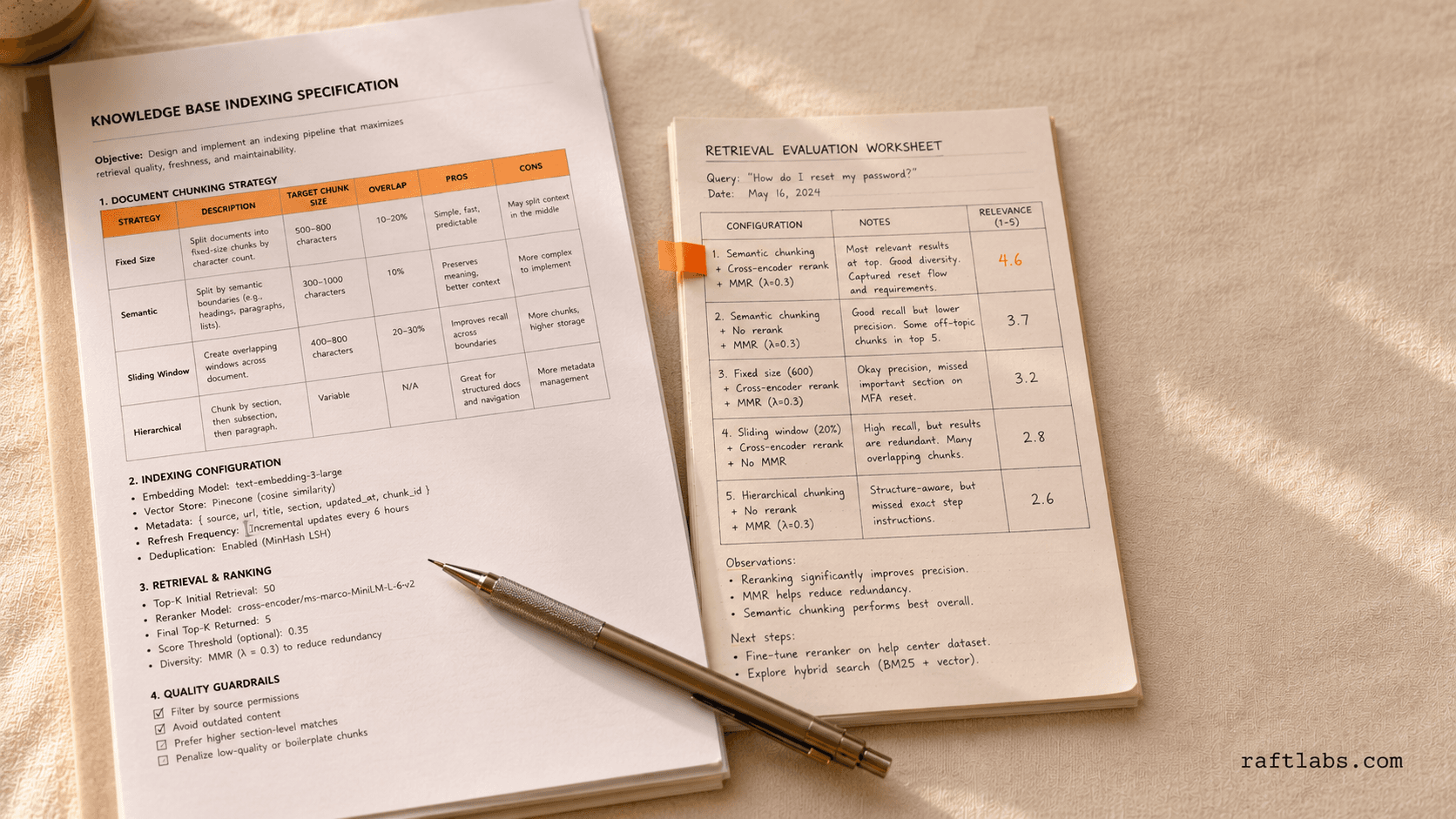
Embedding model selection: OpenAI text-embedding-3-large (3072 dimensions, best accuracy, $0.13/million tokens), text-embedding-3-small (1536 dimensions, 95% of the accuracy at 5x lower cost), Cohere embed-multilingual-v3.0 for multilingual corpora, or open-source alternatives (BGE-M3, E5-large) for environments with data residency requirements where documents cannot leave your infrastructure. Chunking strategy is content-type specific: documentation benefits from semantic chunking at section boundaries; contracts benefit from clause-level chunking with parent document metadata; conversational transcripts benefit from overlapping sliding windows (512 tokens with 50-token overlap). Hybrid search combines dense vector retrieval with BM25 keyword search, the dense retrieval captures semantic similarity while BM25 captures exact-match terms, and a Reciprocal Rank Fusion (RRF) algorithm merges the two rankings. Reranking pipeline using Cohere Rerank or a cross-encoder model (ms-marco-MiniLM-L-6-v2) scores the top-50 retrieved candidates against the query for actual relevance before the top 5 pass to the LLM context. Retrieval quality evaluation using a labelled question-document pair test set measures Mean Reciprocal Rank (MRR) and Hit@k before deployment.

RAG for legal and compliance

RAG systems for legal and compliance teams that need to query contracts, regulations, case files, and policy documents. Contract clause retrieval: find all contracts that contain a specific clause type, obligation, or counterparty term. Regulatory query: surface the relevant section of a regulation or standard for a compliance question. Legal research assistance: retrieve relevant precedents and internal guidance from a legal knowledge base. Source citation critical: every answer includes the exact document, section, and page. Access control essential: attorneys see client matters they are staffed on, not all client matters. Built for the precision requirements of legal and compliance use.

Product documentation RAG

RAG systems connected to your product documentation for user-facing or developer-facing query assistance. Documentation chunked and indexed by feature area, API endpoint, and configuration option. Version-aware retrieval for products with multiple active versions. Developer query assistance: code examples retrieved from documentation alongside explanatory text. User query assistance: step-by-step procedures extracted from longer documentation articles and presented in answer format. Feedback collection for queries that did not produce useful answers, feeding documentation gap identification. The support deflection that starts with the first question your documentation already answers.

How we work

From scope to shipped

Every RAG project follows the same four phases. Retrieval quality is validated before the answer layer is built.

  1. Week 1
    01

    Discovery and scope

    We map the use case, the document library, and the access control requirements. You leave week 1 with a written scope document, a fixed-price quote, and a retrieval quality target. No development starts without your sign-off.

  2. Weeks 2-4
    02

    Ingestion pipeline and retrieval build

    Document extraction, chunking, embedding, and vector index setup. We build the retrieval layer first and evaluate it against a labelled test set before touching the answer generation layer. Retrieval quality is the foundation.

  3. Weeks 5-10
    03

    Answer generation, integration, and QA

    LLM integration with source citation, access control enforcement, and answer quality evaluation. API or chat interface delivered to a staging environment. QA runs in parallel with every sprint.

  4. Weeks 10-12+
    04

    Production deployment and monitoring

    Production deployment with retrieval quality monitoring, answer confidence tracking, and query logging activated on launch day. 8 weeks of post-launch support included in every project.

Why us

Why teams choose RaftLabs

  1. Senior engineers build what they scope

    The engineers who assess your RAG use case also build the system. No bait-and-switch, no offshore handoff after the contract is signed. The team you meet in week 1 ships in week 12.

  2. Fixed price before development starts

    We scope the work, calculate the cost, and lock it in writing before any development starts. A scope change is a change request: priced, agreed, or dropped. It never absorbs into the project and appears on the final invoice.

  3. 9 years and 100+ products shipped

    Clients include Vodafone, T-Mobile, Aldi, Nike, Cisco, and Lockheed Martin. Track record across AI, SaaS, mobile, automation, and enterprise platforms across healthcare, fintech, logistics, and hospitality.

  4. Compliance built in from the start

    GDPR, HIPAA, SOC 2 — compliance requirements are scoped in week 1, not retrofitted before launch. We have shipped HIPAA-compliant RAG systems for US healthcare clients and GDPR-compliant knowledge assistants for European teams.

What question does your team ask repeatedly that has an answer in a document nobody can find?

Tell us your use case, your document volume, and your access control requirements. We will scope the RAG system and give you a fixed cost.

Frequently asked questions

RAG (Retrieval-Augmented Generation) retrieves relevant documents from a knowledge base at query time and passes them to the language model as context before generating an answer. The model answers the question based on the retrieved documents, not solely from its training data. Fine-tuning adjusts the model's weights by training it on your data, updating what the model 'knows.' The practical differences are important. RAG keeps your data in a retrieval system you control: documents are indexed, not baked into model weights. When your documents change, you update the index. When a document is removed or superseded, it is removed from the retrieval system and the model stops citing it. Fine-tuning bakes knowledge into the model: updating it requires retraining, and there is no clear source citation. For most enterprise use cases, customer support, policy lookup, product information, legal review assistance, RAG is the right approach because the knowledge changes frequently and source attribution matters. Fine-tuning is more appropriate for changing the model's reasoning style, output format, or task-specific behaviour.

RAG works with any content that can be indexed: PDFs, Word documents, PowerPoint presentations, web pages, Confluence and Notion pages, Zendesk or Intercom knowledge base articles, plain text files, and structured databases. The ingestion pipeline extracts content from the source format, chunks it into segments appropriate for retrieval, generates embeddings, and stores them in a vector database. For structured data (databases, spreadsheets, CSVs), we use hybrid retrieval approaches: semantic search over unstructured content combined with structured query generation for database records. The retrieval quality depends on document quality and structure. Well-organised, clearly written documents retrieve better than dense, poorly structured ones. We assess your document library during scoping and identify any document quality or organisation issues that will affect retrieval before we commit to retrieval quality targets.

Retrieval quality measures how often the retrieval system finds the right documents for a given query. A RAG system can generate fluent, confident-sounding answers from retrieved documents and still be wrong if it retrieved the wrong documents. Retrieval quality has two dimensions: recall (does the system retrieve the documents that contain the answer?) and precision (does the system avoid retrieving irrelevant documents that confuse the answer?). We evaluate retrieval quality using a test set of questions and expected source documents, measuring recall and precision at different retrieval depths. We iterate on chunking strategy, embedding model, and retrieval configuration until retrieval quality meets a defined threshold for your use case before building the answer generation layer on top of it. Retrieval quality is the foundation. Everything else depends on it.

Document-level access controls are a first-class design requirement in enterprise RAG. The retrieval system must only surface documents the querying user has permission to read. We implement access control in the retrieval layer using metadata filtering: each document in the vector index is tagged with its access group metadata, and at query time the retrieval query is filtered to only return documents the current user's permissions allow. For RAG systems connected to existing document repositories (SharePoint, Confluence, Google Drive), we use the source system's permission model: a document the user cannot read in SharePoint is not indexed for retrieval by that user. Access control design is defined during scoping and tested before deployment. A RAG system that leaks confidential documents to users who should not see them is a more serious problem than one that retrieves the wrong document.

Cost depends on document volume, use case complexity, and access control requirements. A focused single-use-case RAG system (for example, a customer support knowledge base with 5,000 documents) typically runs between $25,000 and $60,000. A multi-use-case enterprise RAG platform with hybrid retrieval, reranking, and role-based document access runs higher. We scope the work, calculate the cost, and lock it in writing before development starts. No sliding invoice.

Yes. We sign NDAs before any technical discovery or document sharing. Most clients in the US, UK, and Australia operate under NDAs from the first call. We have handled confidential document sets for legal firms, healthcare operators, and financial services teams. The NDA is signed before we see any content.

Work with us

Tell us what you need. We'll tell you what it would take.

We scope RAG as a Service in 30 minutes. You walk away with a clear cost, timeline, and approach. No commitment required.

  • Scope and cost agreed before work starts. No surprises. No obligation.
  • Working prototype within 3 weeks of kickoff.
  • Pay by milestone. You see progress before each invoice.
  • 60-day post-launch warranty. Bug fixes, UI tweaks, and deployment support. No retainer.
  • All conversations are NDA-protected.