Pool Builder Management Software
Pool builder software for builders where one stalled stage holds up every job behind it.
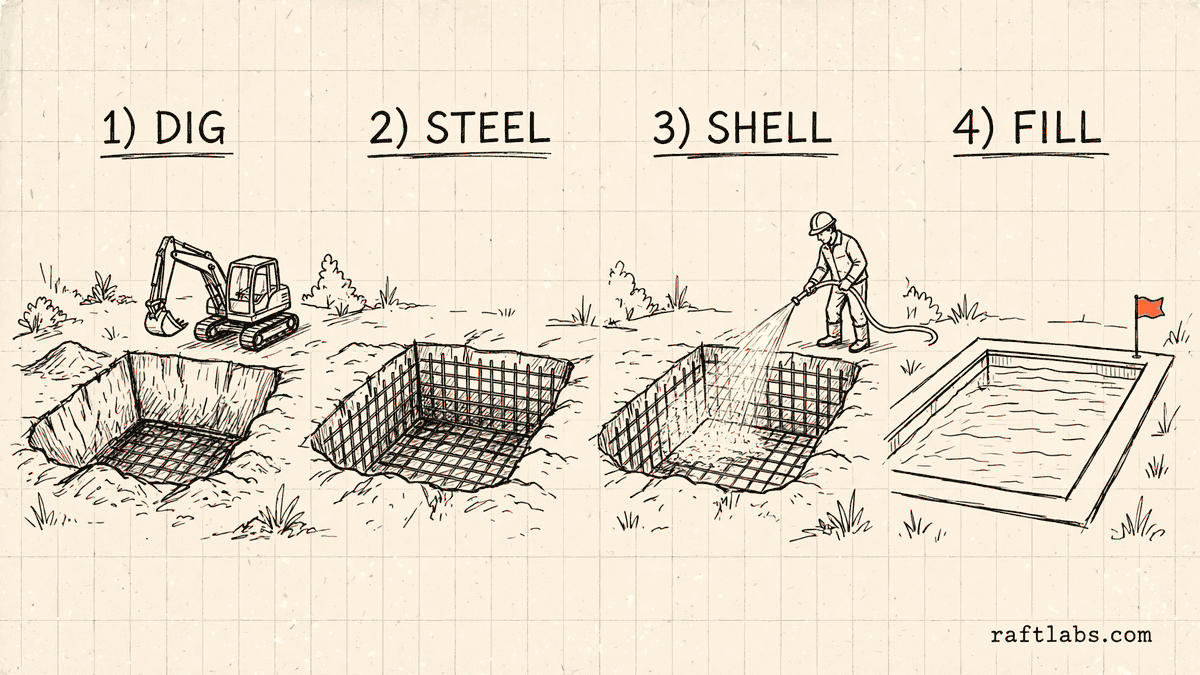
A pool build runs in stages that cannot swap order: the hole is dug, steel and plumbing go in, the concrete shell is sprayed, then tile, decking, and plaster finish it, with an inspection gate between stages. We turn that run into software that holds every job's stage schedule in one place, books each subcontractor against the stage before theirs, tracks inspections and weather delays, and shows the homeowner the same progress the office sees.
Bring one stuck workflow. Leave with a build, buy, repair, or wait recommendation.
Trusted by























The brief
Start with what is not working.
Good software decisions begin with the constraint, not a list of features or a preferred technology.
Each job's stage lives on a whiteboard, a spreadsheet, and the project manager's phone, so nobody can say which crew is due where next week.
Subcontractors are booked by call and text, so a steel crew arrives before the dig passed inspection and a day is lost for everyone.
Rain, a failed inspection, or a late material pushes one stage, and every stage and job behind it is reshuffled by hand.
Plain answer
RaftLabs builds pool builder management software for companies that construct swimming pools. Each job carries its stages in order, from dig through steel, shotcrete, tile and decking, to plaster and start-up, with the subcontractor for each stage booked against the stage before it, inspections tracked as gates, and weather delays pushed through the schedule so the office, the crews, and the homeowner read the same dates.
What to remember
- Use this when the whiteboard, the spreadsheet, and the project manager's phone disagree about which stage each job is on.
- Every job's stages sit in order on one schedule, and a stage cannot be booked until the one before it is done or passed.
- Subcontractors are booked per stage with the handoff conditions named, so a crew never arrives at a site that is not ready for it.
- Quote the builder's own screens as their own scope: the stage board, subcontractor booking, inspection lists, and homeowner updates are a second product, not a single admin-panel line.
- Hire freelancers for one small, well-defined task; use one accountable agency party when the work needs coordination across screens, rules, data, and connections.
The first decision is not what to build.
It is whether software is the right answer at all. We use four possible recommendations before discussing a development scope.
- 01
Buy
Choose a maintained product when it handles your stage scheduling, your subcontractor booking, your inspections, and your homeowner updates, and the remaining gaps can be solved with configuration, a connector, or a small process change. Paying for software you do not have to maintain is often the better trade.
- 02
Repair
Keep the existing system when the office and the site still get value from it and the code can be understood safely. Start with evidence: where the code lives, how the data is organized, what is tested, which outside services it depends on, who can access what, and how updates go live.
- 03
Build
Own the system when your stage sequence, subcontractor mix, or draw rules shape margin, homeowner trust, or speed, and no maintained product will hold them. Start with one complete path, usually the run from signed contract to plaster, and the system connections that path cannot work without.
- 04
Wait
Do not turn an unsettled build process into permanent software. Settle how stages, inspections, and handoffs should work, name the workflow owner, and measure the cost of the current process before paying for a product.
Not sure which path is yours? Bring it to a 30-minute call. Leave with the answer in writing.
Fit
Custom builder software should earn its maintenance burden.
A feature request is not enough. The case is real when the same constraint shows up in time, errors, margin, or customer trust.
Stages, crews, inspections, and homeowner promises are tracked in separate places, and the gaps reach homeowners as missed dates.
Your stage sequence or subcontractor mix differs from a generic product, and the company keeps forcing workarounds.
The organisation can name a workflow owner and what 'done' looks like for the first release.
A maintained product fits your job types and stage rules with reasonable configuration.
The team wants software to settle stage and inspection rules nobody has agreed yet.
The brief is a feature list with no user, transaction, or business result attached.
Not sure which side you are on? Use the first call to make that decision. A useful answer may be to buy, connect, repair, or wait.
Start with the operation, not the software.
A pool build problem usually starts as a sequence problem. The stages cannot swap order: steel before the shell, the shell cured before tile, inspections passed before work is covered up. The schedule for that sequence lives on a whiteboard for some jobs, a spreadsheet for others, and in one project manager's head for the rest. Each record looks fine on its own. The trouble starts when a crew arrives at a site that is not ready for it, and a lost day on one job pushes every job that crew was due on next.
Unlike most construction, a pool build chains many small specialist crews through one small site, one stage at a time. A generic project tool sees tasks; it does not see that the shotcrete crew cannot come before the steel inspection passes, or that plaster waits on a homeowner's tile choice made three stages earlier. The dependencies are the job.
A second product hides inside the first. Homeowners see their progress page and their dates; your team lives in another set of screens: the stage board, subcontractor booking, inspection lists, change order tracking, and a record of who did what. Quotes that squeeze all of that into an "admin panel" line item are where budgets most often break, so we quote your team's screens as their own job, with their own users, from the start.
Custom software makes sense when one owned job record can hold stages, crews, inspections, and homeowner promises together better than a product, connector, or process change. The first release should take the smallest useful path from a signed contract to a finished, filled pool. It should not replace every tool at once.
We start where it hurts.
The build is only one part of the job. The real scope includes how stages are sequenced, how crews are booked, how inspections gate the work, what happens when things fail, who can see and change what, and who runs it after release.
Stage dates on a whiteboard
Put every job's stages in order on one board, with planned and actual dates per stage. What is stuck, and where, answers itself without a round of calls.
Crews booked by text message
Book each stage's crew from the job record, with the conditions for their arrival named. A crew confirms against current dates, not a thread from two weeks ago.
Inspections that quietly stall jobs
Hold each inspection as a gate on the job, with its booking, result, and any correction. A failed inspection visibly holds the next stage instead of stalling it in silence.
Rain that reshuffles everything by hand
Mark a rained-off stage with its reason and let the stages behind it move on the same record. Homeowner dates move with the reason attached, not as a surprise.
Homeowners told dates the schedule lost
Draw the homeowner's progress and dates from the same record the office runs. An update is the schedule itself, not a message someone composed from memory.
Which one is yours?
Bring it to a 30-minute call. Leave with a build, buy, repair, or wait recommendation in writing. Free, whether or not we ever work together.
Verticals
Custom software for specialised operations.
Some workflows only exist in one kind of building company. The same rules apply: configure first, build only the part the maintained products cannot cover, and start with one complete path.
Custom residential builders
Every pool is a one-off design sold at a high price to a watching homeowner. Stage records, finish choices, and change orders stay on the one job, so the promise made at sale is the build that gets run.
Multi-crew, high-volume builders
Many jobs run at once and the same crews cycle through all of them. The board shows crew load across jobs, so a slip on one site is planned around before it becomes three sites slipping.
Builders who also remodel
Remodels start from an existing pool with unknown condition under the surface. Their stage lists carry the survey and the surprises found at dig-out, alongside new builds on the same board.
Design and build firms
The design, the estimate, and the build are one company's work. Selections made at design sit on the job from day one, so the tile the customer chose is the tile the crew is booked to lay.
Franchise and multi-branch builders
Several branches build under one name with local crews and local inspectors. Each branch runs its own board while the owner sees every job's stage the same way, wherever it is being built.
Check it yourself
No story here. A check you can run instead.
This page carries no client story for pool builders, because we will not invent one. What you can do is test any system, ours included, against one full build before you sign.
Run one pool from contract to fill: open the job and walk its stages in order, try to book the shotcrete crew before the steel inspection passes and watch the system hold it, fail that inspection and watch the correction and rebooking appear, then push a week of rain through the schedule and check the crews and the homeowner all read the same new dates. Stages, crews, inspections and homeowner updates should be one record, not four places that agree only when someone retypes them.
The one-build test
What to check before you sign
Bring this check to any vendor, including us. A system that cannot pass it in a demonstration will not pass it in your busiest week.
Which stage, crew, or inspection problem is costing you the most right now?
Bring it to a 30-minute call. Leave with a build, buy, repair, or wait recommendation in writing. Free, whether or not we ever work together.
Let the work pick the shape.
The way people work should decide the form of the software. Project managers work between office and site, crews work outdoors, and homeowners check in from their phones. Those facts tell us what belongs in the first release.
Web app
Work done across roles and locations. Office staff, project managers, subcontractors, and homeowners all get the same current job record in a browser: no installs, no versions, no device limits. When in doubt, this is usually the right first surface.
Mobile app
Work away from a desk: a project manager marking a stage done on site, or a crew confirming tomorrow's booking from the road.
Desktop app
Local hardware, large files, work without a browser. Large plan files and the office workstation often live here, where the company must keep running on the local network.
Browser extension
One task inside a system that otherwise works.
Connected devices
Site and equipment devices, when the physical setting demands them and the equipment maker allows the connection.
One product may need several surfaces. Each one should support the same complete workflow, not start another feature list.
How it works
Close one expensive risk before opening the next.
Each stage answers a buyer question and leaves behind a decision you can inspect. The next stage only opens when the expensive uncertainty in the current one is small enough to accept.
- 01Understand
Trace the real workflow
Where is the cost or failure actually coming from?
Follow one pool from start to finish: the contract, the dig, steel and plumbing, the inspections, the shell, tile and decking, plaster, and start-up. Include the workarounds, the group texts to crews, the whiteboard rewrites, and the corrections that a tidy process diagram usually misses.
Decision produced
A map of the workflow, exceptions, owners, systems, and the baseline cost or delay worth changing.Risk closed
Paying to automate the visible symptom while the expensive constraint remains. - 02Shape
Choose the first useful release
What needs to exist together for one useful result to work?
Choose the shape from the way the work happens, not from a preferred technology. Name the job types you run, how stages and inspections gate each other, the handoff rules, who can access what, the exceptions, and the result the first release must complete.
Decision produced
The right mix of web, mobile, desktop, browser extension, connected device, or behind-the-scenes connection work, with the first-release boundary and a clear definition of done.Risk closed
A small-looking feature list that quietly depends on several interfaces, systems, and owners. - 03Prove
Review working software
Will it hold up outside a controlled demo?
Review the product against the agreed workflow, not a tour of finished screens. Run a full build at peak-season pace, hold one inspection back and watch the shell wait, and test what happens when a crew cancels a week out and three jobs need rebooking.
Decision produced
Working checkpoints tested with realistic data, real user types, system connections, recovery plans, and the people who will use or run the system.Risk closed
Discovering the important gaps during migration or after customers depend on the release. - 04Transfer
Release, measure, and hand over
Did the new workflow improve the original constraint, and can another capable team operate it?
Move a controlled set of users or records first. Compare stages started on their booked day, crews arriving at unready sites, homeowner date complaints, or another agreed measure with the starting point before adding the next workflow.
Decision produced
A controlled release, comparison with the baseline, operating notes, account ownership map, and a recommendation for what should happen next.Risk closed
Measuring development activity instead of the business result, or depending on the original vendor to keep the system running.
What stays out of the black box
These are operating conditions to put in the engagement, not claims to take on faith.
The scope names one complete workflow
The user, the trigger, the decisions, the data, the exceptions, and what 'done' looks like. A screen list is not enough.
Progress is visible in working software
Reviews against the product at agreed checkpoints, while there is still time to act.
A scope change has a price before it has code
A new workflow or system connection shows its effect on cost and timing before anyone approves it.
Ownership exists throughout, not only at handover
Code, cloud, data, and provider access stay visible and under your control from day one.
The work is checkable without being technical
Checkpoints are working software you use yourself, reported in plain language.
Custom software by industry.
Start from your domain. Each area below is a working practice with shipped products behind it.
What it costs
Every project starts at $10K.
The first phase turns the costliest patched workflow into a scoped build with what 'done' looks like agreed in writing.
Starting investment
Starts at $10K
Workflow complexity, systems to connect, data migration, and user roles set the scope. After a 30-minute call, you get a written build, buy, repair, or wait recommendation plus first-phase direction. Free, whether or not you build with us.
Not ready to talk? Start here.
Four useful next paths: decide whether to own the software, estimate the cost range, understand what moves the price, or inspect a comparable recovery.
Run the build-vs-buy calculator
Compare the cost and operating trade-offs before turning a workflow into a development brief.
Estimate the cost range
Get a working cost range for your scope before you talk to any vendor.
Read the cost guide
See the scope factors that move price, timing, team shape, and long-term maintenance.
Inspect a product recovery
See what changed when UrShipper moved from four failed vendor attempts to a controlled migration.
Build or buy
| Buy an existing product | Build custom software | |
|---|---|---|
| Best fit | Handles your stage scheduling, subcontractor booking, inspections, and homeowner updates with reasonable setup, and its pricing makes sense | The way your company runs its builds is itself the advantage |
| Manual work | Configuration and process changes can remove the constraint | Repeated manual scheduling and chasing work per job has a measurable cost |
| Connections | Existing connections work with reasonable setup | A critical connection to your accounting or design tools cannot be done cleanly any other way |
| Build model | The product already handles your stage order, inspection gates, and draw rules the way your company does | Own custom software only when your stage sequence, crew mix, or change order rules justify build and support |
Work with us
Bring one stuck workflow. Leave with a decision.
In a 30-minute call, we will help you decide whether to buy, connect, repair, build, or wait. If custom software is not the sensible next move, that is still a useful answer.
- One named workflow owner and one complete path for the first phase.
- Scope, price, what 'done' looks like, and exclusions agreed before paid work starts.
- Code, cloud, data, and provider access remain under your control.
Frequently asked questions
Straight answers to what buyers ask before they scope. Still stuck? .
It is software that runs a pool construction company from signed contract to a filled pool. Each job is recorded once, and that record holds its stages in build order, the subcontractor booked for each stage, the inspections each stage needs, the materials it waits on, and what the homeowner has been told. The office, the project manager, and the crews all read from the same job record, so which stage a pool is on, and what happens next, is a fact on a screen instead of a round of phone calls.
A pool service company cleans and maintains pools that already exist: weekly routes, water chemistry, repairs, and billing per stop. A pool builder creates the pool: a construction project that runs for weeks through set stages, with different crews for each stage, inspections between them, and a contract paid in draws as stages complete. The service company's problem is a route that repeats; the builder's problem is a sequence that cannot repeat or swap order. This page covers construction only. Builders who also run a service arm keep that operation on its own system, and scoping can name the handoff, such as the finished pool passing to the service team at start-up.
In plain terms, a pool is built like this. First the hole is dug to the pool's shape, called the dig. Steel bars are tied into a cage that gives the shell its strength. Pipes and wiring are run for water and lights. Then the shell is sprayed with shotcrete, a wet concrete mix blown onto the steel at high pressure, also called gunite when it is mixed dry at the nozzle; this is the hard shell of the pool. After it cures, tile and the surrounding deck go on, and finally the inside is coated with plaster, the smooth finish swimmers touch, before the pool is filled and started up. Between stages, an inspector often has to pass the work before the next stage may start. The software holds that order for every job.
Each job carries its stages as an ordered list, with the planned and actual dates for each. A stage shows one of a few clear states: waiting on the stage before it, booked, in progress, waiting on inspection, or done. The builder sees every job on one board, stage by stage, so the question of what is stuck and where answers itself. When a stage finishes late, the stages after it move on the same record, and everyone reading that record sees the same new dates.
Most pool stages are done by specialist crews, often outside firms: diggers, steel crews, plumbers, shotcrete crews, tilers, decking crews, electricians. Each stage on a job names its crew, its booked dates, and what must be true before that crew arrives, such as the dig passed and the steel delivered. The booking goes out from the job record, and the crew confirms against it, so a subcontractor working for several builders still works from this job's current dates, not an old text thread. A crew that finishes early or slips a day updates the same record the next crew reads.
Inspections sit on the job as gates between stages: steel and plumbing are commonly inspected before the shell is sprayed, and electrical and safety barrier checks come at their own points, with the exact set varying by area. Each inspection is recorded with its booking, its result, and any correction asked for. A failed inspection holds the next stage on the record, with the correction and the rebooking visible, instead of the job quietly stalling while the office works out what happened.
Digging, spraying the shell, and plaster all need workable weather, so rain is a scheduling fact, not an excuse found later. A rained-off stage is marked delayed with its reason, and the stages behind it, on that job and on the crews' other jobs, move in the same place the office and the crews read. The homeowner's dates move with them, with the reason attached, so a delay is explained by the record rather than argued about on the phone weeks later.
The homeowner sees their own job: the stage it is on, the stages still to come, and the current dates, drawn from the same record the office uses, so nobody has to compose an update by hand or risk telling the customer a date the schedule no longer holds. Choices the homeowner must make, such as tile and plaster finishes, sit on the job with their decision dates, and a change the homeowner asks for is recorded as a change order with its price and its effect on the schedule before the work is done.
Every job carries its contract price, the stage draws paid against it, and its change orders, each one priced and approved by the homeowner before the extra work starts. Costs land on the job as they happen: subcontractor invoices per stage, materials, and permits. The builder can see, per job and not just at year end, whether the price is holding, and a job that is drifting shows while there are still stages left to correct it on.
Yes, when those parts are named in the scope. A new build, a remodel of an existing pool, and a repair job share the same shape: stages, crews, inspections where required, and a customer watching dates. What differs is the stage list and how long each stage takes. Scoping names which job types the first release covers. Starting with new builds end to end is usually the path that pays first, because that is where crews, inspections, and homeowner promises collide.
Buy an existing product when it handles your stage order, your subcontractor booking, your inspections, and your homeowner updates the way your company builds, and its pricing makes sense. Build custom when your stage sequence, your mix of own crews and subcontractors, or your draw and change order rules are the way your company competes and no maintained product will hold them, when repeated scheduling work per job has a measurable cost, or when a critical connection, such as your accounting or your design tools, cannot be done cleanly any other way. If your build process is still changing every season, wait and settle it first.
For a small, well-defined task with someone technical managing it, freelancers are often cheaper. The pattern that goes wrong is a non-technical buyer coordinating several freelancers becoming the project manager, the tester, and the person who discovers the pieces do not fit. An agency earns its fee when the work needs coordination across screens, rules, data, and connections: one accountable party, one phase price, and checkpoints against the whole workflow. If your need is one screen or one fix, hire the freelancer.
First phases start at $10K. A complete quote names every kind of user, including your own team: homeowners following their build and approving changes, subcontractors confirming bookings, project managers running the stage board, and the owner watching job costs. It also names the system connections, such as your accounting service and any design or estimating tools, the job, customer, and subcontractor records to be moved over, and what is excluded. The first paid phase may cover a bounded audit, a proof of concept, a recovery plan, or a small first release. The final price depends on how many job types you run, how your stages and inspections work, how many crews and concurrent jobs you have, what it needs to connect to, whether past job records need moving over, and the condition of any existing system. The agreed phase is priced in writing before it starts, and any change is priced and approved in writing before the work is done.
Timing depends on scope: a bounded audit or proof of concept is a smaller engagement, while a system covering stage scheduling, subcontractor booking, inspections, and homeowner updates takes longer. The schedule is set once the first workflow and what 'done' looks like are clear. The calendar holds more than building. It also holds settling your stage rules, such as which inspections gate which stages and who may mark a stage done, moving job records over, accounting provider access and approvals, and training for office and project staff. Dates slip when records arrive late, approvals wait, or stage lists change mid-build. A first release that lands before your busy building season gets its first real test in your busiest weeks, so starting early enough for quieter weeks to settle it first is part of the plan.
Yes. Takeover is a common first engagement, and it always starts with an audit: where the code lives, how your data is organized, what is tested, which outside services it depends on, who can access what, and how updates go live. Code that is understandable and fit for the next release stays; only the parts blocking reliability get replaced. And if you already paid another vendor and have nothing working, the audit tells you which story you have before you spend more: the most expensive version is the product that looks finished, clean screens and clicking buttons, while underneath nothing is tested and the important checks run in the browser, where anyone can tamper with them, instead of on the server where they hold.
Security starts with the data, the people, who can see and change what, the systems it connects to, and where it runs. A pool builder system holds homeowner contact details and site addresses, contracts and payment records, site photos, and subcontractor details, so the scope can include access controls, separate testing and live environments, protected passwords and keys, activity logs, backups, and recovery plans. We write down which protections are included and which evidence your team must provide. While we work: penetration testing is taken care of. No production data is used in development, ever: testing runs on made-up homeowner, job, and stage records. Backups are tested, and there are offboarding steps when someone leaves a team. The third-party services this design sends data to, such as payment services, cloud hosts, and any messaging services, are named in the scope document before you sign. We claim practices we can show you, not certifications.
Those duties stay yours. Building permits, the stage inspections your area requires before work may be covered up, contractor licensing, and safety barrier rules for the finished pool apply to your company and your builds, and the obligation sits with the builder doing the work. What the software can do is hold the records those duties need, such as which inspections each job needs, their bookings and results, and the stage sign-offs, and produce them in the form your company already uses. Scoping names which records the system holds for those checks. We will explain plainly what the system records and what it does not, and we never describe a system as making your business compliant.
We need one person who owns the workflow, access to the relevant users and systems, timely answers on business rules, and someone who can accept or reject each milestone. A weekly working session is usually enough once the scope is stable. Your team should not have to manage developers day to day.
Ask for the quote to name everyone who will use the system, including your own team. Every platform has two products: what homeowners see, and what your people use all day: the stage board, subcontractor booking, inspection lists, change order tracking, refunds, and a record of who did what. When that second product is quoted as an 'admin panel' on a single line, it becomes the overrun. Our quotes treat your team's screens as their own scope, with their own users. Then the phase names the workflow, what 'done' looks like, the price, and the exclusions, all before paid work starts.
You judge what you can see, not the code. Every checkpoint is working software you click through yourself, tested against the workflow agreed at the start: open a job and walk its stages in order, book the steel crew only after the dig is marked passed, fail an inspection and watch the next stage hold, then push a rain delay through and check the homeowner's dates moved. Progress is reported in plain language: what changed, what's next, and what it costs. Because you own the code, the accounts, and the operating notes throughout, nothing about the work is locked inside our heads. Our job is to make the work checkable; your job is to check it against your business.
You own it, from day one. The code built for you, the cloud accounts, your homeowner, job, and subcontractor data, analytics, and third-party subscriptions are in your name from the start, not handed over at the end. Outside services and open-source pieces keep their own licence terms. The operating notes and handover material stay current throughout, so another capable team can take over.
After the first release, work can continue as another fixed phase, as an ongoing product engagement, or with your own team running the system from the operating notes. Support arrangements are agreed in writing rather than assumed. Whoever maintains it, the standing costs keep running: hosting, payment service fees, messaging service charges, and any connected-service subscriptions the business uses. The code and accounts stay under your control either way.
You already hold everything. The code, the accounts in your name, your homeowner, job, and subcontractor data, and the operating notes stay with you from day one, so there is nothing to extract from us and no unlock step. Another team can pick up from the notes as they stand.
We work on five principles. Switch to Async: updates are written so you can read them between site visits, not in a meeting you have to attend. Be Prepared: calls cover decisions that are ready to be made. Write: decisions and changes are written down where both sides can find them. Ask and tell: questions and bad news are raised in writing as soon as they appear. Own: the person working on a piece owns its outcome and says so plainly.
Yes. We sign your NDA before anything sensitive is shared, and the details you share for scoping, such as your prices, margins, and job numbers, stay confidential. The stronger protection is ownership: the code, accounts, and data are yours from day one.
No. The team that scopes your pool builder system builds it, and the people on your calls are the people on your project. Our teams are in India & Ireland. Payment and messaging services named in the scope are systems the software connects to, not a handoff of your project.
RaftLabs builds with its own AI workflow process called RaftKit, which you can read about at raftkit.com. In plain terms, the work moves through five stages: a blueprint of what is being built and why, a written plan, the build itself, a two-stage review where work is checked before it can move on, and a final stage where what was learned is written down for the next piece of work. Problems found in review are graded, and the most serious grade stops the work from going out until it is fixed. For you that means the build workflows are planned in writing, checked in stages, and tested against the way your company actually builds, rather than code appearing in one pass that nobody has reviewed.