AI-assisted remote patient monitoring platform
- 150+
- patients enrolled in 12 weeks
- 20%
- reduction in clinical decision-making time
Remote Patient Monitoring Software for Pharma
Sponsors and CROs running decentralised and hybrid trials are moving routine data collection out of the clinic and into the patient's daily environment, reducing site burden and improving retention. The platforms available fall into two camps: enterprise systems with six-figure licences and month-long validation timelines, or generic survey tools that lack the clinical data architecture, regulatory compliance controls, and EDC connectivity a pharma trial actually requires. Custom remote patient monitoring software fits the trial rather than bending the trial to fit the system: the patient app is built around your protocol and population, the data model maps to your clinical terminology and EDC field structure, and HIPAA/GDPR controls are designed in from the start.
Patient-facing mobile app with offline capability, medication reminders, and Bluetooth device sync
Structured clinical data capture with SNOMED and LOINC terminology mapping, linked to protocol eCRF fields
Clinician dashboard with configurable alert thresholds, threshold breach notifications, and site coordinator view
HIPAA-compliant encrypted data storage with full audit trail and EDC integration
Bring the problem, the current workflow, or the existing code. We reply with a practical next step within one business day.
Trusted by










The brief
Good software decisions begin with the constraint, not a list of features or a preferred technology.
Trial subjects dropping out because travelling to site for routine vitals collection is too burdensome for a study that could capture that data remotely?
Patient-reported outcome data arriving in formats that don't map to your EDC protocol fields and require manual data cleaning before a submission-ready dataset can be produced?
Plain answer
Remote patient monitoring software for pharma captures patient-reported outcomes and connected-device readings outside the clinic and transmits structured, EDC-ready data to sponsors and CROs. RaftLabs builds custom platforms for decentralised and hybrid clinical trials: Bluetooth device integration, SNOMED and LOINC mapping, HIPAA-compliant storage, and EDC connectivity. Launch a validated v1 in 14 to 18 weeks, then iterate at a fixed cost.
What to remember
Proof
The FDA finalised its guidance on decentralised clinical trials in 2024 (FDA, 2024), formally recognising remote data collection as part of accepted trial design. That moves routine vitals, symptom logs, and patient-reported outcomes out of the site and into the patient's home. Custom remote patient monitoring software fits that shift to your protocol. The patient app, data model, compliance controls, and clinician dashboard get built around your population and your endpoints, not a vendor's fixed configuration.
Capabilities
Protocol-defined data entry with reminder notifications, medication adherence tracking, Bluetooth sync, and offline mode.
Readings validated for biological plausibility, normalised, and timestamped to the measurement event across BP monitors, CGMs, and more.
Fields mapped to the protocol data dictionary and linked directly to eCRF, with out-of-range values flagged as queries automatically.
Configurable alert thresholds with dashboard, email, and SMS breach notifications, and role-based cross-site access controls.
Encrypted, region-appropriate hosting with minimum-necessary access controls and an immutable audit log supporting 21 CFR Part 11.
Validated data feeds to your primary EDC on a defined schedule, plus FHIR R4 export for site EHR workflows.
How we work
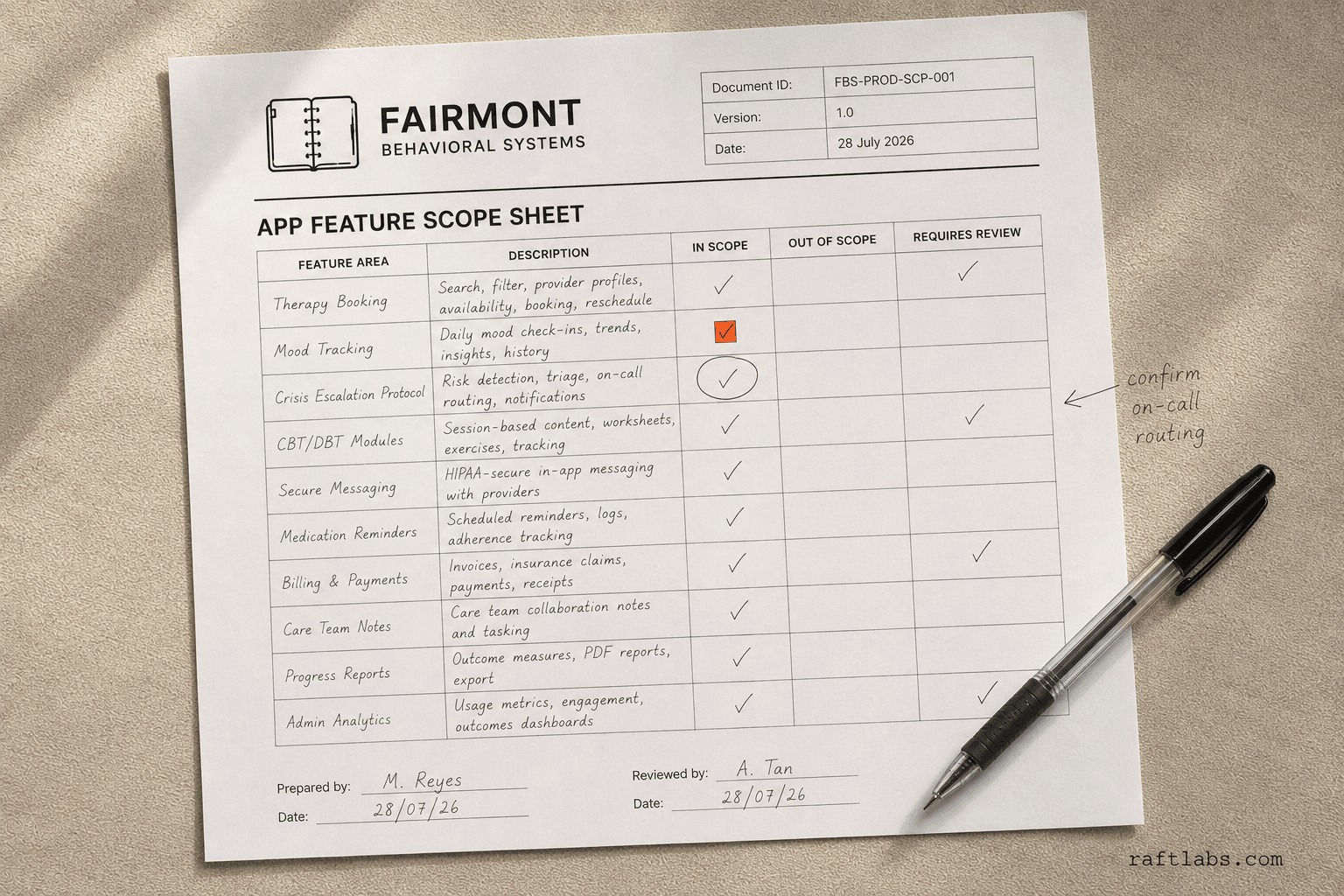
We map your trial design, the data you need to capture remotely, and your regulatory requirements. You leave week 1 with a written scope document and a fixed-price quote.
SNOMED/LOINC mapping, EDC integration approach, and jurisdiction-specific compliance architecture designed against your protocol.
Patient app, device integration, and clinician dashboard built in parallel, tested against real protocol scenarios.
Site coordinators and clinical monitors trained on the dashboard before full rollout.
Why us
The engineers who assess your protocol also build the solution. No bait-and-switch, no offshore handoff after the contract is signed.
We scope the work, calculate the cost, and lock it in writing before any development starts.
We have shipped production software since 2015, including remote patient monitoring, telehealth, and pharma workforce platforms. Real engagements across SaaS, fintech, healthcare, and logistics, not every one published as a named case study.
Custom is the right call for the programmes where it genuinely fits, not by default.
Data flow decisions are recorded so your legal and compliance team can review against your Data Management Plan.
Proof
Useful next steps
Work with us
Mental Health App Development
See the serviceTry it yourself
HIPAA Compliance Checklist
30+ requirements, plain-English, filtered to what you're building.
Open the free tool
Article
How to Build a Crowdfunding Platform Like GoFundMe: Cost, Features & Build Plan
Building a crowdfunding platform like GoFundMe costs $50K-$80K for a medical or nonprofit MVP and $130K-$200K for equity crowdfunding. Here is what to build first, where projects fail, and how vertical-specific operators win against generic platforms.
Read more
Article
How to build an employee training app
A step-by-step guide to building a mobile learning app that cuts training costs, improves retention, and works for distributed teams.
Read more
Article
Zapier vs custom integration: which one is actually right for your business
Zapier, Make, and n8n solve real problems. But they all have the same ceiling. This is the line between where no-code automation wins and where you need to build something custom.
Read more
Article
Productivity App Development: Build a Notion-Like Workspace for Your Vertical
Notion costs $16 per user per month at the Business tier. For a vertical SaaS adding a workspace feature, the bigger problem is not the price: it is that Notion cannot live inside your product, enforce your data types, or meet HIPAA or legal privilege requirements. Here is what custom productivity app development actually costs and when it makes sense.
Read moreEnterprise platforms suit large Phase III programmes with existing contracts and budget for configuration and validation. Custom is typically the right answer for a mid-size sponsor running a focused Phase II study, a CRO building monitoring capability for a specific therapeutic area, or when the protocol's device list, data model, or EDC connectivity doesn't fit standard configuration options.
US trials use HIPAA-compliant architecture with encryption, role-based access, BAAs, and a full audit trail hosted in US-region infrastructure. EU trials layer GDPR requirements on top, including explicit consent capture and EU-region data residency. Cross-jurisdiction trials typically use separate data stores per region with only de-identified aggregate data crossing the boundary.
Yes. We have integrated with Medidata Rave, Oracle Clinical One, and custom EDC systems, either via a direct API integration mapping fields to the corresponding EDC visit and form fields, or via a correctly formatted file-based export for systems using file-based import.
Start with a focused first build: patient iOS and Android app, Bluetooth integration for two or three device types, structured data capture, clinician dashboard, and HIPAA-compliant storage. That entry build typically starts around $50,000 to $90,000. The full platform, once you add EDC integration, EHR connectivity, and multi-region infrastructure, grows to $90,000 to $150,000 as the programme scales.
Work with us
Tell us your trial design, the data you need to capture remotely, and the regulatory requirements you're working to. We'll scope the right build.
Go deeper