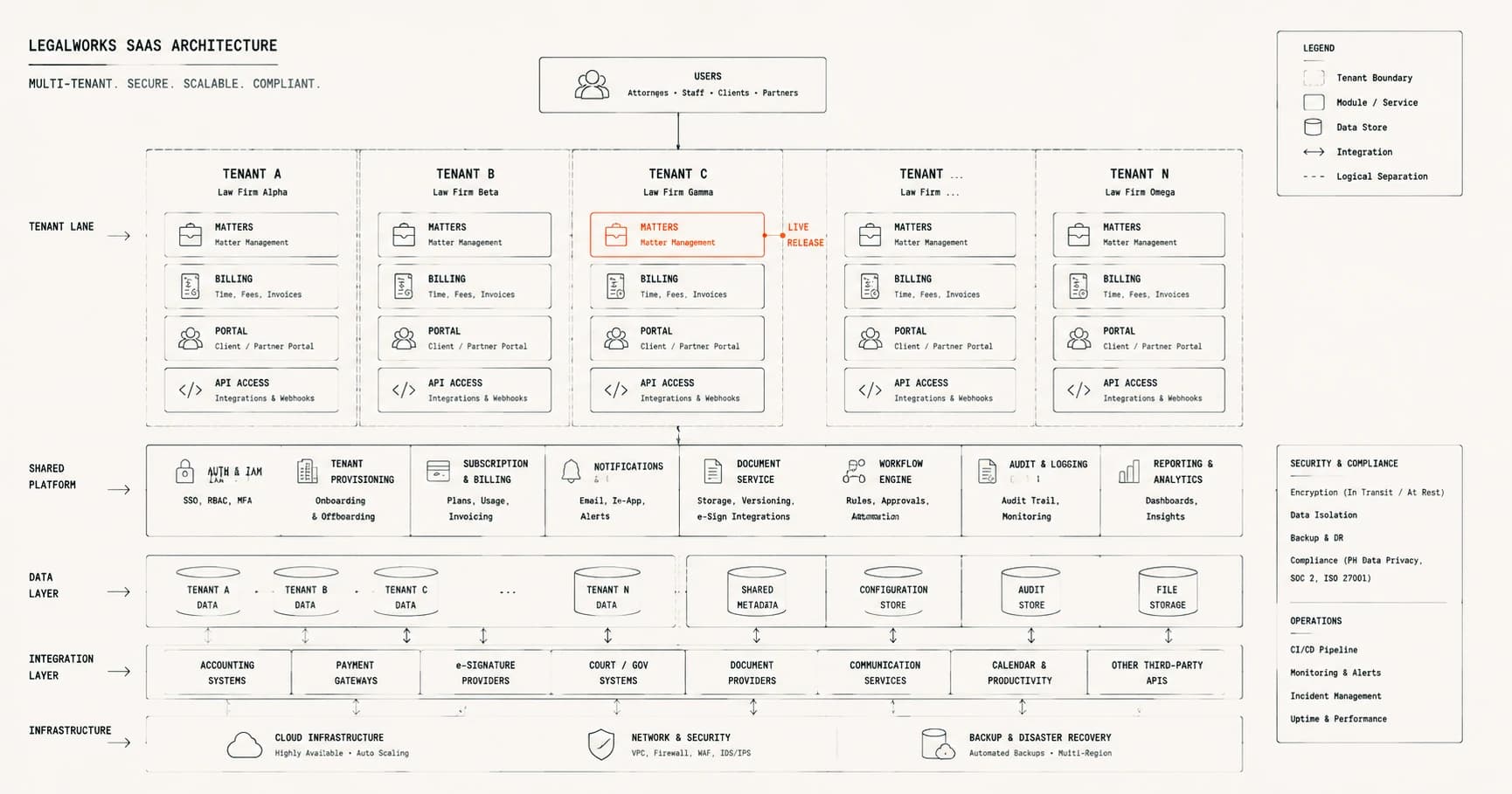
Legal SaaS development that keeps firms, matters, and permissions separate.
A legal SaaS product has to onboard many firms without turning every customer into a custom project. We develop multi-tenant legal products with tenant isolation, matter-level access, document workflows, subscriptions, and integrations designed before the first production customer arrives.
Bring the problem, the current workflow, or the existing code. We reply with a practical next step within one business day.
Evidence and scope
12 to 14 weeks
Validated first release
Multi-tenant core, documents, roles, and one client journey.
$60K
Starting scope
A production-ready legal SaaS foundation.
Deny by default
Risk control
Tenant and matter permissions tested before launch.
Good software decisions begin with the constraint, not a list of features or a preferred technology.
01
Is your legaltech prototype still using one data model and a few manual checks to separate customer firms?
02
Does each new law-firm customer need engineering help for roles, billing, imports, or workflow configuration?
Plain answer
Legal SaaS development creates multi-tenant products that legaltech companies sell to many firms. The architecture must separate tenants, enforce matter permissions, manage documents, and support repeatable onboarding and billing. RaftLabs scopes a production-ready first release from $60,000, with legal and security approval kept client-side.
The second customer is where a legal SaaS architecture tells the truth.
The prototype works for one friendly firm. Then another firm arrives with different roles, document rules, billing, and retention needs. Engineers add conditionals. Support staff request broad access to diagnose problems. One customer migration becomes a product release.
Legal SaaS starts when firms can share a product without sharing data, and configuration can absorb expected differences without forking the codebase.
A legal SaaS product needs a repeatable market, not one firm's backlog in subscription clothing.
The product should solve the same legal job for several customers while allowing bounded configuration.
A fit
01
You are selling one repeatable legal workflow to multiple firms or legal teams.
02
A prototype has validated the job, but tenant isolation, onboarding, or support access needs a production design.
03
The product needs plans, firm administration, usage controls, and integrations that can be operated without engineering per account.
Not a fit
01
One law firm needs software only for its own internal process.
02
Every customer requires a different data model and workflow with no stable product core.
03
The legal job, buyer, and route to market are still untested.
Product scope
What the legal SaaS foundation needs
01
Tenant isolation and firm administration
Separate each firm's users, matters, documents, settings, and billing at the data-access layer. Firm administrators manage their own members and configuration, while product support receives narrow, logged access instead of an all-seeing account.
02
Matter and document permissions
Model access below the tenant boundary where the product requires it. Search, export, previews, generated documents, background jobs, and notifications follow the same matter permissions as the primary screen.
03
Repeatable onboarding and migration
Turn account setup, role mapping, imports, validation, and training into a product path. Customers see migration errors and incomplete records before cutover, and your team can reproduce each onboarding decision.
04
Plans, billing, and usage controls
Support self-serve plans, contracted accounts, entitlements, limits, invoicing, and product analytics around the commercial model you choose. Pricing rules live in configuration rather than scattered checks across the application.
Legal SaaS and internal legal software solve different buying decisions
Legal software vs legal SaaS
Internal legal software
Legal SaaS product
Buyer
Law firm or legal department
Legaltech company serving many firms
Change model
Can follow one organisation closely
Needs a stable core and bounded configuration
Security boundary
Roles and matters within one organisation
Tenant isolation, then roles and matters inside each tenant
Operations
One rollout and internal support
Repeatable onboarding, support access, plans, and product operations
Right page
See legal software development
Continue here
For a system used by one firm or department, see legal software development. A legal SaaS build accepts the extra work only when a product business needs it.
Security controls support legal duties. They do not replace them.
The ABA Model Rule 1.6 requires lawyers to make reasonable efforts to prevent unauthorised access to or disclosure of client information. ABA Formal Opinion 477R adds that the safeguards may need to change with the information, agreement, and law involved.
Those sources do not prescribe one SaaS architecture or certify a product. We use the client's approved requirements to define access, encryption, logs, retention, incident evidence, vendors, and tests. Counsel and security owners decide whether the complete service meets the duties that apply.
Adjacent legal-product proof
16 weeks
to release the Concurrences iOS and Android product
Legal publishing and events
2+ years
in production
Published case-study record
0
reported app-side stability issues
Not a multi-tenant legal SaaS claim
The Concurrences engagement shows RaftLabs adding a maintained product layer to client-owned infrastructure without rewriting the backend. It is relevant evidence for product integration and support. It is not evidence that the app handled privileged matters, tenant isolation, or legal-practice billing.
How it works
From tenant model to first production firms
Architecture first, then controlled customer cohorts.
Phase 1
01
Define the product boundary
Choose the first legal job, buyer, tenant model, configuration surface, and integrations. Separate product requirements from requests that belong to professional services or later releases.
Phase 2
02
Design isolation and access
Model firms, matters, documents, users, roles, logs, retention, and regional hosting before application flows. Your legal and security advisers review the requirements and provider choices.
Phase 3
03
Validate every boundary
Test allowed and denied access across screens, APIs, search, export, documents, support tools, background jobs, and AI retrieval. Validate billing and integration failure paths alongside the main customer journey.
Phase 4
04
Onboard controlled cohorts
Release to a small group of firms, migrate and reconcile their records, and monitor the product. Expand only after onboarding, permissions, support, and recovery procedures work without ad hoc engineering.
Risk
Failure modes to settle before scale
Tenant filters are optional
One missed query can become a data exposure. Isolation belongs in shared data-access controls and must be tested across every access path.
Support can impersonate anyone
Broad support access weakens the confidentiality model. Use approval, time limits, narrow scopes, logging, and visible customer controls where the operating model needs access.
Search and AI bypass matter permissions
Indexes, embeddings, exports, caches, and generated answers need the same authorisation boundary as the source document. Test negative cases, not only relevant answers.
Every customer receives a fork
If expected variation cannot be configured, onboarding becomes custom development and the product economics collapse. Define what is configurable and what the product will refuse.
Scope and price
A production-ready legal SaaS foundation starts at $60,000.
Start with one buyer, one legal job, tenant isolation, core permissions, documents, and the integration needed for a complete user journey.
The full range is set after tenant complexity, customer onboarding, data migration, provider contracts, and security evidence are understood.
Starting investment
Starts at $60,000
A focused first release usually takes 12 to 14 weeks. Migration, mobile apps, enterprise controls, and court or billing integrations can extend the plan.
Fixed-price phase
Once the first phase is scoped, its price is locked in writing. New requirements enter only through an agreed change.
Post-launch support
Eight weeks of support are included for production monitoring, access issues, and onboarding fixes within the agreed scope.
Internal legal software serves one organisation and its own workflow. Legal SaaS serves many subscribing firms, so it also needs tenant isolation, configurable roles and workflows, repeatable onboarding, subscription or contract billing, customer support controls, and product economics that work across accounts.
No. Architecture can support confidentiality, security, retention, and audit requirements, but compliance depends on the product, jurisdictions, contracts, operations, and evidence. Your legal and security advisers define the obligations. We design and test the controls they approve.
Yes, but it is usually a staged product migration rather than a technical conversion. We audit the existing workflows and data, design the tenant model, release the cloud product alongside the desktop version, migrate customers in controlled cohorts, and reconcile each account before its cutover.
It can be designed to. Retrieval, prompts, model calls, logs, and generated outputs must inherit the signed-in user's authorised scope. We test denied-access cases as well as expected answers. A lawyer still reviews legal output, and the client approves provider, retention, and data-processing choices.
A production-ready first release with multi-tenancy, matter and document permissions, core workflows, and one integration starts around $60,000 and usually takes 12 to 14 weeks. Mobile apps, court integrations, complex migrations, enterprise controls, and multiple billing models increase the scope.
Work with us
Bring the legal job and the tenant boundary.
We will map the smallest product a second firm can adopt without becoming a second custom codebase.
Scope and cost agreed before work starts. No surprises. No obligation.
Working prototype within 3 weeks of kickoff.
Pay by milestone. You see progress before each invoice.
60-day post-launch warranty. Bug fixes, UI tweaks, and deployment support. No retainer.