Legal software development that fits the way your firm works.
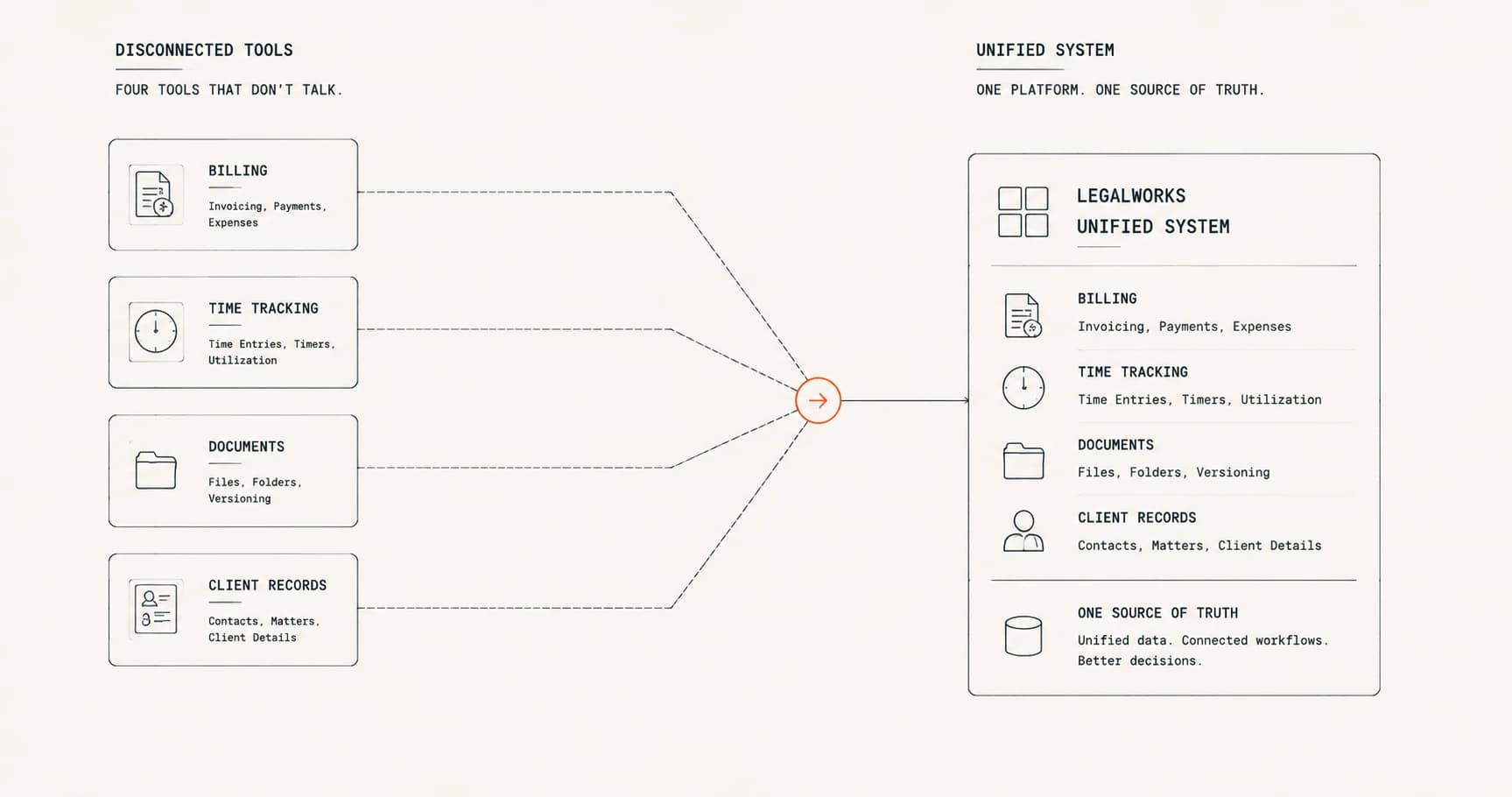
When intake, matters, documents, billing, and client updates live in separate tools, staff spend their day carrying information between them. We develop custom legal software for law firms and in-house legal teams whose workflows no longer fit a standard practice platform.
Bring the problem, the current workflow, or the existing code. We reply with a practical next step within one business day.
Evidence and scope
10 to 16 weeks
Focused first release
One operational workflow with the integrations it needs.
$25K
Starting scope
A client portal or single matter workflow.
Fixed price
Commercial model
The first phase is scoped and priced before development.
Good software decisions begin with the constraint, not a list of features or a preferred technology.
01
Does one matter update require a paralegal to copy the same information across several systems?
02
Are unusual fee arrangements, approvals, or matter structures forcing workarounds in otherwise capable legal software?
Plain answer
Legal software development creates internal systems for law firms and legal teams when standard practice software cannot support their matter, billing, document, or integration rules. RaftLabs scopes one operational workflow first, keeps legal decisions with qualified staff, and prices focused releases from $25,000.
The software works. The gaps between it do not.
A new client fills out an intake form. Staff retype the details into the matter system, create a folder, open a billing record, and email the client for the document the form did not request. None of those tools is necessarily broken. The handoffs are.
Custom legal software is useful when one repeatable path needs to cross those boundaries without losing ownership, context, or an audit trail.
Adjacent legal-sector proof
16 weeks
to release the Concurrences mobile product
Legal publishing and events, not law-firm operations
2+ years
in production
Recorded in the published case study
0
reported app-side stability issues
Client backend changes excluded
RaftLabs built a mobile product for Concurrences, a Paris legal publisher, on top of a client-owned PHP backend. That work proves integration discipline and long-running product support in the legal sector. It does not prove a completed practice-management or trust-accounting deployment.
Custom legal software should remove a measured constraint, not replace software because it feels old.
Start by pricing the operational drag. If configuration solves it cleanly, keep the platform you have.
A fit
01
A repeatable matter workflow crosses systems and staff spend material time reconciling it.
02
Billing, approval, or matter rules are specific enough that a standard platform needs fragile workarounds.
03
The workflow depends on proprietary data or an internal system that standard connectors do not cover.
Not a fit
01
Your firm can adopt a standard practice-management workflow without material compromise.
02
The problem is inconsistent policy or training rather than missing software.
03
The scope is still a list of desired features with no accountable workflow owner.
Scope
What custom legal software can cover
01
Intake and matter operations
Capture the information required to open a matter once, then carry it into conflicts, assignments, tasks, deadlines, and reporting. The operations lead sees incomplete intake and stalled handoffs before they become client follow-ups.
02
Client portals and secure exchange
Give each client an authenticated place for status, messages, documents, forms, and signatures. Access follows the matter and user role, so the firm can test who can see, download, or share each record.
Connect time, fees, expenses, invoices, and payment status to the matter model. Unusual arrangements can be encoded, but the firm's controller approves accounting rules and validates outputs before cutover.
05
Existing-system integration
Connect a practice platform, DMS, CRM, accounting product, e-signature provider, or internal database through supported APIs and controlled imports. Staff work from one path while systems of record stay where they belong.
Is this legal software or a legal SaaS product?
Both may handle matters and documents. The ownership model changes the architecture, commercial plan, and release burden.
Internal legal software vs legal SaaS
Internal legal software
Legal SaaS product
Primary user
One law firm or legal department
Many subscribing firms or legal teams
Operating model
Fits one organisation's rules and systems
Supports tenant configuration without custom work per customer
Data boundary
Role and matter access inside one organisation
Tenant isolation plus role and matter access inside each tenant
Commercial need
Operational return for the buyer
Onboarding, plans, billing, support, and product economics
Right page
Continue here
See legal SaaS development
If you are creating a product to sell across firms, see legal SaaS development. This page is for software one legal organisation uses to run its own work.
How it works
A controlled legal software rollout
One critical workflow first. Controls and migration evidence before cutover.
Phase 1
01
Map one costly workflow
Follow one matter from intake to its next business outcome. Record the rules, handoffs, exceptions, owners, source systems, and current error points. That becomes a bounded first release, not a firm-wide wish list.
Phase 2
02
Set the data and access model
Define matters, people, documents, financial records, roles, retention needs, and integrations. Your legal, finance, and security owners approve the rules that software cannot decide for them.
Phase 3
03
Release and validate
Put the workflow in staging and test it with attorneys, paralegals, operations, and finance. Permission tests cover expected access and denied access. Migrated records and financial outputs are reconciled to their sources.
Phase 4
04
Cut over with evidence
Run the critical path in parallel where risk calls for it, record acceptance, and monitor production. Later workflows enter only after the first one is stable and its operating benefit is visible.
Where legal software projects usually go wrong
A feature list replaces workflow evidence
A long backlog does not show where time or errors are being lost. We anchor the first phase to one path, one owner, and measurable acceptance criteria.
Permissions stop at job titles
Attorney, paralegal, and administrator are not enough when access also depends on matter assignment, client, document type, or ethical wall. We test both allowed and denied paths.
Migration is treated as a file import
Matter relationships, document links, dates, and balances must survive the move. We profile, map, stage, and reconcile before cutover.
Software is asked to interpret professional rules
The firm defines legal, ethical, accounting, and retention requirements. We encode approved rules and evidence, but do not replace counsel or professional judgment.
The ABA Model Rule 1.6 calls for reasonable efforts to prevent unauthorised access or disclosure of client information. It does not certify a particular architecture. Applicable rules and the reasonableness assessment remain with the firm and its advisers.
Scope and price
A focused legal workflow starts at $25,000.
Start with one client portal, matter path, or document workflow and the integrations needed to make it useful.
Broader practice software is priced after the data model, financial controls, migration sources, and integration boundaries are understood.
Starting investment
Starts at $25,000
A focused first release usually takes 10 to 16 weeks. Migration, billing complexity, and additional systems can extend the plan.
Fixed-price phase
Once the first phase is scoped, its price is locked in writing. A requested change is priced and approved before it enters the work.
Post-launch support
Eight weeks of support are included, with production monitoring and the critical workflow checked before handoff.
Legal software development creates custom systems for a law firm's or legal department's internal work, such as intake, matter management, client portals, documents, billing, and reporting. It is different from legal SaaS development, which creates a multi-tenant product that a software company sells to many firms.
Choose an established product when your matter types, billing, and integrations fit its standard model. Custom development becomes worth assessing when repeated workarounds cause measurable errors or delay, a proprietary system must be connected, or the client experience is part of the firm's differentiation. We test that case before recommending a build.
No software vendor should make that guarantee. Rules vary by jurisdiction and can change. Your counsel, controller, or compliance owner defines the applicable requirements and approves the workflow. We translate those approved rules into permissions, audit records, reconciliations, retention controls, and acceptance tests.
Yes, when the source can be accessed and mapped. We profile exports or APIs, clean sample records, test the migration in staging, and reconcile counts and critical balances before cutover. Financial workflows may need a parallel run so the firm can compare outputs before the old system is retired.
A focused client portal or single operational workflow starts around $25,000 and usually takes 10 to 16 weeks. Broader practice software can cost more as billing rules, trust accounting, migrations, mobile apps, and integrations are added. The first phase is scoped and priced before development begins.
Work with us
Show us the workflow your current tools cannot handle.
Bring one matter path, the systems it touches, and the exception that causes the most rework. We will assess whether custom software is justified.
Scope and cost agreed before work starts. No surprises. No obligation.
Working prototype within 3 weeks of kickoff.
Pay by milestone. You see progress before each invoice.
60-day post-launch warranty. Bug fixes, UI tweaks, and deployment support. No retainer.