AI remote patient monitoring for chronic care
- 20%
- less clinical decision-making time
- 150+
- patients in 12 weeks
AI in Healthcare Agent Development
A chatbot responds to what a patient or clinician asks. An AI agent takes a workflow from start to finish: gathering inputs, applying rules, calling systems, and producing outcomes. The difference matters in healthcare, where the cost of half-finished workflows lands on clinical staff. We build healthcare AI agents with defined scope, explicit escalation logic, and HIPAA-aware data handling. Each agent handles one workflow well rather than many workflows poorly.
Prior auth agents that extract criteria, match payer guidelines, submit requests, and track status
Clinical documentation agents that draft SOAP notes and encounter summaries from structured input
Care gap agents that identify patients, generate outreach, and track response
HIPAA-aware architecture with EHR integration via FHIR R4
Bring the problem, the current workflow, or the existing code. We reply with a practical next step within one business day.
Trusted by













The brief
Good software decisions begin with the constraint, not a list of features or a preferred technology.
Clinical staff spending hours on prior authorisations and documentation an AI agent could handle?
Implementing a healthcare chatbot that can answer questions but can't actually complete the workflow?
Plain answer
AI in healthcare, at RaftLabs, means autonomous agents for healthcare workflows: prior authorisation processing, care gap identification, clinical documentation drafting, patient intake, and medication refill handling. Unlike chatbots that only answer questions, these agents take actions end-to-end within defined guardrails, integrating with EHR systems via FHIR and operating under HIPAA-aware architecture. A focused build launches a validated v1 in 10-14 weeks at a fixed cost.
What to remember
A prior authorisation used to move one way. A nurse pulls the chart, reads the payer criteria, assembles the packet, submits it, then chases the status for days. Multiply that by every request, and your most expensive clinical staff spend their afternoons on paperwork.
Now an agent takes the request first. It extracts the criteria from the record, matches the payer guideline, submits the packet, and tracks the deadline on its own. What reaches a nurse is the exception: a criteria mismatch, missing documentation, a denial worth appealing.
A chatbot could have told the nurse the policy. It could not have filed the request. That gap is the whole point.
A chatbot responds to what a patient or clinician asks. An AI agent takes a workflow from start to finish: gathering inputs, applying rules, calling systems, and producing outcomes. The difference matters in healthcare, where the cost of half-finished workflows lands on clinical staff. The American Medical Association's prior authorization survey found physicians and their staff spend an average of about 13 hours a week on prior authorizations alone, the kind of structured, high-volume workflow an agent is built to carry. McKinsey estimates AI can automate 50 to 75% of the manual tasks inside prior authorization (McKinsey), which is why it is the workflow most healthcare teams point an agent at first. This is the engineering discipline behind AI agent development, applied to the clinic.
Many teams arrive with a demo already built. An agent scaffolded in an afternoon with an AI tool answers cleanly on happy-path data. Then it meets a live EHR, real PHI, and an audit trail it was never designed for. We assess what you have, keep the workflow logic that holds, and rebuild the parts that won't survive real patient data. Where the job is broader than one agent, we bring in AI for healthcare and healthcare software development so the agent fits the systems around it.
We build healthcare AI agents with defined scope, explicit escalation logic, and HIPAA-aware data handling. Each agent handles one workflow well rather than many workflows poorly. EHR integration is scoped during discovery, because that's where most projects encounter unexpected complexity. We don't estimate EHR integration generically: API coverage variance between Epic, Cerner, and Athenahealth configurations is large enough to change project scope materially, so we confirm it before we quote.
The team that scopes your workflow is the team that ships it. No bait-and-switch, no handoff after the contract is signed. We scope the work, calculate the cost, and lock it in writing before any development starts. A focused agent launches a validated v1 in 10-14 weeks, then grows as you add workflows.
Everything on the left should already be true for your practice. Even one thing on the right, and a plain chatbot is the smarter first step.
A high-volume clinical or administrative workflow, prior auth, documentation, or care gap outreach, that your staff run the same way every day.
An EHR that exposes FHIR R4 APIs (Epic, Oracle Health/Cerner, Athenahealth) for the agent to read from and write back to.
You need the agent to complete the workflow end-to-end within HIPAA-aware guardrails, not just answer questions.
You need a simple FAQ responder or patient chatbot, not a system that takes action.
The workflow depends entirely on clinical judgment the agent was never given context for.
Your EHR exposes no FHIR or HL7 interface to read from or write back to.
What we build
| What happens | Scripted scheduling bot | Clinical-aware agent | Front-desk staff |
|---|---|---|---|
| Books a routine appointment | Yes, on a fixed script | Yes, against your appointment-type rules | Yes, but slow at volume |
| Reads the record via FHIR | No | Yes, scoped to minimum-necessary PHI | Manually, one chart at a time |
| Handles a red-flag symptom | Routes it blindly | Escalates against clinician-defined criteria | Depends on training and load |
| Writes back to the EHR | No | Yes, as a FHIR resource with an audit trail | By hand |
| Knows when to stop | No sense of exceptions | Hands exceptions to a human | Always human |
Key Insight
The regulatory clock is already running. Under the CMS Interoperability and Prior Authorization Final Rule, impacted payers must return standard prior authorization decisions within seven calendar days and urgent ones within 72 hours, and the FHIR-based Prior Authorization API requirement takes effect January 1, 2027 (CMS). Agents that read and write prior auth over FHIR are being built for the workflow healthcare is about to be required to run at scale.
A healthcare AI agent that demos well is not the same system that survives a real clinic. MIT found that 95% of enterprise generative AI pilots deliver no measurable profit (MIT, The GenAI Divide, 2025). The gap is rarely the model. It is the data, the compliance, and the integration work that a demo skips.
We build on the side of that gap where the work actually runs. RaftLabs has shipped production software since 2015 for clients across the US, UK, Europe, Canada, and the UAE. The healthcare proof below is separate and specific: HIPAA-compliant systems we built and still support for US providers.
Proof
Tell us the workflow you want to automate, your EHR system, and the payer mix. We'll scope what an agent can handle and give you a fixed cost.
How it works
We map the target workflow, your EHR's API coverage, and escalation logic. You leave week 1 with a written scope document and a fixed-price quote.
BAA coverage, data flow, and human-in-the-loop checkpoints designed and documented before any PHI flows through the system.
Agent workflow built against LangGraph, tested against real EHR sandbox data, and reviewed by your clinical team before go-live.
Production deployment with audit logging active from day one and escalation queues staffed and ready.
An AI agent in a clinic fails in specific, predictable ways. We design against each one before it can reach a patient record.
What clients say
Three-year average engagement. Founders and operators describing the work in their own words. No marketing varnish.

 USA
USAAll of the sprints were completed on schedule and on budget. We highly recommend RaftLabs!
Proof
Where you land depends on scope, not negotiation:
What it costs
A focused agent covering one workflow, one EHR integration, and HIPAA-aware architecture, live in 10-14 weeks. Multi-agent systems add documentation, outreach, and FHIR R4 write-back.
We don't estimate EHR integration generically. API coverage varies materially between Epic, Cerner, and Athenahealth, so we confirm it during discovery. Most systems start with a single-workflow agent, then expand to a multi-agent system once the EHR connection is proven in production.
Starting investment
Starts at $35,000
Live in 10-14 weeks. Start with one workflow and one EHR integration, the highest-variance piece, scoped in detail before anything is built, then add agents once the first one proves out.
No hourly billing
Once we scope your first agent, that price is locked in writing, so there's no hourly billing and no invoice surprises. A scope change is a priced change request, agreed before work begins.
Human-in-the-loop
Every clinical decision, note finalisation, and triage redirect keeps a mandatory checkpoint. The agent assembles the context; a clinician makes the call.
Useful next steps
Work with us
Telehealth App Development
See the serviceTry it yourself
HIPAA Compliance Checklist
30+ requirements, plain-English, filtered to what you're building.
Open the free tool
Article
Cost to Build a Quick Commerce App Like Blinkit: Features and What Actually Ships
Real quick commerce app development costs, phased feature breakdown, and why Shopify delivery plugins and WooCommerce dark store plugins fail at scale. Built for grocery chains, pharmacy networks, and dark store operators.
Read more
Article
HIPAA Compliance Software: A 7-Step Development Checklist
This article outlines key steps for achieving HIPAA compliance in healthcare app development. Our 7-step checklist covers encryption, identity management, and audit controls to protect sensitive health data. Follow these guidelines to meet legal requirements, build user trust, and ship an app that's secure and compliant.
Read more
Article
Conversational AI in Healthcare: Key Use Cases, Benefits & Future Trends
Conversational AI helps healthcare providers scale patient interactions, reduce staff burden, and cut operational costs. From appointment scheduling to remote monitoring, this article covers real-world use cases, challenges, and build steps for founders, product teams, and healthcare leaders.
Read more
Article
Mental Health Practice Management Software: Build vs. Buy in 2026
Group therapy practices, EAP providers, and behavioral health networks hit real limits with off-the-shelf tools. Here is what custom mental health practice management software costs, when it pays, and where most projects fail.
Read moreA chatbot responds to a query. An AI agent completes a workflow end-to-end: gathering inputs, applying rules, calling systems, and producing outcomes. Agents operate as stateful, multi-step processes that can call external systems and take actions, modelling the workflow as a directed graph with explicit state, tools, and decision branches. In healthcare, this matters because workflows like prior authorisation, care gap outreach, and medication reconciliation span multiple systems, have exception conditions requiring clinical judgment, and must produce auditable records of every action taken.
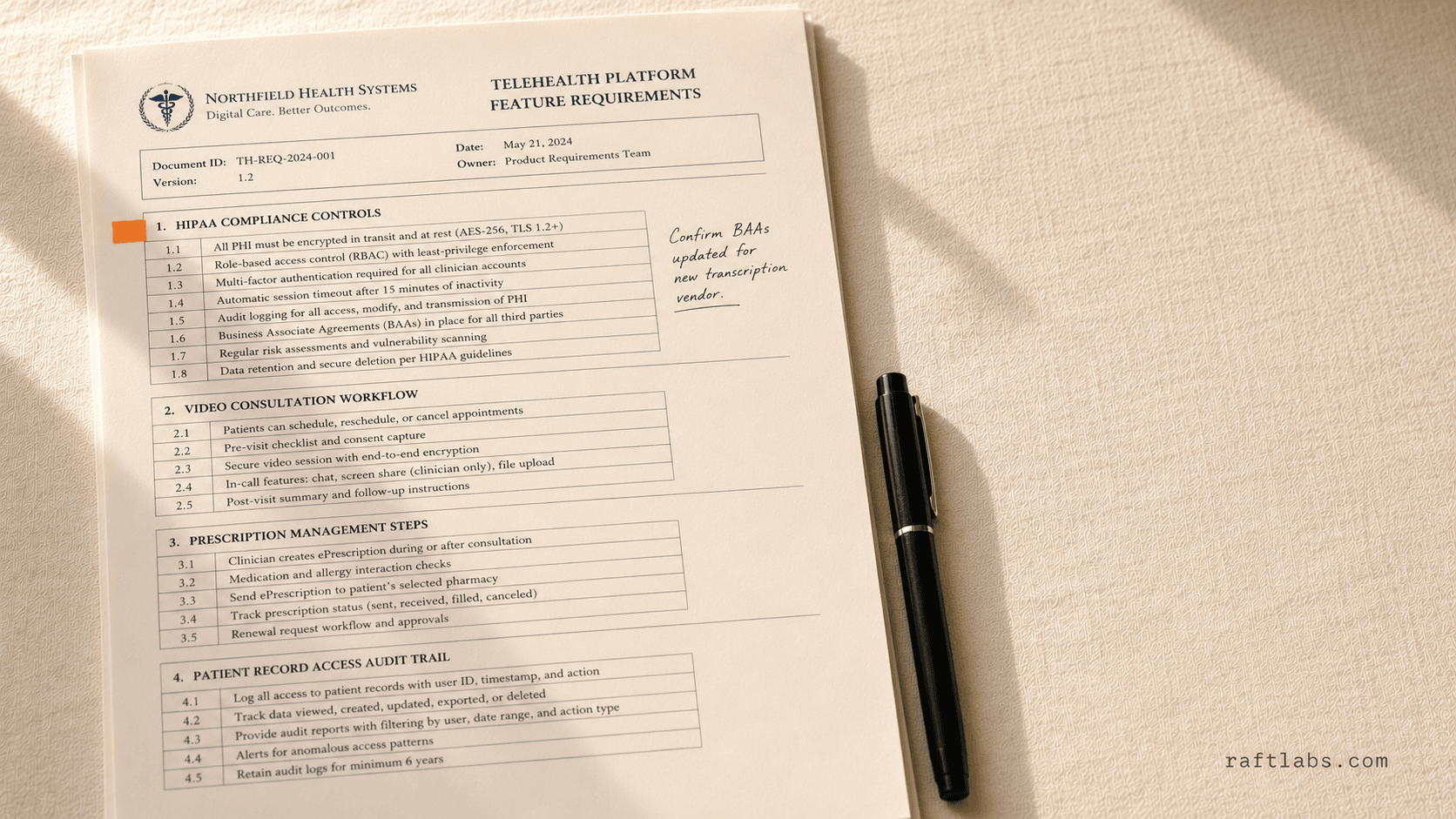
HIPAA compliance for AI agents requires Business Associate Agreements with every infrastructure provider processing PHI, encrypted data handling in transit (TLS 1.2 minimum) and at rest (AES-256), audit logging of every PHI access event, and minimum-necessary data access design. LLM API providers such as Anthropic, OpenAI, and major cloud providers offer BAAs for healthcare customers, but PHI cannot be sent to LLM APIs without one in place. The vector database used for clinical knowledge retrieval is deployed within a HIPAA-eligible environment with network isolation.
We integrate with EHRs that expose FHIR R4 APIs: Epic (via App Orchard and Open API programmes), Oracle Health (Cerner) via Ignite APIs, Athenahealth via Marketplace API, Allscripts, ModMed, and most ONC-certified modern EHRs. CDS Hooks integration is available on Epic and Cerner where the practice has licensed the capability. For scheduling write-back and prior auth submission, integration depth depends on what each EHR's API supports. For EHRs with limited FHIR coverage, HL7 v2 feeds are the fallback path.
A focused healthcare AI agent covering one workflow, one EHR integration, and HIPAA-compliant architecture typically runs $35,000-$75,000 and delivers in 10-14 weeks. A multi-agent system covering prior auth, clinical documentation, and care gap outreach with FHIR R4 write-back and a vector database for clinical knowledge retrieval typically runs $75,000-$175,000. Cost is driven by EHR integration complexity, the number of payer systems involved, and the clinical content scope requiring clinical team review before deployment.
Work with us
Bring the rough workflow, half-built product, or messy brief. We will map the smallest useful first move, then send scope, timeline, and price in plain English.