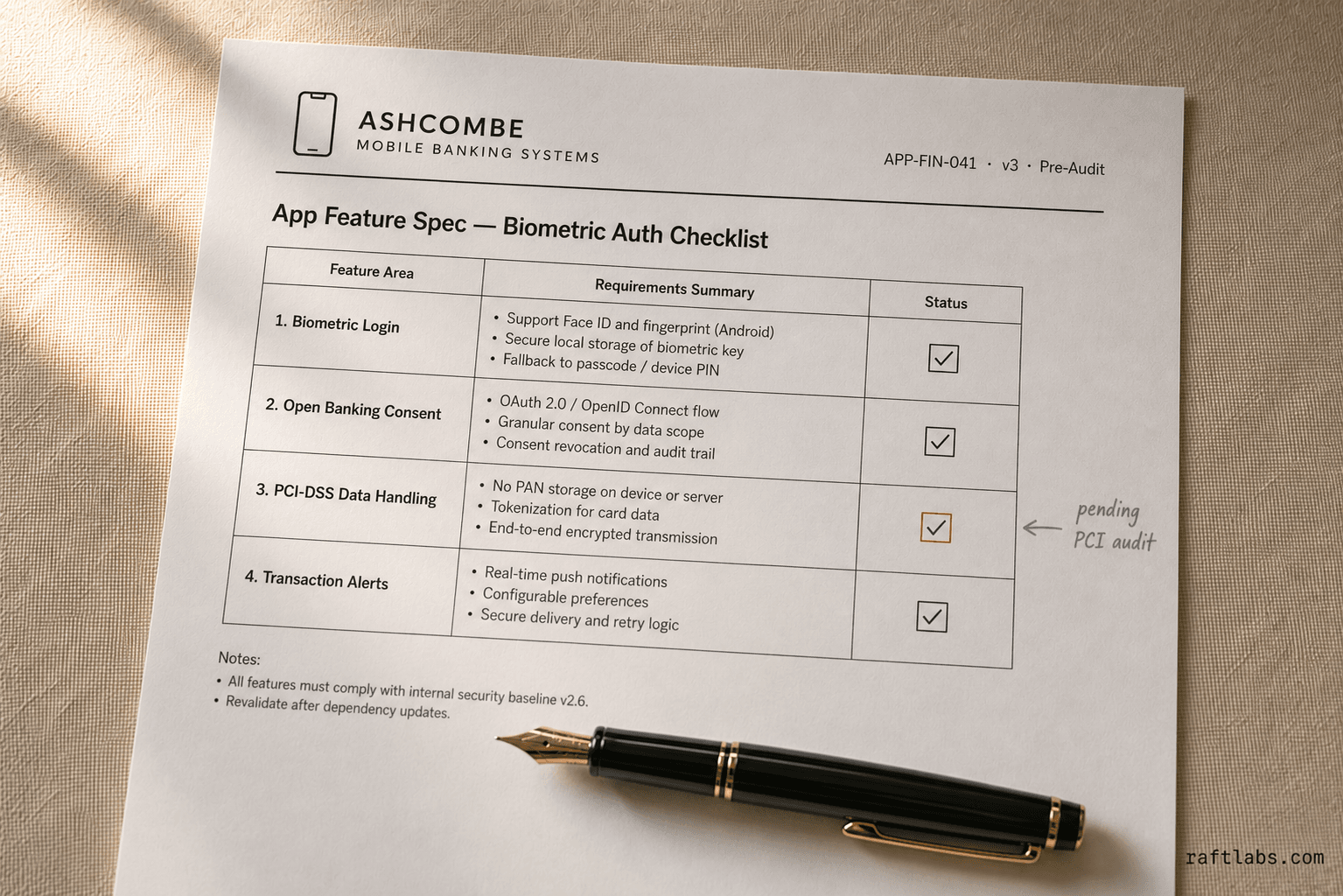
Mobile POS platform for a regulated FinTech operator
- PCI DSS
- compliance audit passed, 2025
Custom FinTech Compliance Software
KYC, AML, and ongoing customer reviews break down when vendor results, transaction alerts, documents, and analyst decisions live in separate tools. We build custom FinTech compliance software that brings one approved workflow into your product and operations stack while keeping policy decisions with your compliance team.
Bring the problem, the current workflow, or the existing code. We reply with a practical next step within one business day.
Evidence and scope
10 to 14 weeks
First workflow
One onboarding or monitoring case from signal to reviewed outcome.
$30K
Starting scope
Vendor orchestration, case queue, evidence, and audit trail.
Human-owned
Policy ownership
Compliance defines rules and approves consequential decisions.
The brief
Good software decisions begin with the constraint, not a list of features or a preferred technology.
Are analysts switching between onboarding, screening, transaction, and document tools to understand one customer case?
Can you reconstruct which data, policy version, reviewer, and approval led to a customer decision?
Plain answer
FinTech compliance software connects KYC, screening, transaction signals, documents, and analyst review. RaftLabs builds custom RegTech workflows when standard tools leave operational gaps. A focused onboarding or monitoring workflow starts at $30,000 and usually takes 10 to 14 weeks in practice.
A customer record passed identity verification, returned a possible sanctions match, and triggered a transaction alert. Three vendors produced three reference numbers. The analyst still has to assemble the case before deciding what to do.
Useful RegTech does not replace that judgment. It gives the reviewer one coherent record and makes the next approved step clear.
Delivery record
The FATF recommendations describe customer due diligence and ongoing scrutiny of transactions on a risk basis. Local law, regulator guidance, product type, and the firm's risk assessment shape the actual workflow. Client-appointed compliance and legal owners make that interpretation.
Use proven providers for identity and screening when they fit. Build the operating layer when the handoffs, product rules, or internal systems are the real constraint.
Analysts assemble one case from several vendors, internal systems, documents, and transaction sources.
Product actions, review queues, permissions, and evidence need to follow an approved proprietary workflow.
A standard case tool leaves material integration or operating gaps after configuration.
A specialist provider already covers the workflow and integrations you need.
Policy owners have not defined customer states, escalation, decision authority, or retention.
You expect software to decide legal obligations or eliminate compliance review for consequential cases.
Scope
| Standard provider suite | Custom operating layer | |
|---|---|---|
| Best fit | Common onboarding, screening, and case patterns | Proprietary product actions, internal data, or review logic |
| Data coverage | Provider-maintained identity, company, PEP, sanctions, or adverse-media sources | Orchestrates approved providers and internal signals |
| Implementation | Configure the vendor workflow and standard integrations | Design, build, and validate the missing operating layer |
| Maintenance | Vendor maintains its data and product | Client owns policy; software and integrations require ongoing support |
| Right decision | Use it when the workflow fits | Build when integration gaps create material operating risk or cost |
Rollout
Start with one product, one jurisdiction, and one operational case type.
Define the product, jurisdiction, policy owner, decision points, vendor inputs, internal data, and required records. Legal questions are resolved by the client's advisers before implementation.
Turn the approved policy into states, permissions, review routes, evidence, escalation, and failure handling. Name who can make each consequential decision.
Test normal, incomplete, matched, ambiguous, high-risk, and vendor-unavailable paths using synthetic, redacted, or appropriately controlled historical data.
Let compliance accept the workflow and release criteria. Monitor queue ageing, overrides, false positives, integration failures, and customer impact before expanding.
The mobile POS case below covered KYC onboarding, transaction processing, and an independent PCI DSS audit for a FinTech operator. It shows relevant delivery discipline, but it is not evidence that RaftLabs has shipped every AML or regulatory reporting workflow described on this page.
Proof
Scope and price
Begin with one onboarding or monitoring case, the approved providers, analyst review, product actions, and an audit trail.
Additional products, jurisdictions, vendors, monitoring models, migrations, and regulator outputs are scoped as later phases phases.
Starting investment
Starts at $30,000
A focused first release usually takes 10 to 14 weeks. Vendor access, policy readiness, and representative test cases affect the schedule.
Fixed first phase
The workflow, integrations, case states, permissions, evidence, acceptance tests, timeline, and price are agreed before development starts.
Post-launch support
Eight weeks of support are included to fix integration and workflow defects found in production operation.
Useful next steps
Work with us
Fintech Mobile App Development
See the serviceTry it yourself
Automation ROI Calculator
Find out what your manual processes cost, and what automation saves.
Open the free tool
Article
AI in Insurance: From Claims Processing to Fraud Detection
Insurance companies process millions of documents, field thousands of claims, and make underwriting decisions on complex risk profiles, manually. AI applies directly to each of these. The question is not whether AI works in insurance. It is which workflows to automate first and how to keep the human judgment where it is legally required.
Read more
Article
Franchise Management Software: Build vs. Buy for 50+ Location Brands
FranConnect costs $120K-$300K/year at 50 locations. When your royalty agreements, onboarding workflows, and compliance audits outgrow off-the-shelf tools, custom franchise management software pays for itself inside 18 months.
Read more
Article
Cost to Build a Cross-Border Payment App Like Wise
Money transfer app development costs $35K-$70K for an MVP covering 2-3 corridors and takes 16-20 weeks. This guide covers cost tables, phased feature sets, why clone scripts fail, and when custom beats off-the-shelf for fintech companies building cross-border payment platforms.
Read more
Article
Insurtech App Development: Cost, Timeline, and What Lemonade Actually Built
Insurtech app development on the MGA path costs $90K-$160K and takes 18-22 weeks. Here is what pet insurers, rental platforms, and gig-worker MGAs need to know before they start.
Read moreFinTech compliance software supports regulated customer and transaction workflows such as identity checks, screening, document collection, risk reviews, alert investigation, and reporting preparation. It connects vendor signals to cases, evidence, and approvals. The firm's compliance and legal teams still define obligations, policy, thresholds, and decision authority.
Buy specialist data and screening capabilities when established providers meet your jurisdiction, coverage, and assurance needs. Custom work is usually the orchestration layer around those providers: product gating, case management, internal data, analyst review, audit history, and integration with proprietary systems. We assess vendor fit before proposing a build.
It can automate low-risk routing or submission steps only when the client's approved policy and legal requirements allow it. Material matches, suspicious activity decisions, account restrictions, and reports need the designated human authority. We encode the agreed workflow and evidence trail; we do not make legal determinations.
A platform can hold versioned workflows for several products or jurisdictions, but each one needs its own approved requirements, owners, tests, and release decision. RaftLabs does not provide a universal compliance rulebook. The client's compliance and legal advisers supply and maintain the applicable interpretation.
A focused KYC onboarding or AML case workflow starts around $30,000 and usually takes 10 to 14 weeks. Cost depends on vendors, internal systems, case logic, permissions, reporting, migration, and assurance needs. Scope, acceptance criteria, timeline, and price are agreed before development starts.
Work with us
We will map the policy owner, vendor inputs, analyst decisions, product actions, and evidence trail, then identify the smallest useful first workflow.