Dock and Boat Lift Management Software
Dock and boat lift software for companies whose whole year is two short seasons and a long list of shorelines.
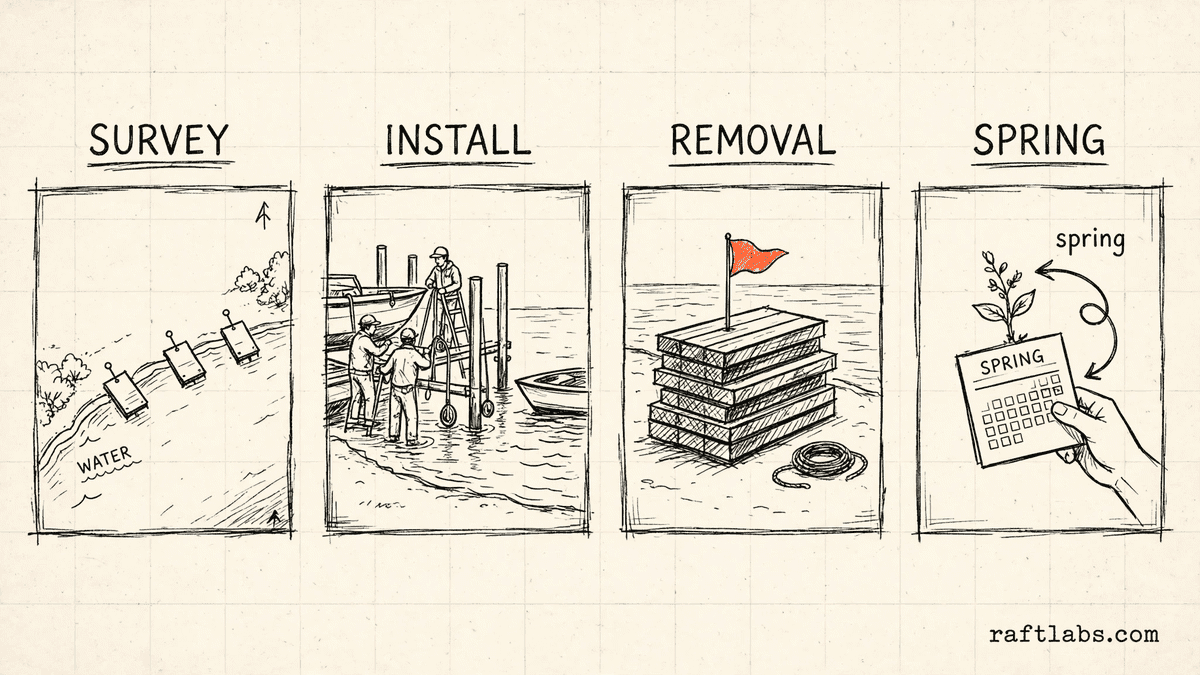
A dock company does not sell appointments. It sells knowing exactly what sits at each property and putting it in and out on time. We turn that into software that pins every dock section, lift, and canopy to its property, carries the seasonal plan forward each spring, works offline on the shoreline, and gets damage priced and approved before spring install.
Bring one stuck workflow. Leave with a build, buy, repair, or wait recommendation.
Trusted by





















The brief
Start with what is not working.
Good software decisions begin with the constraint, not a list of features or a preferred technology.
Every dock company runs the same three steps: a spreadsheet, then a general field-service tool, then the spreadsheet again alongside it, because the tool had nowhere to put what the spreadsheet was for.
Nobody can say, property by property, exactly which sections, lifts, and canopies a crew will find when they arrive.
Damage found at fall removal is remembered, argued about, or forgotten, instead of being priced and approved before spring install.
Plain answer
RaftLabs builds dock and boat lift software for dock, boat lift, and seawall service companies. One record per property pins every dock section, lift, and canopy where it sits, the seasonal install and removal plan carries forward each spring instead of being rebuilt, the crew app works offline on the shoreline, and damage flagged at removal is priced and approved by the customer before spring install, so the season opens with the work already there.
What to remember
- Use this when the property list lives in a spreadsheet that a general field-service tool could never hold.
- Pin every dock section, lift, and canopy to its property, in the water and in winter storage, so a crew knows what it will find before it leaves.
- Carry each property's seasonal plan forward each spring; a new season opens with the work already there, not rebuilt from last year's notes.
- Quote the company's own screens as their own scope: the property map, the season board, the offline crew app, and repair approvals are a second product, not a single admin-panel line.
- Hire freelancers for one small, well-defined task; use one accountable agency party when the work needs coordination across screens, rules, data, and connections.
The first decision is not what to build.
It is whether software is the right answer at all. We use four possible recommendations before discussing a development scope.
- 01
Buy
Choose a maintained product when it holds your property and equipment records, your seasonal rounds, and your offline crew work the way your company runs them. The remaining gaps then have to be solvable with configuration, a connector, or a small process change. Paying for software you do not have to maintain is often the better trade.
- 02
Repair
Keep the existing system when dispatchers and crews still get value from it and the code can be understood safely. Start with evidence: where the code lives, how the data is organized, what is tested, which outside services it depends on, who can access what, and how updates go live.
- 03
Build
Own the system when your property records, seasonal rounds, or damage approval flow shape margin, customer trust, or speed, and no maintained product will hold them. Start with one complete path, usually one full season from spring install to fall removal billing, and the system connections that path cannot work without.
- 04
Wait
Do not turn an unsettled property list into permanent software. Clean the property and equipment record first, settle how seasons and rounds run, name the workflow owner, and measure the cost of the spreadsheet alongside the tool before paying for a product.
Not sure which path is yours? Bring it to a 30-minute call. Leave with the answer in writing.
Fit
Custom dock software should earn its maintenance burden.
A feature request is not enough. The case is real when the same constraint shows up in time, errors, margin, or customer trust.
The property list lives in a spreadsheet beside a general tool, and the errors reach customers as missed properties, wrong equipment, or unapproved repairs.
Your seasonal rounds or damage approval flow differ from a generic product, and the company keeps forcing workarounds.
The business can name a workflow owner and what 'done' looks like for the first release.
A maintained product fits your property records and season structure with reasonable configuration.
The team wants software to settle a property list nobody has cleaned yet.
The brief is a feature list with no user, transaction, or business result attached.
Not sure which side you are on? Use the first call to make that decision. A useful answer may be to buy, connect, repair, or wait.
Start with the operation, not the software.
Every dock company we can learn from runs the same three steps. First a spreadsheet holds the properties, because only the spreadsheet knows what sits at each shoreline. Then a general field-service tool is bought for scheduling and billing. Then the spreadsheet comes back alongside it, because the tool had nowhere to put what the spreadsheet was for: the sections, lifts, and canopies at each property, and the season that carries them in and out. The business ends up running both, and trusting the spreadsheet.
The shoreline itself makes a plain system fail. Crews work from boats, in coves with no signal, against ice and wind that move the plan daily. Software that books fixed appointments and needs a live connection will be abandoned at the landing, and the paper list in the boat is what actually runs the season. Software built for a marina's berths or a boatyard's boat repairs fails differently: it never had a property record to begin with.
A second product hides inside the first. Customers see their repair approval and their bill with the crew's photos; your team lives in another set of screens: the property map, the season board by lake, dispatch, damage flags, and balances still owed. Quotes that squeeze all of that into an 'admin panel' line item are where budgets most often break, so we quote your team's screens as their own job, with their own users, from the start.
Custom software makes sense when one owned property record can hold equipment, seasons, crew days, damage, and billing together better than a product, connector, or process change. The first release should take the smallest useful path: one complete season, spring install to fall removal and payment. It should not replace every tool at once, and it should be built in the off-season, when there is time to get the property record right.
We start where it hurts.
The schedule is only one part of the job. The real scope includes how properties and equipment are recorded, how seasons carry forward, how crews work without signal, what happens when things fail, who can see and change what, and who runs it after release.
The spreadsheet that would not die
Move the property and equipment record into the system itself, pinned per property, so the general tool's missing home stops being a reason to run two records. One list, and it is the one crews work from.
Spring rebuilt from scratch every year
Carry each property's plan forward from its equipment record, so a new season opens with installs, removals, and approved repairs already listed. Spring becomes checking, not rebuilding.
Crews blind without signal
Load the day onto the phone before the landing, with big controls, reference photos, and a clock that keeps running in a dead zone. The record syncs when the boat is back, and nothing is lost in between.
Damage found in fall, forgotten by spring
Flag damage on the piece at removal, with photos, price it in the office, and get the customer's approval on one simple page. Approved repairs join the spring list on their own.
Owners three states away, asking what happened
Send the completion note with the crew's photos and a link to pay when the job closes. Absentee owners see the work at their own shoreline, which is what settles the bill without a phone campaign.
Which one is yours?
Bring it to a 30-minute call. Leave with a build, buy, repair, or wait recommendation in writing. Free, whether or not we ever work together.
Verticals
Custom software for specialised operations.
Some workflows only exist in one kind of business. The same rules apply: configure first, build only the part the maintained products cannot cover, and start with one complete path.
Seasonal install and removal companies
The purest form of the work: every property in during spring, out during fall, in rounds by lake. The season board shows each lake's stage and what is still open, and the lists carry forward year to year.
Dock builders who service what they install
A build creates the property record: what was installed, where, and with which hardware. Service, repair, and seasonal work then read from the build record instead of a sales file nobody updates.
Seawall and shoreline repair companies
Seawall and repair jobs are phased projects on a property: quoted in stages, deposit first, photographed as they go. They sit beside the seasonal lists without disturbing them.
Companies working several lakes
Each lake is at its own point in the season: one iced over, one half in. Lakes open stage by stage, and crews are aimed at the rounds that are actually running, including the customers who pay to go in first.
Multi-crew shoreline operations
Several boats out at once, each with its crew, its lake, and its stops. The office sees where every boat is and how far through the day it has got, and answers customers without radioing the water.
Check it yourself
No story here. A check you can run instead.
This page carries no client story for dock and boat lift companies, because we will not invent one. What you can do is test any system, ours included, against one full season on paper before you sign.
Run one property through a full season: open its record and check every section, lift, and canopy pinned to it, carry its plan into spring install, flag damage at fall removal and send the priced approval, then close the job and check the bill went out with the crew's photos. Property record, season, damage and billing should be one system, not a spreadsheet that agrees with a tool only when someone retypes it.
The one-season test
What to check before you sign
Bring this check to any vendor, including us. A system that cannot pass it in a demonstration will not pass it in your busiest week.
Which property record, season, or damage problem is costing you the most right now?
Bring it to a 30-minute call. Leave with a build, buy, repair, or wait recommendation in writing. Free, whether or not we ever work together.
Let the work pick the shape.
The way people work should decide the form of the software. Dispatchers work at a desk, crews work on the water with gloves on and no signal, and customers work from their phones, often from another state. Those facts tell us what belongs in the first release.
Web app
Work done across roles and locations. Dispatchers, the office, and the owner all get the same current property and season record in a browser: no installs, no versions, no device limits. When in doubt, this is usually the right first surface for the office side.
Mobile app
Work away from a desk and away from signal: the crew app on the water, loading the day at the landing and recording each piece as it is done.
Desktop app
Local hardware, large files, work without a browser. The office station that runs dispatch and billing all season often lives here, where the company must keep running on the local network.
Browser extension
One task inside a system that otherwise works.
Connected devices
Boat position reporting and shoreline devices, when the physical setting demands them and the equipment maker allows the connection.
One product may need several surfaces. Each one should support the same complete workflow, not start another feature list.
How it works
Close one expensive risk before opening the next.
Each stage answers a buyer question and leaves behind a decision you can inspect. The next stage only opens when the expensive uncertainty in the current one is small enough to accept.
- 01Understand
Trace the real workflow
Where is the cost or failure actually coming from?
Follow one property through a full season: the spring install, the summer repair, the fall removal and its damage flags, and the final bill. Include the spreadsheet, the phone calls, the duplicate records, and the corrections that a tidy process diagram usually misses.
Decision produced
A map of the workflow, exceptions, owners, systems, and the baseline cost or delay worth changing.Risk closed
Paying to automate the visible symptom while the expensive constraint remains. - 02Shape
Choose the first useful release
What needs to exist together for one useful result to work?
Choose the shape from the way the work happens, not from a preferred technology. Name the lakes and rounds you run, how properties and equipment are recorded, who can access what, the exceptions, and the result the first release must complete. In this trade the shape almost always includes an offline crew app, and the release date is set by the off-season.
Decision produced
The right mix of web, mobile, desktop, browser extension, connected device, or behind-the-scenes connection work, with the first-release boundary and a clear definition of done.Risk closed
A small-looking feature list that quietly depends on several interfaces, systems, and owners. - 03Prove
Review working software
Will it hold up outside a controlled demo?
Review the product against the agreed workflow, not a tour of finished screens. Run a spring round at full pace, take the crew app out of signal range and bring it back, and test what happens when damage flagged in fall has to appear on the spring list without anyone retyping it.
Decision produced
Working checkpoints tested with realistic data, real user types, system connections, recovery plans, and the people who will use or run the system.Risk closed
Discovering the important gaps during migration or after customers depend on the release. - 04Transfer
Release, measure, and hand over
Did the new workflow improve the original constraint, and can another capable team operate it?
Move a controlled set of users or records first, ideally one lake or one round. Compare missed properties, second trips for unapproved repairs, balances still owed after the season, or another agreed measure with the starting point before adding the next workflow.
Decision produced
A controlled release, comparison with the baseline, operating notes, account ownership map, and a recommendation for what should happen next.Risk closed
Measuring development activity instead of the business result, or depending on the original vendor to keep the system running.
What stays out of the black box
These are operating conditions to put in the engagement, not claims to take on faith.
The scope names one complete workflow
The user, the trigger, the decisions, the data, the exceptions, and what 'done' looks like. A screen list is not enough.
Progress is visible in working software
Reviews against the product at agreed checkpoints, while there is still time to act.
A scope change has a price before it has code
A new workflow or system connection shows its effect on cost and timing before anyone approves it.
Ownership exists throughout, not only at handover
Code, cloud, data, and provider access stay visible and under your control from day one.
The work is checkable without being technical
Checkpoints are working software you use yourself, reported in plain language.
Custom software by industry.
Start from your domain. Each area below is a working practice with shipped products behind it.
What it costs
Every project starts at $10K.
The first phase turns the costliest patched workflow into a scoped build with what 'done' looks like agreed in writing.
Starting investment
Starts at $10K
Workflow complexity, systems to connect, data migration, and user roles set the scope. After a 30-minute call, you get a written build, buy, repair, or wait recommendation plus first-phase direction. Free, whether or not you build with us.
Not ready to talk? Start here.
Four useful next paths: decide whether to own the software, estimate the cost range, understand what moves the price, or inspect a comparable recovery.
Run the build-vs-buy calculator
Compare the cost and operating trade-offs before turning a workflow into a development brief.
Estimate the cost range
Get a working cost range for your scope before you talk to any vendor.
Read the cost guide
See the scope factors that move price, timing, team shape, and long-term maintenance.
Inspect a product recovery
See what changed when UrShipper moved from four failed vendor attempts to a controlled migration.
Build or buy
| Buy an existing product | Build custom software | |
|---|---|---|
| Best fit | Holds your property and equipment records, seasonal rounds, and offline crew work with reasonable setup, and its pricing makes sense | The way your company runs its seasons and its property record is itself the advantage |
| Manual work | Configuration and process changes can remove the constraint | Repeated manual work rebuilding the season and retyping the property list every spring has a measurable cost |
| Connections | Existing connections work with reasonable setup | A critical connection to your payment, accounting, or messaging service cannot be done cleanly any other way |
| Service model | The product already handles your per-property equipment, carried-forward seasons, and damage approvals the way your company does | Own custom software only when your property record, season structure, or approval flow justify build and support |
Work with us
Bring one stuck workflow. Leave with a decision.
In a 30-minute call, we will help you decide whether to buy, connect, repair, build, or wait. If custom software is not the sensible next move, that is still a useful answer.
- One named workflow owner and one complete path for the first phase.
- Scope, price, what 'done' looks like, and exclusions agreed before paid work starts.
- Code, cloud, data, and provider access remain under your control.
Frequently asked questions
Straight answers to what buyers ask before they scope. Still stuck? .
It is software that runs a dock company's season from the first property to the last payment. Each property is recorded once with everything that sits at it: every dock section, every lift, every canopy, pinned where it goes in the water and where it stacks for the winter. That record becomes the spring install list, the fall removal list, the crew's day on the water, and the bill. Because every step reads from the same property record, the plan is entered once and carried forward, instead of being rebuilt from a spreadsheet every spring.
Marina management software runs a marina: berths booked by tenants, boats stored, and facilities rented. Boatyard and vessel repair software runs work on boats themselves: engines, hulls, and winterizing in a yard. This page is about service at other people's properties. The unit of work is not a berth or a boat. It is a shoreline property and the equipment pinned to it, visited twice a year by a crew that works from a boat, often with no signal. A tool built for berths or for boat repair has nowhere to put that property record, which is why the spreadsheet always comes back.
Each property holds its own equipment list: the dock sections by count and type, each lift with what it carries, each canopy, and any raft or extra platform, each pinned on a simple map of the shoreline where it sits in the water and noted where it stacks on shore for the winter. Access notes sit on the property too, such as which boat gets in and which grounds out. When a crew opens the property, they see what they will find before they leave the landing, and a section added or retired is changed once, on that property.
Last season's plan is the starting point, not a memory. When the new season opens, every property's install list is already there from its equipment record, in the same order the rounds run, lake by lake as the ice allows. Changes made during the year, a new lift, a retired section, a repair approved in the fall, are already in the record, so spring starts from the truth. Fall removal works the same way in reverse, off the same list, which is what makes the two short seasons survivable.
The day's work loads onto the crew's phones before they leave the landing: the properties, the equipment lists, the access notes, and the reference photos. On the water, with no signal, the crew still clocks in and out, marks each piece done, and takes photos, and the record keeps itself on the phone. When the boat is back in coverage, everything sends. A dead zone delays the office seeing the record; it never loses the record.
When a crew finds damage taking a piece out in the fall, a bent section, a worn lift cable, a torn canopy, they flag it on that piece with photos at the removal itself. The office prices the repair from that flag, and the customer gets one simple approval: what was found, one price, and a button to approve or decline, with no account to sign into. Approved repairs land on the spring install list for that property automatically, so the fix happens on the install visit instead of becoming a second trip in the busiest weeks of the year.
Dock work is not booked into fixed appointments, because wind and ice move the day. Crews are sent out with a boat, a stretch of shoreline, and the gear that decides what work they can take. When the weather turns, the day's remaining properties are still a list, not a calendar to unpick, so the dispatcher re-aims the crew at the properties that are still reachable and nothing has to be unbooked. The office can see which boats are out, where each one is, and how far through its stops it has got.
Seawall work and one-off dock repairs run as their own jobs on the same property record: quoted in phases where the work is large, with a deposit collected before materials are ordered, and the finished work photographed and added to the property's equipment record. The seasonal lists are not disturbed by them, and when the crew returns for removal, the record shows the repair that was done in the summer and who approved it.
Buy an existing product when it handles your core workflow the way your business runs it, and its pricing makes sense. Build custom when the way you run that workflow is the way you compete and no maintained product will hold it, when repeated manual work after every job has a measurable cost, or when a critical connection, such as your payment or accounting service, cannot be done cleanly any other way. If your rules are still changing every month, wait and settle them first.
For a small, well-defined task with someone technical managing it, freelancers are often cheaper. The pattern that goes wrong is a non-technical buyer coordinating several freelancers becoming the project manager, the tester, and the person who discovers the pieces do not fit. An agency earns its fee when the work needs coordination across screens, rules, data, and connections: one accountable party, one phase price, and checkpoints against the whole workflow. If your need is one screen or one fix, hire the freelancer.
First phases start at $10K. A complete quote names every kind of user, including your own team: customers approving repair prices and paying on completion, dispatchers sending crews out by lake and day, crews recording each piece on the shoreline, and the owner reading the season's progress. It also names the system connections, such as your payment service, your accounting, and your messaging service, the records to be moved over, and what is excluded. The first paid phase may cover a bounded audit, a proof of concept, a recovery plan, or a small first release. The final price depends on how many properties and lakes you cover, how your seasons and rounds run, whether seawall and repair work is included, what it needs to connect to, and whether the property spreadsheet needs moving over, which it usually does. The agreed phase is priced in writing before it starts, and any change is priced and approved in writing before the work is done.
Timing depends on scope: a bounded audit or proof of concept is a smaller engagement, while a system covering the full workflow takes longer. The schedule is set once the first workflow and what 'done' looks like are clear. The calendar holds more than building. It also holds settling your season stages and service rules, moving the property and equipment spreadsheet over, which is the real record of the business, payment and messaging provider access and approvals, and training for dispatchers and crews. The calendar here is the season itself: a first release has to land in the off-season, because spring install is no time to learn new software. Dates slip when records arrive late, approvals wait, or rules change mid-build.
Yes. Takeover is a common first engagement, and it always starts with an audit: where the code lives, how your data is organized, what is tested, which outside services it depends on, who can access what, and how updates go live. Code that is understandable and fit for the next release stays; only the parts blocking reliability get replaced. And if you already paid another vendor and have nothing working, the audit tells you which story you have before you spend more: the most expensive version is the product that looks finished, clean screens and clicking buttons, while underneath nothing is tested and the important checks run in the browser, where anyone can tamper with them, instead of on the server where they hold.
Security starts with the data, the people, who can see and change what, the systems it connects to, and where it runs. This kind of system holds customer contact details, payment records, property and equipment records, and crew photos, so the scope can include access controls, separate testing and live environments, protected passwords and keys, activity logs, backups, and recovery plans. We write down which protections are included and which evidence your team must provide. While we work: penetration testing is taken care of. No production data is used in development, ever: testing runs on made-up records. Backups are tested, and there are offboarding steps when someone leaves a team. The third-party services this design sends data to, such as payment services, cloud hosts, and any messaging services, are named in the scope document before you sign. We claim practices we can show you, not certifications.
Those duties stay yours. Rules on shoreline and seawall permits, working in protected waters, fuel and equipment handling near the water, and local contractor licensing and record rules apply to your company and your crews, and the obligation sits with the business doing the work. What the software can do is hold the records those duties need, such as which properties carry permit notes, what was installed or repaired where, and the photos taken at each visit, and produce them in the form your company already uses. Scoping names which records the system holds for those checks. We will explain plainly what the system records and what it does not, and we never describe a system as making your company compliant.
We need one person who owns the workflow, access to the relevant users and systems, timely answers on business rules, and someone who can accept or reject each milestone. A weekly working session is usually enough once the scope is stable. Your team should not have to manage developers day to day.
Ask for the quote to name everyone who will use the system, including your own team. Every platform has two products: what customers see, and what your people use all day: the property map and equipment book, the season board by lake, the crew dispatch view, damage and repair approvals, and balances still owed, and a record of who did what. When that second product is quoted as an 'admin panel' on a single line, it becomes the overrun. Our quotes treat your team's screens as their own scope, with their own users. Then the phase names the workflow, what 'done' looks like, the price, and the exclusions, all before paid work starts.
You judge what you can see, not the code. Every checkpoint is working software you click through yourself, tested against the workflow agreed at the start: open one property and check its pinned sections, lifts, and canopy against what your crew chief remembers, carry last season forward and watch the spring list build itself, then flag damage at a removal and send the priced approval to the customer. Progress is reported in plain language: what changed, what's next, and what it costs. Because you own the code, the accounts, and the operating notes throughout, nothing about the work is locked inside our heads. Our job is to make the work checkable; your job is to check it against your business.
You own it, from day one. The code built for you, the cloud accounts, your customer, property, and equipment records, analytics, and third-party subscriptions are in your name from the start, not handed over at the end. Outside services and open-source pieces keep their own licence terms. The operating notes and handover material stay current throughout, so another capable team can take over.
After the first release, work can continue as another fixed phase, as an ongoing product engagement, or with your own team running the system from the operating notes. Support arrangements are agreed in writing rather than assumed. Whoever maintains it, the standing costs keep running: hosting, payment service fees, messaging service charges, and any connected-service subscriptions the business uses. The code and accounts stay under your control either way.
You already hold everything. The code, the accounts in your name, your customer, property, and equipment records, and the operating notes stay with you from day one, so there is nothing to extract from us and no unlock step. Another team can pick up from the notes as they stand.
We work on five principles. Switch to Async: updates are written so you can read them between jobs, not in a meeting you have to attend. Be Prepared: calls cover decisions that are ready to be made. Write: decisions and changes are written down where both sides can find them. Ask and tell: questions and bad news are raised in writing as soon as they appear. Own: the person working on a piece owns its outcome and says so plainly.
Yes. We sign your NDA before anything sensitive is shared, and the details you share for scoping, such as your rates, margins, and customer numbers, stay confidential. The stronger protection is ownership: the code, accounts, and data are yours from day one.
No. The team that scopes your system builds it, and the people on your calls are the people on your project. Our teams are in India & Ireland. Payment and messaging services named in the scope are systems the software connects to, not a handoff of your project.
RaftLabs builds with its own AI workflow process called RaftKit, which you can read about at raftkit.com. In plain terms, the work moves through five stages: a blueprint of what is being built and why, a written plan, the build itself, a two-stage review where work is checked before it can move on, and a final stage where what was learned is written down for the next piece of work. Problems found in review are graded, and the most serious grade stops the work from going out until it is fixed. For you that means the workflows are planned in writing, checked in stages, and tested against the way your business actually runs, rather than code appearing in one pass that nobody has reviewed.