Custom nonprofit CRM and software for established nonprofits, foundations, and NGOs who need donor management, fundraising, grant tracking, and program delivery tools built around their specific mission and organizational structure, not adapted from a platform designed for the average charity.
Off-the-shelf nonprofit platforms cover common workflows for small to mid-size organizations. When your donor relationship complexity, multi-chapter structure, grant compliance requirements, or case management needs go beyond what those platforms handle, we build the system around your organization.
Donor management with relationship tracking, giving history, and major gift pipeline management
Online fundraising platforms with campaign pages, peer-to-peer fundraising, and recurring donation management
Grant management software covering applications, tracking, reporting, and compliance documentation
Volunteer coordination, beneficiary case management, and integrated nonprofit operations tools
3+ years Retention·Week 1 First milestone·Fixed price Pricing
The problem
Sound familiar?
Managing major donor relationships, corporate partnerships, and foundation grants across three separate systems with no single view of a donor's full relationship with your organization?
Volunteer coordinators scheduling shifts in spreadsheets and chasing confirmations by email because your current system can't handle the scale or complexity of your volunteer program?
Short answer
RaftLabs builds custom nonprofit CRM and software for established nonprofits, NGOs, and foundations that have outgrown Salesforce Nonprofit, Bloomerang, or DonorPerfect. We build donor management CRM, online fundraising, grant management, volunteer coordination, and beneficiary case management systems. Most builds launch a first working version in 12 to 16 weeks at a fixed, agreed cost, typically $40K to $85K, then grow from there.
Who this is for
Nonprofits we build for
Established nonprofits
A CRM and operations system that fits your team instead of consuming a salary to administer.
NGOs
Fundraising and program delivery in one record, across every site you run.
Foundations
Grant and impact data that assembles itself from operations.
Social service organisations
Beneficiary records under role-based access designed for vulnerable-population confidentiality.
When your mission has outgrown the platform you started with
Nonprofit platforms like Salesforce Nonprofit, Bloomerang, and DonorPerfect solve real problems for organizations in the early and middle stages of growth. The limits show up when an organization grows large enough, or complex enough, that the platform's data model no longer fits the work.
A multi-chapter organization needs consolidated donor data across chapters without losing chapter-level autonomy. A foundation managing a grant program needs a workflow that tracks applications, due diligence, awards, and compliance reporting in one system, not pieced together from a CRM, a spreadsheet, and a shared drive.
We build the software that fits the organization rather than making the organization fit the software. We have been shipping production software since 2015 across complex, multi-stakeholder environments, including civic engagement and membership community platforms that share a nonprofit's structural problems: many entities, restricted data, and people who each see a different slice of the same record. We understand the compliance requirements, the multi-entity structures, and the donor relationship dynamics that define large nonprofit operations.
01 Diagnosis
Where nonprofit software usually breaks
01
Problem
The 'free' CRM costs a full-time salary
Solution
Salesforce was picked up by a lot of nonprofits because of the free price tag, without thinking about what they were getting into. The real issue is paying someone a full-time salary to manage software applications made for Fortune 500 companies, run by a team of one. When a donor is simultaneously a board member, a corporate match participant, and a planned giving prospect, maintaining accurate relationship records costs staff hours and produces a fragmented picture that major gift officers can't use. We build a donor CRM around the full relationship, not the transaction: one record, complete giving history, every relationship visible at once. Giving history surfaces before every donor meeting, so the ask starts from knowledge, not notes.
02
Problem
Angry donors getting multiple appeals
Solution
You think you have 50,000 donors. You have 38,000 people and 12,000 duplicates. The impact is angry donors receiving the same appeal three times, skewed metrics, and wasted mailing costs. Half the Giving Tuesday segment has no email addresses. Campaign attribution is wrong because the campaigns were misnamed. We build data hygiene into the system: deduplication, address validation, and deceased donor management at the scale larger organizations require. Duplicates and dead contacts get cleaned at entry, so the file fundraisers export is the file that exists.
03
Problem
What happens if she leaves?
Solution
One staff member holds most of it together. Everyone wonders what happens if she leaves. Volunteer data lives in a collection of spreadsheets: one per program, one per year, none of them connected. Hours data is too unreliable to report to funders with confidence. Manual volunteer scheduling at scale produces no-shows, double-bookings, and coordinators spending more time managing the process than the volunteers. We build volunteer management with automated shift scheduling, self-service sign-up, and reliable hours data for grant reporting. Schedules, roles, and history live in the system, so one resignation stops being a program risk.
04
Problem
The platform doesn't keep your donor data
Solution
Third-party fundraising platforms charge a commission on top of payment processing fees, and some don't retain donor information for future campaigns. That makes it difficult to cultivate long-term donor relationships: you pay for the donors and don't get to keep them. A custom fundraising platform with direct payment integration removes the platform layer and returns that margin, and the donor data, to the organization. Because donation pages capture cardholder data, we build payment flows that keep you in the lightest PCI scope. Card details are tokenized through the payment processor so raw card numbers never touch your servers. Processing runs on your terms, so the donor relationship and the data never sit in someone else's platform.
02 What we ship
Nonprofit software we build
01
Donor management and CRM
Donor CRM built around the full relationship rather than the transaction. Individual and household donor records hold complete giving history, communication log, event attendance, volunteer activity, and major gift pipeline status in one view. Relationship mapping for complex donors: the same individual may be a major donor, a board member, and a corporate match program participant. Donor segmentation covers annual fund strategy, lapsed donors, mid-level donors approaching major gift threshold, and recurring donors by program. LYBUNT and SYBUNT reporting supports retention analysis. Every gift posts against the right record the first time, so follow-ups never chase phantom donors.
02
Online fundraising and campaign platforms
Online fundraising platform with campaign-specific donation pages, peer-to-peer fundraising, event registration, and recurring giving management, all under your brand rather than a third-party platform's. Peer-to-peer fundraising gives supporters their own pages, team fundraising, progress tracking, and automated thank-you communications. Recurring donation management covers flexible frequency options, payment method updating, and lapsed recurring donor re-engagement. A campaign analytics dashboard shows real-time totals, donor acquisition cost, average gift size, and channel attribution. Platform fees stop skimming each campaign, so more of every raise reaches the work.
03
Grant management software
Grant management platform covering the full grant lifecycle, from prospecting and application through award, compliance, and reporting. For grant-seeking organizations: a grant calendar with deadlines, letter of inquiry tracking, application submission records, and grant period compliance deadlines in one system. For grant-making foundations: an online application portal, internal review and scoring workflow, award letter generation, and grantee reporting tracked through the grant period. Retention rules and consent records enforce themselves in the system, month after month.
04
Volunteer management
Volunteer management for organizations running large or complex volunteer programs. Shift scheduling across multiple sites and programs, volunteer recruitment and onboarding, hours tracking, and communication tools. Each volunteer profile records skills, availability, background check status, training completions, and program history. Automated shift reminders, confirmation requests, and thank-you messages trigger from schedule events. Hours logging supports volunteer portal self-reporting and coordinator entry. Sessions log at the door, so funder reports pull from records, not recollection.
05
Beneficiary case management
Case management for social service organizations tracking service delivery to beneficiaries. Intake, assessment, service plan, referrals, and outcome measurement in one system built around your program model rather than a generic social care template. Referral tracking to partner organizations includes referral outcome follow-up and closed-loop reporting. Outcome measurement administers standardized assessment tools at intake, intervals, and case closure, with aggregate outcome reporting for funders and board. Outcomes accumulate as programs run, so the next application starts half-written.
06
Nonprofit operations and finance
Integrated operations for larger nonprofits: fund accounting, HR, payroll, and program management connected rather than running as separate systems. Fund accounting covers restricted and unrestricted fund management, grant budget tracking, functional expense allocation for Form 990 reporting, and an audit trail for restricted fund expenditure. A board portal handles meeting documents, committee management, conflict of interest disclosures, and resolution recording. A compliance calendar tracks regulatory filing deadlines, grant reporting due dates, and board meeting schedules. Fundraising, cases, and volunteers read from the same record, ending the export-and-merge routine.
Integrations
Fundraising and programs in one record
Donor data, casework, and reporting share a system, so the grant report assembles from operations.
Fundraising
Donor records and giving history you own and can export · Donation processing without platform lock-in
Program delivery
Casework and beneficiary records · Volunteer coordination · Attendance and impact data for grant reporting
Your donors, your data, your exports: leaving a platform should never mean losing the file.
03 Buy, build, or wait
Stay on the platform while it fits.
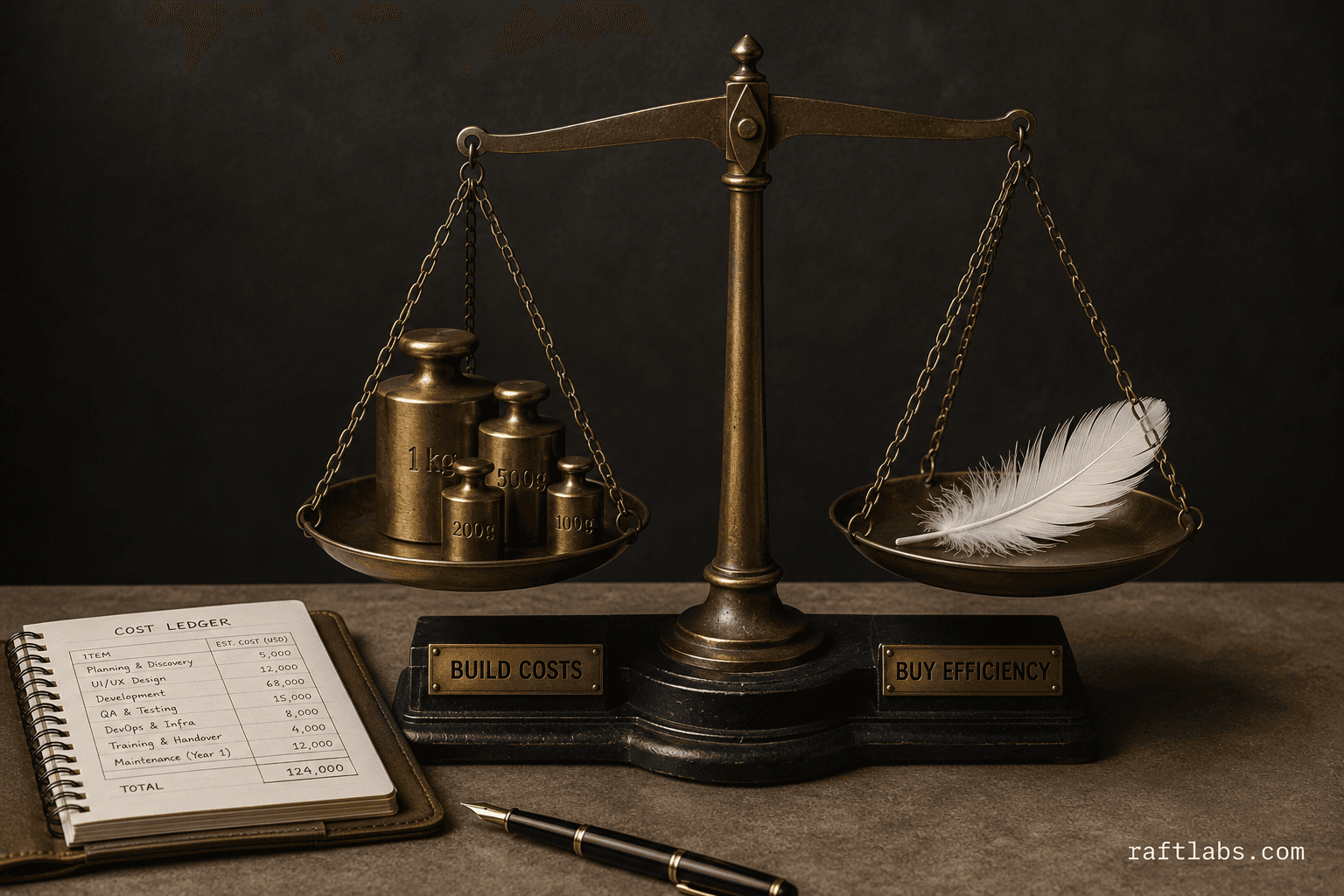
The nonprofit software decision is usually about the free platform: what it costs to keep, what it costs to leave, and what breaks in between.
Stay on the platform
Salesforce Nonprofit, Bloomerang, DonorPerfect
They serve the majority of nonprofits well. Stay while the workarounds are rare.
Build custom
When the free CRM costs a salary
Paying a full-time salary to manage Fortune 500 software on a team of one. A custom system fits the organization instead.
When the donor data can't get out
Lossy contact imports, platforms that don't retain donor information. Your donors, your data, your exports.
When the workarounds cost more
Spending more time working around the platform than working in it is the signal.
Bottom line
Stay on the platform while it fits. Build when the workarounds cost more than the build.
04 How we work
How we build nonprofit software
01
Discovery
We map your organizational structure, chapters, program types, donor segments, and grant portfolios against your current tools to find exactly where the data model breaks down. This session produces a requirements document your leadership and program teams can review before a line of code is written. The risk this retires: the requirement nobody stated because everyone assumed it.
02
Architecture
We design the data model around your specific entity structure: multi-chapter relationships, restricted fund accounting boundaries, and the access control rules that separate fundraising staff from caseworker data. Your IT and compliance leads review the architecture before build starts. The risk this retires: the access boundary the system can't enforce.
03
Build
Development runs in two-week sprints with working software demonstrated at each review. Donor management, case management, and fundraising modules are built and tested independently before integration, so your team can give feedback on real functionality rather than mockups. The risk this retires: the module that doesn't fit discovered after launch.
04
Launch and support
Go-live is staged: staff training, a parallel-run period where both old and new systems are active, then full cutover once your team is confident. Post-launch support covers bug fixes, minor configuration changes, and the documentation your team needs to manage the system independently. The risk this retires: the migration where donor data gets lost.
05 Track record
What a first build looks like
01
Founded
2015
02
Weeks to a first working version
12-16
03
Cost, agreed before we build
Fixed
08 Why us
Why choose us?
01
Fits a team of one
The system is sized to your organisation, so administration stops costing the salary the free CRM quietly demands.
02
Confidentiality by architecture
Role-based access is designed in from the start: caseworkers see their cases, managers see aggregates, finance sees budgets, never case content.
03
Phased for board approval
A first working version lands in 12 to 16 weeks at a fixed cost, so the board funds proof before scale.
09 Questions
Common questions
Salesforce Nonprofit, Bloomerang, and DonorPerfect serve the majority of nonprofits well. Custom software is the right choice when your organizational structure, program complexity, or donor relationship model diverges from what those platforms were built for. A multi-chapter national organization where each chapter needs autonomy but leadership needs consolidated data can't be effectively managed in a single-entity CRM. A foundation with a grant-making program needs workflow that the standard nonprofit CRM wasn't designed to support. A social service organization where case management, volunteer management, and donor management all need to connect to each other needs integration that standard platforms don't provide natively. If you're spending more time working around the platform than working in it, that's the signal that custom makes sense.
Yes. Connecting fundraising and program delivery is one of the most valuable things a custom system can do for a nonprofit. When a major donor asks what impact their gift has achieved, the answer should come from the program record rather than a report assembled manually for the meeting. We build systems where the donor record connects to the program it funds, and the program record connects to the outcome data that demonstrates impact. The data model and access control design for combining fundraising and program data requires careful planning during discovery. Different staff have access to different data sets, and the system needs to enforce those boundaries while still enabling the connections that make impact reporting possible.
Beneficiary data in social service organizations is subject to strict confidentiality obligations. HIPAA in the US for health-related services. GDPR in the UK and EU. Specific confidentiality requirements for services to vulnerable populations including domestic violence survivors, substance misuse clients, and children. We design the access control architecture around these requirements from the start. Role-based access means caseworkers see only their assigned cases, program managers see aggregate data without individual identifying information, and finance staff see budget data without case content. Consent management is built into the intake workflow. Data retention policies are enforced by the system rather than left to manual compliance. If your program operates under specific regulatory confidentiality requirements, we review them during discovery and design the data architecture to meet them.
A first working version launches in 12 to 16 weeks and typically runs $40K to $85K. A grown platform covering fundraising, program delivery, and grant reporting typically runs $110K to $250K. We scope every project before pricing. Fixed cost, agreed before work starts.
Boards approve projects they understand. We scope the first phase as a single module with a fixed cost and a measurable outcome: the donor CRM, the fundraising platform, or the grant tracker, not the whole integrated platform. The board sees one line item, one timeline, and one result. Later phases are separate decisions with their own costs and their own evidence. That is also why we design the architecture to extend: phase one never has to be rebuilt for phase two.
Get a build-vs-platform plan for your nonprofit operation
Tell us your organization type, the platform you've outgrown, and the operational or fundraising problem you need to solve. We'll tell you what we'd build and how.
Scope and cost agreed before work starts. No surprises. No obligation.
Working prototype within 3 weeks of kickoff.
Pay by milestone. You see progress before each invoice.
60-day post-launch warranty. Bug fixes, UI tweaks, and deployment support. No retainer.