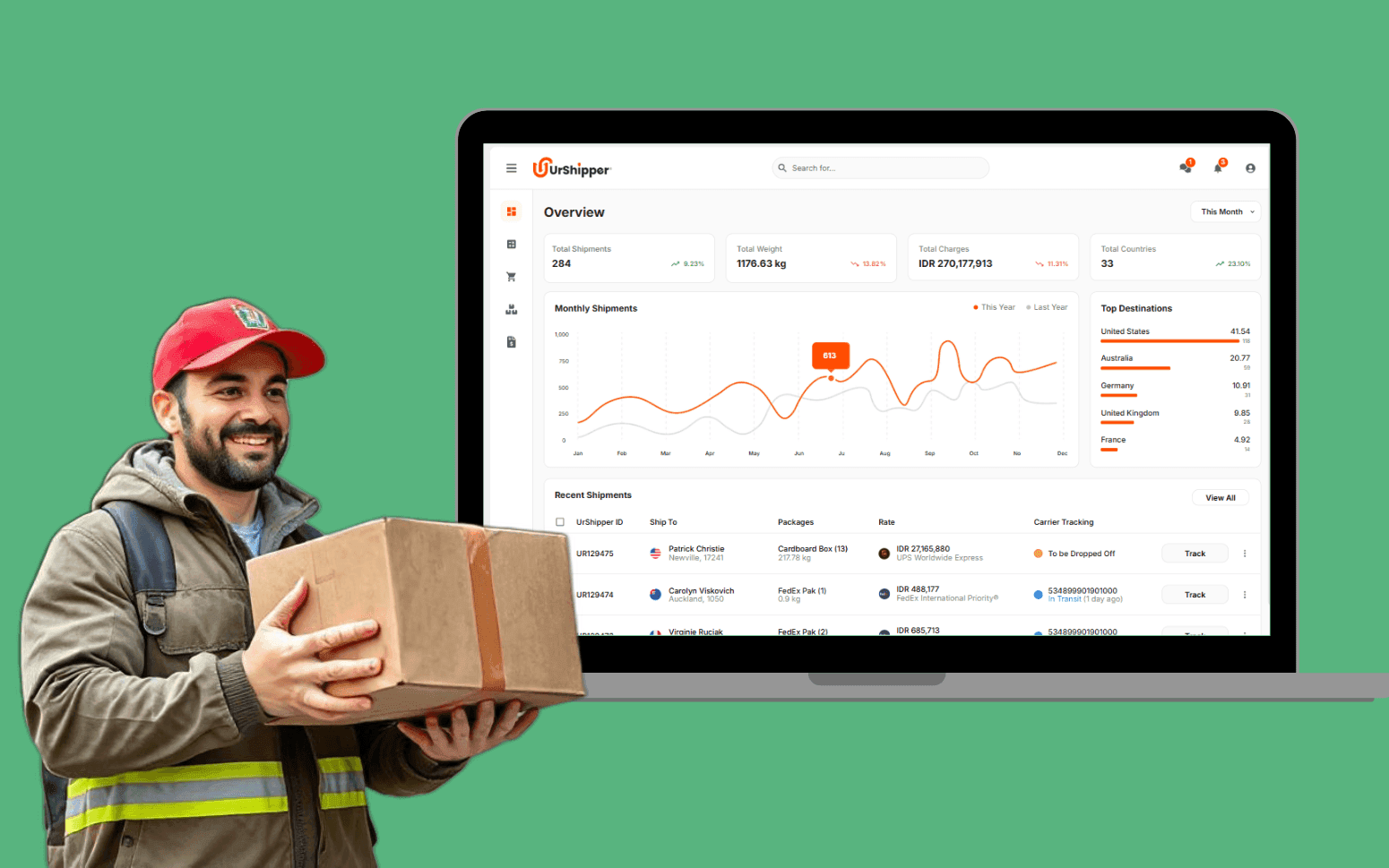

Scalable multi-carrier shipping platform for UrShipper
- 2,000+
- shipments across 70+ countries in year one
- 200+
- customers migrated with zero service disruption
Supply chains running on spreadsheets and email give you visibility a week after the fact. By the time you see a stockout, a supplier delay, or a logistics bottleneck in a report, the damage is already done. We build custom supply chain software that gives you real-time visibility across inventory, suppliers, logistics, and demand, so you can see problems before they become costs.
Custom supply chain visibility, planning, and execution software for your operations
Real-time inventory and logistics tracking across your locations and partners
Supplier portal and collaboration tools to reduce manual back-and-forth
Shipping and operations platforms in production, including UrShipper's multi-carrier shipping platform
Bring the problem, the current workflow, or the existing code. We reply with a practical next step within one business day.
Trusted by




























The brief
Good software decisions begin with the constraint, not a list of features or a preferred technology.
Supply chain problems showing up in spreadsheets a week after they've already cost you?
Inventory accuracy low because your systems don't talk to each other?
Plain answer
RaftLabs builds custom supply chain software for businesses across the US, UK, Europe, Canada, and Southeast Asia, covering inventory tracking, supplier portals, demand planning, and logistics visibility. A first module launches as a validated v1 in about 12 to 14 weeks, with a fixed cost agreed before development starts.
What to remember
Proof
The real problem with a spreadsheet-driven supply chain is not the spreadsheet. It is latency. By the time data is keyed in, formatted, and reviewed, the moment to act has passed.
That gap is expensive. IHL Group put the cost of global inventory distortion, out-of-stocks plus overstocks, at $1.7 trillion in 2024, and named supply chain disruption as the single largest driver at $301 billion (IHL Group, 2024). McKinsey's 2024 Global Supply Chain Leader Survey found that companies digitizing their supply chains report annual EBIT growth of 3.2% and revenue growth of 2.3%, yet only about a quarter say that work is done (McKinsey, 2024). The gap between knowing and acting is still wide open for most operations teams.
Custom software closes it by giving you data while it can still change a decision. Inventory levels as goods move. Supplier confirmations as POs are issued. Shipment status while parcels are in transit. Demand signals as orders land.
For the ERP that your platform will connect to, see ERP development. For inventory management as a standalone module, see our inventory management software development service.
We scope every build around one operating view: a supply chain fails at three points, and each is a latency you can shrink with the right software. Naming them up front is how we decide which module to build first.
We have shipped this end to end. RaftLabs was UrShipper's fifth attempt at a multi-carrier shipping platform, after four vendors failed on silent carrier-API breaks. We rebuilt it in 14 weeks with FedEx, DHL, UPS, Aramex, and Shippo integrations. Result: 200+ existing customers migrated with zero service disruption, 92 new businesses signed up in the first two months, and 2,000+ shipments moved across 70+ countries in year one.
Capabilities
Real-time inventory tracking across warehouses, 3PL locations, and in-transit stock, with multi-location stock views, reorder triggers, and cycle count workflows. The inventory data your operations team needs to make decisions, not the data from last week's report.
A web portal where suppliers view open POs, confirm delivery dates, submit advance shipping notices, and upload invoices. Structured supplier data instead of PDFs and emails, delivery exceptions surfaced before they become stockouts, and supplier scorecards for performance tracking.
Purchase requisition to PO workflow with approval routing, supplier catalogue management, three-way matching for invoice validation, and contract management for blanket orders and framework agreements. The procurement workflow that keeps your supply chain funded and documented.
SKU-level demand forecasting from sales history, seasonality, and forward order data, feeding reorder recommendations and safety stock calculations based on lead time and demand variability. Scenario planning for promotions and new product launches moves you from gut-feel ordering to data-driven replenishment.
Carrier integration for real-time shipment status across national and regional carriers, with in-transit visibility on your dashboard instead of separate carrier portals. Delay alerts before customers ask, plus proof of delivery capture and exception management.
A single view of your supply chain: inventory levels, open POs, in-transit shipments, supplier delivery performance, and demand forecast versus stock, in one dashboard. Data is pulled from your ERP, WMS, carrier feeds, and supplier systems so your team runs the operation without chasing data.
Why us
The engineers who assess your problem also build the solution. No bait-and-switch, no offshore handoff after the contract is signed. The team you meet in week 1 is the team that launches your validated v1.
We scope the work, calculate the cost, and lock it in writing before any development starts. A scope change is a change request: priced, agreed, or dropped. It never absorbs into the project and surprises you on the final invoice.
Real engagements across SaaS, fintech, healthcare, and logistics, not every one published as a named case study. Shipped work spans logistics, fintech, healthcare, and manufacturing, from UrShipper's multi-carrier shipping platform to enterprise operations tools.
GDPR, HIPAA, SOC 2 - compliance requirements are scoped in week 1, not retrofitted before launch. We have shipped HIPAA-compliant systems for US healthcare clients and GDPR-compliant products for European markets.
Process
We start by mapping where your supply chain data lives, where it's missing, and where latency is costing you. Which visibility gaps lead to stockouts? Where does manual data entry slow procurement? Which supplier relationships are managed entirely by email? The module priority follows the pain, not a generic implementation order.
Current system and data flow audit across inventory, procurement, and logistics
Visibility gap mapping: where you're seeing data too late to act
Integration landscape review: ERP, WMS, carrier APIs, supplier systems
Fixed-cost scope for the first phase with milestone delivery dates
We design the data model and integration architecture before writing code. Real-time inventory across multiple locations, carrier API integration for in-transit visibility, supplier portal data flows, and demand planning data pipelines, all designed with your current systems as the constraint.
Data model for inventory, procurement, and logistics events
Integration architecture for ERP, WMS, carrier APIs, and supplier systems
Supplier portal design: PO visibility, ASN submission, delivery confirmation flows
Demand planning data pipeline from sales and order management systems
We build in 2-week sprints. Inventory management, supplier portal, procurement workflows, and visibility dashboards are built in sequence against agreed specifications. Every sprint delivers working software, not status reports. Your operations team can test and give feedback before the next sprint starts.
2-week sprints with working software demos at the end of each
Core modules built in priority order: highest-pain areas first
Automated tests for inventory calculations, reorder logic, and data sync
Code review and integration tests as standard practice
We connect the platform to your ERP for inventory and financial data, carrier APIs for shipment status, supplier systems for PO and ASN data, and your e-commerce or OMS for demand signals. Each integration is tested against real production data volumes before go-live. Data quality issues discovered during integration testing are resolved, not deferred.
ERP integration tested against real inventory and transaction volumes
Carrier API integrations validated for shipment status accuracy
Supplier portal tested with representative suppliers before full rollout
End-to-end data flow validation from demand signal to replenishment trigger
We deploy to production with monitoring that tells you when data feeds stop updating, when reorder triggers misfire, or when supplier portal activity drops. Your operations team has the visibility they need from day one. Configuration tools let you adjust reorder thresholds, safety stock parameters, and supplier scorecards without engineering.
Production deployment with real-time data feed monitoring and alerting
Operations team training on dashboards, supplier portal admin, and configuration
Supplier onboarding support for the portal rollout
Handover documentation and 90-day support plan
Most operations teams are choosing between three options, not deciding whether to buy software at all. Here is the honest trade-off.
| What matters | Spreadsheets and email | Off-the-shelf suite | Custom platform |
|---|---|---|---|
| Fit to your workflow | Exact, but manual | Your process bends to the tool | Built around how you operate |
| Real-time visibility | None, data is always stale | Partial, gated by their modules | End to end across your systems |
| ERP, WMS, and carrier integration | Copy-paste and re-keying | Connectors you pay per seat for | Owned integrations, no per-seat gate |
| Cost shape | Cheap now, expensive in errors | Recurring license, grows with seats | Fixed build, then you own it |
| Right when | You are pre-scale | Your process is fully standard | Your process is your edge |
We are not the right fit for every team. If your process is genuinely standard and a packaged suite covers it, buy the suite. Custom software earns its cost when the way you route POs, forecast demand, or manage carriers is part of how you compete, or when no tool integrates cleanly with the systems you already run.
We have shipped enough of these to name the failure modes up front, not discover them in week 8.
Looking ahead, the teams that pull away are moving from reporting on the past to acting on the near future: demand models that adjust reorder points as signals shift, and agents that clear routine exceptions before a person sees them. We build the clean data and integration foundation that makes that step possible, rather than bolting AI onto feeds nobody trusts yet.
Proof
Useful next steps
Work with us
Inventory Management ERP
See the serviceTry it yourself
Build vs Buy Calculator
The real cost of building in-house (most teams miss 40%).
Open the free tool
Article
How to Build a Live Shopping Marketplace Like Whatnot (2026 Cost Guide)
For collectible marketplace founders, specialty retail brands, and vertical live commerce operators ready to stop paying Whatnot's cut. This is what building actually costs, how long it takes, and what kills these projects post-launch.
Read more
Article
How to Build a Customer Loyalty Rewards Program
How to build a customer loyalty rewards program that drives retention. Covers program types, design decisions, and a real example from Energia Rewards built by RaftLabs.
Read more
Article
AI in Retail: What Moves Revenue vs What Is Just Hype
Retail generates more data than most industries and extracts less value from it than most. The gap is not in AI capability, it is in knowing which retail workflows benefit from AI and which ones the vendor pitch decks make sound better than they are. Here is an honest breakdown.
Read more
Article
Custom Locksmith Software: When to Build vs. Buy
Vonigo, ServiceTrade, FieldRoutes, and Kickserv all work until your locksmith business hits specific walls. This guide covers the exact thresholds, what custom locksmith management software costs to build, and when RaftLabs makes sense.
Read moreSupply chain software development is building custom digital platforms that manage the flow of goods, information, and money across your supply network. This includes inventory management, supplier collaboration, demand planning, logistics tracking, and procurement workflows. Custom supply chain software is designed around your specific product lines, supplier relationships, and fulfilment operations, not a generic supply chain platform built for a different kind of business.
We build: inventory management systems with real-time stock tracking and reorder automation, supplier portals for PO management and delivery confirmation, demand planning tools that forecast requirements from sales data and historical patterns, warehouse management systems for pick-pack-ship operations, logistics tracking platforms with carrier integration, procurement systems for PO and contract management, and supply chain visibility dashboards that aggregate data from multiple systems. Most projects start with the highest-pain module and expand from there.
Integration with your existing systems is usually the most important part of supply chain software. We build connectors for SAP, Oracle, Microsoft Dynamics, NetSuite, and other ERPs for inventory and financial data. We integrate with WMS platforms, carrier APIs (FedEx, UPS, DHL), customs and compliance systems, and supplier EDI feeds. If a system has an API or an EDI connection, we can integrate with it. For systems without APIs, we use file-based integration.
Yes. Supplier portals are one of the highest-value supply chain software investments, they eliminate the manual email and spreadsheet back-and-forth that slows down procurement and causes delivery surprises. We build portals where suppliers can view open POs, confirm delivery dates, submit ASNs, manage their catalogue, and raise invoices. Suppliers get a web interface; you get structured data that feeds directly into your ERP and operations systems.
We build demand planning tools that pull sales history, seasonality data, and market signals to generate forward demand forecasts at the SKU level. The forecasts feed into reorder triggers and safety stock calculations, so your procurement team is working from a model rather than from gut feel. We integrate with your sales platforms for demand signals and your ERP for inventory and lead time data. Advanced implementations layer in machine learning models that improve forecast accuracy as more data accumulates.
We price land-and-expand. A first module, like inventory management or a supplier portal, starts around $40,000-$80,000 and launches as a validated v1 in about 12 to 14 weeks. From there the platform grows into multi-module visibility, planning, and execution across your supply network. Cost depends on the number of systems integrated, the complexity of the business rules, and the volume of data flowing through the platform. We scope and fix the price of every phase before development starts.
Work with us
Tell us where you're blind and what's costing you. We'll scope the platform and give you a fixed cost.