Language Learning App Development Company

Built for edtech founders, corporate training providers, and tutoring marketplace operators whose learning experience, adaptive content engine, or integration requirements have outgrown generic LMS platforms and white-label course tools. When your differentiation lives in how learners progress, how tutors are matched, or how speech is assessed, a standard platform will always compromise the product.

  • Adaptive lesson engines that sequence content based on each learner's proficiency, error patterns, and session history

  • AI speech recognition and pronunciation scoring using Google Cloud Speech-to-Text, Azure Cognitive Services, or custom acoustic models

  • Spaced repetition systems (SRS) built on SM-2 or custom algorithms that surface vocabulary and grammar at the optimal review interval

  • Live tutor marketplace with calendar-based booking, session management, Zoom or Daily.co video integration, and payout automation via Stripe Connect

Recognition

Sound familiar?

  • Stuck on an LMS that handles your content delivery but can't support adaptive sequencing, pronunciation scoring, or live tutor booking without bolting on five separate tools?

  • Learner drop-off climbing because your platform pushes everyone through the same lesson path regardless of proficiency, pace, or how they've been performing?

  • Corporate clients asking for SCORM exports, SSO, and HR system integration that your current platform either doesn't support or charges you a per-seat premium to unlock?

The short answer

RaftLabs builds custom language learning app development solutions for edtech startups, corporate training providers, and tutoring marketplace operators. We ship adaptive lesson engines, AI speech recognition and pronunciation scoring, spaced repetition systems, and live tutor booking platforms. Most projects go from kick-off to a live product in 12 to 16 weeks at a fixed, agreed cost.

What is language learning app development?

Language learning app development is the process of designing and building custom software that teaches users a new language through structured lessons, adaptive content sequencing, speech recognition, and progress tracking. It covers everything from self-paced mobile apps and web platforms to enterprise corporate training tools and live tutor marketplace products, with the software tailored to a specific pedagogical model, learner profile, or business model.

01 Diagnosis

Problems we solve for language learning businesses

  1. 01
    Problem

    Your platform pushes every learner through the same lesson path

    Solution

    When every learner follows an identical sequence regardless of what they already know, two things happen: advanced learners disengage in the early modules, and struggling learners fall behind and drop off without intervention. Neither group finishes. According to research cited by language learning platform operators, apps using adaptive spaced repetition combined with AI pronunciation correction increased learner material retention by 38% compared to static lesson sequences.The fix is an adaptive engine that reads each learner's performance at the session level, identifies gaps in vocabulary and grammar, and selects the next content item accordingly. Combined with spaced repetition scheduling built on algorithms like SM-2, vocabulary resurfaces at the optimal review interval rather than in a fixed weekly cycle. The result is a learner path that tightens around each user's actual needs, not an assumed average.

  2. 02
    Problem

    Speech assessment is broken or missing

    Solution

    Pronunciation is the hardest skill to teach at scale because it requires real-time, accurate feedback on sounds the learner can't yet hear. Most language platforms either skip speech assessment entirely, rely on basic keyword spotting that passes near-misses, or integrate a third-party tool that produces a score with no explanatory feedback. Learners practice speaking, get a thumbs-up, and form incorrect habits for months.Accurate speech assessment requires integrating purpose-built acoustic models through APIs like Google Cloud Speech-to-Text, Azure Cognitive Services Speech SDK, or specialist providers like SoapBox Labs for children's speech. On top of transcription, pronunciation scoring needs phoneme-level comparison, fluency scoring based on pace and pausing, and feedback the learner can act on. The engineering complexity of getting this right is consistently underestimated, and the gap between a score that appears and a score the learner trusts is where retention is won or lost.

  3. 03
    Problem

    Corporate clients can't connect your platform to their systems

    Solution

    Enterprise language training buyers run on HRIS platforms like Workday and BambooHR, identity providers like Okta and Azure Active Directory, and LMS systems that require SCORM or xAPI content packages. When your platform doesn't support SSO, doesn't export compliance-ready completion data, and can't push progress into the corporate learning record, the procurement conversation stalls.The cost of failing this test is losing the contract. The cost of passing it with a patchwork of manual exports and CSV files is the operations overhead every time a corporate cohort rolls over. We design the integration layer, SAML SSO, xAPI activity statements, SCORM packaging, and REST webhooks for HR systems, into the architecture from the start. Corporate clients can onboard through their existing identity provider, and training managers can pull completion data into their reporting dashboards without contacting your support team.

  4. 04
    Problem

    Your tutor marketplace is too manual to scale

    Solution

    Tutoring marketplace operators running tutor matching, session booking, and lesson payment through email, spreadsheets, and manual bank transfers hit a ceiling that has nothing to do with learner demand. The administrative overhead per session stays fixed while the margin per session shrinks as tutor supply grows. The bottleneck is the back office, not the market.A purpose-built tutor marketplace automates the matching logic, surfaces tutor availability through calendar integration, handles session booking and reminders, runs video sessions through Zoom or Daily.co, and pays tutors automatically on schedule via Stripe Connect. Dispute handling, review collection, refund logic, and tutor performance scoring run without a team member touching each case. The unit economics of a well-built marketplace look very different from a manually-operated one at the same learner volume.

02 What we ship

Language learning software we build

  1. Adaptive lesson engines

    We build lesson sequencing engines that track learner performance at the item level, across vocabulary, grammar, reading, and listening, and select the next content item based on accuracy, response time, and error patterns. The engine is built to your pedagogical model: whether that is proficiency-band progression, topic-first sequencing, or a hybrid approach for mixed-level corporate cohorts.

    Spaced repetition scheduling based on SM-2 or a custom interval algorithm surfaces vocabulary at the optimal review point for each learner rather than at a fixed calendar date. The scheduling parameters are configurable, so your content team can tune review density for high-priority exam vocabulary or low-frequency business terms.

    Built for edtech startups building a differentiated learning product, corporate training providers replacing static course libraries, and language schools moving their curriculum to a digital adaptive format.

  2. AI speech recognition and pronunciation scoring

    We integrate Google Cloud Speech-to-Text, Azure Cognitive Services Speech SDK, and specialist providers like SoapBox Labs to deliver real-time transcription and pronunciation assessment inside your app. On top of transcription, we build phoneme-level scoring, fluency analysis based on pace and pausing, and actionable feedback that tells the learner which sounds to correct, not just a pass-fail score.

    The speech layer is calibrated for your target language and learner profile. Accent variation handling, background noise tolerance thresholds, and confidence score tuning are configured for the specific population using the app. Children's speech, non-native accents, and low-bandwidth conditions each require different calibration, and we scope that during discovery.

    Built for language learning apps where pronunciation is a core learning objective, corporate English training providers, and edtech companies building a speak-first curriculum.

  3. Spaced repetition and vocabulary systems

    We build vocabulary and grammar review systems on spaced repetition algorithms that surface items at the interval most likely to consolidate long-term memory. The interval logic is implemented as a first-class system, not a static quiz scheduler, so each learner's review queue reflects their actual retention curve across every item they've encountered.

    Content management for vocabulary systems includes bulk import from CSV or structured data sources, tagging by topic, difficulty, and grammar category, and learner-facing decks for self-study alongside system-generated review queues. Word frequency lists, CEFR-level tagging, and custom content libraries for specialist vocabulary are all configurable by your content team without a developer.

    Built for language learning apps with large vocabulary curricula, exam preparation platforms, and corporate language training tools where learners need to acquire domain-specific business vocabulary quickly.

  4. Live tutor marketplace platforms

    We build end-to-end tutor marketplace platforms covering tutor onboarding and profile management, learner-facing search and matching, calendar-based session booking with timezone handling, live video session delivery via Zoom SDK or Daily.co, and automated payout to tutors via Stripe Connect. The marketplace logic, matching rules, availability management, and commission structure, is built to your business model.

    Session management covers booking confirmations, pre-session reminders, cancellation and rescheduling policies, and post-session review collection. Dispute handling, refund workflows, and tutor performance scoring run without manual case management. Reporting dashboards give marketplace operators visibility into session volume, tutor utilisation, and learner retention at the cohort level.

    Built for tutoring marketplace operators replacing manual coordination, language schools adding live 1-on-1 sessions to a self-paced product, and corporate training providers building a managed tutor network.


  5. Progress tracking and analytics dashboards

    We build learner-facing progress dashboards that show vocabulary acquisition, lesson streak data, skill-level progression across speaking, listening, reading, and writing, and time-to-goal projections based on current pace. The data surfaces at the learner level to keep individuals engaged and at the cohort level for instructors and training managers.

    Corporate training dashboards give L&D managers visibility into completion rates, proficiency gains, and learner activity across teams and departments. Progress data exports to CSV or pushes via API to HRIS and LMS platforms. Completion certificates with CEFR level assessments are generated automatically and delivered to the learner's profile and the corporate training record.

    Built for corporate language training providers, tutoring marketplace operators tracking learner outcomes, and edtech companies that need to demonstrate measurable learning gains to enterprise procurement teams.

  6. Corporate training integrations and enterprise features

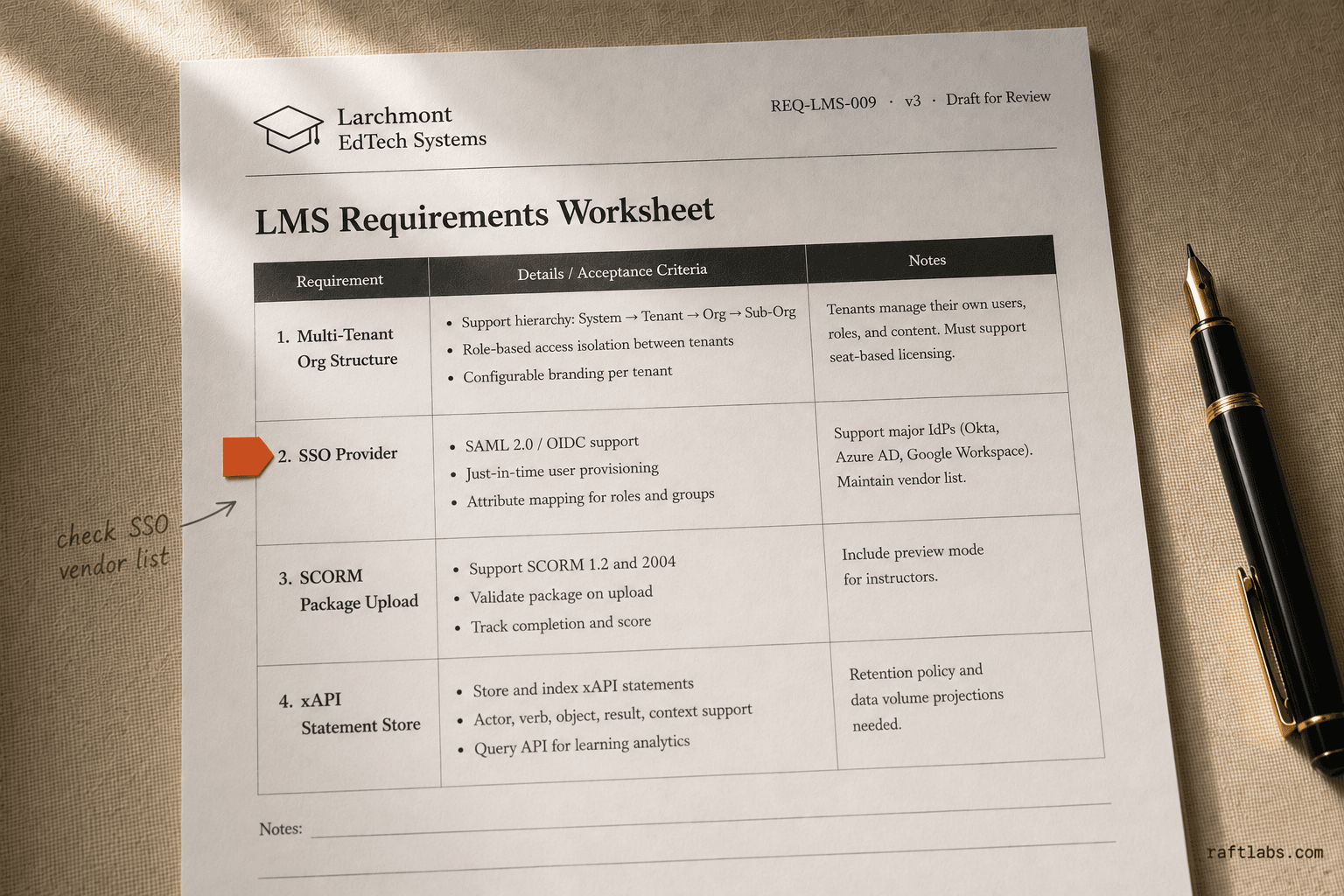
    We build the integration layer that lets enterprise buyers deploy your platform inside their existing systems. SAML 2.0 and OAuth SSO connect your app to identity providers including Okta, Azure Active Directory, and Google Workspace, so employees log in with their company credentials. SCORM 1.2 and xAPI content packages let you export lessons and completion data into any corporate LMS.

    REST API webhooks push progress events, completion records, and proficiency scores into HRIS platforms like Workday, BambooHR, and SAP SuccessFactors. Multi-tenant architecture isolates each corporate client's data, admin permissions, and branding. Bulk user provisioning via SCIM handles roster changes without manual account management.

    Built for language learning platforms entering enterprise sales, corporate training providers integrating with large employers' tech stacks, and edtech companies whose commercial growth depends on passing enterprise security and compliance reviews.

03 How we work

How we build language learning products

  1. 01

    Discovery

    We map your pedagogical model, learner profile, and the content and integration requirements in detail. We identify where your current platform creates product limitations or operational overhead. For language learning products, we scope the speech assessment calibration requirements, the adaptive engine logic, and the LMS or HRIS integrations your corporate clients need. A fixed-price specification is produced before development begins.
  2. 02

    Design

    We design the learner experience, the content management system your team will use to author and update lessons, and the data model underneath the adaptive engine. For tutor marketplace products, we design the matching logic, the booking flow, and the payout architecture before writing production code. Prototypes are clickable and testable before budget commits to build.
  3. 03

    Build

    We build in two-week cycles with working software at each checkpoint. The core lesson engine and learner data model ship first. Speech recognition integration, spaced repetition scheduling, and the admin dashboard follow in subsequent cycles. Corporate integrations are built against your first target enterprise client's actual identity provider and LMS, not a generic spec.
  4. 04

    Launch

    We go live with a controlled cohort before full release. Speech assessment calibration is validated against real learner audio. Corporate SSO and LMS integration is tested end-to-end with the first enterprise client's IT team before the contract goes live. Post-launch support covers content management questions, new language additions, and performance work as learner volume grows.

Companies we've built for

Vodafone
Nike
Microsoft
Cisco
T-Mobile
Aldi
Heineken
GE

04 Track record

What language learning businesses get when they work with us

Week delivery for language learning MVP products
12-16
Software products shipped across edtech and consumer apps
100+
Years building adaptive, AI-integrated digital products
6+
Cost delivery agreed before development starts
Fixed

06 Client voices

What our clients say

Three-year average engagement. Founders and operators describing the work in their own words. No marketing varnish.

D
Daniel Reeves
USA flagUSA
CEO

RaftLabs nailed what other agencies couldn't — they started with our business problem and worked backwards to the right product. We were live in 14 weeks.

07 Why us

Why choose us?

  1. 01

    We've seen your problem before

    The industry changes. The broken process usually looks the same. Across 14+ industries and 100+ products, we recognise your problem fast, and we frame the fix around your margin and your operations.

  2. 02

    We own the number, not the ticket

    We measure success the way you do: hours saved, revenue earned, margin recovered. We stay through launch and growth, so the result is ours to own.

  3. 03

    Serious businesses trust us

    Vodafone, T-Mobile, Cisco, Energia, Aldi, Nike. Six years, 100+ products in production, 4.9 on Clutch. Serious businesses keep coming back because we stay accountable long after launch.

08 Questions

Frequently asked questions

Yes. Building the adaptive layer, proprietary speech scoring, or tutor matching logic on top of or alongside an existing platform is a specific type of engagement we take on. During discovery we scope exactly what needs to be built custom versus what can stay on the existing system. The outcome is a working integration, not a full platform rebuild.

Yes. We build adaptive engines that track per-learner proficiency across vocabulary, grammar, and speaking, then select and sequence content based on error patterns, time-on-task, and spaced repetition schedules. The sequencing logic is built to your pedagogical model. We also build the content management layer so your curriculum team can add or update lessons without a developer.

An MVP covering adaptive lessons, progress tracking, and basic speech assessment typically delivers in 12 to 16 weeks. Cost depends on scope. A focused MVP runs $40,000 to $80,000. A full platform with a live tutor marketplace, AI speech recognition, corporate SSO, and SCORM export runs $100,000 to $250,000 or more depending on integration complexity and the number of languages supported. Fixed cost is agreed before development starts.

Yes. We build SCORM 1.2 and xAPI exports for LMS compatibility, SAML 2.0 and OAuth SSO for enterprise identity providers including Okta and Azure Active Directory, and REST API integrations with HRIS platforms like Workday and BambooHR. SCIM-based user provisioning handles bulk roster changes. Corporate integrations are scoped during discovery and designed into the architecture from the start, not added after go-live.

Off-the-shelf platforms like Teachable, Thinkific, or TalentLMS are the right call when your product is standard course delivery and your differentiator is your content, not your technology. Custom development makes sense when your differentiation is in adaptive sequencing, proprietary speech assessment, a live tutor marketplace, or an enterprise integration stack that no platform supports without heavy per-seat fees. We scope the build-versus-extend decision during discovery so you invest in the right thing at the right time.

In most cases, AI speech recognition can be added to an existing product without a full rebuild. We integrate Google Cloud Speech-to-Text, Azure Cognitive Services Speech SDK, or specialist providers depending on the language, learner age group, and accuracy requirements. The integration scope, API wiring, audio capture pipeline, and scoring display layer, is typically a 4 to 8 week addition. We assess the existing codebase during discovery and give a fixed scope before work starts.

Ready to build your language learning app?

Tell us what you are building and we will scope it out together.

  • Scope and cost agreed before work starts. No surprises. No obligation.
  • Working prototype within 3 weeks of kickoff.
  • Pay by milestone. You see progress before each invoice.
  • 60-day post-launch warranty. Bug fixes, UI tweaks, and deployment support. No retainer.
  • All conversations are NDA-protected.