Concierge software that gets the front desk off the phone.
Front desks spend half their day fielding calls that guests could handle themselves: wake-up calls, extra towels, taxi bookings, restaurant reservations. The staff answers the same questions on repeat, and requests logged on paper or WhatsApp have no audit trail. International guests with language barriers add another layer of friction on both sides. We build custom digital concierge apps for hotels, resorts, and serviced apartments. Guests submit requests, track status, and communicate with staff from a mobile app or in-room tablet. Operations teams get a full request log, routing to the right department, and real-time visibility across the property. Integrated with Mews, Opera, Apaleo, and other PMS platforms. Multi-language support included.
Guests self-serve room service, housekeeping, taxi bookings, and wake-up calls without calling the front desk.
Every request is logged, routed, and tracked, no paper slips, no WhatsApp threads.
Multi-language support removes the communication barrier for international guests.
PMS integration with Mews, Opera, and Apaleo syncs guest profiles and room data automatically.
Every request runs on an SLA clock, so nothing sits unassigned past its response target.
Shipping hospitality platforms since 2015, in production across the US, UK, and Ireland.
Bring the problem, the current workflow, or the existing code. We reply with a practical next step within one business day.
Recent outcomes
72+ weekly self check-ins
Self-service platform · City Break Apartments, Ireland
Built a guest self-service platform with mobile check-in and request management for serviced apartments in Dublin.
7x self check-in growth
Booking platform · City Break Apartments
Redesigned the direct booking and self-service flow. 580+ active users within 2 months of rollout.
Good software decisions begin with the constraint, not a list of features or a preferred technology.
01
Front desk staff fielding the same calls all day for services guests could request themselves?
02
No way to know which guest requests are outstanding, in progress, or missed?
03
International guests struggling to communicate needs due to language barriers?
Plain answer
RaftLabs builds custom concierge software for hotels, resorts, and serviced apartments. Guests request services, track status against an SLA, and message staff from a mobile app or in-room tablet. The software integrates with Mews, Opera, Apaleo, and Cloudbeds, with multi-language support. A first module starts around $25,000 to $45,000; a validated v1 launches in 10 to 14 weeks.
What to remember
A validated concierge-app v1 for hotels and serviced apartments launches in 10 to 14 weeks at a fixed price.
A first module starts around $25,000 to $45,000; a full multi-property platform grows to $90,000 to $150,000 over time.
Every guest request runs on a response and resolution SLA, routed to the department or vendor that owns it.
Integrates with Mews, Opera, Apaleo, and Cloudbeds; custom PMS integration available for other platforms.
City Break Apartments reached 72+ weekly self check-ins, up 7x, after the guest self-service app launched.
The front desk phone that never stops ringing for towels.
It's 9pm and the front desk is on the phone: an extra pillow to 412, a taxi booked for 6am, the spa hours, a dinner reservation. Every request lands as a note on a paper slip or a WhatsApp thread nobody can search later.
A guest who doesn't speak the receptionist's language gives up and waits until morning. Another calls twice because no one confirmed the first request ever went through.
Now the same guest opens an app, taps extra towels, picks their language, and watches the status move from received to on the way. The request is logged, routed to housekeeping, and timestamped.
The front desk is free for the arrival walking through the door.
Oracle Hospitality's consumer research found that 73% of travellers want to run their whole stay from their phone: check-in and check-out, ordering food, and asking for service. When a property still funnels those taps through the front desk, the gap between what a guest expects and what they get is where review scores slip. Move the routine requests into an app and the desk stops answering the same questions all evening.
At City Break Apartments in Dublin, the guest self-service platform we built now handles 72+ weekly self check-ins, up from fewer than 10 a week before launch. RaftLabs has shipped hospitality platforms since 2015, in production across the US, UK, and Ireland. The team that scopes your concierge app is the team that ships it, and the price is locked in writing before any development starts.
Proof
72+
weekly self check-ins through a guest self-service app RaftLabs built for City Break Apartments
RaftLabs, City Break Apartments
7x
growth in self check-ins after launch, up from fewer than 10 a week
RaftLabs, City Break Apartments
73%
of travellers want to run their whole stay from their phone, including service requests
Oracle Hospitality consumer research
A concierge app pays off when routine requests already flood the front desk.
Everything on the left should already be true for your property. Even one thing on the right, and a lighter fix is the smarter first step.
A fit
01
A hotel, resort, or serviced apartment where the front desk fields the same routine requests all day, on paper or WhatsApp.
02
You run a PMS like Mews, Opera, Apaleo, or Cloudbeds and want guest profiles and room data to flow into the app automatically.
03
International guests hit language barriers today that your staff work around by hand.
Not a fit
01
A single small property where the front desk handles request volume comfortably by phone.
02
You want an off-the-shelf app with no PMS integration and no custom routing.
03
You need in-room tablet hardware procured and mounted, not the software that runs on it.
Two-way chat between guests and staff. Guests ask questions, make special requests, and get answers without calling the front desk. Staff reply from the web-based operations dashboard.
03
Restaurant and spa booking
Guests browse availability and book restaurant slots, spa appointments, and activity sessions directly in the app. Bookings sync to your reservation system or appear in the staff dashboard for confirmation.
04
SLA clocks and escalation
Each request category carries a response and resolution target. A request that passes its target escalates to a duty manager, so a 6am taxi never sits unseen in a queue. Managers see which categories breach most.
05
Off-property vendor network
Requests that leave the property, taxis, restaurants, tours, florists, route to the partner who fulfils them, not just an internal queue. Vendors confirm or decline, and the guest sees the same live status.
06
In-app payments and folio posting
Chargeable requests, room service, paid transport, spa upgrades, are paid by card in the app or posted to the room folio through the PMS. No separate terminal trip, no cash handling at the door.
07
Returning-guest tiers
Recognise repeat and loyalty-tier guests on arrival and surface the perks they are owed, priority routing, welcome amenities, late checkout, without staff looking anyone up by hand.
08
Push notifications
Request status updates sent automatically to guests: confirmed, in progress, complete. Proactive alerts for check-in readiness, welcome messages, and checkout reminders.
09
Multi-language support
Guest interface available in any language. Request categories, menu items, and system messages managed from the admin panel. Right-to-left languages supported.
Web-based staff interface for managing the request queue, assigning tasks, updating status, and reviewing the full request log with timestamps and resolution times.
12
In-room tablet and personal device support
Kiosk mode for in-room tablets tied to the room. Personal device access via booking reference or SMS link. Both modes access the same request catalog and messaging.
Why hotels choose a custom concierge app
01
No more lost requests
Every request is logged with a timestamp, a department assignment, and a resolution status. Managers see the full queue at a glance and identify bottlenecks without chasing down WhatsApp threads.
02
Front desk freed for high-value work
Routine calls, room service orders, and towel requests are handled by the app, so staff spend less time on repeat inquiries and more time on arrivals, VIP guests, and situations that actually need a human.
03
International guests served without friction
Guests submit requests in their own language and staff see them in the operations language, so no bilingual staff is required for every interaction. Fewer misunderstandings, fewer follow-up calls.
04
Audit trail for operations
Every request carries a staff member, a timestamp, and a resolution time. Managers use the data to identify which request types take longest, which shifts have backlog, and where to focus training.
05
Guests feel more in control
Guests dislike waiting on hold and repeating requests to different staff members. An app that shows their request status in real time reduces anxiety and increases satisfaction scores.
06
Upsell and ancillary revenue
Restaurant bookings, spa slots, and add-on services surfaced in the same interface guests use to request towels. Upsell without a hard sell.
Guest data handling that meets GDPR requirements is scoped in week 1, not retrofitted before launch, drawing on hospitality platforms we have shipped for European markets including Ireland and the UK, without added scope creep.
What is your front desk spending its day on?
Walk us through the requests your team fields most. We'll show you how a concierge app would handle them and what it takes to build.
How it works
The request-to-resolution build
Week 1
01
Map every request and set its SLA
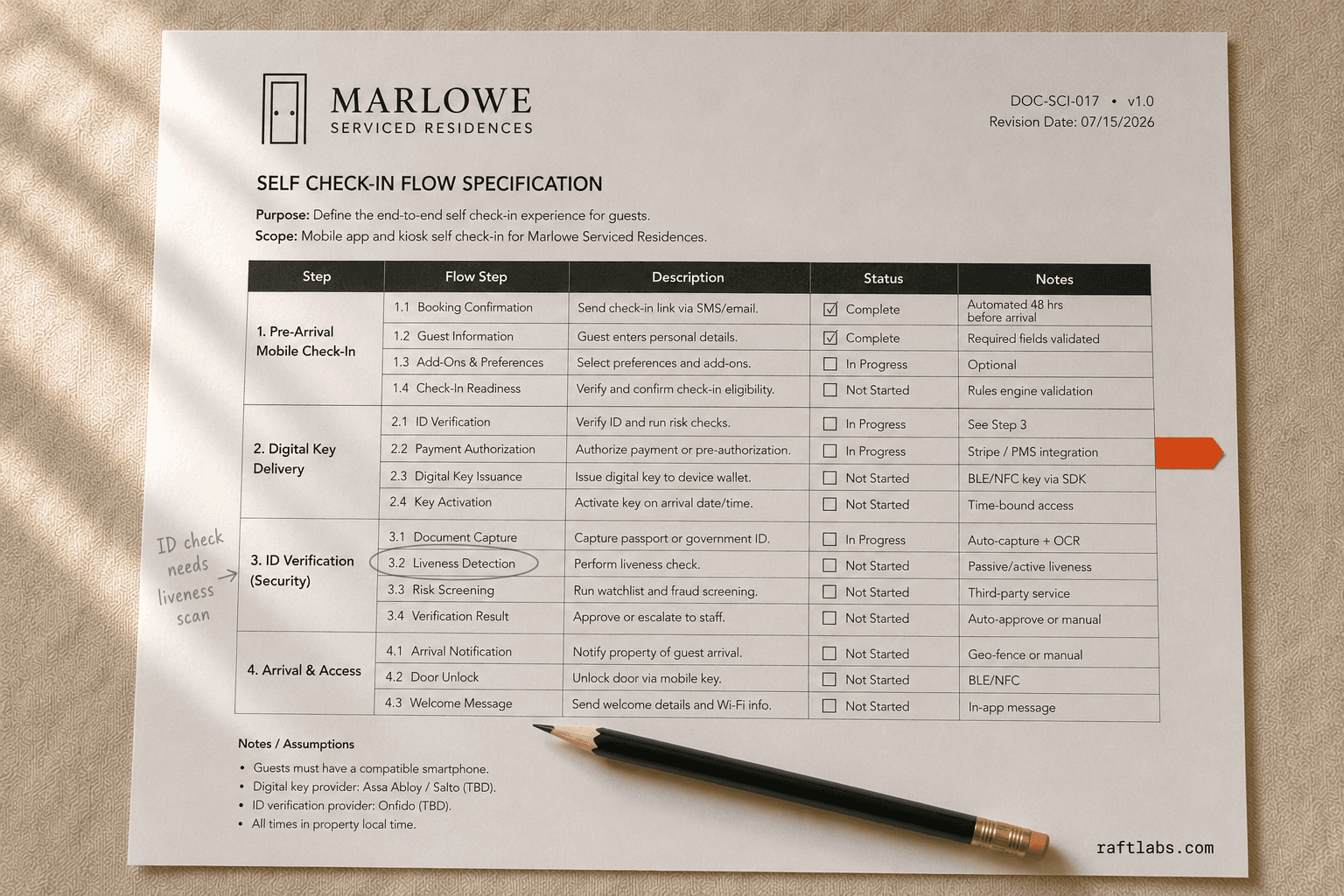
We list the requests your guests actually make, from wake-up calls to spa slots, and for each one we name the department or outside vendor that owns it and the response and resolution SLA it should run on. Chargeable requests get a payment path here: card in-app or a folio post through the PMS. You leave the week with a routing matrix, an SLA table, and a fixed-price quote.
Weeks 2-4
02
Wire the PMS, payment, and vendor spine
The integration layer goes in before the screens. We connect your PMS (Mews, Opera, Apaleo, Cloudbeds) for guest identity and room state, wire the payment rail for chargeable requests, and set up the vendor network so off-property requests reach the partner who fulfils them. This is tested against your PMS staging environment, not on live guests.
Weeks 4-11
03
Build the guest and staff surfaces together
Guest app and staff dashboard are built as one system so routing, live chat, and SLA timers behave the same on both sides. A request carries a countdown against its target and escalates when it breaches. Returning-guest tiers and multi-language content load in here. Working app at a staging URL from sprint one, with a demo every two weeks.
Weeks 12-14
04
Pilot one property, then expand
We launch the v1 on a single property and watch the real routing and SLA data: which categories breach, where guests drop off, which vendors lag. We tune against that evidence, then roll to the rest of the estate. Staff training and guest onboarding materials are included, plus 8 weeks of post-launch support.
Scope your concierge app.
A 30-minute call to walk through your property's requests and PMS. A costed scope follows in about two business days. Fixed price, locked in writing before any development starts.
A digital concierge app lets hotel and serviced apartment guests request services, ask questions, book spa or restaurant slots, and communicate with staff from a mobile app or in-room tablet, without calling the front desk. The app routes each request to the right department, tracks its status in real time, and maintains a full audit log. For operations teams, it replaces paper slips and WhatsApp threads with a structured request queue. For guests, it removes the friction of waiting on hold or repeating requests. A good concierge app covers room service orders, housekeeping requests, maintenance reports, wake-up calls, taxi and transport bookings, restaurant reservations, local recommendations, and two-way messaging with staff. Multi-language support handles international guests without requiring bilingual staff for every interaction.
We integrate concierge apps with the PMS platforms most commonly used in hotels and serviced apartments: Mews, Opera, Apaleo, and Cloudbeds. PMS integration means the app reads guest profile data, room assignments, and check-in status automatically, so staff see each request alongside the guest's profile without manual data entry. Departing guests are automatically deactivated, and arriving guests receive access before check-in for a smoother arrival. If your PMS is not on that list, we audit its API during discovery. We have integrated with more than a dozen hospitality systems and can assess feasibility before any development starts. The integration is tested against your PMS staging environment before go-live, so no surprises appear on day one with real guests.
Each service request submitted through the app appears on an operations dashboard assigned to the relevant department. A housekeeping request goes to the housekeeping queue. A maintenance report goes to maintenance. A taxi booking goes to the front desk or a transport coordinator, depending on how you route it. Staff acknowledge requests, update status to in progress, and mark them complete. The guest sees status changes in real time in the app. Every request carries a timestamp, staff member, and resolution time, giving managers a full audit log and the data to identify bottlenecks. Push notifications alert guests when their request is updated. The staff-facing dashboard is web-based and works on any device, no separate app required for your team.
Yes. Multi-language support is a core feature, not an add-on. The guest interface can display in any language you need. Request categories, menu items, and system messages are translated and maintained in the admin panel without requiring a developer. For markets with Chinese, Arabic, or right-to-left languages, we test layout and rendering specifically during QA. The operations-side dashboard stays in your preferred language regardless of what the guest sees. We scope which languages you need in discovery and include them in the fixed-price quote. Adding a new language post-launch is straightforward: strings are stored in a translation file and updated through the admin panel, not a development change request.
Yes. We build the guest-facing app as a responsive web application or native app, depending on your device strategy. On in-room tablets, it runs as a kiosk-mode web app tied to the room, with no login required for the guest. On personal devices, guests log in with a booking reference or receive a unique link via SMS or email at check-in. Both modes access the same request catalog and messaging interface. Tablet hardware procurement and mounting is outside our scope, but we work with whatever device specification you have in place and can advise on models that work well for hotel kiosk use.
We build the first module first, then expand. A v1 covering guest requests, SLA-tracked routing, in-app messaging, push notifications, one PMS integration, and a staff operations dashboard launches in 10 to 14 weeks and starts around $25,000 to $45,000. From there, restaurant and spa booking, in-app payments, an off-property vendor network, and multi-property rollout are added in phases; a full platform grows to roughly $90,000 to $150,000 over time. Cost tracks scope and the number of integrations. You receive a fixed-price document after the first week of discovery, and the price is locked in writing before any development starts.
Work with us
Tell us where the work is stuck.
Bring the rough workflow, half-built product, or messy brief. We will map the smallest useful first move, then send scope, timeline, and price in plain English.
Scope and cost agreed before work starts. No surprises. No obligation.
Working prototype within 3 weeks of kickoff.
Pay by milestone. You see progress before each invoice.
60-day post-launch warranty. Bug fixes, UI tweaks, and deployment support. No retainer.