Bail Bond Agency Software Development
A bail bond agency's real product is risk management: every bond written is the agency on the hook for the full amount if a defendant misses court. Most bail software wasn't built around that fact - it's a generic CRM with a few bail-specific fields bolted on. We build the bond ledger, collateral tracking, and court-date compliance system around the risk your agency is actually carrying. Software organises the approved work; it does not replace licensed underwriting or legal judgement.
Bond ledger and collateral tracking built around forfeiture risk, not a generic CRM with bail fields added
Court-date compliance automation - reminders, check-ins, and status tracking per defendant
Multi-office agent and commission tracking for agencies operating across locations
Fixed-cost delivery, scoped up front, with full data portability
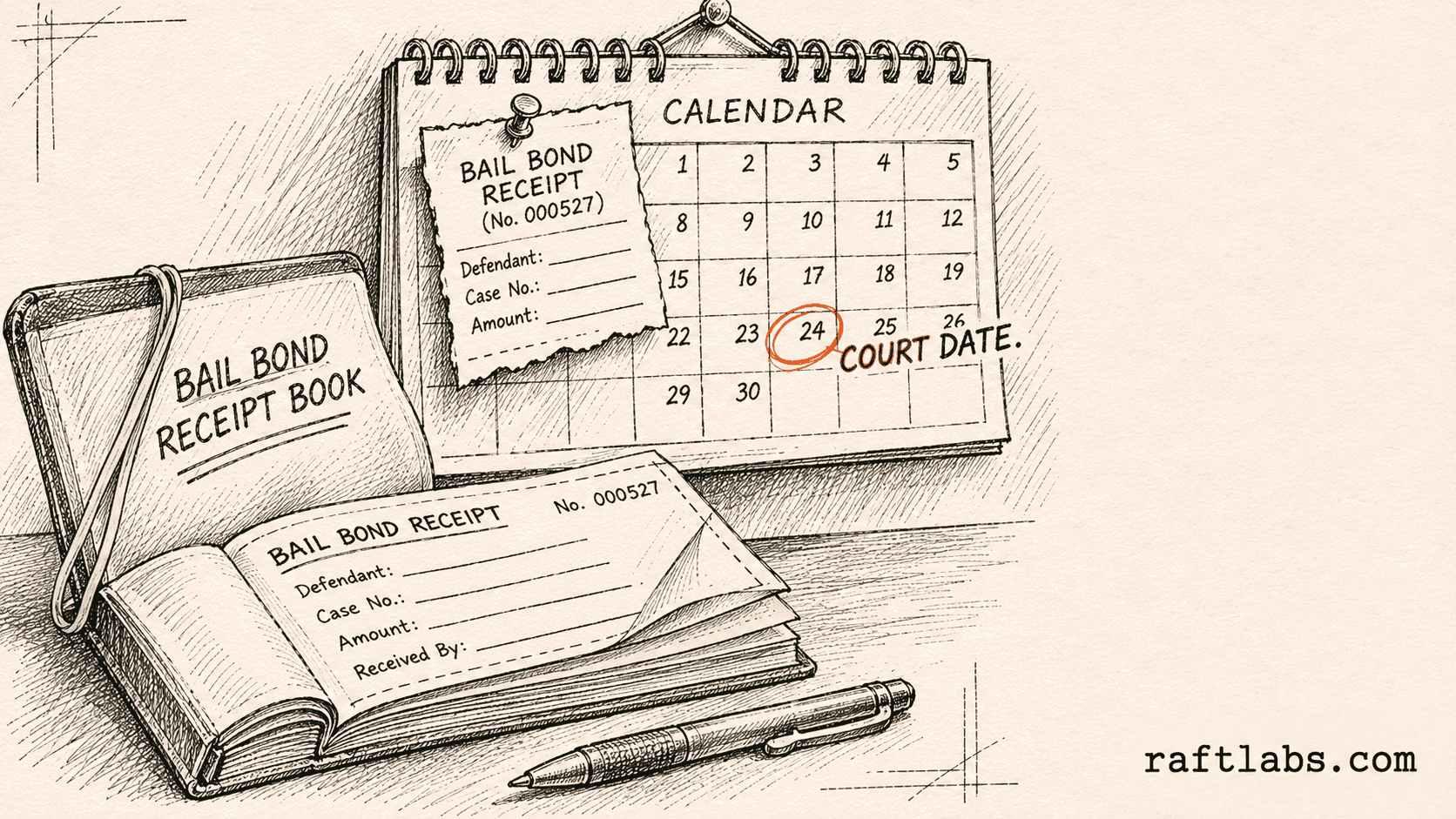
The problem
Sound familiar?
Court-date reminders still going out as manual phone calls because your current software doesn't automate them?
Collateral records - cash, property liens, vehicle titles - scattered across paper files and a spreadsheet nobody fully trusts?
Short answer
RaftLabs builds custom software for bail bond agencies: bond ledger and collateral tracking, court-date compliance and reminder automation, indemnitor management, and multi-office agent and commission tracking. We build for agencies outgrowing spreadsheets, paper bond books, or legacy single-vendor software they can no longer customize. A single-office build typically costs $40K to $110K. Fixed cost, scoped before pricing, with post-launch support.
Who this is for
Bail bond agencies we build for
Agencies outgrowing spreadsheets
Bond books and collateral records still living on paper files and spreadsheets nobody fully trusts.
Agencies leaving legacy bail software
Moving off a single-vendor system you can no longer customize, with your data exported in full.
Multi-office agencies
Agent and commission tracking across locations, with each office seeing its own book.
Agencies working across state lines
State compliance and reporting built as configurable rules, not hardcoded one-state requirements.
01 Diagnosis
Where bail bond software usually breaks
- 01Problem
A missed court date turns a cosigner's promise into a real bill
CostA missed court date is what turns a cosigner's promise into a real bill. Staying in touch and helping the defendant keep every appearance protects both of you. Every missed date is a forfeiture risk your agency is carrying financially, which makes reminders one of the highest-stakes, most repetitive tasks in the business. Manually calling or texting every defendant ahead of every date does not work once you have more than a small book of business.
SolutionAutomated reminders, scheduled check-ins, and a clear view of each defendant's compliance status turn a task your staff dreads into a system that runs itself and flags the defendants who actually need a personal follow-up call. Babysitting the bond stops being manual grind.
- 02Problem
Underestimated collateral
CostAgencies lose money on underestimated collateral, bad bonds, and inefficiencies in internal processes. Collateral (cash, property liens, vehicle titles) is what makes a bond recoverable if it goes into forfeiture, so an inaccurate or scattered collateral record isn't just an inconvenience, it's real financial exposure. When collateral tracking lives partly on paper and partly in a spreadsheet nobody fully trusts, an agency can't answer what do we actually hold against this bond with confidence during an audit or a dispute.
SolutionA structured collateral ledger tied to each bond keeps that answer current and defensible, so the collateral holds up in an audit or a dispute.
- 03Problem
Doesn't force you to follow a process that isn't how you do business
CostMost software sold to bail agencies is a generic contact-management tool with a few bail-specific fields added. It isn't designed around the actual risk structure of the business: bond amount versus collateral value, indemnitor obligations, and forfeiture exposure per defendant. Many programs are custom programs written for a specific bail agency and then sold nationally, which doesn't work. That mismatch shows up as workarounds, side spreadsheets tracking the numbers the software can't.
SolutionWe build the bond ledger around your process, not ours, so the software doesn't force you to follow a specific process that isn't how you do business. Software that fits your book, not the other way round.
- 04Problem
Take advantage of the bail company trapped in their software
CostOn top of a monthly fee, some vendors charge $5 to access your own files. No other bail software company charges you to store your files. They take advantage of the bail company trapped in their software. Agencies using surety-provided software face a data-hostage risk: no easy method to extract the data if they switch sureties. Agencies operating through several offices often run each location on its own spreadsheet or its own instance of a legacy tool, which means ownership can't see total forfeiture exposure without manually compiling reports.
SolutionWe build with data custody (who holds your data and how you get it out) as a design requirement: your data and your exports, so no vendor can hold your agency hostage.
02 What we ship
What we build for bail bond agencies
Bond ledger and collateral tracking
A structured ledger tracking every bond, its collateral position (cash, property liens, vehicle titles), assessed value, custody, movements, approvals, and release conditions, built as an auditable record tied to each bond, not a notes field. Premiums, payment plans, reversals, and balances sit in the same record, with corrections and full audit history rather than edited-over entries, so the ledger survives an audit.
Forfeiture-risk ranking
Ranks the active book by forfeiture risk, exposure, unpaid premium, and watch status, with forfeiture deadline clocks counted down. Missed steps, disputed data, forfeiture events, recovery tasks, and surety handoffs route to authorised people under your policy. Court reminders are table stakes; the real question is whether the system ranks the book.
Court-date compliance automation
Automated SMS and call reminders ahead of court dates, scheduled defendant check-ins, and a compliance-status view flagging defendants at risk of a missed date before it happens. Court-date tracking is the number one feature agents ask for, and the number one failure in existing tools. Reminders that run themselves. Every date keeps its source, received time, change history, and verification; notices carry approved templates, recipient, delivery state, acknowledgement, retries, and escalation. A sent message does not prove receipt or attendance.
Indemnitor and co-signer management
Tracking for who co-signed each bond, their collateral or payment-plan obligations, and their contact and follow-up history, connected to the bond and defendant record rather than kept separately. This matters most when a bond goes into forfeiture and your agency needs a clear record of who's obligated for what. A record that holds up in forfeiture.
Multi-office and commission tracking
Visibility into which agent wrote which bond, commission splits, and office-level performance, with access controls scoped so agents see their own book, not the whole agency's. One view across every office.
State compliance and reporting
Compliance and reporting logic built as configurable rules for each state your agency operates in, since bail bond regulation, forms, and surety documentation vary by jurisdiction. Operating in a new state is a configuration change, not a rebuild. Compliance that travels.
Legacy and paper-record migration
Migration off single-vendor legacy bail software or paper bond books: mapping existing records, validating what transfers cleanly, and flagging what needs manual review before cutover, so the migration never becomes a data-hostage situation. We confirm before the project that you own your data and can export it in full, so leaving is always an option.
Integrations
Works with the systems you already run
Court-record connections are scoped in discovery, since availability varies by jurisdiction. Where no integration exists, the manual status-update workflow keeps one system of record either way.
- Court case data
- Court record APIs · Public case-lookup data · Manual status updates
- Reminder channels
- Automated SMS reminders · Automated call reminders
- Migrate from
- Legacy bail bond software · Paper bond books · Spreadsheets
03 Buy, build, or wait
Stay on the vendor while it fits.
The bail bond software decision is usually about the vendor: what it charges, what it owns, and what it forces you to do.
Stay on the vendor
Simply Bail, Captira
When the tool fits your process and the pricing stays honest.
Build custom
When they charge you for your own files
$5 per file access on top of the monthly fee. Owned software has no file-access ransom.
When the tool forces your process
Generic CRM with bail fields added, or a repackaged one-agency tool. Build around how you write bonds.
When the data is the hostage
Surety-provided software with no extraction path. Your data and your exports stay yours.
Bottom line
Stay on the vendor while it fits. Build when the vendor owns your data or your process.
04 How we work
How we build bail bond agency software
- Step 0101
Discovery and compliance scoping
Two to three weeks working with your team to map your bond and collateral workflow, court-date compliance process, indemnitor management, and the state-specific compliance and reporting requirements your agency operates under. This surfaces requirements that would cause rework if discovered mid-build. The risk this retires: the state rule nobody mentioned because everyone assumed it.
- Step 0202
Ledger and architecture design
We design the bond and collateral data model, the compliance-reporting rules engine for your operating states, and the access-control structure for multi-office or multi-agent setups. Court-date reminder automation and any court-record integrations are prototyped early since they're the highest-value, most time-sensitive features. The risk this retires: the data model that can't express your collateral.
- Step 0303
Build in two-week sprints
You review working software at each sprint, not wireframes. Bond ledger, collateral tracking, and reminder-automation components are built and tested incrementally, so issues surface early, not at the end of the project. The risk this retires: the reminder that doesn't send discovered after go-live.
- Step 0404
Compliance testing and rollout
Before full rollout, the software runs alongside your existing process on real bonds so your team can validate the ledger and compliance reporting against what your current process produces. We fix discrepancies before cutover, then support the transition as staff move off spreadsheets or legacy software. The risk this retires: the cutover the staff weren't ready for.
05 Track record
What you get working with RaftLabs
- Founded
- 2015
- Typical fixed-cost delivery timeline
- 10-24 wk
- Cost, agreed before we build
- Fixed
08 Why us
Why choose us?
- 01
Built around forfeiture risk, not a generic CRM
The bond ledger, collateral tracking, and court-date compliance system are designed around the risk your agency is actually carrying: bond amount versus collateral value, indemnitor obligations, and forfeiture exposure per defendant. - 02
Your data stays yours
We confirm before the project that you own your data and can export it in full. No $5 file-access fees, no surety-software hostage problem, no trapped book. - 03
Fixed cost, and a system field agents can run
Fixed cost, agreed before work starts. Mobile-first workflows shaped with your agents, and the system ships when they can run a full day on it without help.
Frequently asked questions
Straight answers to what buyers ask before they scope. Still stuck? .
Yes. Collateral tracking is central to this kind of software: what was posted, its assessed value, any liens attached, and the conditions under which it gets released back to the indemnitor. We build this as a structured ledger tied to each bond, not a notes field, so your agency has an accurate, auditable record of every collateral position at any point in time.
Yes. Automated SMS and call reminders ahead of court dates, scheduled check-in requirements, and status tracking per defendant are a standard part of what we build. The goal is reducing the manual reminder workload on your staff while giving you a clear view of which defendants are compliant and which are at risk of a missed date.
Yes. Indemnitor obligations - who co-signed a bond, what collateral or payment plan they're responsible for, and their contact and follow-up history - get tracked alongside the bond and defendant records, not as a separate disconnected system. This matters most when a bond goes into forfeiture and your agency needs a clear record of who's obligated for what.
Yes. Agencies operating across multiple offices or with several licensed agents writing bonds need visibility into which agent wrote which bond, commission splits, and office-level performance, without agents having visibility into every other office's book. We scope the access-control and reporting structure around how your agency is actually organized.
A single-office build takes 10 to 16 weeks and costs $40K to $110K; a full multi-office platform takes 16 to 24 weeks and costs $120K to $400K. We scope every project before pricing. Fixed cost, agreed before work starts.
Yes, if your agency operates across state lines. Bail bond regulation is state-regulated similarly to insurance, and reporting requirements, forms, and surety documentation vary by state. We build the compliance and reporting logic as configurable rules rather than hardcoding one state's requirements, so operating in a new state is a configuration change, not a rebuild.
Where a court or county system exposes an API or public case-lookup data, yes - we scope this during discovery since availability varies significantly by jurisdiction. Where no integration exists, we build the manual status-update workflow so your staff can log court outcomes directly against the bond record, keeping one system of record either way.
Yes. Migrating from a single-vendor legacy system you can no longer customize, or from paper bond books and spreadsheets, is a common reason agencies come to us. We scope the migration as its own phase: mapping your existing records, validating what transfers cleanly, and flagging what needs manual review before cutover.
That fear is common and honest. Agents work jails, courthouses, and cars, not desks, so the software has to work on a phone in the field. We design the staff workflows with your agents: mobile-first, one-tap bond lookups, reminders that send themselves, and a Do Not Bond list everyone can check. The system ships when your agents can run a full day on it without help.
Use a maintained bail product when its jurisdiction, surety, payments, records, support, updates, and controls fit. Custom development is justified only when a critical workflow cannot be configured and the agency can fund legal review, migration, security, support, vendor integrations, regulatory change, and long-term maintenance.
Ask what each tracking feature actually does: which alerts fire on re-arrest, how location data is captured and with what consent, and how GPS monitoring maps to bail conditions. Preserve date source, received time, change history, verification, approved templates, recipient, delivery state, acknowledgement, retries, escalation, and manual review.
Ask the forfeiture question first: does it rank the book by forfeiture risk, exposure, unpaid premium, and watch status, or stop at court reminders? Then follow the collateral story end to end: premium, plan, payment, reversal, balance, collateral type, custody, receipt, valuation source, movement, approval, condition, release, and return evidence. And demand audit-ready reporting: execution reports, agent accountability tracking, and downloadable reports for audit preparation.
Bail bond software by product
- 01
Bail bond agency software development
bond ledger, collateral tracking, court-date compliance, multi-office tracking
- 02
Legal software development
case management, compliance, and legal workflow software
- 03
Fintech software development
ledgers, payments, and financial compliance software
- 04
Legal compliance automation
compliance workflows and regulatory reporting automation
- 05
Custom software development
fixed-cost custom builds, discovery through delivery
- 06
MVP development
scoped, fixed-cost first version for a new platform
Get a build-vs-spreadsheet plan for your bail bond agency
Tell us how your agency tracks bonds and collateral today, and where the gaps are. We'll tell you how we'd approach it.
- Scope and cost agreed before work starts. No surprises. No obligation.
- Working prototype within 3 weeks of kickoff.
- Pay by milestone. You see progress before each invoice.
- 60-day post-launch warranty. Bug fixes, UI tweaks, and deployment support. No retainer.
- All conversations are NDA-protected.