"Their ability to understand the problem statement and come up with effective solutions was commendable."
Georgina Denis
Researcher and Scientific Writer, Clue by Biowink
AI for Law Firms and Legal Departments
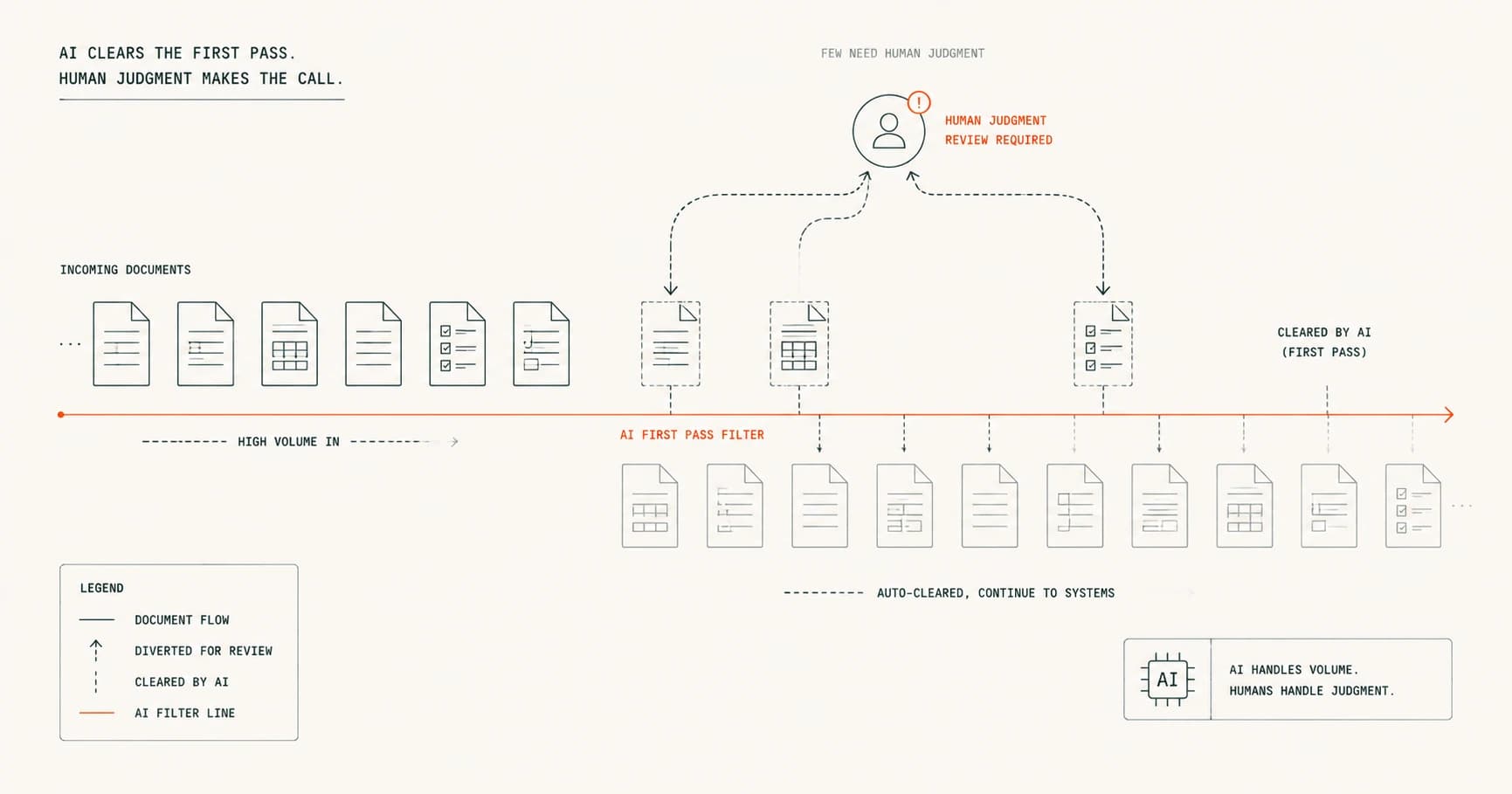
Legal AI should improve response time, capacity, and consistency without asking a lawyer to trust a black box. We build focused systems around your firm's knowledge, matter permissions, operating methods, and client obligations. Every material answer leads back to a source. Every consequential decision stays with a lawyer.
Bring the problem, the current workflow, or the existing code. We reply with a practical next step within one business day.
The brief
Good software decisions begin with the constraint, not a list of features or a preferred technology.
Are lawyers already using general AI while the firm still lacks an approved data path, source record, or review policy?
Have pilots produced impressive answers but no measured change in turnaround time, write-offs, backlog, or client service?
Does valuable precedent and matter knowledge remain difficult to use because it is split across document, knowledge, and practice systems?
Plain answer
AI for law firms is most useful when it improves a repeated legal workflow using approved sources, matter permissions, measurable evaluation, and lawyer review. Established firms should usually buy a proven legal product when it fits. Custom development is justified when proprietary knowledge, operating methods, integrations, or client data boundaries create expensive gaps.
An associate asks a legal AI tool for the authority behind a proposition. The answer reads cleanly. The citation looks plausible, which makes it the part that needs checking most. If the lawyer must repeat the research from scratch, the firm has gained a response and lost the time it expected to save.
A useful legal system shortens the route to the source and the completed work. It shows the contract passage, judgment, transcript line, or firm document behind the answer. It fits the working matter, records the review, and returns the result to the system the team already uses. When the evidence is weak, it stops.
| What is happening now | What we change | What should improve |
|---|---|---|
| Lawyers repeat searches or re-check every citation because an AI answer is separated from its evidence. | We ground the answer in an approved source set and show the exact passage beside every material conclusion. | Less duplicate verification, faster first-pass work, and a clearer review record. |
| Useful precedent, playbooks, and matter knowledge are split across document, knowledge, and practice systems. | We connect one valuable workflow to the systems and permissions the team already uses instead of creating another isolated AI destination. | Faster access to approved knowledge and less time rebuilding context by hand. |
| A pilot produces impressive outputs but nobody can say whether it improves turnaround, write-offs, backlog, or client service. | We establish a baseline, build an evaluation set from real work, and define professional and commercial acceptance conditions before rollout. | A go, change, or stop decision based on evidence rather than demo quality. |
| People already use general AI while the firm lacks a controlled data path, retention rule, source record, or review policy. | We place the provider, permissions, logging, refusal path, and lawyer approval inside one governed workflow. | Better visibility over confidential data and fewer uncontrolled workarounds. |
| Fixed-fee pressure, growing queues, or outside-counsel overflow consume capacity that should go to legal judgment. | We automate one repeated reading, retrieval, extraction, or drafting first pass while lawyers keep the consequential decision. | Shorter queues, more consistent work, and capacity recovered without treating judgment as an automation target. |
The answer is not a general legal chatbot. It is a focused system that moves one repeated task from approved source to review-ready work, with the evidence, permissions, and human decision visible at every step.
The professional case asks whether the system protects confidentiality, respects permissions, shows authoritative sources, surfaces uncertainty, and keeps a qualified lawyer responsible for the work. Failure on those conditions ends the evaluation.
The business case asks what improves after those conditions are met. For a law firm, that may be faster client response, fewer write-offs, more consistent work across a practice, stronger fixed-fee margin, or capacity for work the firm previously declined. For an in-house department, it may be a shorter queue, less outside-counsel overflow, faster commercial decisions, or more time for the issues that need legal judgment.
Count the whole workflow. A model that produces a draft in seconds has not saved time if the lawyer spends longer finding its sources, correcting it, moving it into the matter file, and documenting the decision.
The trust gap
A Stanford and Yale research team found that two leading retrieval-based legal research tools hallucinated more than 17% of the time. Retrieval made them safer than a general model, but not error-free. That finding sets the right design rule: every material legal answer needs a visible source and a lawyer who owns the decision. Read the published research.
The left side describes a workflow that can be tested and owned. The right side needs a product, policy, or process decision before custom software.
A repeated task consumes meaningful lawyer time, delays client or business work, or creates avoidable write-offs or outside-counsel cost.
The organisation controls the documents, playbook, cases, precedents, or other sources that should ground the output.
A practice or legal owner can define unacceptable errors, review the evaluation set, and approve the human checkpoint.
The workflow depends on proprietary knowledge, permissions, systems, or methods that standard products do not support cleanly.
The goal is a broad chatbot that can answer any legal question without a defined source set.
Nobody owns permissions, retention, or the decision about which model providers may receive matter data.
The task happens too rarely for a custom system to repay the evaluation and maintenance work.
A licensed legal product already fits the work and the remaining problem is training or adoption.
We assess all four routes. Recommending a licensed product or a focused integration is a valid outcome, even when it means there is no custom build.
| Use case | The system does | The lawyer verifies |
|---|---|---|
| Commercial contract review | Extracts clauses and compares them with an approved playbook | The risk position and every proposed redline |
| Legal research | Retrieves cases and firm knowledge, then drafts an answer with source passages | Every proposition and authority relied upon |
| Drafting and summarization | Creates a first draft or condenses cases, briefs, depositions, and document sets from approved material | Accuracy, omissions, context, and the final language |
| Due diligence | Sorts documents and flags issues against a defined risk matrix | Materiality, context, and the final report |
| eDiscovery review | Groups duplicates, classifies likely relevance, and flags possible privilege | The review protocol, privilege calls, validation, and completion |
| Deposition and transcript analysis | Finds statements, topics, and possible inconsistencies across testimony | Meaning, relevance, and litigation strategy |
| Client intake | Collects defined facts, routes the enquiry, and prepares the matter record | Conflicts, legal analysis, and whether to accept the matter |
The ABA's Formal Opinion 512 names research, contract review, due diligence, document review, regulatory compliance, and drafting as AI-assisted legal tasks. It also makes the boundary clear: lawyers remain responsible for competence, client confidentiality, supervision, candour, and the work they put forward.
Lexis+ with Protégé, for example, already combines natural-language legal research, linked citations, Shepard's validation, summaries, and organisation documents. A custom project should not recreate an authoritative legal content product. It should close the valuable gap between licensed intelligence and the firm's own knowledge, permissions, method, and working systems.
For clause-by-clause commercial work, use AI contract review software. For large litigation populations, use legal document review automation. For approved templates and deterministic clause assembly, use document automation. If the job is a stable data move rather than interpretation, see when legal RPA fits.
What the solution includes
What working with us looks like
You bring one repeated task, the systems it touches, and the people who own it. We map the complete workflow, cost, failure points, and baseline. You leave with a defined first use case and a decision about whether custom work is justified.
Together we decide which documents the system may use, who may see each answer, how long data stays, and where human approval belongs. The output is a source and control design that closes the confidentiality and access questions before live matter data is connected.
Your legal owner provides representative work and known answers. We build and test the riskiest part against normal cases, hard cases, and unacceptable errors. The output is an evidence-backed go, change, or stop decision, not a polished demo that hides failure.
We integrate the approved workflow, record source and reviewer decisions, and release it to a controlled group. You receive the working system, acceptance record, ownership documentation, and eight weeks of post-launch support. Expansion happens only after quality and business evidence hold up under real use.
Company-wide client feedback
Our independent Clutch, GoodFirms, and Sortlist ratings appear beside the opening offer. This review describes our broader delivery approach. We do not present it as a legal AI case study.
"Their ability to understand the problem statement and come up with effective solutions was commendable."
Georgina Denis
Researcher and Scientific Writer, Clue by Biowink
The baseline is recorded before the pilot. A successful first workflow must meet the professional acceptance conditions and improve at least one operating measure. More usage is not a result when time, quality, or economics remain unchanged.
The first engagement should make one decision easier, not commit the firm to an AI programme. Bring the repeated task, the systems and sources it touches, and the errors the legal owner cannot accept. We will help you decide whether the sensible next move is to buy a product, integrate what you already have, build a focused workflow, or wait until the process is ready.
Work with us
We will map how the work is done today, where review and privilege matter, what a reliable result looks like, and whether you should buy, integrate, or build. If a standard product fits, we will say so.
Start with a repeated first-pass task where lawyers can verify the answer against a source. Contract clause extraction, retrieval across an approved knowledge base, due diligence issue spotting, and transcript search can fit. Avoid starting with a broad legal assistant that has no defined source set, error cost, or accountable owner.
A custom legal AI system limits what it can read, retrieves from approved sources, follows a defined output format, records the evidence behind each answer, and routes uncertain results to a lawyer. A general chat tool may still help with low-risk drafting, but it does not automatically provide those controls or fit your matter workflow.
Retrieval, source links, and structured outputs reduce risk but do not remove it. We test against an evaluation set with known answers, expose the supporting passage, measure failures by use case, and require human review where an incorrect answer carries legal or financial cost. The system must be allowed to say it cannot support an answer.
Access follows the firm's existing matter permissions wherever possible. Data sources, retention, model providers, regions, logs, and deletion rules are agreed before documents enter the system. Provider terms must prohibit training on client matter data, and the system records the events required for audit.
Yes, as a first pass. A legal AI system can draft from approved precedents and structured matter facts, or summarize a deposition, case, brief, or document set with page and passage references. The firm defines the source set and output format. A lawyer checks accuracy, omissions, context, authorities, and any material statement before the work is used or sent outside the team.
Buy a proven legal product when it covers the task, content, permissions, integrations, and commercial model. Integrate existing products when the main gap is access to firm knowledge or matter workflow. Consider custom development when a valuable repeated process depends on proprietary methods, internal sources, client-specific controls, or systems that standard configuration cannot support cleanly.
Start with the economics of the workflow rather than model speed. Depending on the work, measure total lawyer time, turnaround time, write-offs, fixed-fee margin, backlog, outside-counsel spend, rework, response quality, and the volume the team can handle. Usage and prompt counts measure adoption, not value. Quality and client obligations remain acceptance conditions, not trade-offs for faster output.
Yes, when the systems provide suitable APIs, permissions, and document access. The design should preserve matter security and ethical walls, retrieve only the sources the user may see, and return source references and approved work product to the existing system. Connecting everything at once is rarely the right first release; one source set and workflow is easier to evaluate and govern.
Common causes include starting with a broad assistant instead of a repeated task, testing polished examples rather than real matters, ignoring how lawyers work in Word or their document system, providing no practice owner, and measuring logins instead of completed work. Adoption improves when the workflow saves verifiable effort, fits the existing working surface, and gives reviewers a clear correction and escalation path.
Start with one repeated task, one accountable legal owner, an agreed source set, representative examples, and one clear point of review. Source access, document volume, permissions, evaluation depth, model use, and integration determine the scope. RaftLabs prices that first phase after the workflow and risks are understood, rather than publishing one figure that assumes every firm has the same systems and obligations.