The clause that matters is rarely the one that looks unusual.
A counterparty returns a familiar agreement. Most of the language is unchanged, so the review starts to feel routine. Then one limitation, indemnity, or renewal provision shifts just enough to move the risk.
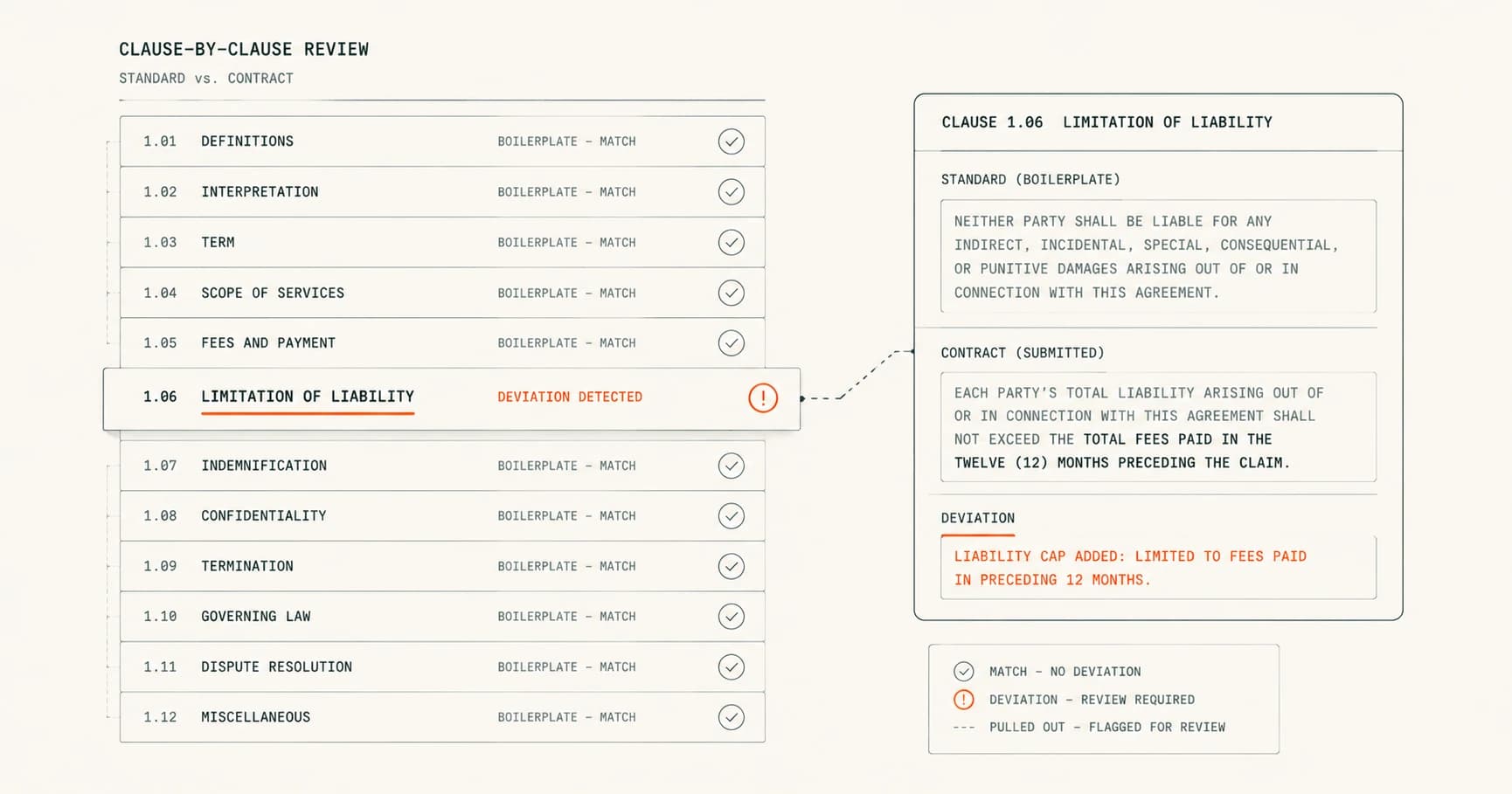
AI contract review should make that change easier to see without making the legal call. The useful system shows the clause, the approved position, the deviation, and the source of the suggested fallback in one place. The attorney decides what happens next.
Delivery evidence
- Near 99%
- internal validation measure reached in an adjacent AI document system
- Sample and test method are not public; not contract review
- 99.9%
- monitored uptime on that document-validation platform
- First four weeks of the recorded campaign
- 4.9/5
- average client rating across delivered projects
- Clutch, verified reviews
We have not published a contract-review deployment, so the numbers above are not presented as contract accuracy. The adjacent project proves a narrower engineering discipline: extract structured fields from messy documents, assign confidence, validate against a known answer, and keep the production service reliable. Contract clauses require their own labelled test set and attorney-defined acceptance criteria.
Custom contract review works when your legal positions are specific and repeated.
A licence is usually the better answer when a standard product already supports your contracts and playbook.
A fit01One or more repeatable contract types consume enough attorney time to justify a dedicated review path.
02Legal can document preferred positions, acceptable fallbacks, and escalation rules for the clauses in scope.
03The review needs to connect with your own document system, CLM, matter data, or approval route.
Not a fit01Most agreements are bespoke and every material clause requires fresh judgment.
02Your team has no settled playbook or labelled examples yet.
03An existing contract-review product meets the need without extensive workarounds.
Review scope
What the first system can cover
01Clause extraction and classification
Each clause returns as structured data with its type, source text, page reference, and confidence. Parties, dates, values, notice periods, and other defined terms can be extracted alongside the clause set. Uncertain results stay in the review queue.
The system compares extracted language with your approved position, accepted variants, and escalation rules. Reviewers see what changed and why the playbook treats it as standard, negotiable, or high risk.
03Missing provisions and fallback language
Required clauses that do not appear in the draft are flagged. Where legal has supplied approved fallback language, the system can prepare a suggested redline. An attorney must approve it before the counterparty sees it.
04Review queue and system integration
Contracts can enter from the document or lifecycle system your team already uses. Findings, reviewer decisions, and approved versions return to the same record, so the AI step does not create a second inbox or an isolated report.
AI contract review vs contract lifecycle management
| AI contract review | Contract lifecycle management |
|---|
| Primary job | Analyse the language inside a draft | Control the agreement process from intake to renewal |
| Core input | Contract text and legal playbook | Request data, templates, approval rules, and contract records |
| Main output | Clause findings, risk flags, and suggested fallback language | A routed, approved, signed, and tracked agreement |
| Human owner | Attorney deciding the legal position | Legal operations or procurement managing the workflow |
| Use together | Can become the review step inside CLM | Can trigger review and store its approved result |
If your bottleneck is intake, approvals, signature, or renewals, start with contract lifecycle management software. If the problem is finding relevant evidence across a litigation population, use legal document review automation. This page is for the language inside repeatable commercial contracts.
How it works
From one playbook to a measured first release
- Phase 1
01Choose one contract type
Select a repeatable agreement with enough review volume and stable legal positions to justify automation. Define the baseline: time per review, common deviations, and current escalation path.
- Phase 2
02Encode the playbook
Define clause types, approved positions, fallback language, risk levels, and escalation rules with the legal team. Ambiguous positions stay out of automation until counsel resolves them.
- Phase 3
03Validate on past contracts
Test extraction and deviation flags against a labelled set, including awkward drafts and rare clauses. Results are reported by clause type so a strong common clause cannot hide a weak high-risk one.
- Phase 4
04Integrate and monitor
Put the review step into the existing document flow, keep attorney approval mandatory, and measure accepted, rejected, and missed flags. Expand only after the first contract type meets the agreed checks.
- One accuracy number
- An overall score can hide poor results on rare, expensive clauses. Acceptance checks need to be set per clause type and per error cost.
- A playbook nobody owns
- The model cannot settle a legal position that the team has not settled. A named owner must approve each rule and future change.
- Confident language
- A polished explanation can still be wrong. The interface must expose source text, confidence, and playbook evidence rather than asking reviewers to trust a summary.
First contract type
Start with one review workflow at $30,000.
The first release covers a defined clause set, playbook comparison, attorney review, and one integration. More contract types earn their place later.
A standard product will cost less when its playbooks and integrations fit. Custom software makes sense when your positions, workflow, or data boundaries create expensive workarounds.
Starting investment
Starts at $30,000
A focused first release usually takes 8 to 14 weeks. Clause count, playbook readiness, redlines, integrations, and security requirements move the number.
Measured before expansion
The first contract type is tested against an agreed labelled set. We do not recommend adding another type until the original workflow meets its acceptance checks.
Attorney approval stays mandatory
No risk decision or suggested redline goes to a counterparty without the review step your legal team defines.