Online Marketplace Development: Cost, Timeline, and Build Decisions
A founder-level guide to online marketplace development. Covers when to go custom vs. use Sharetribe or Arcadier, what V1/V2/V3 actually costs, and where two-sided marketplace builds fail. Includes real cost ranges and operator scenarios.

In this article
Short answer
Online marketplace development costs $25,000-$45,000 for an MVP and $80,000-$200,000+ for a full-featured platform. Custom builds make sense when your transaction model, trust mechanics, or vertical integrations exceed what Sharetribe or Arcadier can support. RaftLabs builds two-sided marketplaces for goods, services, and rentals with custom matching and payment in 10-20 weeks.
Key takeaways
- SaaS tools like Sharetribe and Arcadier work for standard listing-and-booking flows. Once you need custom matching, escrow, multi-party payments, or vertical-specific trust mechanics, you need a custom build.
- A marketplace MVP costs $25,000-$45,000 and takes 8-12 weeks. Budget $80,000-$180,000 for a production-grade platform with mobile apps, dispute resolution, and seller verification.
- The cold start problem is go-to-market, not engineering. Seed your supply side manually before you open to buyers. Launching both sides simultaneously is the primary cause of marketplace failure.
- Payment architecture is the highest-risk technical decision. Stripe Connect removes the need for a money transmitter licence for most use cases. Custom payment routing is a six-to-twelve month detour.
- V1 should do one transaction type well. V2 adds trust mechanics and seller tools. V3 adds mobile, analytics, and scale infrastructure. Teams that try to ship all three simultaneously ship none of them well.
You have a two-sided marketplace idea and you are evaluating your options. Maybe you tried Sharetribe and hit the ceiling on custom matching logic. Maybe Arcadier works for the basics but you need escrow, credential verification, and a mobile app for your service providers. Or you have a rental platform concept where the fee structure and dispute workflow are specific enough that no SaaS template will fit.
Online marketplace development decisions all come down to the same question: what does your transaction model actually require, and which path gets you there without burning your runway?
Here is where projects stand financially before you read further.
| Build phase | Timeline | Cost range |
|---|---|---|
| MVP (core transaction + basic trust) | 8-12 weeks | $25,000-$45,000 |
| Full platform (escrow, disputes, mobile) | 14-20 weeks | $80,000-$160,000 |
| Scale-ready (analytics, fraud, multi-currency) | 20-28 weeks | $160,000-$300,000+ |
According to McKinsey's B2B Pulse research, 72% of companies that built their own marketplace saw market-share growth over two years versus 42% that did not — but the research also shows that founders consistently underinvest in the payment and trust mechanics that make V1 transactions actually complete.
Sharetribe, Arcadier, and Nautical Commerce vs. Custom Builds
SaaS marketplace tools have improved significantly. Before you spend $80,000 on a custom build, you should know exactly what these platforms can and cannot do.
Sharetribe is the most widely used marketplace SaaS. It handles listings, bookings, and basic payment routing through Stripe Connect. The hosted version gets you live in days. The open-source version (Sharetribe Web Template) gives you a starting codebase you own. The ceiling is real though: matching logic, custom escrow flows, and multi-party payment splits require custom engineering work that partially defeats the purpose.
Arcadier targets B2B and rental marketplace operators. It handles multi-vendor catalogs, booking management, and invoicing. The visual customisation is deeper than Sharetribe. The integration ceiling is similar: when you need conditional fee structures, custom verification workflows, or deeply branded seller dashboards, you are fighting the platform.
Nautical Commerce is purpose-built for multi-vendor B2B marketplaces. It is the strongest of the three for wholesale, distribution, and complex pricing structures (tiered pricing, volume discounts, contract pricing). If your marketplace is a B2B supply-side catalog with net terms and PO workflows, Nautical may be the right call. It is overkill for consumer service or rental marketplaces.
When custom marketplace software wins:
| Situation | Why SaaS falls short |
|---|---|
| Custom matching (skill-based, availability, geo-radius) | SaaS matching is keyword search or category filter only |
| Multi-party escrow with conditional release | SaaS escrow is binary hold-and-release |
| Credential, licence, or insurance verification | Not built in; requires custom integration |
| Seller-facing mobile app (service providers on the go) | SaaS mobile experience is limited |
| Rental with damage deposit and condition tracking | Not a native flow in any SaaS tool |
| Commission structures beyond flat percentage | Rarely supported without workarounds |
| White-label seller onboarding with your brand | SaaS branding is surface-level |
"The biggest mistake I see founders make is starting with Sharetribe because it is cheap, hitting the ceiling at month three, and then rebuilding from scratch. The rebuild costs more than the custom build would have," says Prasanna Krishnamoorthy, Partner at Upekkha, a SaaS accelerator that has worked with over 200 marketplace founders.
The honest threshold: if your marketplace has standard listings, bookings, and a flat commission, start with Sharetribe. If your transaction model has any of the conditions in the table above, start with a custom build.
Who Actually Builds Custom Marketplace Software
Custom online marketplace development is not for everyone at day one. These are the operator profiles that consistently need it.
The service marketplace with verified providers. A home services platform needs background checks, licence verification, and insurance confirmation before a service provider can accept bookings. Sharetribe has no native verification workflow. You end up running verification manually outside the product, which breaks the trust mechanic that makes the marketplace defensible. Custom builds allow you to gate listing activation on verification status, display credential badges to buyers, and expire listings when credentials lapse.
The rental platform with damage deposits. A peer-to-peer equipment rental or property rental platform needs damage deposit holds, condition reporting at pickup and return, and conditional deposit release tied to dispute outcomes. This flow does not exist in any SaaS tool. The escrow logic alone requires custom payment architecture. Founders who try to approximate this with manual bank transfers or Stripe checkout sessions spend most of their operations time on edge cases that the product should handle automatically.
The B2B marketplace with non-standard pricing. A wholesale marketplace where suppliers quote in volume tiers, buyers have contracted pricing, and payments run on net-30 terms cannot be modelled in Sharetribe or Arcadier. Nautical Commerce gets closer but still requires custom integration for ERP sync, purchase order workflows, and contract-specific catalogue visibility. Custom builds handle these as first-class features because the data model is designed around the actual transaction.
The marketplace where matching is the product. If your competitive advantage is better matching (matching freelancers to projects by skills and availability, matching tutors to students by learning style, matching borrowers to lenders by risk profile), SaaS keyword search will not represent your product accurately. The matching algorithm is a core part of the build. Custom marketplace software lets you design the matching logic as a product feature with its own testing, iteration, and improvement cycle.
V1, V2, V3: Features and Costs Per Phase
The biggest budget mistake in marketplace development is building V3 with V1 funding. Here is how phased delivery works and what each phase actually costs.
V1: Core transaction (8-12 weeks, $25,000-$45,000)
V1's only job is to complete one transaction type end-to-end. A real buyer pays a real seller through your platform, the platform takes a fee, and both parties can see their transaction history.
What V1 includes:
Buyer and seller accounts with onboarding flows
Listing creation and search (basic filter, not advanced matching)
Single transaction flow with Stripe Connect (charge buyer, release to seller, platform fee)
Email notifications at each transaction stage
Basic reviews after transaction completion
Admin dashboard: user management, payout controls, transaction log
Messaging between buyer and seller
What V1 deliberately excludes:
Mobile apps (web-responsive only)
Dispute resolution workflow (support email handles this manually)
Identity verification integration (manual review by admin)
Advanced matching or recommendation engine
Analytics beyond basic transaction counts
V1 cost drivers: Stripe Connect integration accounts for roughly 30-35% of V1 engineering time. Get this right and everything else is faster. Get it wrong and you spend the first three months of operations dealing with failed payouts and disputed charges.
V2: Trust and seller tools (10-14 weeks, $40,000-$80,000)
V2 adds the mechanics that turn one-time transactions into repeat business and make the platform operationally manageable at 50-500 active users.
What V2 adds:
Dispute resolution workflow (in-app, with escrow hold logic)
Identity verification integration (Persona, Jumio, or Stripe Identity)
Seller dashboard (earnings, payout schedule, listing performance)
Advanced search with filtering and availability-based results
Buyer protection messaging and refund policy
Fraud detection rules (velocity limits, device fingerprinting)
V2 cost drivers: Dispute resolution and escrow logic together typically represent 20-25% of V2 spend. The decision tree for "who gets the money when a dispute is raised" needs to be fully mapped before a developer writes a line of code. Every undefined edge case becomes a support ticket or a chargeback.
V3: Mobile and scale (12-18 weeks, $60,000-$120,000)
V3 addresses the user experience gaps that appear once you have consistent transaction volume.
What V3 adds:
Native mobile apps (iOS and Android) for buyers and/or sellers
Push notifications for booking requests, messages, and payout events
Analytics dashboard for operators (cohort retention, listing conversion, GMV by category)
Multi-currency support with local payout methods
API integrations (calendar sync, background check providers, ERP systems)
Performance infrastructure (caching, CDN, database query optimisation for scale)
V3 cost drivers: Mobile apps alone add $20,000-$40,000 depending on complexity. If your service providers are mobile-first (home services, delivery, on-demand), mobile is effectively a V1 requirement and should be scoped into the initial budget. Do not treat it as a V3 feature if your supply side lives on their phones.
Where Marketplace Projects Fail
Most custom marketplace development projects do not fail because the engineering is bad. They fail for two consistent reasons.
Launching both sides simultaneously
The cold start problem is the chicken-and-egg challenge every marketplace faces. Buyers will not arrive to an empty marketplace. Sellers will not list on a platform with no buyers. The solution has been the same across every successful marketplace in the last 20 years: seed the supply side manually before you open to buyers.
Airbnb recruited their first hosts by going door-to-door in New York. Etsy launched by recruiting craft fair sellers before opening to buyers. Thumbtack seeded service providers in specific cities before accepting buyer requests.
This is not an engineering problem. But if your product is not built to support supply seeding (manual admin approval of providers, geographic launch controls, invite-only seller registration), you will not be able to execute the go-to-market strategy that makes the launch work.
Teams that budget the engineering without budgeting the supply acquisition consistently run out of runway before they find supply-demand equilibrium.
Undefined payment edge cases
Payment edge cases kill marketplace momentum quietly. The typical V1 launch handles the success path fine. The first disputed transaction, partial refund, or failed seller payout reveals every undefined edge case in the payment architecture.
What happens when a buyer disputes a charge three days after the seller has already been paid out? What happens when a seller's bank account is invalid and the payout fails? What happens when a buyer wants a partial refund because the service was partially delivered?
These scenarios need defined flows with agreed logic before the product goes live. A seller who cannot get their payout after a dispute will leave the platform and tell other sellers. A buyer who cannot get a refund will file a chargeback, which triggers Stripe's dispute process and costs you $15 per chargeback plus the original charge.
The fix is a payment edge case map completed during scoping, before any code is written. Every scenario gets a defined outcome. It takes two to three hours and saves weeks of operational firefighting.
How RaftLabs Builds Marketplace Platforms
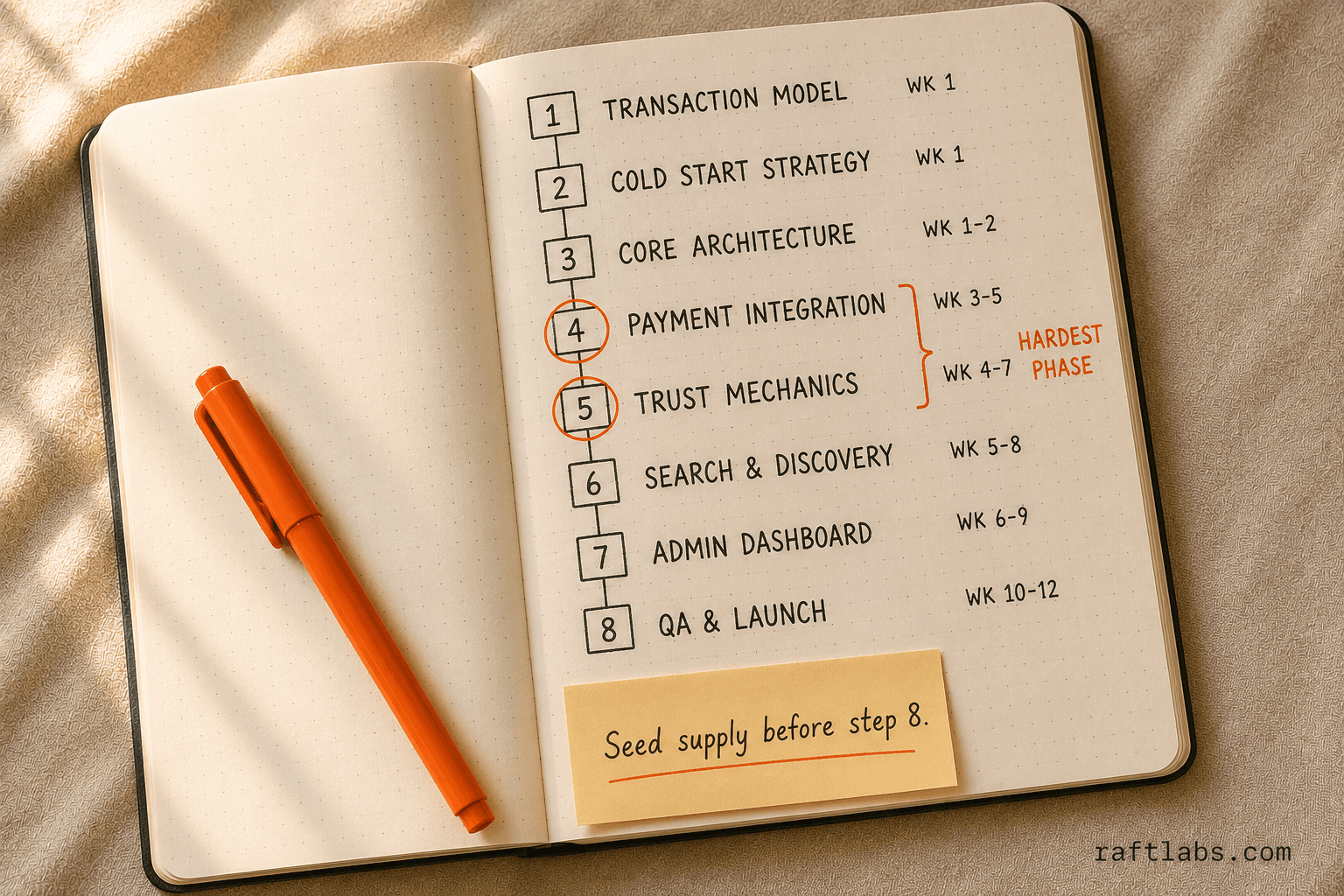
RaftLabs has shipped marketplace platforms across home services, equipment rental, B2B supply, and talent matching. Every engagement starts the same way: a transaction model workshop in week one before any code is written.
The workshop covers three things: the exact payment flow (who pays, when, what fee structure), the trust mechanics the vertical requires at launch (verification, escrow, dispute logic), and the cold start strategy (which side gets seeded first and how). Teams that walk out of that session with clear answers build faster because the engineers have a complete spec, not a partial one.
Our marketplace engagements run at fixed price for V1 and V2. We do not bill hourly because hourly billing creates the wrong incentives: it makes scope ambiguity profitable for us and expensive for you. Fixed price forces clarity upfront, which is where the real leverage in a marketplace build lives.
Stripe Connect is our default payment architecture for two-sided marketplaces. We have integrated Stripe Connect with Express accounts, Custom accounts, and platform-level fee structures across enough marketplace builds that we have documented every edge case. For marketplaces that need custom escrow with conditional release tied to dispute outcomes, we extend Stripe Connect with server-side escrow state machines rather than building payment routing from scratch.
If you have a transaction model that does not fit a SaaS tool and you know which side you will seed first, you have enough for a scoping call. We will tell you what V1 should include and what it costs.
Supporting Statistics
Digital Commerce 360 reports that B2B marketplaces grew nearly 100% year-over-year in 2023, reaching $224 billion — the fastest-growing digital sales channel in B2B commerce.
McKinsey's B2B Pulse survey found that 77% of B2B buyers now prefer completing transactions through digital channels, up from roughly 20% of industrial companies expressing that preference in 2017.
According to McKinsey research, 72% of companies that built their own marketplace experienced market-share growth over two years versus 42% of companies that did not, making owned-marketplace infrastructure the clearest differentiator in B2B digital commerce.
Frequently Asked Questions
How much does online marketplace development cost?
A marketplace MVP runs $25,000-$45,000. A full platform with mobile apps, escrow, dispute resolution, and seller verification costs $80,000-$200,000+. The biggest cost drivers are payment complexity (Stripe Connect vs. custom escrow), mobile apps (add $20,000-$40,000), and identity verification integrations (add $5,000-$15,000). Fixed-price engagements are available for well-scoped projects.
How long does it take to build a marketplace?
A two-sided marketplace MVP takes 8-12 weeks with a focused team. A production-grade platform with mobile apps, escrow, and advanced trust mechanics takes 16-22 weeks. The primary timeline variable is payment complexity. Stripe Connect integration adds 3-4 weeks. Custom payment routing or multi-jurisdiction compliance adds 8-12 weeks on top of that.
Should I use Sharetribe or build a custom marketplace?
Use Sharetribe or Arcadier if your transaction model is listing-plus-booking with standard fees and you want to launch in 4-6 weeks. Build custom when you need non-standard matching (skill-based, geo-radius, availability), multi-party payments, custom escrow, vertical-specific verification (licences, insurance, credentials), or a branded seller experience Sharetribe cannot replicate.
What is the cold start problem and how do I solve it?
The cold start problem is the chicken-and-egg challenge every marketplace faces: buyers will not come without sellers, and sellers will not come without buyers. The solution is always to seed one side first. Most successful marketplaces seed supply (sellers, service providers, renters) before opening to buyers. Airbnb and Etsy both used manual supply-side outreach in their first months. This is a go-to-market decision, not a product feature.
Do I need Stripe Connect for my marketplace?
For most marketplaces, yes. Stripe Connect handles split payments, escrow-style holds, and automated payouts to sellers in 40+ countries without requiring a money transmitter licence. The alternative is collecting payment into your own account and routing manually, which requires a money transmitter licence in most US states and an EMI licence in the UK and EU. Custom payment routing adds six to twelve months and six figures to the project.
Ask an AI
Get an instant summary of this post from your preferred AI assistant.
Frequently asked questions
- A marketplace MVP runs $25,000-$45,000. A full platform with mobile apps, escrow, dispute resolution, and seller verification costs $80,000-$200,000+. The biggest cost drivers are payment complexity (Stripe Connect vs. custom escrow), mobile apps (add $20,000-$40,000), and identity verification integrations (add $5,000-$15,000). Fixed-price engagements are available for well-scoped projects.
- A two-sided marketplace MVP takes 8-12 weeks with a focused team. A production-grade platform with mobile apps, escrow, and advanced trust mechanics takes 16-22 weeks. The primary timeline variable is payment complexity. Stripe Connect integration adds 3-4 weeks. Custom payment routing or multi-jurisdiction compliance adds 8-12 weeks on top of that.
- Use Sharetribe or Arcadier if your transaction model is listing-plus-booking with standard fees and you want to launch in 4-6 weeks. Build custom when you need non-standard matching (skill-based, geo-radius, availability), multi-party payments, custom escrow, vertical-specific verification (licences, insurance, credentials), or a branded seller experience Sharetribe cannot replicate.
- The cold start problem is the chicken-and-egg challenge every marketplace faces: buyers will not come without sellers, and sellers will not come without buyers. The solution is always to seed one side first. Most successful marketplaces seed supply (sellers, service providers, renters) before opening to buyers. Airbnb and Etsy both used manual supply-side outreach in their first months. This is a go-to-market decision, not a product feature.
- For most marketplaces, yes. Stripe Connect handles split payments, escrow-style holds, and automated payouts to sellers in 40+ countries without requiring a money transmitter licence. The alternative is collecting payment into your own account and routing manually, which requires a money transmitter licence in most US states and an EMI licence in the UK and EU. Custom payment routing adds six to twelve months and six figures to the project.