Scalable Multi-Carrier Shipping Software for a Global Logistics Platform
- 2K+
- shipments across 70+ countries in year one
Warehouse Management Software
Warehouse management software controls and tracks every movement of inventory through a facility, from the moment goods are received at the dock through putaway, picking, packing, and shipping. A 1% mispick rate at a facility processing 2,000 orders a day produces 20 wrong orders daily, each costing $50 to $300 to correct. Paper pick lists print in SKU order, not floor order, so pickers zigzag across aisles rather than sweeping them in sequence. A custom WMS ties together the specific floor layout, SKU types, picking logic, robotics hardware, and ERP or OMS integrations that define how a particular warehouse operation runs, rather than forcing that operation to fit a generic platform's configuration options.
Receiving and putaway workflows with barcode and RFID scan confirmation, directed location assignment, and dock-to-shelf tracking
Picking route optimization using shortest-path algorithms across single-order, batch, zone, and wave picking modes
Real-time inventory tracking with cycle count scheduling, shrinkage alerting, and multi-location bin management
Robotics and conveyor integration via AMR, AGV, and conveyor control APIs including Locus Robotics, Fetch Robotics, and Honeywell Intelligrated
Bring the problem, the current workflow, or the existing code. We reply with a practical next step within one business day.
Trusted by












The brief
Good software decisions begin with the constraint, not a list of features or a preferred technology.
Your pickers walking the same inefficient routes every shift because no one has mapped an optimized path through the floor?
Inventory records in your system never matching what is physically on the shelves, leading to oversells and emergency cycle counts?
Plain answer
RaftLabs builds custom warehouse management software for e-commerce brands, 3PL operators, distribution centers, and manufacturers: receiving and putaway, order picking route optimization, real-time inventory tracking, robotics and conveyor integration, and shipping and returns. Most warehouse management software development launches a validated v1 in 10 to 14 weeks, then expands, with scope and cost fixed in writing before any build.
What to remember
Proof
Warehouse management software controls every inventory movement through a facility, from dock receiving through putaway, picking, packing, and dispatch. It replaces paper pick lists and spreadsheet stock counts with directed, scan-confirmed workflows and a live view of what sits in every bin.
Order picking is where most of the cost hides. Traveling between picks can consume up to half of a picker's working time, and picking accounts for the largest share of a warehouse's operating labor (Bartholdi and Hackman, Warehouse and Distribution Science, Georgia Tech). That is where custom warehouse management software development earns its cost. It ties picking logic, slotting, and route generation to your actual floor map, instead of forcing the operation to fit a generic platform's fixed configuration.
Capabilities
Dock-to-shelf scan confirmation with directed putaway rules and cross-docking for open orders awaiting inbound stock.
Shortest-path routing across single-order, batch, zone, and wave picking, with pick-to-light and voice picking support.
ABC-velocity-scheduled counts with automated recount requests and shrinkage alerting across multi-location bins.
REST/MQTT task dispatch to AMR/AGV fleets and WCS-driven sort decisions, with fleet health visible in one dashboard.
Live carrier rate shopping, ZPL label printing without a print-queue intermediary, and automated end-of-day manifesting.
Activity-based invoicing generated directly from WMS transactions, with per-client SLA dashboards and portal access.
How we work
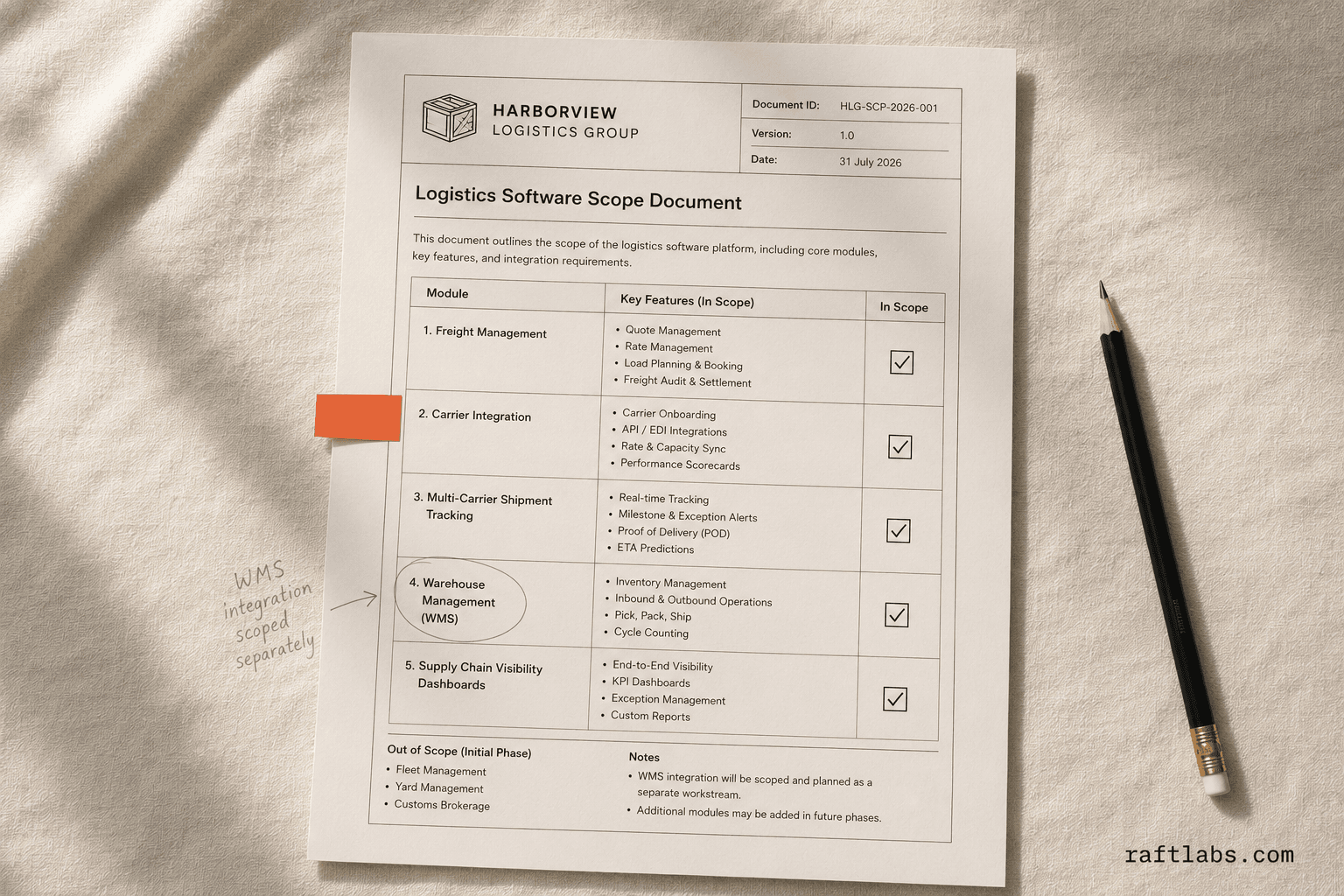
We map your floor layout, order volume, and where your current process creates errors or bottlenecks. You leave week 1 with a written scope document and a fixed-price quote.
Bin hierarchy, pick route logic, and integration contracts designed against your actual floor map and systems.
Receiving and inventory ship first as your working v1. Picking workflows, carrier integration, and dashboards follow in two-week cycles.
The new WMS runs alongside your existing process for about two weeks before cutover. You launch a validated v1 in 10 to 14 weeks, then expand from there.
Why us
The engineers who assess your floor layout also build the solution. No bait-and-switch, no offshore handoff after the contract is signed.
We scope the work, calculate the cost, and lock it in writing before any development starts.
Real engagements across SaaS, fintech, healthcare, and logistics, not every one published as a named case study. Our closest logistics build is UrShipper, a multi-carrier shipping platform that moved 2,000+ shipments across 70+ countries in its first year.
Barcode scanners, printers, and robotics APIs are tested against what's on your floor, not a simulator.
If your core inventory model works, we recommend extension over a full rebuild.
Proof
Useful next steps
Work with us
Logistics Software Development
See the serviceTry it yourself
Logistics Software Cost Calculator
TMS, fleet, freight, or shipping software. Honest build range in 3 minutes.
Open the free tool
Article
Quick Commerce Platform Development: Build a Blinkit-Style App That Actually Ships
Quick commerce platform development costs $30,000-$140,000 depending on dark store count, platform scope, and delivery model. Here is the full cost breakdown, the SaaS tools that fail at volume, and a phased feature plan for grocery chains and dark store operators.
Read more
Article
How much does IoT development cost? (2026 breakdown)
An IoT system costs $20,000-$300,000+ to build depending on device complexity, connectivity type, and fleet size. Here's what drives the range, three real budget scenarios, and what ongoing costs look like in production.
Read more
Article
Black Car Dispatch Software: Build vs. Buy for Operators
Generic dispatch tools treat airport pickups like pizza deliveries. Black car and limo operations run on advance reservations, flight tracking, and corporate accounts. Here is what the software actually needs and when to build your own.
Read more
Article
Pet Grooming Software: When to Build vs. Buy (and What It Costs)
MoeGo and 123Pet work fine for one salon. At 10+ locations, every workaround costs you money. Here is what custom pet grooming scheduling software actually involves, what it costs, and when the numbers tip in favor of building.
Read moreCustom becomes the right choice when your operation needs multi-client billing logic that doesn't fit standard tenancy models, picking algorithms tuned to your specific floor layout, tight integration with proprietary robotics or conveyor hardware, or returns workflows with grading logic specific to your product categories.
Yes, if the hardware vendor exposes an API or standard message protocol. Providers including Locus Robotics, Fetch Robotics, Honeywell Intelligrated, Dematic, and Bastian Solutions expose REST or MQTT interfaces for task dispatch and status callbacks.
A focused first version covering receiving, picking, and inventory management launches in 10 to 14 weeks and starts around $40,000 to $80,000. From there the platform grows: robotics and conveyor integration, multi-site support, 3PL billing, and returns management take the full build toward $80,000 to $180,000 over time. Scope and cost are fixed in writing before any development starts.
Yes. Extending an existing platform is often right when the core inventory and location model works but specific workflows are missing, a returns grading portal, a mobile picker app replacing paper, or a robotics dispatch layer on top of the current system.
Work with us
Tell us your floor layout, order volume, and where your current process creates errors or bottlenecks. We will scope the right WMS for your operation.
Go deeper