Sign Company Management Software
Sign company software for jobs that run as one chain, not five handoffs.
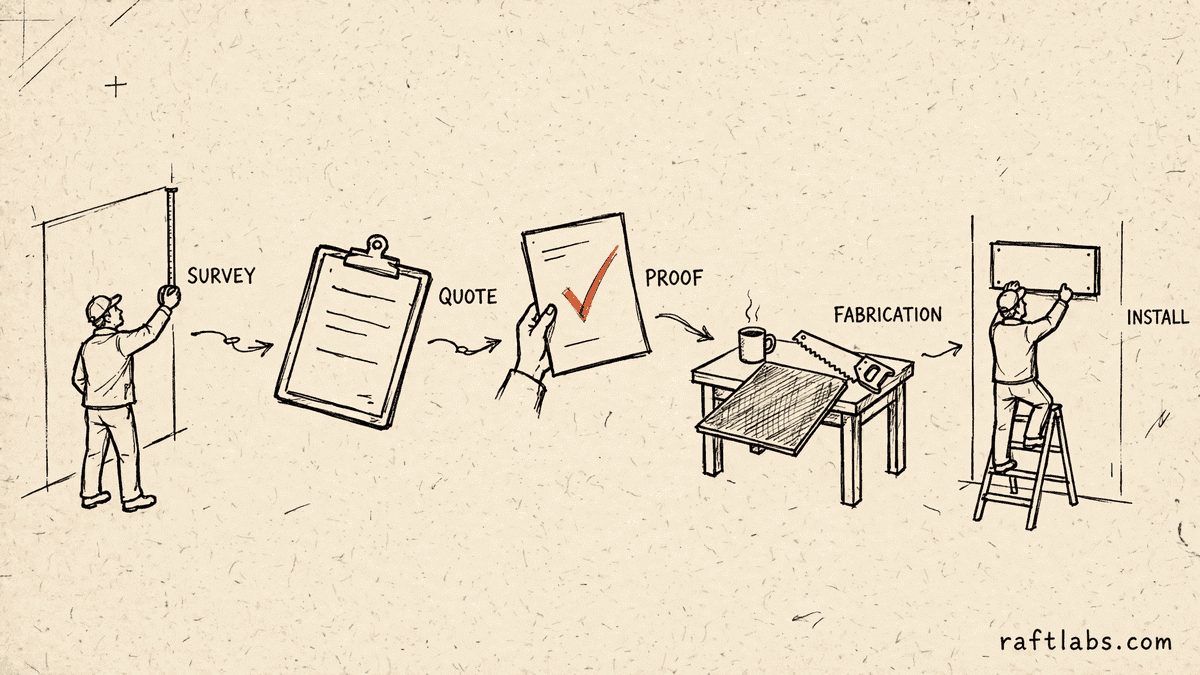
A sign job runs through a site survey, a quote, a proof, the workshop floor, and an install. When each step lives in a different place, margin is a surprise on the invoice. We turn that chain into one system your office, your floor, and your fitters all use.
Bring one stuck workflow. Leave with a build, buy, repair, or wait recommendation.
Trusted by























The brief
Start with what is not working.
Good software decisions begin with the constraint, not a list of features or a preferred technology.
The proof sits in an email thread, and nobody can show which version the client actually signed off.
Materials, fabrication, and the fitter day rate are priced from memory, so the real margin only shows up on the invoice.
The schedule lives on a whiteboard and in one person's head, so a rush job breaks the week by lunchtime.
Plain answer
Sign company management software runs a sign job on one record from site survey to install sign-off. The quote prices materials, fabrication and fitting as separate lines, the proof is approved against the quote line it belongs to, fabrication waits for that approval, and the invoice follows the signed install.
What to remember
- A sign job is a chain of promises: survey, quote, proof, fabrication, and install. Run the chain on one record and each step can see the step before it.
- Price materials, fabrication, and fitting as separate quote lines, each carrying its real cost, so margin shows while you are still quoting.
- No material gets cut until the client has approved the proof tied to that quote line, with the date and the name on record.
- The fitter signs the install off on a phone, with photos, and the invoice follows from the finished job instead of waiting in the office.
- Use a maintained sign tool when it already runs your chain cleanly. Own custom software when your chain is the way you win and keep margin.
Fit
Custom sign software should earn its maintenance burden.
A feature request is not enough. The case is real when the same break shows up in reprints, margin, missed install dates, or invoices that go out late.
Survey, quote, proof, fabrication, and install live apart, and the gaps between them cost margin on real jobs.
Your quoting, proof, or install rules are specific to how your company works, and no maintained tool holds them as they are.
The company can name a workflow owner and what 'done' looks like for the first release.
A maintained sign tool already runs your chain with reasonable setup and its pricing makes sense.
The team wants software to settle an argument about how jobs should be priced or approved.
The brief is a feature list with no job, customer, or business result attached.
Not sure which side you are on? Use the first call to make that decision. A useful answer may be to buy, connect, repair, or wait.
Start with the job, not the software.
A sign job is a chain of promises. The survey promises the sign will fit the site. The quote promises a price built from materials, fabrication, and a fitter day rate. The proof promises the client the exact artwork they signed. The install promises the sign is up, photographed, and accepted. Run those promises in separate places and the chain breaks where nobody is watching.
Take a fascia job for a shopfront. The survey notes sit in a phone photo album. The quote is priced from memory in a spreadsheet, with the panel, the letters, and the lift day as one lump sum. The proof goes out as an email attachment, the client replies with approval, and a revised file is uploaded the next morning without anyone noticing the approval now points at artwork the client never saw. The fitter finishes on Friday, the client is not on site, and the invoice waits until the following week for a photo to come back in the van. Every step was done by someone doing their job. The job still lost margin in four places.
A second product hides inside the first. Customers see one proof and one install date; your team lives in another: approvals, exceptions, reprints, managing users, and a record of who did what. Quotes that squeeze all of that into an "admin panel" line item are where budgets most often break. On a real platform, your team's screens are routinely the most underestimated part of the work, so we quote them as their own job, with their own users, from the start.
Sign company management software makes sense when one owned system can hold that chain better than a product, a connector, or a process change. The first release should take the smallest useful path from survey to sign-off. It should not replace every tool at once. Our guide to sign company management software covers how such a system is put together and when buying beats owning, so this page can stay focused on the chain itself.
We start where it hurts.
The screen is only one part of the job. The real scope includes the pricing rules, the proof record, the floor queue, what happens when a job runs late, who can see and change what, and who runs it after release.
One job record from survey to sign-off
Site measurements, photos, and access notes are captured against the job from the first visit. The accepted quote becomes the job in one move, with every line, price, and specification carried across as accepted. Nothing is typed twice, and the job can still be corrected if the work changes.
Quotes that show margin while you quote
Materials, fabrication, and fitting are priced as separate lines, and each line carries its real supplier cost. Mark-up and margin show on the quote itself, not weeks later on the invoice. A fascia, a set of letters, the electrical connection, and a day on a lift are each priced from real numbers.
Proof approval tied to the quote line
The artwork goes to the client for approval against the line it belongs to, and the approval is dated and named on the job. Fabrication waits for that approval. If a new version is uploaded after approval, the job returns to awaiting approval, because the client has not seen the current file.
A floor queue the workshop can run
Each job carries its steps in order, each step with the area that owns it and the minutes it should take. The floor sees what is ready, what is in progress, and what is finished today, and a waiting step says what it is waiting on. The plan comes from the minutes in the job and the hours your people actually have, so a late job shows early, not when the client calls.
Install sign-off that raises the invoice
The fitter completes the sign-off on a phone on site: photos of the finished sign, any snags in plain words, and signatures from the fitter and the customer. The sign-off closes the job, and the invoice is raised from the finished record and sent to your accounting package without anyone typing it again.
Which one is yours?
Bring it to a 30-minute call. Leave with a build, buy, repair, or wait recommendation in writing. Free, whether or not we ever work together.
Buy first
The maintained tools, honestly.
Most sign companies should buy before they own. Here is where each maintained tool is strongest, and where each one stops, so you can match the tool to your chain instead of your feature list.
shopVOX: quoting and job board for sign shops
Built for sign, print, and apparel shops, with quoting, a drag-and-drop job board, online proof approval, and invoices that sync to common accounting packages. Repeat customers can order through a customer portal. Its shape suits shops whose main need is order handling and quoting in one friendly system.
CoreBridge: estimates, production, and accounting connected
Business management software built for print, sign, graphics, and apparel businesses. It connects estimates, production, and accounting so owners can see what is really happening across the shop, and it is widely used by franchise sign networks with standard ways of working.
Zigaflow: quote, order, job, and invoice on one record
Built around the whole flow rather than estimating alone: quote lines that carry supplier cost, purchase orders raised from the job, artwork approval tied to the quote line, install sign-off on a phone, and invoices posted to accounting without retyping. A strong fit when the chain matters more than press-style estimating.
When to own instead
Own custom software when the maintained tools stop at your chain. That can mean proof approval that must reset when a new version lands, or a floor plan worked out from the minutes in each job. It can also mean permit or client rules no standard tool holds, or several locations that need one true record. Our guide to sign company management software works through each ceiling in detail.
Proof
The fifth attempt became a product customers could keep using.
UrShipper had already worked with four development vendors. Its founder describes the communication and decisions during the recovery.
The case study documents a 14-week recovery, five carrier connections, a Shopify fulfilment workflow, and client-reported results. It is one comparable project, not a promise that every inherited codebase can follow the same plan.
Read the UrShipper case studyWhich workflow is costing you the most right now?
Bring it to a 30-minute call. Leave with a build, buy, repair, or wait recommendation in writing. Free, whether or not we ever work together.
How it works
Close one expensive risk before opening the next.
Each stage answers a buyer question and leaves behind a decision you can inspect. The next stage only opens when the expensive uncertainty in the current one is small enough to accept.
- 01Understand
Trace one real sign job
Where is the margin actually leaking?
Follow one job from the site survey through the quote, the proof round, fabrication, and the install. Include the workarounds, the retyped details, the waiting, and the failure paths that a tidy process diagram usually misses.
Decision produced
A map of one job from survey to sign-off, with the exceptions, owners, systems, and the baseline cost or delay worth changing.Risk closed
Paying to automate the visible symptom while the expensive constraint remains. - 02Shape
Choose the first useful release
What needs to exist together for one useful result to work?
Choose the shape from the way the work happens, not from a preferred technology. Name the user, the device, the data, the system connections, who can access what, the exceptions, and the result the first release must complete.
Decision produced
The right mix of office screens, floor screens, and a phone view for fitters, with the first-release boundary and a clear definition of done.Risk closed
A small-looking feature list that quietly depends on several interfaces, systems, and owners. - 03Prove
Review working software
Will it hold up outside a controlled demo?
Review the product against the agreed workflow, not a tour of finished screens. Run a real survey into a quote, approve a real proof, replace it with a new version, and watch the job wait for approval again before it reaches the floor.
Decision produced
Working checkpoints tested with realistic data, real user types, system connections, recovery plans, and the people who will use or run the system.Risk closed
Discovering the important gaps during migration or after customers depend on the release. - 04Transfer
Release, measure, and hand over
Did the new workflow improve the original constraint, and can another capable team operate it?
Move a controlled set of jobs or one crew first. Compare time, errors, completion, or another agreed measure with the starting point before adding the next workflow.
Decision produced
A controlled release, comparison with the baseline, operating notes, account ownership map, and a recommendation for what should happen next.Risk closed
Measuring development activity instead of the business result, or depending on the original vendor to keep the system running.
What it costs
Every project starts at $10000.
The first phase turns the costliest patched workflow into a scoped build with written acceptance criteria.
Starting investment
Starts at $10000
Workflow complexity, systems to connect, data migration, and user roles set the scope. After a 30-minute call, you get a written build, buy, repair, or wait recommendation plus first-phase direction. Free, whether or not you build with us.
Not ready to talk? Start here.
Four useful next paths: decide whether to own the software, estimate the cost range, read how a sign system is put together, or inspect a comparable recovery.
Run the build-vs-buy calculator
Compare the cost and operating trade-offs before turning a workflow into a development brief.
Estimate the cost range
Get a working cost range for your scope before you talk to any vendor.
Read the sign company guide
See how a sign company system is put together, where the maintained tools stop, and what a first release should cover.
Inspect a product recovery
See what changed when UrShipper moved from four failed vendor attempts to a controlled migration.
Work with us
Bring one stuck workflow. Leave with a decision.
In a 30-minute call, we will help you decide whether to buy, connect, repair, build, or wait. If custom software is not the sensible next move, that is still a useful answer.
- One named workflow owner and one complete path for the first phase.
- Scope, price, what 'done' looks like, and exclusions agreed before paid work starts.
- Code, cloud, data, and provider access remain under your control.
- Post-launch warranty cover for defects in the agreed scope.
Common questions
Sign company management software runs a sign job on one record from site survey to install sign-off. The survey notes and photos sit on the job, the quote prices materials, fabrication and fitting as separate lines, the proof is approved against its line, the floor works the job in order, and the invoice follows the signed install.
As separate lines, never as one lump sum. Each line carries its own real cost: the panel and vinyl from the supplier, the fabrication hours on your machines, and the fitter day rate with any access equipment. Mark-up and margin then show on every line while you are still quoting, so a fascia, a set of letters, and a day on a lift are priced from real numbers and the job total is the sum of them.
Because the proof is a promise about one specific item on the job. When approval lives in an email thread, nobody can prove later which version the client signed, and the wrong colour or spelling can reach the machine. When the approval sits on the quote line it belongs to, dated and named, the version the client signed is never in doubt, and fabrication waits until that approval exists.
The earlier approval stops counting. A new file means the client has not seen the current artwork, so the job goes back to awaiting approval and no material is cut. The record keeps both versions and both decisions, so if a dispute comes later you can show exactly what was approved, when, and by whom.
Yes. The fitter completes a short form on site: photos of the finished sign, any snags noted in plain words, and two signatures, one from the fitter and one from the customer when they are present. That sign-off closes the job and the invoice is raised from the finished record, instead of waiting for a photo and a signature to find their way back to the office.
Each job carries its steps in order: design, print or cut, fabrication, and install, each with the time it should take. The floor sees one queue per area, with the steps that are ready to start at the top and waiting steps marked with what they are waiting on. Steps only become ready when the step before them finishes, and prices never show on the floor screens.
Every start and finish on the floor is recorded against the job, with who did the step and how long it actually took. Your next quote for similar work then starts from real times instead of estimates from memory. Over a few months, the gap between what you priced and what the job cost is the clearest signal of where margin is leaking.
The order to each supplier is raised from the job itself, so the panel, the vinyl, and any bought-in parts arrive against the same record that carries the quote. The supplier confirms the order, and their invoice is matched back against it. Nothing is retyped into a separate list, and a late delivery shows up on the job it will hold up.
Buy a maintained tool when it already runs your chain: quote lines that carry real cost, proof approval tied to the line, a floor queue your team will use, and sign-off on a phone. Own custom software when the way you run that chain is itself the advantage, or when the gaps between your current tools cost more than owning the fix. Our guide to sign company management software works through the buy side in detail, so this page can stay on the running of the job.
The first paid phase may cover a bounded audit, a proof of concept, or a small first release, and first phases start at $10000. The final price depends on how deep the job chain goes, how many kinds of users it serves, what it needs to connect to, whether job history needs moving over, and whether fitters need a phone view on site. The agreed phase is priced in writing before it starts.
You judge what you can see, not the code. Every checkpoint is working software you click through yourself, tested against the workflow agreed at the start: run a real survey into a quote, approve a real proof, and watch the job move across the floor. Progress is reported in plain language: what changed, what is next, and what it costs. Our job is to make the work checkable; your job is to check it against your business.
We need one person who owns the job chain, access to the people who survey, quote, fabricate, and fit, timely answers on how you price and approve work, and someone who can accept or reject each milestone. A weekly working session is usually enough once the scope is stable. The team that scopes your project is the team that does the work: no handoff to another vendor after you sign, and you can talk to the people doing the work directly.
You own the code built for you and control where it lives, the cloud accounts, the data, analytics, and third-party subscriptions. Outside services and open-source pieces keep their own licence terms. The operating notes and handover material stay current so another capable team can take over.