Print Shop Management Software
Print shop management software for jobs that reach the press right the first time.
Your orders, artwork files, proof approvals, press schedule, and invoices live in separate tools, and the gaps between them are where jobs go wrong. We turn the print workflow worth owning into one system your office and your press floor both use.
Bring one stuck workflow. Leave with a build, buy, repair, or wait recommendation.
Trusted by























The brief
Start with what is not working.
Good software decisions begin with the constraint, not a list of features or a preferred technology.
A customer calls about a banner and nobody can find the file, the proof, or the due date.
A bad file reaches the press because nobody checked it first, and the reprint comes out of your margin.
The press schedule lives on a whiteboard, so finishing never knows when the press is actually done.
Plain answer
Print shop management software runs a commercial print shop from first order to delivery. It takes orders online or by phone, checks artwork files before they reach the press, records proof approvals, schedules each press by deadline, tracks paper and ink stock, and invoices against the same job record, so no job depends on memory or a whiteboard.
What to remember
- Match the tool to your kind of printing first: screen print, sign and wide-format, and commercial offset are different workflows, and the wrong match is the most common buying mistake.
- One job record from order to delivery is what stops lost files, wrong proofs, and missed deadlines; a tool that only tracks part of the job leaves the gaps open.
- Artwork should be checked automatically before a person reviews it, and every proof approval should be recorded with the file version, the time, and the name.
- Estimating has to count waste, setup time, and finishing, or the price looks right and the job still loses money.
- The simplest tool your team opens every day beats the powerful one they avoid, and you should be able to take your jobs and customer data with you if you leave.
Fit
Custom print software should earn its maintenance burden.
A feature request is not enough. The case is real when the same constraint shows up in lost files, wrong proofs, missed press slots, or quotes that leave out waste, setup, and finishing.
Orders, artwork, proof approvals, the press schedule, and invoices live in separate tools and the gaps between them cost margin.
Your prepress rules are specific: bleed per substrate, color profiles per press, or package shapes no maintained tool can hold.
The company can name a workflow owner and what 'done' looks like for the first release.
A maintained print tool handles the workflow with reasonable setup and its pricing makes sense.
Screen printing or apparel is the main product and a tool built for that segment already fits.
The brief is a feature list with no job, press, or business result attached.
Not sure which side you are on? Use the first call to make that decision. A useful answer may be to buy, connect, repair, or wait.
Start with the job, not the software.
A print shop rarely fails on the press. It fails in the gaps between tools. The order lives in email, the artwork in a shared folder, the proof approval in a reply thread, the schedule on a whiteboard, and the invoice in accounting. Each tool works on its own. Together, they leak.
Take a commercial shop running digital, wide-format, and screen print across several departments. The front desk takes an order for a banner by phone. Prepress opens the file and finds the resolution too low, but nobody told the customer, so the job waits. The proof goes out by email, the customer replies "looks good" in a thread nobody can find later, and when the banner prints wrong, there is no record of which file version was approved. The press finishes late, finishing never hears about it, and the customer calls asking where their order is.
A second product hides inside the first. Customers see one order form; your team lives in another: approvals, exceptions, reprints, managing users, and a record of who did what. Quotes that squeeze all of that into an "admin panel" line item are where budgets most often break. On a real platform, your team's screens are routinely the most underestimated part of the build, so we quote them as their own job, with their own users, from the start.
Print shop management software makes sense when one owned system can remove that constraint better than a product, a connector, or a process change. The first release should take the smallest useful path from first order to delivery. It should not replace every tool at once. Our build vs buy guide sets out where the major maintained tools cap out, and what a first custom release should cover, so this page can stay focused on the decision in front of you.
We start where it hurts.
The interface is only one part of the job. The real scope includes the file rules, the proof record, the connections to your other systems, what happens when a press runs late, who can see and change what, and who runs it after release.
One job record every department can see
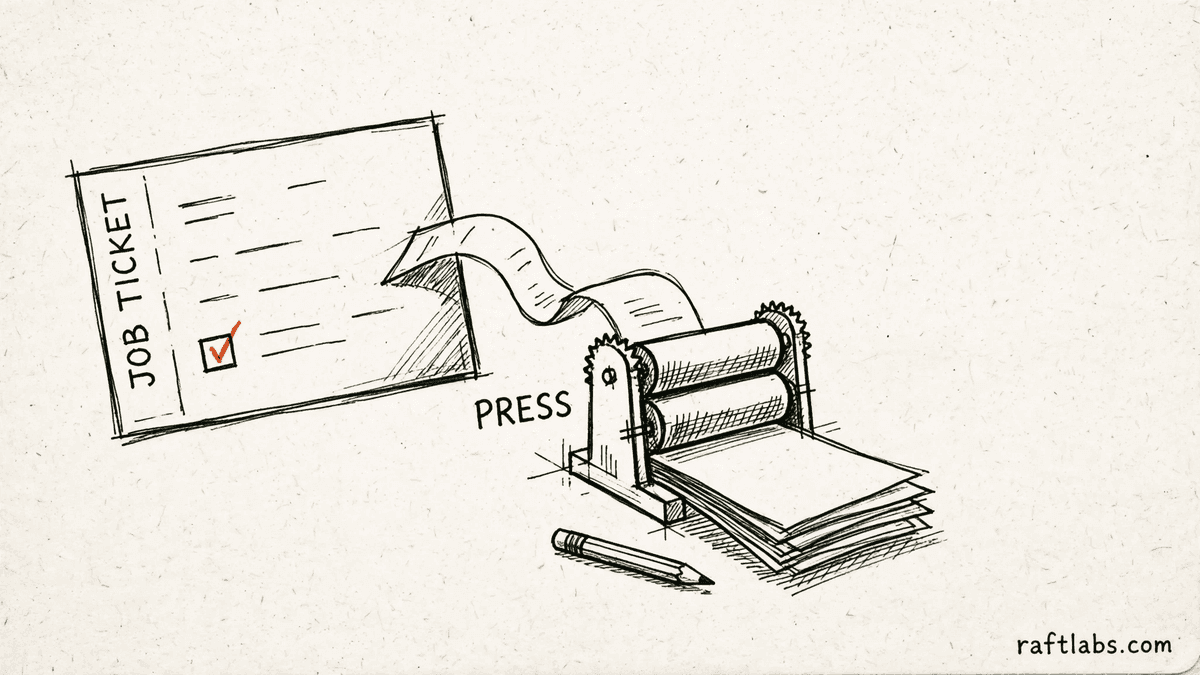
Every order gets a ticket the moment it enters the system, whether the customer orders online, emails in, or calls. Customer details, product specs, pricing, due date, and current status live on the same record, and each move on the ticket logs who made it and when.
Files checked before they reach the press
Artwork is checked automatically the moment it arrives: resolution, color mode, bleed size for that product, and embedded fonts. A failed file comes back with a specific fix, so the customer corrects and resends without calling the shop.
Proof approval with a record
The customer approves a proof in the portal or asks for a revision with a note, and each round creates a versioned record. When they approve, the system logs the file version, the time, and their name, and that record stays attached to the job.
A press queue sorted by deadline, split by press
Digital, wide-format, and screen print each see their own queue sorted by due time, not by order of receipt. Operators mark jobs in production when they start and complete when they finish, so finishing knows what is coming next.
Estimating that counts waste, setup, and finishing
Quotes are built from reusable rules: paper and ink with a waste allowance, press setup and makeready time, finishing steps, and rush charges. Two estimators pricing the same job get the same answer, and a quantity change reprices from the same rules.
Which one is yours?
Bring it to a 30-minute call. Leave with a build, buy, repair, or wait recommendation in writing. Free, whether or not we ever work together.
Buy first
The maintained tools, honestly.
Most print shops should buy before they build. Here is where each maintained tool is strongest, and where each one caps out, so you can match the tool to your kind of printing instead of your feature list.
Printavo: job tickets for screen print and apparel
The best-known name in shop management, built for screen printers and apparel decorators. Quotes, orders, production scheduling, mockups, and customer approvals in one friendly cloud system your team learns fast. Its weakness for a commercial shop is prepress: no real automated file check, no structured proof approval with versioning, and no production queue split by press type.
shopVOX: estimating depth for sign and wide-format
Built for sign shops, wide-format printers, and multi-process manufacturers. Estimating depth, order management, production workflows, and accounting connections, with a shop-floor app for scanning and status updates. Its weakness is breadth across segments: a shop that is mostly commercial offset work will find its estimating and scheduling shaped around substrates and large-format jobs, not paper, plates, and finishing.
PrintIQ: a modern print MIS for commercial printers
A cloud print MIS built for commercial printers: estimating, planning, production, stock, and reporting in one system, with a current interface rather than one adapted from older software. Its weakness is scale: it is a serious system with a serious setup, so a small shop with one press and a handful of staff will pay for depth it does not use yet.
When to own instead
Own custom software when the maintained tools cap out. That means several departments that need one live job record, prepress rules for specialty substrates or package shapes no maintained tool can hold, or a white-label web-to-print platform for resellers or franchise locations. It also means job volumes where manual file checks and proof emails pull your prepress team away from real prepress work. Our build vs buy guide works through each ceiling in detail.
Proof
The fifth attempt became a product customers could keep using.
UrShipper had already worked with four development vendors. Its founder describes the communication and decisions during the recovery.
The case study documents a 14-week recovery, five carrier connections, a Shopify fulfilment workflow, and client-reported results. It is one comparable project, not a promise that every inherited codebase can follow the same plan.
Read the UrShipper case studyWhich workflow is costing you the most right now?
Bring it to a 30-minute call. Leave with a build, buy, repair, or wait recommendation in writing. Free, whether or not we ever work together.
How it works
Close one expensive risk before opening the next.
Each stage answers a buyer question and leaves behind a decision you can inspect. The next stage only opens when the expensive uncertainty in the current one is small enough to accept.
- 01Understand
Trace one real job
Where is the margin actually leaking?
Follow one order from the first call through file intake, the automatic check, proof approval, the press queue, finishing, and the final invoice. Include the workarounds, the re-entered data, the waiting, and the failure paths that a tidy process diagram usually misses.
Decision produced
A map of one job from first order to delivery, with the exceptions, owners, systems, and the baseline cost or delay worth changing.Risk closed
Paying to automate the visible symptom while the expensive constraint remains. - 02Shape
Choose the first useful release
What needs to exist together for one useful result to work?
Choose the shape from the way the work happens, not from a preferred technology. Name the user, the device, the data, the system connections, who can access what, the exceptions, and the result the first release must complete.
Decision produced
The right mix of web, mobile, and behind-the-scenes connection work, with the first-release boundary and a clear definition of done.Risk closed
A small-looking feature list that quietly depends on several interfaces, systems, and owners. - 03Prove
Review working software
Will it hold up outside a controlled demo?
Review the product against the agreed workflow, not a tour of finished screens. Run a real customer file through the automatic check, approve a real proof, and watch the job move through the press queue by deadline.
Decision produced
Working checkpoints tested with realistic data, real user types, system connections, recovery plans, and the people who will use or run the system.Risk closed
Discovering the important gaps during migration or after customers depend on the release. - 04Transfer
Release, measure, and hand over
Did the new workflow improve the original constraint, and can another capable team operate it?
Move a controlled set of jobs or one press first. Compare time, errors, completion, or another agreed measure with the starting point before adding the next workflow.
Decision produced
A controlled release, comparison with the baseline, operating notes, account ownership map, and a recommendation for what should happen next.Risk closed
Measuring development activity instead of the business result, or depending on the original vendor to keep the system running.
What it costs
Every project starts at $10000.
The first phase turns the costliest patched workflow into a scoped build with written acceptance criteria.
Starting investment
Starts at $10000
Workflow complexity, systems to connect, data migration, and user roles set the scope. After a 30-minute call, you get a written build, buy, repair, or wait recommendation plus first-phase direction. Free, whether or not you build with us.
Not ready to talk? Start here.
Four useful next paths: decide whether to own the software, work through where the maintained tools cap out, estimate the cost range, or inspect a comparable recovery.
Run the build-vs-buy calculator
Compare the cost and operating trade-offs before turning a workflow into a development brief.
Estimate the cost range
Get a working cost range for your scope before you talk to any vendor.
Read the print shop build vs buy guide
See where Printavo, PrintSmith, and EFI Fiery cap out, what a first custom release covers, and what it costs.
Inspect a product recovery
See what changed when UrShipper moved from four failed vendor attempts to a controlled migration.
Work with us
Bring one stuck workflow. Leave with a decision.
In a 30-minute call, we will help you decide whether to buy, connect, repair, build, or wait. If custom software is not the sensible next move, that is still a useful answer.
- One named workflow owner and one complete path for the first phase.
- Scope, price, what 'done' looks like, and exclusions agreed before paid work starts.
- Code, cloud, data, and provider access remain under your control.
- Post-launch warranty cover for defects in the agreed scope.
Common questions
Print shop management software runs a commercial print shop from first order to delivery. It takes orders online, by email, or by phone, creates one job record per order, checks artwork files before they reach the press, records proof approvals, schedules each press by deadline, tracks paper and ink stock, and invoices against the same job record. The print-specific part matters: a generic order tool can take an order, but it does not know bleed, color mode, resolution, press types, or finishing steps, and it cannot tell prepress, press, and finishing what to do next.
It depends on what you print. Printavo is strongest for screen print and apparel shops: job tickets, approvals, and production tracking in one friendly system. shopVOX is strongest for sign, wide-format, and multi-process shops: estimating depth and production workflows built around substrates and large-format work. PrintIQ is strongest for commercial printers that need a modern print MIS: estimating, planning, production, and stock in one system. There is no single best tool. Match the tool to your production type first, then check the total price including per-user fees and add-ons before you commit.
Printavo is a good fit when screen printing or apparel is your main product and you want simple job tracking your team learns fast. It is a weaker fit for a commercial shop running offset, digital, and wide-format work, because it has no real automated file check, no structured proof approval with versioning, and no production queue split by press type. Small shops should also check the entry plan limits: the cheapest plan caps how many quotes and invoices you can send each month and charges extra per user, so work out the total for your actual team size, not the headline price for one user.
Usually, yes. A full print MIS such as EFI PrintSmith or Avanti is built for larger commercial operations with several departments and complex estimating. Setup and training can cost more than a new press and take months to configure, which is hard to justify under about twenty employees. If you are a small shop, a cloud tool built for your segment, or a focused custom release covering job tickets, file checks, proof approval, and one production queue, will serve you better than a system built for a plant ten times your size.
Most shops need two kinds of software, and no single product does both well. Shop management software runs the business: quotes, orders, scheduling, invoicing, and payments. Prepress software prepares the file: color separation, film output, and the RIP step that turns artwork into something the press can print. Buy the shop tool for your segment and the prepress tool for your output method, and make sure the handoff between them is a named step on the job record, not a file dropped in a shared folder.
Check every file automatically the moment it arrives, before a person reviews it. The check should cover resolution, color mode, bleed size for that product, and embedded fonts, and when a file fails it should say exactly what is wrong and how to fix it, so the customer can correct and resend without calling the shop. Then keep the human proof step as the backstop: the customer approves a proof, and the system records the file version, the time, and their name against the job. A file that passes the automatic check but was made from a low-resolution original will still print poorly, so the proof approval is what catches what the check cannot.
The price has to be built from the job, not copied from a competitor. The estimate should count paper and ink with a waste allowance, press setup and makeready time, finishing steps such as cutting, folding, and binding, and rush charges where they apply. Those inputs should come from reusable rules, so two estimators pricing the same job get the same answer. The test to run in a demo is a repeat order with a quantity change: the price should update from the same rules, not from a fresh guess. If the tool cannot show waste, setup, and finishing as separate lines, the price will look right and the job can still lose money.
Ask before you sign, and test the answer. Can you export every job record, customer, file, and invoice in a usable format, and open the export yourself? Some tools make this easy and some make it hard: shops have reported data they could not get out, and connections that stopped working the moment they cancelled. Put the export right in writing, run a trial export during the free trial, and keep your own copy of customer files outside the tool. If a vendor will not show you an export, treat that as a cost of choosing them.
Buy an existing tool when it handles your workflow with reasonable setup and its pricing makes sense. Printavo, shopVOX, and PrintIQ each cover a large part of a print shop well. Own custom software when the way you work breaks the maintained tools: several departments that need one live job record, prepress rules for specialty substrates or package shapes that no maintained tool can hold, a white-label web-to-print platform for resellers or franchise locations, or job volumes where manual file checks and proof emails are pulling your prepress team away from real prepress work. Our build vs buy guide for print shop management software sets out where each major tool caps out and what a first custom release should cover.
Web-to-print means customers order through your own online storefront instead of by email or phone: they pick a product, set the size, paper, finish, and quantity, upload their file, see the price update, approve a proof, and pay, and the job record is created automatically on your side. You need it when repeat orders and online volume are a real share of your business, or when you sell through resellers and corporate accounts that each need their own branded storefront and pricing. If most of your work still comes in by phone and walk-in, a storefront adds setup and maintenance for little return, and a simple order form with file upload is enough.
The first paid phase may cover a bounded audit, a proof of concept, or a small first release, and first phases start at $10000. A full first release is a larger engagement: our build vs buy guide puts a working first version at $110,000 to $180,000 over 12 to 16 weeks. The final price depends on how many departments and press types it serves, how specific your prepress rules are, what it needs to connect to, whether web-to-print or multi-location storefronts are involved, and how much existing job data needs moving over. The agreed phase is priced in writing before it starts.
You judge what you can see, not the code. Every checkpoint is working software you click through yourself, tested against the workflow agreed at the start: run a real customer file through the automatic check, approve a real proof, and watch the job move through the press queue by deadline. Progress is reported in plain language: what changed, what is next, and what it costs. Because you own the code, the accounts, and the operating notes throughout, nothing about the work is locked inside our heads. Our job is to make the work checkable; your job is to check it against your business.
For a small, well-defined task with someone technical managing it, freelancers are often cheaper. The pattern that goes wrong is a non-technical buyer coordinating several freelancers becoming the project manager, the tester, and the person who discovers the pieces do not fit. A custom software company earns its fee when the work needs coordination across screens, rules, data, and connections: one accountable party, one phase price, and checkpoints against the whole workflow. If your need is one screen or one fix, hire the freelancer.
You own the code built for you and control where it lives, the cloud accounts, the data, analytics, and third-party subscriptions. Outside services and open-source pieces keep their own licence terms. The operating notes and handover material stay current so another capable team can take over.
That is the question that decides whether the software pays for itself. The best tool is the one your team opens every day, and a simple tool people use beats a powerful one they avoid. Test it the way the floor will use it: from a screen at the press, with ink on hands and a deadline on the clock. Can the operator see their queue for the day, the file, the proof status, and the due time without calling the office? If the production view hides the fields the office relies on, the floor will go back to the whiteboard, and the system will quietly stop being true.