Event Management Software Development

Event software for the hours when every update matters.

We turn registration, ticketing, schedules, speakers, attendees, sponsors, notifications, check-in, feedback, and reporting into one controlled event workflow. Start with the moments that create queues, missed sessions, support work, or weak sponsor value.

Bring one event format and its busiest hour. You will hear from us within one business day.

Recent work

EventRaft

One native iOS and Android platform replaced separate registration, schedule, communication, sponsor, and feedback tools.

With real time updates and notifications, content management was a breeze. Helped us save tonnes of time.

Sam S., Editor, Literary Fest
50,000
users in six months
95%
reported user satisfaction

The brief

Start with what is not working.

Good software decisions begin with the constraint, not a list of features or a preferred technology.

01

Are registration, ticketing, schedules, speaker data, attendee messages, and feedback spread across several tools?

02

Can one schedule change reach the right attendees before it becomes a queue, missed session, or support rush?

03

Do sponsors, organisers, and attendees see activity, but no one can connect it into a useful event record?

Plain answer

Event management software development creates an organiser's registration, ticketing, schedule, check-in, communication, sponsor, and reporting workflows when established products do not fit. RaftLabs starts with one event format: $9,500 for a bounded proof or about $30,000 for a production v1.

What to remember

  • The first release should support one event format from registration through post-event reporting.
  • Live changes, check-in peaks, role access, communication, and recovery deserve as much attention as the event catalogue.
  • Buy a maintained platform when its ticketing, branding, data, sponsor, and attendee model fit.

Proof

50,000
users in six months
EventRaft product record
95%
reported user satisfaction
EventRaft case study
25%
faster event management
Client product record

The EventRaft case study documents one native iOS and Android platform delivered in 20 weeks. The figures show that one product reached meaningful use. They do not promise the same adoption, satisfaction, efficiency, or timeline for another organiser.

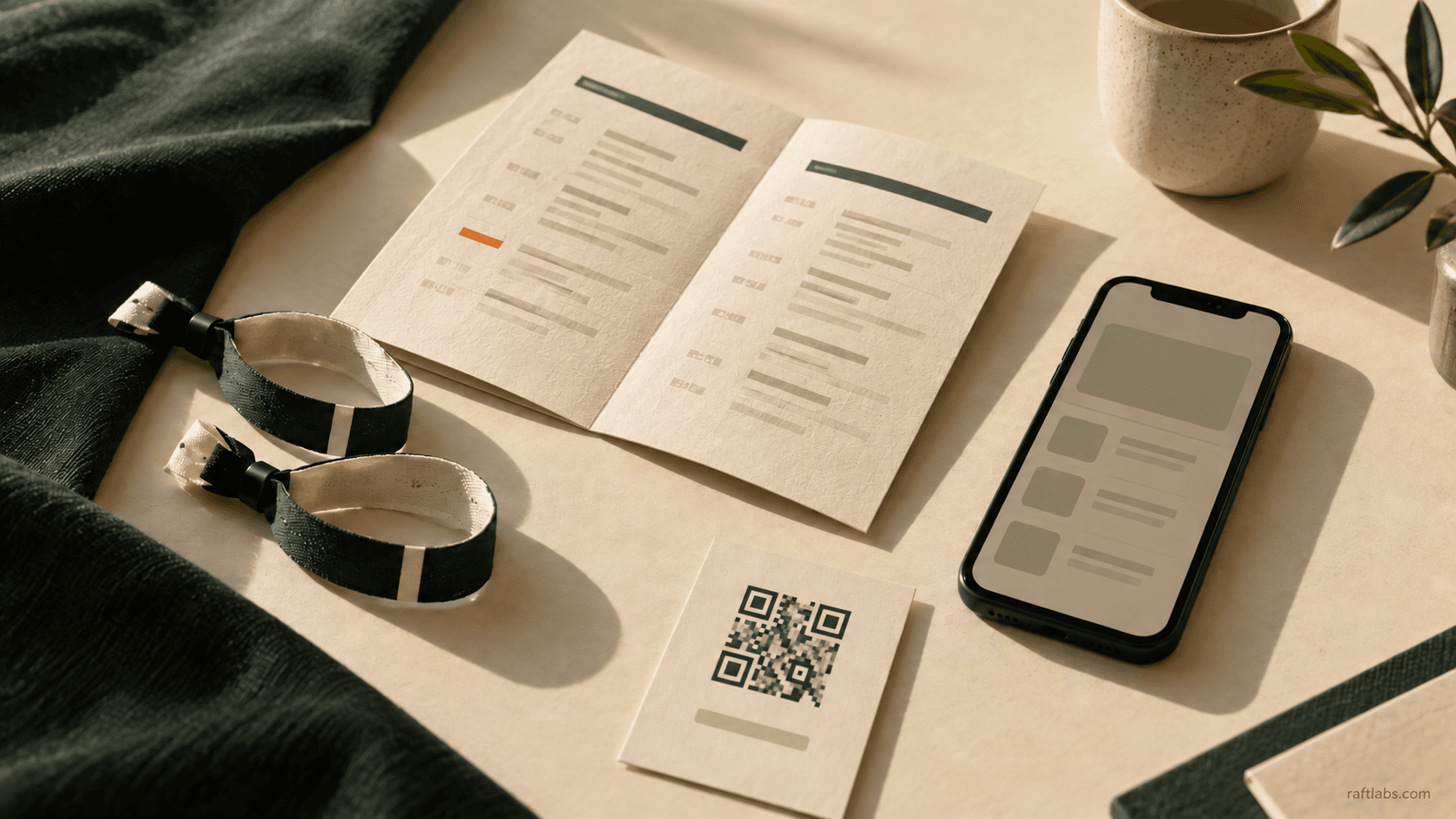
Event wristbands, session schedule, check-in card, and mobile event interface representing one managed event workflow

Fit

Custom event software should own a distinct event model, not a longer feature list.

Most organisers should begin with an established platform and integrate only the gaps that matter.

A fit
01

The event format, attendee experience, sponsor product, commercial model, or repeated operating workflow creates a material advantage.

02

Event, marketing, finance, support, privacy, security, and product owners can define one complete release and live fallback.

03

Representative attendee, ticket, schedule, venue, speaker, sponsor, change, and support cases are available before the event date.

Not a fit
01

An established event platform covers the workflow with reasonable configuration and integration.

02

The organiser has not fixed the event model, ownership, support process, or live fallback.

03

The business expects software alone to guarantee attendance, engagement, sponsor value, ticket sales, or an incident-free event.

Choose the product shape from the event

NeedBest fitDecision boundary
Standard registration, tickets, and emailEstablished event platformUse maintained workflows, payments, support, and updates.
Branded attendee experience with live updatesResponsive web or event appChoose native only when notifications, offline use, or repeated engagement justify it.
Several systems with one missing handoffIntegration layerKeep the source products and connect identity, tickets, schedules, CRM, or reporting.
Distinct multi-event product or operating modelCustom event platformOwn the differentiated workflow and define event-day operations with it.

What belongs in the first event lifecycle

  • 01
    Registration, ticketing, and identity
    Model attendee types, ticket rules, capacity, invitations, payment handoff, confirmation, transfer, cancellation, consent, duplicate identity, and the record used at check-in.
  • 02
    Programme, speakers, and live change
    Manage sessions, tracks, rooms, speakers, capacity, personal schedules, publishing approval, conflicts, and changes that must reach the right attendees without creating several versions of the truth.
  • 03
    Check-in and event-day recovery
    Support approved QR or lookup paths, device and network limits, duplicate scans, manual override, badge or wristband handoff, queue visibility, re-entry, incident evidence, and a staffed fallback.
  • 04
    Attendee, sponsor, and organiser experience
    Give each role the right content, messages, networking, sponsor placement, lead or engagement data, moderation, and support without exposing private or commercially restricted information.
  • 05
    Feedback and post-event evidence
    Connect attendance, session feedback, communication, sponsor activity, support cases, and exports into reports the next event can use. Keep measurement definitions close to each figure.

Treat the event date as an operating deadline, not a launch slogan

  1. 01
    Define

    Map the event clock

    Which actions and changes happen before, during, and after the event?

    Trace registration, content, ticketing, speakers, sponsors, communications, check-in, sessions, feedback, and reporting against the real event calendar.

    Decision produced

    A lifecycle map with roles, authoritative data, deadlines, peaks, approval, support, and fallback.

    Risk closed

    Designing static screens for a product that changes by the minute.
  2. 02
    Prove

    Prove the peak moments

    What breaks when many people act at once?

    Use realistic accounts, tickets, devices, network conditions, and volume. Include duplicate scans, last-minute changes, provider delays, and staff override.

    Decision produced

    Test evidence for registration opens, check-in, schedule publication, notification delivery, and recovery.

    Risk closed

    Discovering queue, scan, provider, or notification limits when attendees are waiting.
  3. 03
    Release

    Deliver one complete event

    Can every core role complete its work without switching to an unofficial spreadsheet?

    Review the software with the people who will publish, scan, support, sponsor, speak, and attend. Keep nonessential ideas outside the first event boundary.

    Decision produced

    A focused release with attendee and organiser paths, integrations, controls, monitoring, and acceptance evidence.

    Risk closed

    Replacing three tools with one platform that still needs three workarounds.
  4. 04
    Control

    Rehearse and operate

    Who acts when a live assumption fails?

    Run the key event hours before launch. During the event, keep content authority, support, communication, and technical escalation explicit.

    Decision produced

    A timed rehearsal, trained owners, incident path, rollback or fallback, monitoring, and post-event review.

    Risk closed

    Treating production release as the end of the work.

What clients say

What an EventRaft organiser said

Three-year average engagement. Founders and operators describing the work in their own words. No marketing varnish.

S
Sam S.
India flagIndia
Editor, Literary Fest
With real time updates and notifications, content management was a breeze. Helped us save tonnes of time.

The quote and metrics describe EventRaft and one literary-festival user.

Read the EventRaft case study

What must be settled before the event date

  • 01
    The event has one publishing authority
    Name who can change schedules, rooms, speakers, ticket rules, and attendee messages, and how those changes reach every surface.
  • 02
    The check-in path has a fallback
    Document device, network, lookup, duplicate, override, queue, and support behaviour before the first attendee arrives.
  • 03
    Data use is visible
    Define consent, sponsor access, exports, retention, moderation, deletion, and the systems that own attendee and commercial records.
  • 04
    The rehearsal is part of delivery
    Acceptance includes a timed run with realistic roles, devices, data, volume, and event-day owners.

Start with the event risk that cannot wait for doors to open.

A bounded audit, workflow prototype, or integration proof starts at $9,500. A focused production v1 commonly starts around $30,000.

The first conversation should decide whether to configure, connect, repair, or build. Any paid next step names the event boundary, rehearsal evidence, exclusions, timing, and price.

Starting investment

Starts at $9,500

Minimum paid phase. Native apps, ticketing, payments, networking, several event formats, and deep integrations increase the production scope.

Price held for the phase

The agreed phase price changes only when you approve a material scope change.

60-day launch warranty

Defects in the agreed release scope, release support, and small interface corrections are covered for 60 days after launch.

Event management software development questions

Custom event management software supports an organiser's registration, ticketing, schedules, speakers, venues, attendees, sponsors, communication, check-in, feedback, and reporting model. It makes sense when established products cannot support a material event workflow, commercial model, integration, or owned attendee experience.

Use an established platform when its registration, ticketing, branding, mobile experience, data access, sponsor tools, integrations, and pricing fit. Consider custom work when the event model itself is part of the product, the attendee experience creates strategic value, or repeated operating gaps remain after configuration.

Every RaftLabs project starts at $9,500. That can cover a product audit, workflow prototype, integration proof, or event-day risk rehearsal. A focused production v1 commonly starts around $30,000 and grows with ticketing, payments, native apps, several event formats, complex roles, streaming, networking, sponsor products, migration, and integrations.

A focused web or cross-platform v1 for one event format commonly takes 10 to 14 weeks. Native apps, several integrations, complex ticketing, networking, or a large content and attendee migration can extend the plan. The release should leave time for a timed rehearsal before the event date.

The answer must come from load and operational testing against the planned volume, devices, scan path, network, and fallback procedure. We define peak assumptions, test the important paths, monitor queue and error behaviour, and keep a staffed fallback for the live event. No software team should promise unlimited scale without that evidence.

Yes, when a responsive web or progressive web experience covers the need. Native apps earn their cost when push notifications, deeper device access, offline content, repeated events, or richer networking matter. The event format and attendee behaviour should decide the surface.

The client should control the repository, cloud, analytics, event data, and provider accounts, subject to third-party terms. The scope should also name retention, consent, role access, exports, deletion, sponsor visibility, and the systems that remain authoritative.

We need one event owner, the event format and dates, representative registration and schedule data, ticket and payment rules, attendee and organiser roles, integrations, sponsor commitments, support plans, and the people who can accept each milestone.

The operating plan names monitoring, alert owners, support channels, fallback check-in, content and schedule authority, notification approval, rollback, and incident records. The first live release should use a controlled event or attendee group where possible.

Work with us

Bring the event hour your current tools make hardest.

We will trace the people, changes, data, systems, and fallback path, then recommend whether to configure, connect, repair, or build.

  • One event format and its busiest live moments first.
  • A rehearsal plan before attendees depend on the release.
  • Data, provider, role, and support ownership written into scope.
  • A 60-day warranty for defects in the agreed release scope.