Microservices vs Monolith: When Should You Actually Migrate?
Microservices is the right architecture for some businesses and a costly over-engineering mistake for others. Here's a decision framework for CTOs who need to decide - not just learn.

In this article
Short answer
Microservices are worth migrating to when your monolith is causing deployment bottlenecks, independent team scaling problems, or reliability failures in production. They're the wrong choice when your team is under 30 engineers, your product is still evolving, or you don't have DevOps maturity to manage distributed systems. For most growing companies, a modular monolith - a well-structured single codebase with clear internal boundaries - delivers 80% of the benefits at 20% of the cost and complexity.
Key takeaways
- A monolith isn't a problem until it becomes one. The question isn't 'are microservices better?' it's 'is my monolith causing real business pain?'
- The five real signs you need to migrate: deployment collisions between teams, a single module's failure taking down the whole product, inability to scale one feature independently, compliance requirements forcing data isolation, and team size above 50 engineers with cross-team code conflicts.
- You're NOT ready for microservices if you have fewer than 3 backend engineers, your product roadmap changes every quarter, or you lack CI/CD pipelines and container infrastructure.
- A modular monolith - a single deployable with strict internal module boundaries - is the right answer for most companies in the $1M-$50M revenue range.
- If you do migrate, do it as the Strangler Fig pattern: carve out one service at a time from the edges, never attempt a big-bang rewrite.
Here's a conversation we have often with CTOs at growing companies.
They've read about microservices. Netflix uses them. Amazon uses them. Their engineers are asking for them. They've seen the conference talks. They're wondering if they're doing something wrong by still running a monolith.
They're not.
Microservices solve a specific set of problems. If you have those problems, migrating is worth serious consideration. If you don't, you're about to spend 12-18 months making your engineering organization significantly more complex for no measurable gain.
This guide is a decision framework, not a tutorial. We won't walk through Docker files or Kubernetes configs. We'll walk through the questions you need to answer before you commit to one of the biggest engineering bets your company can make.
Why microservices is misunderstood
The software industry loves to pattern-match on what big companies do. Netflix and Amazon use microservices, therefore microservices are the correct architecture.
What gets left out of that story: Netflix and Amazon migrated to microservices after their monoliths became genuinely unmanageable. Netflix had hundreds of engineers deploying to a shared codebase and spending more time coordinating deploys than writing features. Amazon had teams blocked on each other for months. The scale of their problems justified the complexity of the solution.
Most businesses are not at that scale. Most businesses have 3-20 engineers and a monolith that works fine - they just heard microservices are "more professional." According to O'Reilly's Microservices Adoption in 2020 report, 77 percent of respondents had adopted microservices, yet the most cited challenge was the organizational and operational complexity that came with running them — not the technical implementation itself.

The other thing that gets left out: both companies have hundreds of engineers dedicated to the platform that runs their microservices. They built internal developer platforms, service meshes, distributed tracing systems, and on-call rotations specifically for managing a distributed system. That platform is itself a major engineering investment.
You're not paying for that.
Before you decide anything, ask this question: Is my monolith actually causing me business pain today? Not hypothetical future pain. Real, measurable pain - teams blocked, revenue impacted, releases slipping.
If the answer is no, stop reading and go build features.
Monolith vs. microservices: the honest trade-offs
Before you decide what to do, you need a clear picture of what you're comparing.
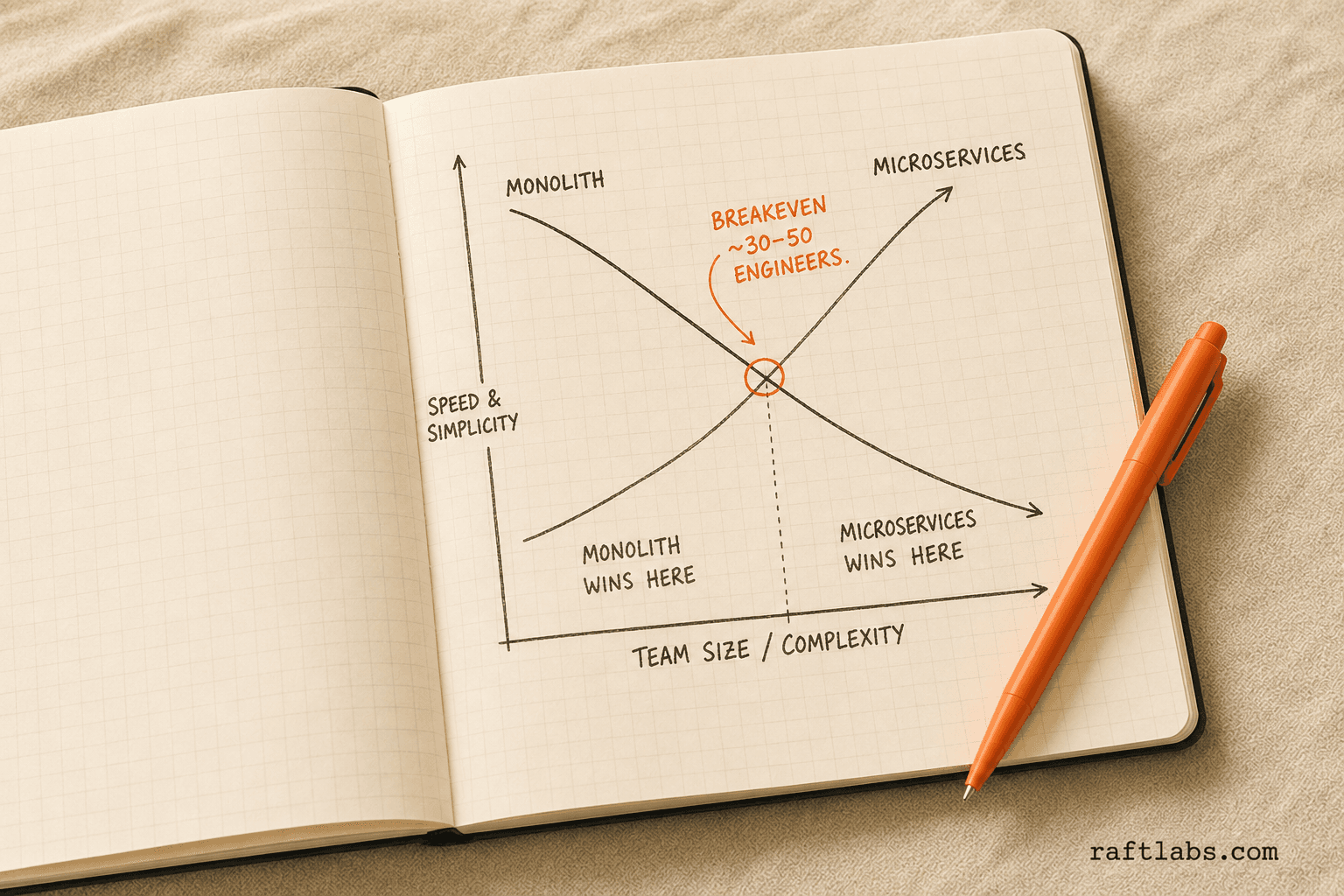
| Dimension | Monolith | Microservices |
|---|---|---|
| Deployment | One build, one deploy | Each service deploys independently |
| Development speed (early) | Fast - one codebase, one local env | Slow - each service has its own setup |
| Development speed (at scale) | Slows as teams grow and collide | Stays fast per team with clear ownership |
| Operational complexity | Low - one process to monitor | High - distributed tracing, service mesh, retries |
| Infrastructure cost | Low | 2-4x higher (orchestration, multiple databases) |
| Fault isolation | Low - one bug can crash everything | High - a failing service doesn't kill the rest |
| Team autonomy | Low at scale | High - teams own and deploy their service |
| Data model | Simple - shared database | Complex - each service owns its data |
| Debugging | Easy - one log stream | Hard - traces span multiple services |
| Time to first production | Weeks | Months |
The pattern is clear: a monolith wins on simplicity, speed, and cost in the early stages. Microservices win on team independence and fault isolation at scale. The question is which stage you're actually in.
A common misconception is that microservices are "the next step" you graduate to. They're not. They're a different solution to a different set of problems. Some companies run at significant scale - $50M+ revenue, 50+ engineers - on a well-structured monolith without issues.
5 signs your monolith is actually the problem
These are the signals that the cost of staying on a monolith is now higher than the cost of migrating.
1. Deployment collisions are slowing you down. Your team ships features, but getting them to production is a coordination nightmare. Three teams want to deploy the same week and someone always gets bumped. A single bad deploy from one team rolls back the work of two others. When deployment scheduling becomes a weekly negotiation, you've hit the monolith's ceiling.
2. One module failing takes down your whole product. Your recommendation engine goes haywire and your entire checkout flow goes down with it. There's no isolation. Everything fails together. In a microservices architecture, a failing recommendation service degrades gracefully - the rest of the product keeps running.
3. You can't scale one part of the product independently. Your data processing pipeline runs during business hours and needs 10x the compute of your API layer. But because they're the same deployable, you scale everything or nothing. You're paying for compute you don't need and potentially starving the part that does need it.
4. Compliance is forcing data isolation. Healthcare, finance, or enterprise B2B requirements demand that certain data live in a separate, audited environment. Your current monolith has one shared database. Separating that data at the application layer while staying on one codebase becomes increasingly difficult to audit and certify.
5. Team size and code conflicts are compressing your velocity. You have 40+ engineers. PRs take 5 days to review because 8 teams are touching the same files. Merge conflicts are a daily occurrence. Your architecture review process has become a bottleneck. This is an organizational scaling problem that a microservices split - done right - can solve.
5 signs you're NOT ready for microservices
These are the signs that migrating now would make things worse, not better.
1. Your team is under 20-30 engineers. Conway's Law says your architecture mirrors your team structure. If you have 10 engineers, a microservices architecture means each person maintains multiple services, context-switches constantly, and has no one to share operational load with. The coordination cost of distributed systems requires a certain minimum team size to absorb.
2. Your product roadmap changes quarterly. Microservices require stable service boundaries. If you're still figuring out what your product is - pivoting, testing features, changing core flows - a microservices split will freeze your ability to refactor. You'll end up with services built around assumptions that no longer hold.
3. You don't have CI/CD pipelines and containers today. Microservices require infrastructure maturity. You need automated deployments, container orchestration (Kubernetes or equivalent), service discovery, distributed tracing, and centralized logging. If you're still deploying via FTP or clicking buttons in a dashboard, microservices will crush you. Get your DevOps foundations right first.
4. Your engineers haven't operated distributed systems before. Running distributed systems is a distinct skill set. Network partitions, eventual consistency, circuit breakers, retry storms, service mesh configuration - these are problems your team will encounter in production and needs to solve fast. If your engineers haven't dealt with them before, expect a painful 6-12 month learning curve.
5. Your monolith doesn't have good test coverage. You can't confidently extract a service from a codebase you can't test. If your monolith is poorly tested, fix that first. Every service extraction requires confidence that you've maintained the same behavior. Without tests, you're flying blind and will spend months chasing regressions.
The migration decision framework: a scorecard
Run through this before making any decision. Score each item 0 (not true), 1 (partially true), or 2 (definitely true).
Reasons to migrate:
| Signal | Score (0-2) |
|---|---|
| Deployment collisions block releases weekly | |
| A module failure has caused full outages in the last 6 months | |
| We can't scale one part of the product independently | |
| Teams of 5+ are blocked on each other's PRs | |
| Compliance requires isolated data environments | |
| We have 30+ engineers with active backend work | |
| We have CI/CD, containers, and DevOps maturity today |
Reasons to stay or go modular:
| Signal | Score (0-2) |
|---|---|
| Team is under 20 engineers | |
| Product direction is still evolving | |
| No CI/CD or container infrastructure | |
| Engineers haven't operated distributed systems | |
| Monolith has poor test coverage | |
| No dedicated DevOps or platform engineering capacity |
Scoring:
Migration score 10+ and Staying score under 4: Microservices migration is worth a serious architecture review.
Migration score 6-9: Consider a modular monolith first as an intermediate step.
Migration score under 6: Stay with the monolith and focus on internal structure.
What a microservices migration actually costs
Let's be direct. Most estimates you'll see are optimistic.
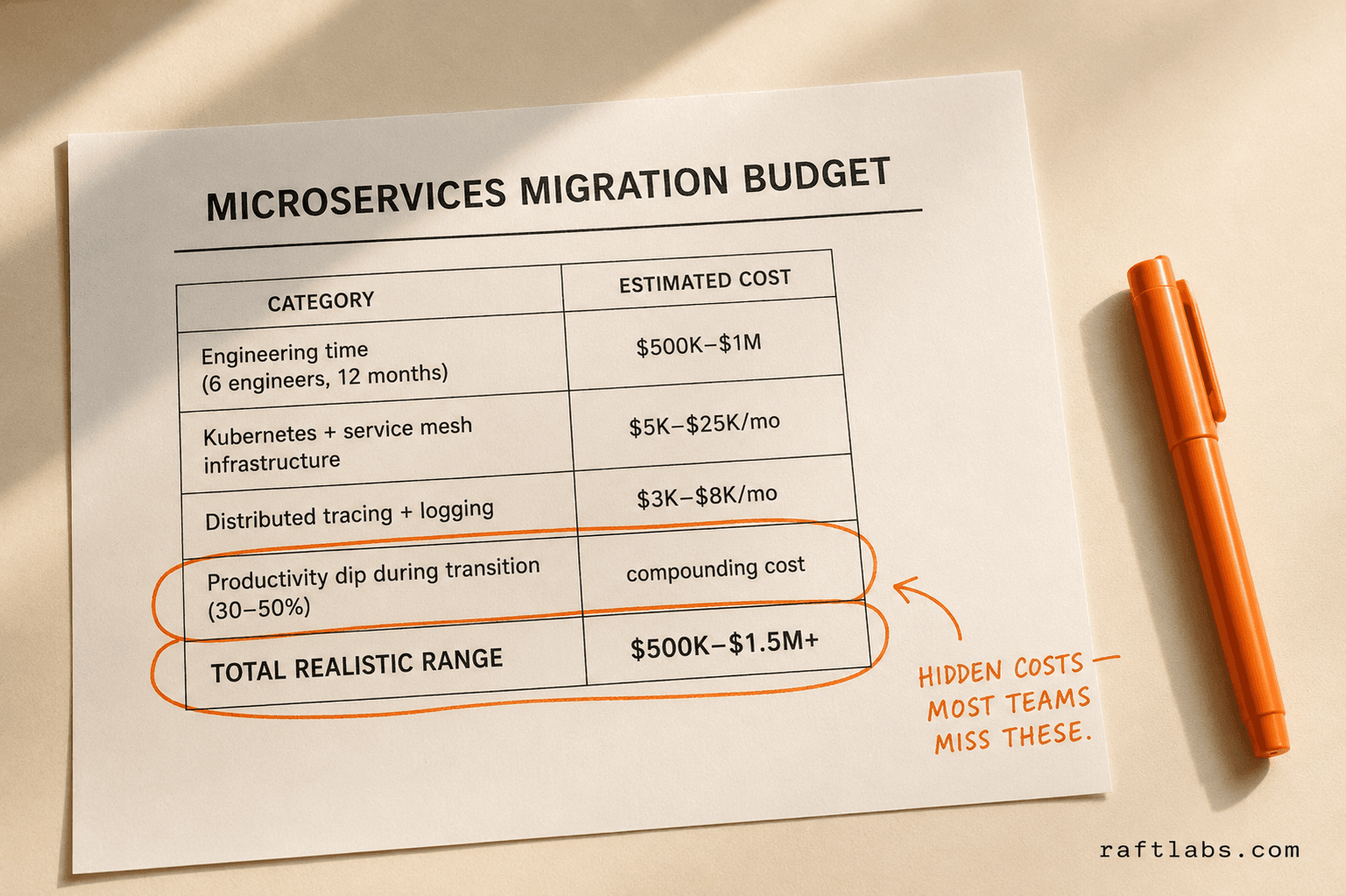
Time: Plan for 12-24 months for a full migration of a medium-sized product. A product with 5-10 logical domains (auth, billing, notifications, user management, core business logic, reporting, etc.) takes a minimum of 12 months when done responsibly using the Strangler Fig pattern.
Developer cost: At $150-$200/hr for senior engineers, 12 months of part-time migration work across a team of 6 is $500,000-$1,000,000 in engineering time alone. This is before infrastructure.
Infrastructure: Kubernetes clusters, a service mesh (Istio or Linkerd), distributed tracing (Datadog, New Relic, or Jaeger), centralized logging, and multiple separate databases typically add $5,000-$25,000/month to your infrastructure bill compared to a well-run monolith.
Productivity hit: During migration, feature velocity drops 30-50%. Your team is doing two things at once - shipping features on the monolith and rebuilding pieces of it as services. This is unavoidable and needs to be planned for in your roadmap. The 2024 DORA State of DevOps report found that high-performing teams deploy between once per day and once per week — a cadence that requires exactly the infrastructure maturity most teams are still building during a migration.
The number most teams don't plan for: New hires. A microservices architecture requires every new engineer to understand the inter-service contracts, deployment process, and observability setup before they're productive. Onboarding time increases by 2-4 weeks per new hire compared to a monolith.
The middle path: modular monolith
Here's what most CTOs don't hear often enough: there's a third option that solves most of the real problems without the full cost of microservices.
A modular monolith is a single deployable application with strict internal module boundaries. Think of it as microservices' organizational benefits - clear ownership, independent testing, interface-driven communication between domains - packaged inside one codebase and one deployment.
What you gain:
Teams own modules, not shared files
Modules can't directly access each other's databases (enforced at the code level)
Each module has its own test suite that runs independently
You can extract a module into a real service later, cleanly, when you actually need to
What you don't get:
Independent deployment per module (still one deploy)
Horizontal scaling of individual components
True fault isolation (though a well-structured module boundary reduces blast radius significantly)
For most companies at $1M-$50M revenue with 10-50 engineers, a modular monolith delivers 80% of the organizational benefits of microservices at 20% of the operational cost. It's not a compromise. For many companies, it's genuinely the better architecture. McKinsey research shows that properly addressing architecture constraints can free engineers to spend up to 50 percent more of their time on value-generating work — and a clean modular monolith boundary is often where that leverage comes from.
The Shopify engineering team wrote publicly about keeping their core monolith - called the "Shopify Monolith" - even as they scaled past thousands of engineers, by investing heavily in module boundaries and tooling. They do run separate services, but the core product stayed modular-monolith for years after they had every reason to break it up.
If you decide to migrate: the Strangler Fig approach
If you've run the scorecard and migration is the right call, here's how to do it without breaking your product or your team.
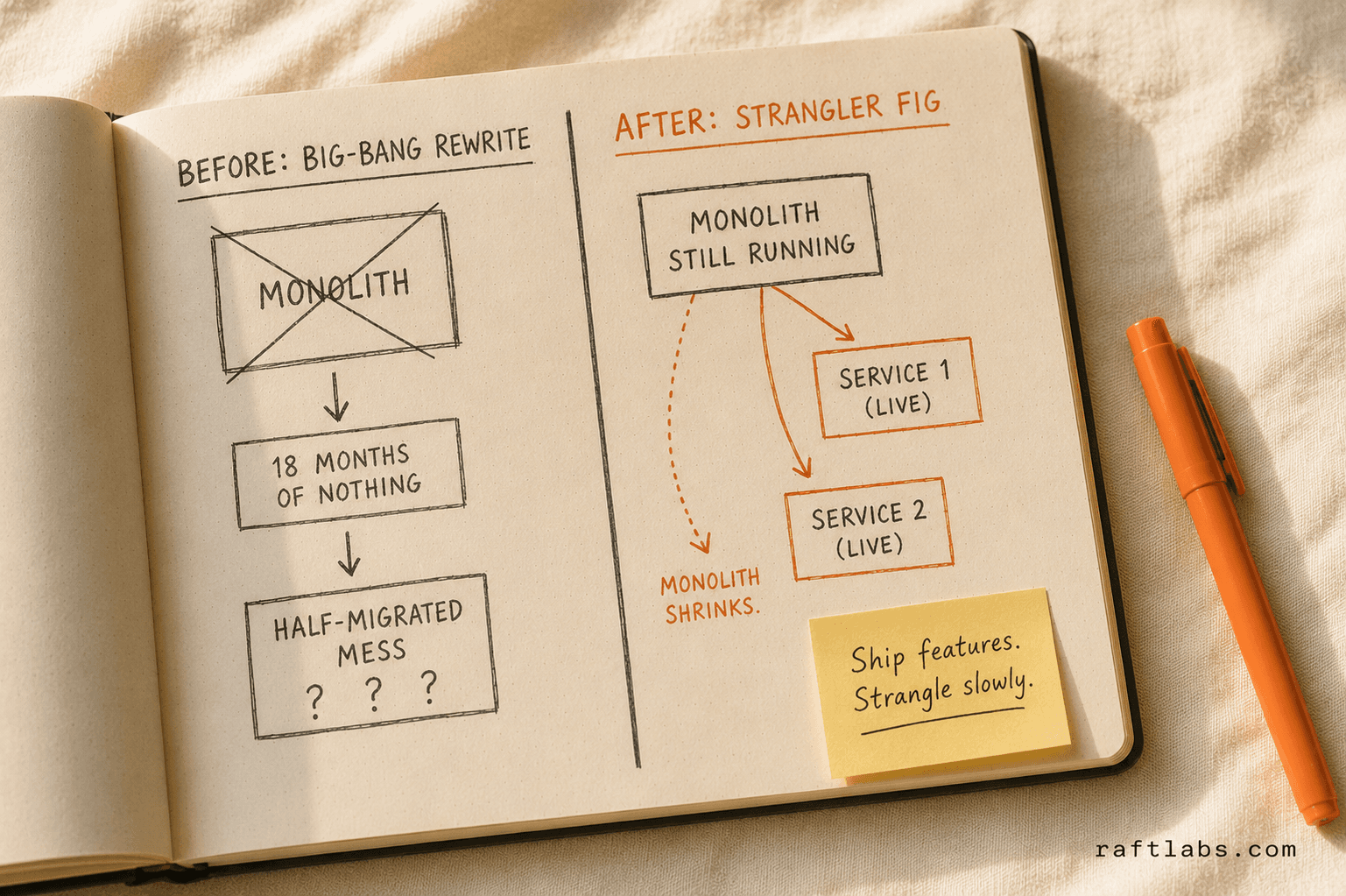
The Strangler Fig pattern: You don't rewrite. You carve off services one at a time from the outside, while the monolith continues to run. New requests that used to go to the monolith get intercepted at a routing layer and directed to the new service. Once the service handles all the traffic, you delete the corresponding code from the monolith. Repeat.
Phase 1 (Weeks 1-8): Infrastructure first. Build the platform before you extract a single service. Container orchestration, CI/CD pipelines, observability (logs, traces, metrics), and a service discovery system. This is the foundation everything else runs on. Skipping this phase is the most common reason migrations fail.
Phase 2 (Weeks 9-20): Extract a leaf service. Pick a service that has clear boundaries and minimal inbound dependencies. Authentication, email notifications, or PDF generation are classic first extractions. They have well-defined inputs and outputs, limited database coupling, and failure doesn't block core business flow. Don't start with billing or your core data model.
Phase 3 (Months 5-12): Progressively extract core domains. Now that your team has operated a real service in production and understands the operational patterns, extract the next service. Then the next. Use a routing/API gateway to control traffic. Keep the monolith running as you extract - you're not racing to kill it, you're slowly replacing it.
The rule that saves migrations: Never migrate a database until after you've migrated the service logic. Data migrations are the highest-risk part of the entire process. Move the business logic first, stabilize it in production, then work on data isolation.
What to watch for:
| Warning sign | What it means |
|---|---|
| No service owns a decision in under 2 weeks | Boundaries are unclear - redefine before extracting |
| Your first service added 3x more code than the monolith equivalent | You're over-engineering. Simplify the interface |
| Production incidents doubled after the first extraction | Your observability setup isn't complete yet |
| Feature velocity dropped over 60% | Too many engineers in migration mode - rebalance toward delivery |
Making the call
Microservices aren't better architecture. They're a different architecture suited to a different scale of team and product complexity.
Before you commit to a migration, be honest about where the pain is actually coming from. Teams that migrate to microservices before they need to spend 12-18 months on infrastructure and then spend another 12 months wondering why they're slower than before.
Teams that solve the real problem - whether that's modular code structure, better CI/CD, clearer team ownership, or database performance - ship faster and with less drama.
If after reading this you're not sure whether your situation calls for a migration, that's actually a useful signal. If your monolith were causing the kind of pain that justifies microservices, you'd know. The decision would feel urgent, not exploratory.
That said, if you do have the pain signals and you're ready to move, a well-planned migration is absolutely worth it. The companies that get it right come out the other side with faster deployment cycles, better fault isolation, and team autonomy that compounds over time.
If you want a second opinion on your architecture before committing, that's exactly what our application modernization practice is built for. We start with a diagnostic - not a pitch - and tell you honestly what we think the right move is.
Ask an AI
Get an instant summary of this post from your preferred AI assistant.
Frequently asked questions
- A monolith is a single codebase that deploys as one unit. All features - authentication, billing, notifications, search - live in one process. Microservices split those features into separate, independently deployable services that communicate over a network. The monolith is simpler to build and operate. Microservices offer more deployment flexibility and fault isolation but add significant operational complexity.
- Don't migrate if your team is under 20-30 engineers, if your product is still changing rapidly, if you don't have CI/CD pipelines and container infrastructure already in place, or if your current monolith isn't actually causing business problems. Microservices introduce distributed systems complexity - debugging across services, network latency, data consistency challenges - that small teams simply can't absorb without slowing down.
- A realistic microservices migration for a mid-sized product (5-15 services extracted) takes 12-24 months when done correctly with the Strangler Fig pattern. Teams that attempt a big-bang rewrite typically spend 18+ months and often end up back at a monolith or with an unmaintainable half-migrated system. Budget at least one quarter just for planning, team training, and infrastructure setup before any code moves.
- A modular monolith is a single deployable application with strict internal module boundaries - no direct cross-module database access, clear interfaces between modules, and independent testing per module. You get most of the organizational benefits of microservices (team ownership, isolated changes, clear interfaces) without the distributed systems overhead. It's the right choice for companies under 100 engineers where deployment frequency is not the bottleneck.
- Budget $150,000-$500,000+ for a genuine microservices migration of a medium-sized product. That includes architecture planning, developer time to extract services, DevOps infrastructure (Kubernetes, service mesh, distributed tracing), and the productivity dip during the transition (typically 30-50% slower feature delivery for 6-12 months). Many teams underestimate the operational overhead: you're not just building services, you're building the platform to run them.
- RaftLabs guides microservices vs. monolith decisions starting with a diagnostic to assess what the business actually needs before recommending a direction. Our 12-week delivery sprints move from decision to production deployment on a fixed timeline and fixed price. 4.9/5 on Clutch.