How to Build a Fintech App in 2026: Cost, Timeline, and What to Decide First
A practical guide to fintech app development for operators building payments, lending, investment, or insurance products. Covers cost ranges, SaaS vs. custom thresholds, compliance decisions, and how RaftLabs structures fintech builds.

In this article
Short answer
To build a fintech app, start with compliance scoping in week 1, pick your payment infrastructure (Stripe for most, Plaid for bank data, Brex-style BaaS for card issuing), then integrate KYC/AML before shipping to real users. A payments MVP costs $30,000-$80,000 and takes 8-12 weeks. A full fintech platform with open banking and card issuing runs $100,000-$250,000 and 16-24 weeks. RaftLabs builds fintech products for operators in payments, lending, insurance, and investment. Compliance adds 20-30% to cost vs. an equivalent non-regulated product.
Key takeaways
- Compliance is architecture, not a phase. PCI-DSS, KYC/AML, and GDPR decisions made in week 1 shape every system you build. Getting them wrong means a costly rearchitect at week 10.
- Stripe handles 90% of fintech payment needs. Use Plaid for bank account connections and ACH. Only go custom or direct banking API when Stripe and Plaid cannot solve the specific problem.
- A fintech MVP costs $30,000-$80,000 and ships in 8-12 weeks. A full platform with card issuing, multi-currency, and open banking runs $100,000-$250,000 and 16-24 weeks.
- Custom software makes sense when you need margins Stripe cannot give you, when regulatory requirements demand it, or when your product IS the financial infrastructure.
- KYC/AML integration adds $5,000-$15,000 and 2-3 weeks. Budget it early. User experience around identity verification is the top drop-off point in fintech onboarding.
You have a fintech idea and a business case. Maybe you're an operator who wants to embed payments inside an existing product, or a founder building a lending platform for an underserved market, or an insurance company that wants to own its own claims disbursement flow. You've looked at Stripe, poked around Plaid's docs, and started wondering whether you need a custom build or whether an off-the-shelf API stack will do the job.
The answer depends on one thing: whether your product IS the financial infrastructure, or whether it just uses financial infrastructure.
For most early-stage operators, Stripe and Plaid are the right call. For operators who need to control margins, own the data, or meet regulatory requirements that SaaS APIs cannot satisfy, custom software is the only path. This guide walks you through how to build a fintech app, what it costs, and exactly where the line is between using existing tools and building your own.
A fintech MVP costs $30,000-$80,000 and ships in 8-12 weeks. A full platform with open banking and card issuing runs $100,000-$250,000 and 16-24 weeks. Here is what that buys you.
| Scope | Timeline | Cost |
|---|---|---|
| Payments MVP (Stripe, no banking licence) | 8-10 weeks | $30,000-$60,000 |
| Fintech MVP with KYC/AML and open banking | 10-14 weeks | $60,000-$100,000 |
| Full fintech platform (BaaS, card issuing, multi-currency) | 16-24 weeks | $100,000-$250,000+ |
| Platform at scale (ongoing feature dev + compliance) | Ongoing | $15,000-$40,000/mo |

Who actually builds a custom fintech app
Not every fintech product needs a custom build. But there are four operator types where custom software is the only real answer.
The first is the embedded finance operator. You run a logistics platform, a marketplace, or a professional services business with a large transaction volume. You want to embed payments, lending, or insurance directly inside your product so users never leave. Stripe Connect can get you started, but as your volume grows, 2.9% + $0.30 per transaction becomes a significant line item. At $5M in annual payment volume, Stripe costs you roughly $145,000 per year. A custom payment integration at that scale pays for itself within 18 months.
The second is the regulated lender or insurance operator. You are originating loans, managing underwriting, or processing insurance claims. Your regulatory environment requires specific data handling, audit trails, and reporting that generic SaaS APIs were not built for. You need to own the data pipeline because compliance requires it, and because the data itself is where your underwriting edge lives.
The third is the B2B fintech builder. You are not building for consumers, you are building financial infrastructure for other businesses: a treasury management tool for mid-market companies, a spend analytics platform for procurement teams, or a reconciliation engine for multi-entity accounting. Brex and similar products show what's possible. But you're not building for the same use case Brex built for. You need the same depth with a different scope.
The fourth is the financial services company digitizing an existing workflow. A wealth manager who wants a client-facing investment portal. An insurance carrier that wants to own its claims disbursement. A bank that wants a custom cash flow forecasting tool for its SMB customers. These are not greenfield startups. They are established businesses with existing revenue and specific technical requirements that off-the-shelf fintech SaaS cannot meet.
Fintech app features: V1, V2, V3
Phase your build. Shipping everything in V1 is how fintech projects run over budget and over time.
V1: Core financial function ($30,000-$80,000, 8-12 weeks)
V1 should do one thing well. If you are building a payments product, V1 is a user who can authenticate, connect a payment method, and send or receive money. The compliance layer goes in here too: KYC/AML verification before any money moves, PCI-DSS scope locked to Stripe Elements so card data never touches your servers, and basic fraud velocity limits. Nothing else. No analytics dashboard. No multi-currency. No card issuing. One clean flow that works.
Core V1 components:
User authentication with multi-factor authentication
KYC/AML identity verification via Jumio, Onfido, or Persona
Payment method collection (Stripe Elements for cards, Plaid for bank accounts)
Core transaction flow (initiate, confirm, receipt)
Basic transaction history
Fraud velocity limits and transaction monitoring
Compliance logging and audit trail
Admin panel for manual review and dispute handling
V2: Product depth ($40,000-$80,000, 8-12 weeks after V1)
V2 adds the features that make your product a real business tool. This is where you add the second and third user flows, the reporting layer, and the integrations that your enterprise or power users need. For a lending platform, V2 might be the underwriting decision engine. For an insurance product, it might be the claims management workflow. For a payments platform, it might be multi-currency support and settlement reporting.
Common V2 additions:
Multi-currency support and FX handling
Recurring payments and subscription billing
Advanced fraud rules based on real transaction data
Reporting and analytics dashboard
Webhook and API layer for third-party integrations
Customer support tooling (dispute management, refunds, adjustments)
V3: Scale and moat ($50,000-$150,000+, ongoing)
V3 is where the financial product becomes defensible. Card issuing. White-label infrastructure for other operators. Proprietary underwriting models trained on your own transaction data. Direct bank integrations that bypass BaaS provider costs. These are expensive and complex, but they are also the layer that separates a fintech product with real margins from one that is permanently dependent on third-party APIs.
Plaid, Stripe, and Brex vs. custom fintech software
Before you scope a custom build, you need an honest answer to one question: is the off-the-shelf API stack good enough?
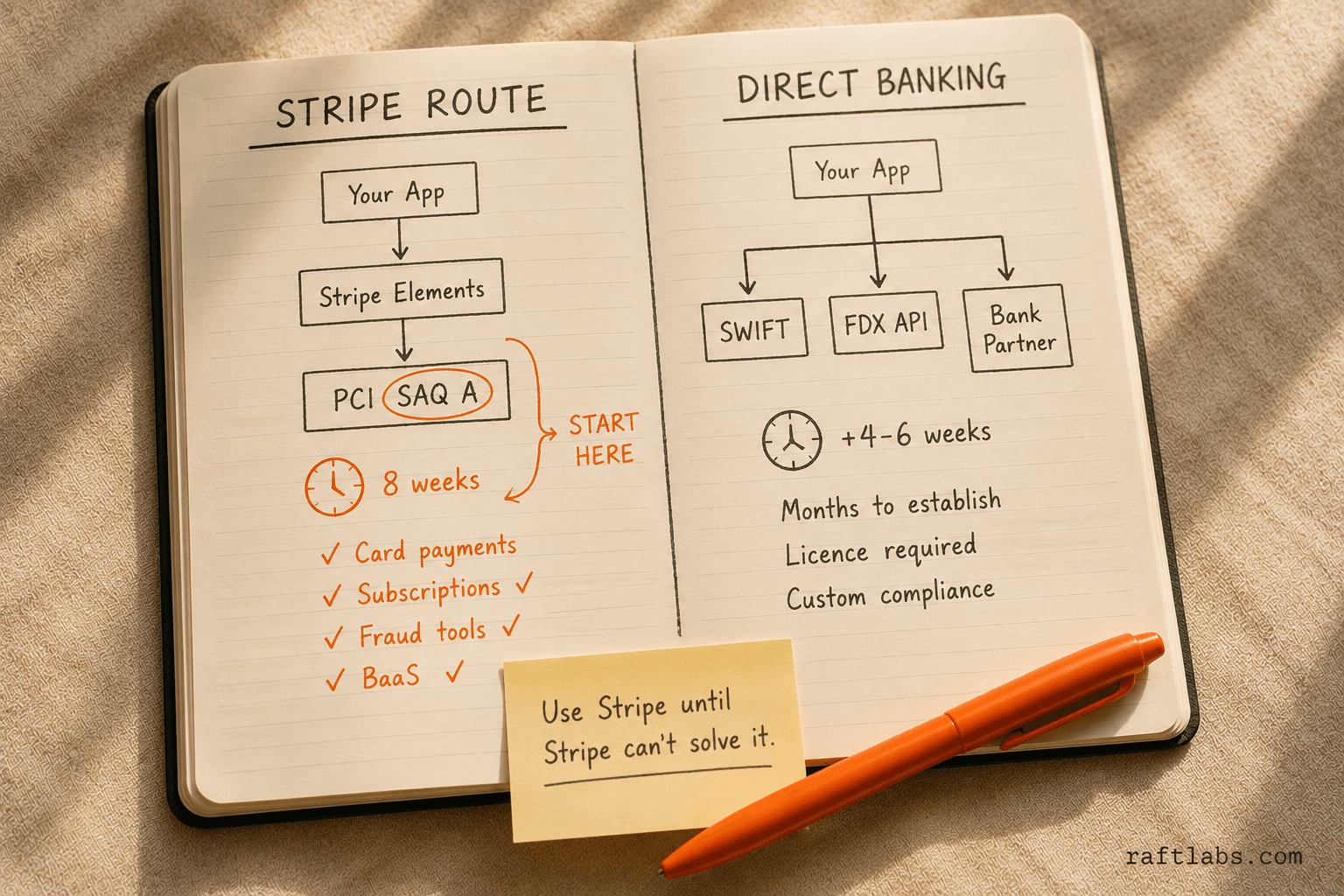
Stripe handles card payments, subscriptions, payouts, fraud detection, and banking-as-a-service through Stripe Treasury. The developer experience is excellent. Compliance scope with Stripe Elements puts you in PCI SAQ A, the simplest tier. For most fintech MVPs, Stripe is the right call.
Plaid connects your users' bank accounts for ACH transfers, balance checks, and transaction history. It covers 12,000+ financial institutions in the US. For any product that needs to read bank account data or initiate bank transfers, Plaid is the standard solution.
Brex is a corporate card and spend management platform. Unlike Stripe and Plaid, Brex is not an API infrastructure provider you build on top of. It is a direct competitor or reference product. Operators building corporate spend management tools compete with Brex; they do not build with it.
Use Stripe and Plaid when:
You are pre-revenue or early-stage testing product-market fit
Your transaction volume is under $2M-$5M annually
Your product uses financial features but is not primarily a financial product
You need to ship in under 12 weeks
Your compliance requirements fit within what Stripe's standard integration covers
Build custom software instead when:
- Your transaction volume makes Stripe's per-transaction fees a material P&L line. At 2.9% + $0.30 per transaction, a $10M GMV business pays Stripe $290,000+ annually. A custom payment integration plus a direct processor relationship typically costs 0.2%-0.5% per transaction at volume.
- Your regulatory environment requires data handling that SaaS APIs cannot satisfy. Certain lending, insurance, and investment products have audit, residency, and reporting requirements that generic APIs were not designed to meet.
- Financial infrastructure is your competitive moat. If your product is differentiated by the speed, accuracy, or depth of its financial data processing, you cannot afford to be constrained by what Plaid or Stripe can expose via API.
- You are embedding financial services inside an existing product with its own large user base and data assets. The integration complexity at scale often exceeds what API wrappers handle well.
- You are building for a market where Stripe and Plaid have limited coverage. Stripe has strong US and EU coverage but limited reach in Southeast Asia, Latin America, and parts of the Middle East. Building for those markets often requires direct local processor relationships.
According to McKinsey, the global embedded finance market - valued at approximately $66.8 billion in 2023 - is projected to grow at a 16.4% CAGR and reach $230 billion by 2030. The operators capturing that market are not using off-the-shelf APIs alone. They are building the infrastructure layer as their moat.
The compliance layer you cannot skip
Compliance is not a feature you add at the end. It is the architectural foundation. Every decision you make in weeks 1-2 is a compliance decision.
PCI-DSS applies to any product that accepts card payments. Use Stripe Elements or Stripe.js so card data never touches your servers. This puts you in PCI SAQ A scope, the simplest tier. Building your own card input forms puts you in PCI Level 1, which requires an annual audit that costs more than most fintech MVPs. According to the PCI Security Standards Council, Level 1 compliance audits range from $50,000 to $200,000 annually. Never store raw card data.
KYC/AML is required for any product that moves money. Budget $5,000-$15,000 for KYC/AML integration and 2-3 weeks of build time. Jumio, Onfido, and Persona are the standard providers. The integration is not the hard part. Designing the verification flow so users complete it without abandoning is where most fintech products fail. According to Signicat's Battle to Onboard report, 68% of European consumers have abandoned a financial service application during onboarding - a figure that has risen steadily every year since the report debuted in 2016.
GDPR and CCPA apply as soon as you have European or California users. Data residency, consent management, and the right to erasure must be built in at launch, not retrofitted. Retrofitting GDPR compliance after launch is one of the costlier mistakes in fintech development.
As Andrew Moylan, Head of Global Regulatory Affairs at ACAMS, has noted: "The firms that treat compliance as a checkbox get caught. The firms that treat it as infrastructure build things that last."
Where custom fintech app projects fail
Two failure modes account for most failed fintech builds.
The first is building product before compliance architecture. Teams that start with the user-facing product and plan to "add compliance later" almost always hit a wall at week 8-10. They have a working product that cannot legally go live. Adding compliance infrastructure to an existing codebase means rearchitecting database schemas, changing how user data is stored and transmitted, and often rewriting the payment flow from scratch. This adds $30,000-$50,000 and 6-8 weeks to the project. It is avoidable. Two weeks of compliance scoping in week 1 costs less than one week of rearchitecting at week 10.
The second is underestimating BaaS onboarding timelines. If your product requires a banking-as-a-service partner (Stripe Treasury, Unit, Synapse, or Column), the approval process takes 2-6 weeks and cannot be accelerated by paying more. The underwriting and compliance review is on the provider's timeline, not yours. Every team that does not start BaaS onboarding in week 4 ends up in week 10 with a finished product that cannot go live. This happens consistently. The fix is to submit the BaaS application in week 4 of development as a hard rule, not when the product "feels ready."
How RaftLabs builds fintech apps
Our clearest fintech delivery is a mobile POS platform we built for a UAE fintech operator, under NDA: KYC onboarding, two payment processors (PayBy and Stripe), and a PCI DSS audit passed in 2025. The pattern across every engagement is consistent: teams that invest two weeks in compliance architecture ship faster overall, not slower. The product code in weeks 3-10 is clean precisely because the compliance foundation was locked in week 1. Teams that skip that step spend weeks 8-12 refactoring instead of shipping.
Our fintech engagements start with a compliance scoping session. We map your regulatory exposure, confirm which payment infrastructure fits your use case (Stripe vs. Plaid vs. direct banking API vs. BaaS), identify your KYC/AML requirements, and give you a fixed-scope estimate before any code is written. Most engagements run 10-14 weeks at fixed scope for MVP. We do not use hourly billing for fintech builds because the compliance complexity makes hourly estimates unreliable. You get a number, a timeline, and a defined scope before we start.
If you are at the stage where you know your product, know your market, and are deciding between using Stripe/Plaid as-is or commissioning a custom build, here is what the first 30 days with RaftLabs looks like: week 1 is compliance scoping and architecture review, week 2 is payment stack selection and scope finalization, and weeks 3-4 are KYC/AML integration and core data model. You have a working auth and identity verification layer in four weeks and a shippable MVP in ten.
Ask an AI
Get an instant summary of this post from your preferred AI assistant.
Frequently asked questions
- A fintech MVP takes 8-12 weeks. A full platform with open banking, card issuing, and multi-currency support takes 16-24 weeks. Compliance review and BaaS partner onboarding add 2-4 weeks to any timeline involving licensed financial activities. Teams that skip compliance planning in week 1 typically add 6-8 weeks of rework at the end.
- A payments MVP costs $30,000-$80,000. A fintech app with KYC/AML, open banking, and full compliance infrastructure runs $80,000-$150,000. A full platform with card issuing, multi-currency, and custom fraud logic runs $150,000-$250,000+. Compliance adds 20-30% to cost vs. an equivalent non-regulated app.
- It depends on what your app does. Accepting payments via Stripe does not require a licence. Holding customer funds, issuing cards, or providing regulated financial advice does. Most fintech MVPs use a BaaS partner (Stripe Treasury, Unit, or Synapse) to avoid direct licensing. In the US, check Money Transmitter Licence requirements by state. In the EU and UK, you need an e-money or payment institution licence for regulated activities.
- Use Stripe and Plaid when you are early-stage, testing a concept, or your margin structure can absorb 2-3% per transaction. Build custom when your transaction volume makes Stripe's fees a material cost, when you need financial infrastructure as a competitive moat, when your regulatory environment requires it, or when you need to embed financial services inside a larger product that has its own data and user base.
- Stripe handles card payments, subscriptions, disbursements, and fraud. Plaid connects bank accounts for ACH transfers, balance checks, and transaction history. Brex is a corporate card and spend management platform, not an API infrastructure provider. Most fintech apps use Stripe for card rails and Plaid for bank data. Brex is a competitor reference point, not a building block.