Well drilling cost calculator
Build a well drilling estimate as a low to high range: drilling and casing at your own price per foot, plus pump, pressure tank, and fees. Depth sets the range.
- Low to high range, not one figure
- Drilling and casing on separate lines
- Fixed items shown once
Before you run the numbers
A range, because depth is not known yet
Most jobs can be priced to a single figure before work starts. A water well cannot. The final depth is decided by where water is found during drilling, and that depth drives the two biggest lines in the price: the drilling itself and the casing that lines the hole.
This calculator is built for that fact. Enter a low depth and a high depth, your own price per foot for drilling and for casing, and your pump, tank, and fee figures. It shows a low total and a high total, with each line shown at both depths.
Your numbers
1. Expected depth range
The final depth is decided by where water is found during drilling, which is why this tool works with a range.
2. Your price per foot
3. Pump and pressure tank
4. Permit and testing fees
Result
Estimated total range
Enter your own depths and prices on the left to see the range.
Short answer
A well drilling cost calculator works out a low and high total from a low and high depth, using your own price per foot for drilling and for casing, plus your pump, tank, and permit fees. The range exists because the final depth is set by where water is found.
What the cost covers
What goes into the price of drilling a well?
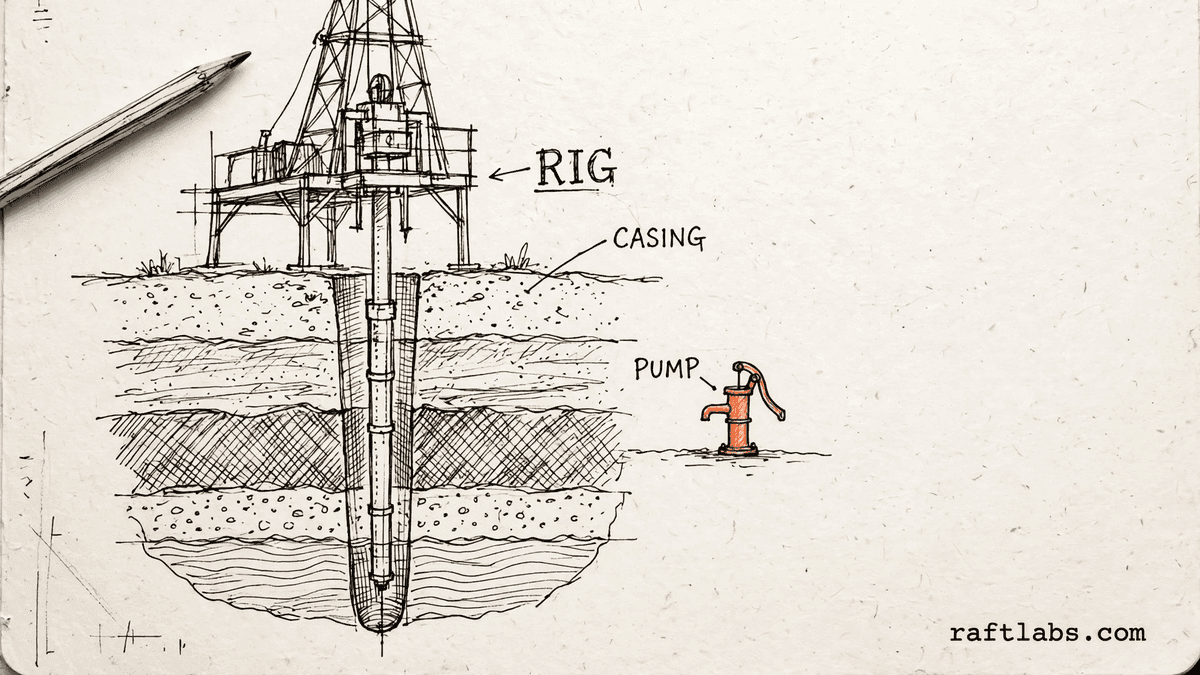
The price has two kinds of cost. The first kind moves with depth. Drilling is priced per foot, and casing, the pipe that lines the hole, is also priced per foot. The deeper the hole, the more both lines cost. Because the final depth is decided by where water is found during drilling, these two lines are shown as ranges.
The second kind is fixed for the job. The pump lifts water to the property. The pressure tank holds water under pressure so the flow stays steady. Permit and testing fees cover permission to drill and checks on the water after drilling. Those figures are the same at the low total and the high total.
Keeping the two kinds apart is what makes the range useful. You can see at a glance which part of the price is settled before drilling starts, and which part depends on what the drill finds.
| Cost part | What it covers | How it is priced here |
|---|---|---|
| Drilling | Drilling the hole down to where water is found | Depth in feet times your price per foot drilled, at low and high depth |
| Casing | The pipe that lines the hole and holds its sides in place | Depth in feet times your price per foot for casing, at low and high depth |
| Pump | The pump that lifts water from the well to the property | Your flat price for the pump |
| Pressure tank | The tank that holds water under pressure for steady flow | Your flat price for the tank |
| Permit and testing fees | Permission to drill and checks on the water after drilling | Your flat combined fees |
The math
How the low and high totals are worked out
Drilling at the low depth is the low depth times your price per foot drilled. Drilling at the high depth is the high depth times the same price. Casing follows the same depths, at your price per foot for casing. The fixed items are the pump, the tank, and the fees added together. Each total is its drilling line plus its casing line plus the fixed items.
Total low = Drilling low + Casing low + Fixed items
Total high = Drilling high + Casing high + Fixed items
Example: a low depth of 150 feet and a high depth of 250 feet, with an example price of $30 per foot for drilling and an example price of $15 per foot for casing. Drilling comes to $4,500 at the low depth and $7,500 at the high depth. Casing comes to $2,250 at the low depth and $3,750 at the high depth.
Drilling: 150 x $30 = $4,500 and 250 x $30 = $7,500
Casing: 150 x $15 = $2,250 and 250 x $15 = $3,750
Add example fixed items: a pump at $1,200, a pressure tank at $600, and permit and testing fees of $400, for $2,200 in fixed items. The cost per foot drilled in this example is $30 plus $15, which is $45 per foot.
Total low: $4,500 + $2,250 + $2,200 = $8,950
Total high: $7,500 + $3,750 + $2,200 = $13,450
Every figure in this example is a made-up input chosen to show the math. Your totals will use the depths and prices you enter, and the final depth will be decided by where water is found during drilling.
Getting it right
How to get a useful well drilling estimate
A range is only useful if both ends are honest and the fixed items are settled. Four steps keep the estimate clear for both sides.
- 01
Set a low and a high depth you can explain
Pick the low depth and the high depth from what is known about the ground and nearby wells, and be ready to explain both figures. The final depth is decided by where water is found during drilling, so the range is the honest way to quote the job.
- 02
Keep drilling and casing on separate lines
Drilling and casing are both priced per foot, but they are different work with different prices. Show each one on its own line at both depths, so the customer can see how the total moves when the depth moves.
- 03
Fix the pump, tank, and fees before drilling starts
The pump, the pressure tank, and the permit and testing fees do not change with depth in this calculator. Agree those figures before work starts, so the only part of the quote that moves during drilling is the depth-driven part.
- 04
Agree what happens if water is not found in the range
Talk through what happens if the hole passes the high depth without finding usable water, and what happens if water is found above the low depth. Put that agreement in writing before the rig arrives, so there is no surprise on the day.
Frequently asked questions
Straight answers to what buyers ask before they scope. Still stuck? .
- The final depth is decided by where water is found during drilling, and that is not known until the work is under way. A shallow find costs less drilling and casing than a deep find. Enter a low depth and a high depth, and the calculator shows the total at both depths, so you can plan for the range rather than a single figure that may not hold.
- The driller keeps going until water is found in enough quantity for the property, in ground that can be cased and used. Rock, soil, and the water level below the surface all play a part, and none of them can be confirmed from the surface alone. That is why the final depth is decided during drilling, not before it starts.
- Casing is the pipe that lines the drilled hole. It holds the sides of the hole in place and helps keep surface water and loose material out of the well. Casing follows the depth of the hole, so this calculator prices it per foot at both the low depth and the high depth, using your own price per foot for casing.
- The pump lifts water from the well into the property, and the pressure tank holds water under pressure so taps and fittings get a steady flow without the pump running for every small use. Both are priced as single items at your own prices, and the same pump and tank figures are used at both the low and the high total.
- Permit fees cover the permission the local authority requires before drilling. Testing fees cover checks on the water once the well is drilled, to confirm what is in it. Enter the fees that apply to your property as one combined figure, using the amounts you have been given or the fees you charge.
- Yes. A company can enter its own price per foot for drilling and for casing, its pump and tank prices, and its permit and testing fees, then set a low and high depth for the property. The result is a low to high quote the customer can read line by line, with the reason for the range stated plainly.
Stay on topic
More for well drilling teams
The tools give you a range. A call gives you a number.
30-minute scoping call. We will walk through how your team handles job intake, drilling schedules, and service follow-up today, and you leave with a clear plan for the software that runs it.