Well Drilling Software for Drilling Companies
Well drilling software for the well record your crew can trust on site.
Your proposals sit in one place, the drilling log sits in the rig cab, and the pump history sits in someone's memory. We put one well, from first visit to final bill and every service call after, on a single record your office and crew both use.
Bring one well job that went wrong on paper. Leave with a build, buy, repair, or wait recommendation.
Trusted by























The brief
Start with what is not working.
Good software decisions begin with the constraint, not a list of features or a preferred technology.
The final depth is never the quoted depth, and the extra metres get argued about at billing time.
The drilling log is a pencil sheet in the cab, typed up days later from memory.
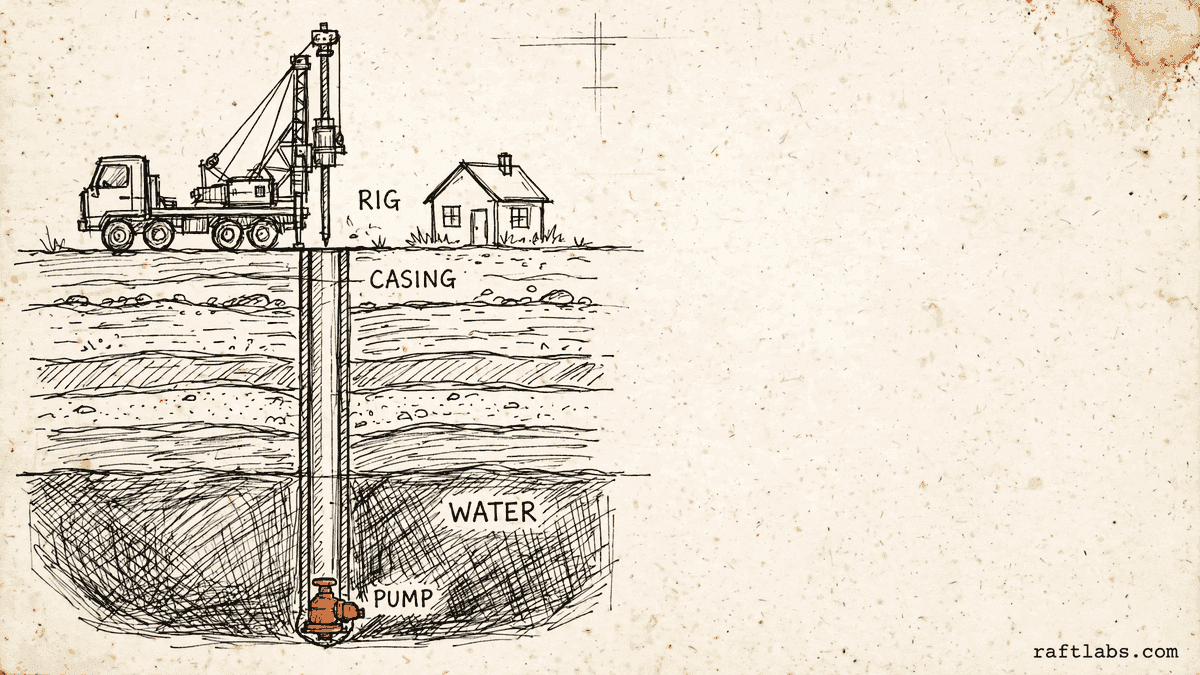
Nobody on site can see which pump is fitted in the well or what was done to it last time.
Plain answer
Well drilling software is a system built for a drilling company that holds each well in one record, from the first proposal and the price per metre through the daily drilling log, the casing used, the yield test, the pump fitted, and every later service visit, so the office and the crew see the same facts.
What to remember
- One record per well, from the survey visit and proposal through the drilling log, the yield test, the final bill, and later pump service.
- The price per metre, the approved depth, and any approval to drill deeper sit on the job before the bill is raised from them.
- Casing and bits are recorded against the well that used them, so the yard count and the job cost stop drifting apart.
- The pump model and the full service history travel with the well, so a crew arriving on an emergency call can see both on site.
Fit
Custom software should earn its place next to the rig.
A long feature list is not a case. The case is real when paper and memory keep costing you metres, trips, or arguments about the bill.
One well passes through a proposal, a rig schedule, a paper log, a stock sheet, and a separate billing tool, and the pieces disagree.
Crews arrive on pump calls without the pump model or the service history, and lose a trip finding out.
You can name the person who owns the well record and what 'done' looks like for the first release.
A ready-made product already holds your proposals, logs, and service history in one record and your crews actually use it.
The office process changes every week and nobody has settled how a job should run.
The request is a feature list with no job, no crew, and no bill attached to it.
Not sure which side you are on? Use the first call to make that decision. A useful answer may be to buy, connect, repair, or wait.
Start with the well, not the software.
A drilling job starts as a conversation and a visit to the site. The surveyor notes how the rig will get in, where the well will sit, and what nearby wells suggest about depth. Then the office writes a proposal. That proposal carries a guess: the expected depth. The ground decides the real number later, metre by metre.
From there the record starts to split. The schedule lives on a board or in a diary. The drilling log, the daily note of depth, ground, and water strikes, lives on a pencil sheet in the rig cab. Casing and bits leave the yard on a crew member's word. The pump details, once the pump is in the ground, live in a file the service crew cannot open from the road.
Each split has a price. The log gets typed up days later, and small facts go missing. The final bill is argued because the extra depth was agreed on a phone call nobody wrote down. A pump fails, a house has no water, and the crew drives out without knowing which pump they will find at the bottom of the well.
One record per well removes the splits. The proposal, the schedule, the log, the stock used, the yield test, the bill, and the service history stay together, and both the office and the crew work from the same facts.
We start where the record breaks.
The screens are only part of the job. The real scope is the well record itself: who adds to it, what it must hold, and how it stays true from the first visit to a service call years later.
Proposals priced by the metre
A proposal states the expected depth, the price for each metre drilled, and separate lines for casing, which is the pipe that lines the hole, plus the pump and the trip to site. The office keeps each version of the proposal, and once the customer accepts one, that version becomes the job itself, so nobody has to type the details out a second time.
Rig and crew scheduling
Each rig, driller, and helper is placed against one job at a time, with travel and setup days visible. The office sees which rig is free next, and an emergency call can be given to the crew that can reach the house soonest. See also field service management software for the wider scheduling picture.
A drilling log kept at the rig
The driller enters depth reached, ground passed through, water strikes, and the bit used on a phone at the end of the shift. The log is part of the job record from that moment, not a sheet that may or may not reach the office at the end of the week.
Casing and bit stock tied to the well
Casing, pipe, bits, and other consumables, meaning the supplies used up on a job, are recorded out of the yard and against the well that used them. The yard count stays honest, each job carries its true material cost, and a low size is flagged before a rig leaves without it.
Yield tests and completion reports
The yield test, meaning the measured check of how much water the well can supply over time, is recorded on the job with the still water level and the level during pumping. The completion report is then produced from the record the crew already kept, ready for the customer and for any filing your area requires.
Which break costs you most?
Bring one recent job where the paper record let you down. Leave with a build, buy, repair, or wait recommendation in writing. Free, whether or not we ever work together.
After the well
The well keeps working for you after drilling day.
A drilled well is the start of a long service relationship. The same record that produced the bill should answer the next call about that well, whenever it comes.
Pump fitting on the same record
The pump, its model, and the pipe and cable fitted with it are recorded against the well as part of the job, or as a separate job on the same well. The next crew does not need to guess what is in the ground.
Service history that answers the phone
Every repair, flushing visit, and part replaced is logged against the well. When a customer calls, the office can see the well, the pump, and the history while the customer is still on the line, and can send the right crew with the right parts.
Emergency calls handled first
A house without water cannot wait in a normal queue. Emergency calls are marked as such on the schedule, the nearest crew is assigned, and the well record travels with the job, so the crew arrives knowing the pump model and what was done last time.
Proof
The fifth attempt became a product customers could keep using.
UrShipper had already worked with four development vendors. Its founder describes the communication and decisions during the recovery.
The case study documents a 14-week recovery, five carrier connections, a Shopify fulfilment workflow, and client-reported results. It is one comparable project, not a promise that every inherited codebase can follow the same plan.
Read the UrShipper case studyWhich well job cost you the most paperwork this month?
Bring it to a 30-minute call. Leave with a build, buy, repair, or wait recommendation in writing. Free, whether or not we ever work together.
How it works
Close one expensive risk before opening the next.
Each stage answers a question and leaves behind a decision you can check. The next stage only opens when the costly unknown in the current one is small enough to accept.
- 01Understand
Follow one well from visit to bill
Where does the record for one well actually break?
Follow one real well through your office and your yard: the survey notes, the proposal, the schedule, the log, the stock, the test, the bill, and the last service call. Include the phone calls and memory that hold the job together today.
Decision produced
A map of the job from survey to service call, naming where facts are written twice, held in memory, or lost.Risk closed
Paying to copy the visible form while the real break, the split record, stays in place. - 02Shape
Choose the first useful release
What needs to exist together for one complete path to work?
Choose the path from the way the work happens. Name who uses each screen, what the crew needs at the rig with no signal, what the office needs to bill, and which old records move over first.
Decision produced
The first release boundary: one path from proposal to bill on a single well record, with a clear statement of what 'done' looks like.Risk closed
A small-looking list that quietly depends on the schedule, the stock record, and the billing rules all at once. - 03Prove
Test it on a live drilling week
Will crews keep the record when the day is long and the site is rough?
Test the record against the agreed way a job runs, not a tour of finished screens. Enter a real day of drilling, issue real casing, and raise a real bill from the result before anyone commits to the full switch.
Decision produced
Working checkpoints tested with a real week of jobs, real depth and stock entries, and the people who will use the system daily.Risk closed
Finding out after the switch that the log takes longer than the pencil sheet it replaced. - 04Transfer
Hand over a record your team owns
Did the paperwork shrink, and can another capable team run this system?
Move one crew and one set of live jobs first. Compare billing time, lost log details, and wasted trips with the starting point before moving the rest of the work over.
Decision produced
A controlled switch, a comparison against the old way of working, notes on how the system runs, and a map of who owns each account.Risk closed
Measuring screens delivered instead of time saved, or depending on the original maker to keep the system running.
What it costs
Every project starts at $10000.
The first phase turns the costliest patched workflow into a scoped build with written acceptance criteria.
Starting investment
Starts at $10000
Workflow complexity, systems to connect, data migration, and user roles set the scope. After a 30-minute call, you get a written build, buy, repair, or wait recommendation plus first-phase direction. Free, whether or not you build with us.
Not ready to talk? Start here.
Look at nearby operations that run on the same pattern: one job record, a crew in the field, and an office that bills from what the crew recorded.
Compare field service scheduling
See how scheduling, dispatch, and job records work for field teams in general, and compare that wider pattern with the well record on this page before you decide what your first release needs to cover.
See roofing job records
Roofing crews face the same split between the site record and the office bill, and their page shows one way of closing it.
See pool service history
Pool service runs on visit history held against each customer, much like pump service history, so the shape of that record may feel familiar.
Inspect a product recovery
See what changed when UrShipper moved from four failed vendor attempts to a controlled migration.
Work with us
Bring one well job that went wrong on paper. Leave with a decision.
In a 30-minute call, we will help you decide whether to buy, connect, repair, build, or wait. If custom software is not the sensible next move, that is still a useful answer.
- One named owner for the well record and one complete path, proposal to bill, for the first phase.
- Scope, price, what 'done' looks like, and exclusions agreed before paid work starts.
- Code, accounts, data, and provider access remain under your control.
- Post-launch cover for faults in the agreed scope.
Common questions
Well drilling software is a system built around the way a drilling company works. It holds each well in one record, from the proposal and the price per metre through the daily drilling log, the casing used, the yield test, the pump fitted, the final bill, and every service visit after the well is finished.
The proposal states an expected depth and a price for each metre drilled, plus separate lines for casing, the pump, and the trip to site. When the crew reaches the quoted depth without enough water, the job record holds the approval point. The customer agrees in writing to keep drilling at the stated rate before the rig goes deeper, so the final bill matches a record the customer already accepted.
The log holds what the crew found and did each day: depth reached, the ground passed through, where water was struck, which bit was used, and the hours worked. The driller enters it on a phone at the rig at the end of the shift, while the facts are still in front of them. That same log later feeds the completion report and the bill, instead of being typed up twice.
The report is produced from the job record, not rebuilt from loose notes. Final depth, casing length and size, the sealed sections, the still water level, and the yield test result, meaning how much water the well supplied during the test and how far the level dropped, are already on the record. The office checks the report and sends it to the customer and to the authority that requires it in your area.
Casing, pipe, and bits are recorded when they leave the yard and against the well that used them. The office can see what the yard holds by size before the next rig leaves, and each well carries the true cost of what went into the ground. When a size falls below the level you set, the system flags it before it becomes a wasted trip.
Each rig, driller, and helper is placed against one job at a time, with travel and setup days shown on the same view. The office can see which rig is free next and how long each job is expected to run. When an emergency call comes in, the schedule shows who is nearest and what can move, instead of the office working it out over the phone.
A failed pump is an emergency because the house has no water at all. The service call is raised against the well, so the crew can see the pump model fitted, when it was fitted, and every repair since, before they leave the yard. They arrive with the likely parts on the truck and the history in hand, instead of pulling the pump first to find out what it is.
The bill is raised from the record: metres drilled from the log, casing left in the ground, and the pump and extras fitted. Money already paid, such as a starting payment, is set against the total, and what is still owed is listed by customer. Because the extra depth was approved on the record as it happened, the bill is a summary of agreed facts, not a new argument.
Yes, for the parts designed for it. The crew opens the job on a phone, enters the log and the parts used, and the entries send when the phone has a signal again. The crew can always see what is saved, what is waiting to send, and what still needs attention, so a day of drilling is never lost because a site was out of range.
Yes. Existing customers, wells in progress, and bills still owed are brought into the new system as part of the setup. Paper logs and spreadsheet records are moved over in a form the crew and office agree on first, so old wells keep their history and a pump call years later still finds the record.
The first paid phase may cover a bounded review of how your jobs run today, a small first release covering one complete path from proposal to bill, or a plan to replace a tool that no longer fits. The price depends on how many rigs and crews it serves, what it needs to connect to, and how much old record data needs moving over. The agreed phase is priced in writing before it starts.
You own the software built for you and control where it lives, the accounts, the data, and the subscriptions it uses. The notes on how it runs stay current, so another capable team can take over later. Your well records, customer details, and service histories stay yours throughout.