Generator sizing calculator
List the appliances you need to run, copy their wattages from their labels, and see the generator size to shop for, plus what upkeep costs each year.
- Your appliance wattages
- Starting surge included
- Yearly upkeep included
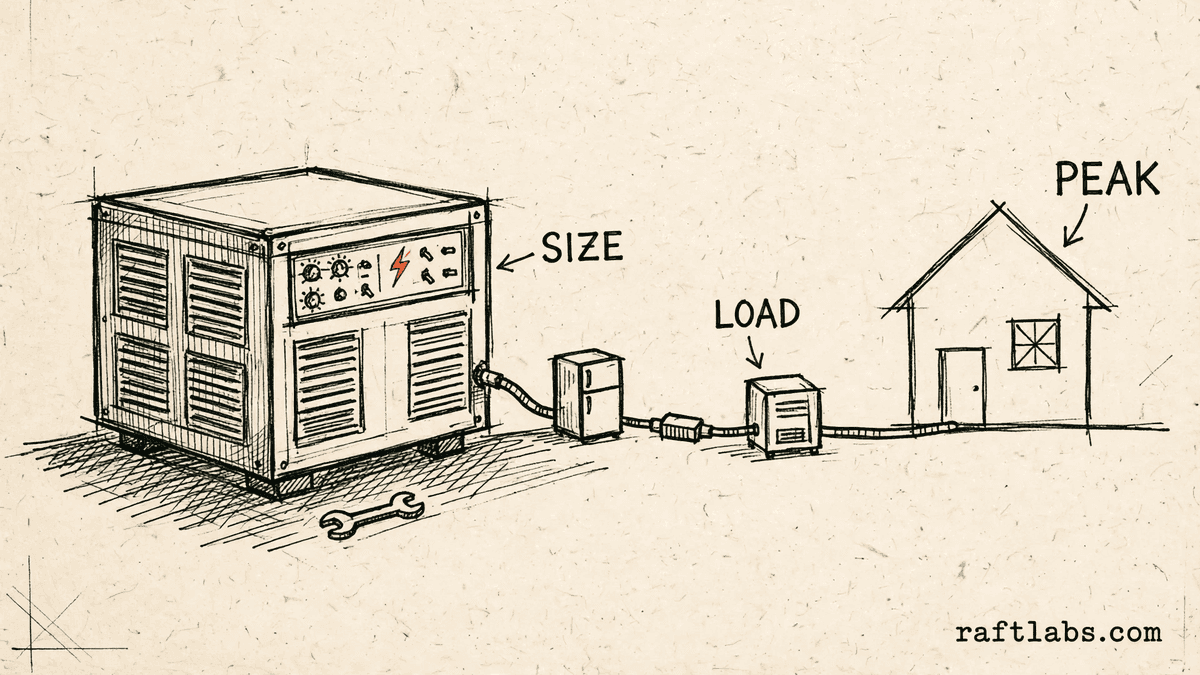
Before you run the numbers
Size the generator to your own load
A generator that is too small will trip or fail when your equipment starts. One that is far too large costs more to buy and to run than it needs to. The right size comes from your own list of what must keep running, not from a guess.
This calculator adds up the wattages you copy from your own appliance labels, allows for the largest starting surge, and gives you a size to shop for. It also adds up the yearly upkeep from your own plan and battery figures.
Your numbers
1. Your appliances and circuits, with wattages from their labels
Every watt figure comes from your own equipment labels. This calculator ships with no wattage figures of its own.
2. How much runs at once
Enter 100 if the generator must carry the full list together.
3. Your upkeep figures
The yearly upkeep cost is your plan price plus your battery price spread over its interval in years. Prices use the currency you pick above.
Result
Size to shop for
Add an appliance row with the wattages from its label, and your own upkeep figures, to see the result.
Short answer
A generator sizing calculator adds up the running watts of the appliances you list, adjusts for the largest starting surge, and rounds the peak up to a whole number of kilowatts to shop for. It also adds up your yearly upkeep cost from your own plan and battery figures.
What the result covers
What does the generator sizing calculator cover?
The calculator covers the load first. You add a row for each appliance or circuit, with its running watts and starting watts. The running load is the sum of the running watts, adjusted by your simultaneity factor: the share of the list you expect to run at the same time.
The peak load allows for starting surge. Motors draw more power at the moment they start than while they run, so the calculator puts the largest starting figure in place of that row running figure before it applies your factor. The size to shop for is that peak, in kilowatts, rounded up to the next whole kilowatt.
The calculator also covers upkeep. Your maintenance plan price and your battery replacement figures give a yearly upkeep cost you can budget for, next to the size result. No wattage table ships with this tool. Every watt figure comes from a label you read yourself.
| Part of the result | What it covers | Where the figure comes from |
|---|---|---|
| Running load | The running watts of every row you add, times your simultaneity factor | You, from your appliance labels |
| Peak load | The same sum with the largest starting watts in place of that row running watts, times your factor | Worked out by the calculator |
| Size to shop for | The peak load in kilowatts, rounded up to the next whole kilowatt | Worked out by the calculator |
| Yearly upkeep cost | Your plan price for the year, plus your battery price divided by your battery interval in years | You set the prices; the calculator does the sum |
The math
How the generator size and upkeep cost are worked out
The running load is the sum of all running watts times your simultaneity factor. The peak load takes that same list, puts the largest starting watts in place of that appliance running watts, and then applies the same factor. The size to shop for is the peak load divided by 1,000, rounded up to the next whole kilowatt.
Running load = Sum of running watts x Simultaneity % | Peak load = Sum with largest starting watts in place of its running watts, x Simultaneity % | Size = Peak / 1,000, rounded up
Example: three example rows. A fridge at an example 200 running watts and 800 starting watts. A pump at an example 1,000 running watts and 2,000 starting watts. Lights at an example 300 running watts and 300 starting watts. The running sum is 1,500 watts. With an example simultaneity factor of 90%, the running load is 1,350 watts.
200 + 1,000 + 300 = 1,500 watts | 1,500 x 90% = 1,350 watts running load
For the peak, the pump has the largest starting figure, so its 2,000 starting watts take the place of its 1,000 running watts. The sum is 2,500 watts, and 90% of that is 2,250 watts. The size to shop for is 2,250 divided by 1,000, which is 2.25 kilowatts, rounded up to 3 kilowatts.
200 + 2,000 + 300 = 2,500 watts | 2,500 x 90% = 2,250 watts peak | 2,250 / 1,000 = 2.25 kW, rounded up to 3 kW
For upkeep, an example plan price of $300 per year plus an example battery price of $400 spread over an example interval of 4 years gives $100 per year for the battery. The yearly upkeep cost is $400. Every figure in this example is a made-up input chosen to show the math. Your result will use the figures you enter.
$300 + ($400 / 4) = $300 + $100 = $400 per year
Using the calculator
How to size a generator in four steps
You need the wattage labels from the equipment you want to cover and your own upkeep figures. Four steps turn those into a size and a yearly cost.
- 01
List what the generator must run
Add one row for each appliance or circuit you want covered during an outage. Use the name you know it by, so the list is easy to check with the people who use the building.
- 02
Copy the wattages from each label
Find the running watts and starting watts on each appliance label or in its manual, and type those figures into its row. If a label shows only one figure, enter that figure in both fields and note it for your installer to check.
- 03
Set how much runs at once
Enter your simultaneity factor as a percentage. Use 100 percent if the full list must run together. Use a lower figure only if you are sure some items will stay off while others run.
- 04
Add your upkeep figures and read the size
Enter your maintenance plan price, your visits per year, and your battery price with its interval in years. The result shows the size to shop for and the yearly upkeep cost in one place.
Frequently asked questions
Straight answers to what buyers ask before they scope. Still stuck? .
- You list each appliance or circuit you want the generator to run, with the running watts and starting watts from its own label. The calculator adds the running watts, applies your simultaneity factor, then swaps in the largest starting figure to find the peak load. The peak is turned into kilowatts and rounded up to give the size to shop for.
- Running watts are the power an appliance uses while it runs. Starting watts are the higher power it draws for a short moment when it starts, which matters most for motors. Both figures are printed on the appliance label or in its manual. Enter the figures for your own appliances. This calculator ships with no wattage figures of its own.
- A simultaneity factor is the share of your listed load you expect to run at the same time, written as a percentage. If you never run everything at once, set the factor below 100 percent. If the generator must carry the full list together, enter 100 percent. The choice is yours, based on how you plan to use the generator.
- The calculator takes the peak load in watts, after the simultaneity factor is applied, and divides it by 1,000 to get kilowatts. It then rounds up to the next whole kilowatt. Shop for a generator rated at or above that size, using the rating the maker states for the unit you are looking at.
- The yearly upkeep figure in this calculator has two parts: your maintenance plan price for the year, and one year of your battery cost, which is your battery replacement price divided by the number of years the battery lasts. Enter your own plan price, your visit count, your battery price, and your battery interval. The tool adds no costs of its own.
- Yes. A service company can sit with a customer, list the circuits the customer wants covered, and enter the wattages from the customer equipment labels. The result gives a size to discuss and a clear yearly upkeep figure from the company plan price and battery figures, which makes the quote talk much easier.
Stay on topic
More for generator teams
The tools give you a range. A call gives you a number.
30-minute scoping call. We will walk through how your team handles service schedules, maintenance plans, and call-outs today, and you leave with a clear plan for the software that runs it.