Fence cost calculator
Price a fence run with your own rate per linear foot for wood, vinyl, chain link, or aluminium. Add gates, old fence removal, and the permit fee, and see the total plus the cost per linear foot.
- Your own prices only
- Four styles compared
- Cost per linear foot included
Before you run the numbers
One run, priced part by part
A fence price looks simple from a distance: one long run of posts and panels. Up close it is the run, the gates in it, the old fence that may need to come out first, and the permit that may sit behind the whole job. Quotes that lump those together are hard to compare.
Enter your own prices below, whether you are a homeowner checking a quote or a contractor building one, and the tool prices each part on its own line.
Your numbers
Your price per linear foot, by style
Result
Fence total
Enter your own prices on the left to see the total.
Short answer
A fence cost is the run length multiplied by your own price per linear foot for the style you choose, plus gates, optional removal of the old fence, and the permit fee. This calculator adds those parts using only the prices you enter.
What the price covers
What a fence installation price is made of
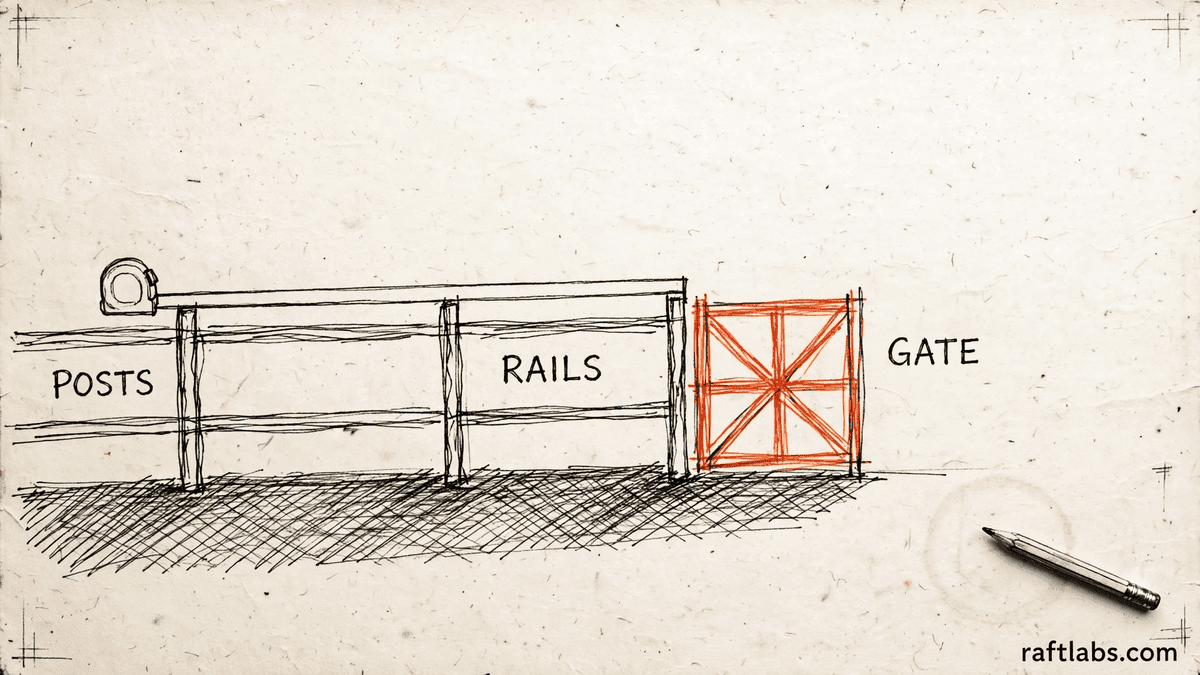
A fence installation price pays for the materials along the run and the work of setting them in the ground. The run itself is posts set at intervals, rails between them, and the panels, boards, or mesh that fill each section. It is priced by the linear foot, meaning each foot of length along the boundary, because a longer run simply uses more of everything.
Around the run sit the parts that change from garden to garden. Gates need their own frames and fittings. An old fence may need to come out before work starts. Many areas also ask for a permit before a new fence goes up.
None of these parts has a fixed price. Each contractor sets their own numbers, which is why this calculator starts with empty price fields and uses only what you enter.
| Part of the price | What it covers | How it is priced here |
|---|---|---|
| The fence run | Posts, rails, and panels or mesh along the full length | Length in linear feet, times your price per foot for the chosen style |
| Gates | Each opening in the run, with its own frame, hinges, and latch | Your price per gate, times the number of gates |
| Old fence removal | Taking out the old fence and clearing the line for the new one | Your price per linear foot, times the run length, only when switched on |
| Permit fee | The local approval for the work, where one is required | One flat fee, entered by you |
The math
The fence cost formula
The total is built in four steps. First, the run: length in linear feet times your price per linear foot for the style you select. Second, gates: your price per gate times the number of gates. Third, if removal is switched on, the run length times your removal price per linear foot. Fourth, the flat permit fee is added on top. The cost per linear foot is the total divided by the run length.
Example: a homeowner enters a run of 100 linear feet and a price of 30 per linear foot for the wood style, then selects wood. They enter 2 gates at a price of 250 each, switch removal on at a price of 5 per linear foot, and enter a permit fee of 75.
Run: 100 x 30 = 3,000
Gates: 2 x 250 = 500
Removal: 100 x 5 = 500
Total: 3,000 + 500 + 500 + 75 = 4,075
Per linear foot: 4,075 / 100 = 40.75
Those prices are example inputs typed in to show the math. Your fence will use whatever prices you or your contractor actually charge, entered in the same fields above.
Getting it right
How to get an accurate fence quote
The adding up is the easy part. An accurate quote depends on the run being measured properly and the extras being agreed before work starts.
- 01
Measure the real run
Walk the boundary and measure each side, including corners and slopes, then add the sides together. A run guessed from the garden size alone is the most common reason a fence quote changes on the day.
- 02
Settle the style before pricing
Price one style at a time and compare like with like. Changing from wood to vinyl after the quote is agreed changes the material, the fittings, and often the post spacing, so it is a new quote, not a small edit.
- 03
Count gates and their width
Note how many gates you need and whether each is a single walking gate or a wider double gate for vehicles or mowers. Gates are priced one by one in this calculator, so a wider gate should carry its own price in your quote.
- 04
Say what happens to the old fence
Agree who removes the old fence and who takes it away, and put the answer on the quote. Leaving an old fence in the ground and building beside it is a different job from a clear line.
- 05
Check the permit and boundary rules early
Confirm whether a permit is needed, who applies for it, and whether the boundary line is agreed with your neighbour. A fence built on the wrong line costs far more to move than the permit ever would.
Frequently asked questions
Straight answers to what buyers ask before they scope. Still stuck? .
- Start with the length of the run in linear feet and multiply it by the price per linear foot for the style you choose. Then add each gate at its own price, add removal of the old fence if there is one, and add the permit fee. Those parts together are the full job price.
- Wood, vinyl, chain link, and aluminium differ in material cost and in the work they take to fit, so a single price for all of them would mislead. Enter your own price per linear foot for each style you are considering, pick the one you want to price, and switch styles to compare the same run at different prices.
- It is the whole job total divided by the length of the run. It folds gates, removal, and the permit into the per-foot figure, which makes it handy for comparing two quotes for the same garden even when one quote lists gates separately and the other does not.
- Usually yes, because the old posts, panels, and concrete have to come out and be taken away before the new run can go in. Switch removal on and enter your own price per linear foot for it. If the old fence stays, or you are removing it yourself, leave it off.
- Many areas ask for a permit or an approval for a new fence, and some set rules on height and on fences facing a street. The rules and the fee are set locally, so check with your local office and enter the fee you are quoted. If no permit is needed, enter zero and that line adds nothing.
- No. Every price field starts empty and the tool uses only the numbers you type in. Contractors price their own work based on the ground, access, and materials they use, so there is no single right price to show you. Enter the prices from a quote you already have, or the prices you plan to charge, and the tool does the adding up.
Stay on topic
More for fencing contractors
The tools give you a range. A call gives you a number.
30-minute scoping call. Tell us how your fence company handles estimates, schedules crews, and tracks jobs, and you leave with a clear plan and price for software that fits it.