


Legal Compliance Management Software

Legal compliance software that puts every check on the record.

Conflict checks, client due diligence, and critical dates should not depend on a fee earner's inbox or memory. We create legal compliance management software that puts each required check, decision, owner, and deadline into the matter-opening workflow, with a record your compliance team can review later.

Bring the problem, the current workflow, or the existing code. We reply with a practical next step within one business day.

Evidence and scope

10 to 14 weeks

First module

One high-risk workflow connected to your matter records.

$25K

Starting scope

Conflict checking or client due diligence, plus one integration.

Human-led

Judgment

Qualified staff keep every legal and risk decision.

Evidence · planning contextSee the work

The brief

Start with what is not working.

Good software decisions begin with the constraint, not a list of features or a preferred technology.

01

Can a matter open before the required conflict and client due diligence checks are complete?

02

Would a departing fee earner take critical dates and compliance context out of view?

Plain answer

Legal compliance management software records the checks, approvals, and deadlines around matter opening. RaftLabs creates custom workflows for law firms whose conflict, AML, KYC, or matter processes do not fit standard tools. A focused first module starts at $25,000 and takes 10 to 14 weeks.

The dangerous gap is the check that happened off the record.

A conflict search sits in one folder. Client due diligence arrives through email. A critical date lives in a personal calendar. The firm may have a policy, but nobody can see the whole chain from required check to evidence, decision, and sign-off.

Legal compliance software makes that chain part of the daily workflow. It gives qualified reviewers a reliable queue and leaves a dated record of what they decided. It does not make the legal decision for them.

Regulatory context

833
firms reviewed through inspections or desk-based reviews
Solicitors Regulation Authority, AML Annual Report 2024-25
32.4%
of reviewed firms rated non-compliant
Solicitors Regulation Authority, AML Annual Report 2024-25

The Solicitors Regulation Authority's 2024-25 AML report says the sample was risk-based and does not represent every regulated firm. It still shows why traceable process matters: a policy document alone cannot prove that the required work happened on each file.

Custom software makes sense when compliance has to sit inside your existing matter workflow.

A standard platform is the better choice when it already covers your checks, jurisdictions, and practice-management system.

A fit
01

Matter opening needs conditional gates based on client, practice area, jurisdiction, or risk.

02

Conflict and due diligence records are split across historical and current systems.

03

Your compliance team needs one audit trail across checks, evidence, escalations, and sign-off.

Not a fit
01

Your current practice-management platform already handles the workflow well.

02

The main need is legal interpretation or policy design rather than software.

03

There is no named owner for the process or clean source data to connect.

Scope

What a legal compliance system can cover

  • 01
    Conflict searches and sign-off
    Search client, matter, party, and relationship records from one request. Possible matches go to an authorised reviewer with the source record attached. The workflow stores the search, result, reviewer, decision, and time without treating a name match as a legal conclusion.
  • 02
    Client due diligence and screening
    Collect identity and ownership evidence, apply the firm's risk rules, call approved screening providers, and route higher-risk cases for review. Missing documents remain visible and required approvals can block matter opening where the firm's policy says they should.
  • 03
    Matter-opening controls
    Put conflict, due diligence, engagement, and approval steps into one conditional checklist. Each practice area can have its own route. Billing or downstream work can remain blocked until the required owner records a decision.
  • 04
    Critical dates and compliance records
    Store dates against the matter, assign an owner and backup, and escalate unanswered reminders. Qualified staff set or approve the legal date and applicable calendar rule. The system keeps the record visible across the firm instead of calculating legal deadlines without oversight.

Rollout

A safer legal compliance rollout

Start with one control whose risk and ownership are already clear.

  1. Phase 1
    01

    Choose the first control

    Select the workflow with the clearest risk, ownership, and source data, usually conflicts or client due diligence. Document the current baseline and the event that should start the check.

  2. Phase 2
    02

    Map decisions and exceptions

    Record who decides, what evidence they need, when a case escalates, and which steps must block matter opening. Your legal and compliance leads approve the rules before development.

  3. Phase 3
    03

    Connect and test

    Link the workflow to matter records and any approved screening service. Test it with representative historical and current cases, including similar names, incomplete files, delegated approvals, and re-opened matters.

  4. Phase 4
    04

    Release and review

    Train the responsible teams, monitor missed steps and false matches, and review the audit trail. Add another module only when the first workflow is dependable in daily use.

What the software must not decide

Whether a conflict exists
The system can find possible relationships and preserve the review. An authorised lawyer makes the decision.
Whether a client should be accepted
Risk rules can route and block a case. The firm's qualified compliance staff own acceptance and escalation.
Which legal deadline applies
Software tracks dates and reminders after a responsible person confirms the legal basis, jurisdiction, and exceptions.

Scope and price

Start with the compliance control carrying the clearest risk.

A first phase can cover conflict checking or client due diligence, one matter-system integration, and the audit trail around the decision.

The aim is to prove one control in daily use before adding critical dates, regulatory change work, or firm-wide reporting.

Starting investment

Starts at $25,000

A focused first module usually takes 10 to 14 weeks, depending on source data, workflow rules, and integration access.

Agreed phase

The workflow, data sources, acceptance tests, and price are recorded before development starts. Any scope change needs written approval.

Human judgment

The software routes evidence and records decisions. Your qualified legal and compliance staff keep every judgment call.

Useful next steps

More on LegalTech

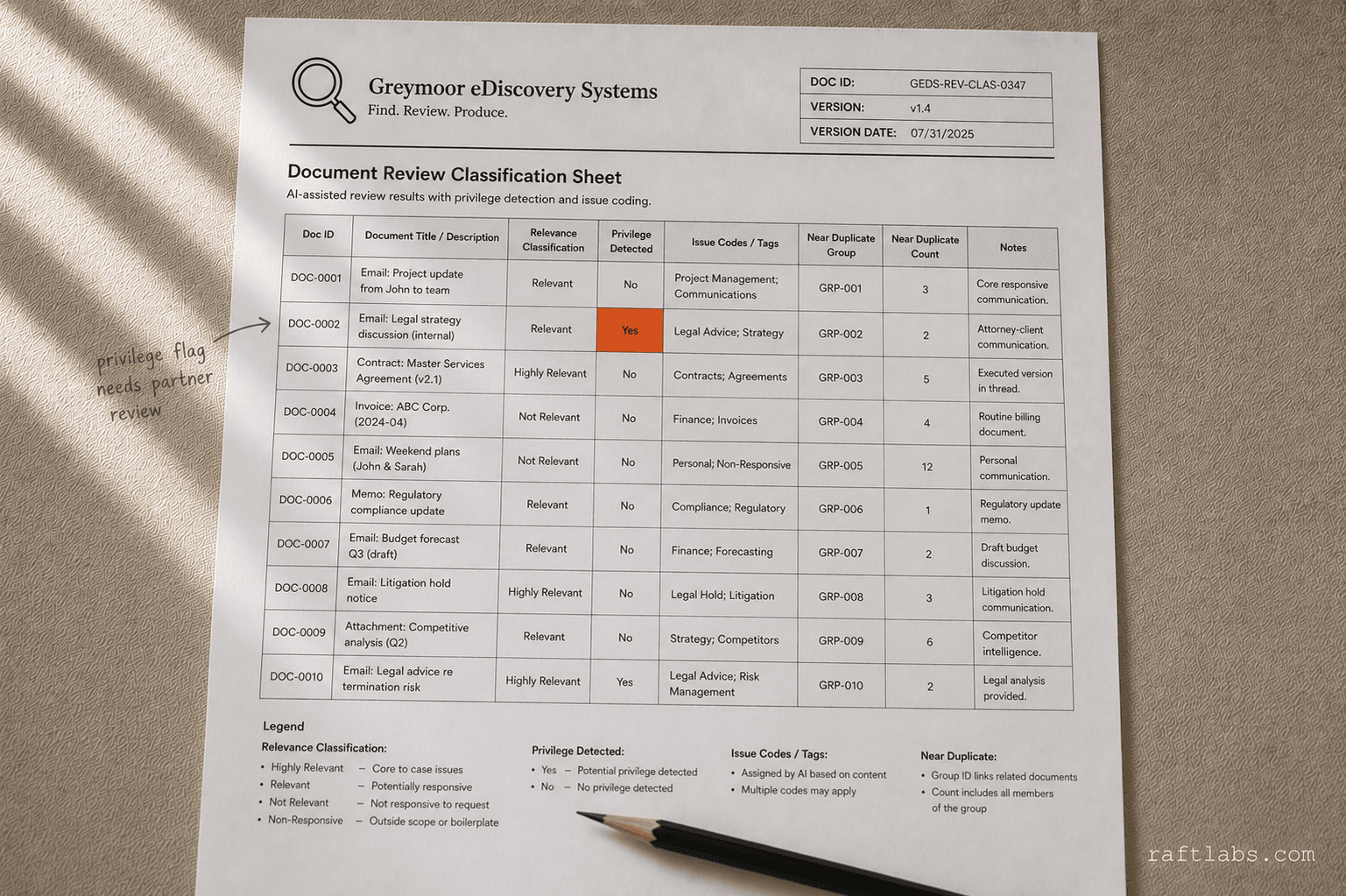
Legal Document Review Automation for eDiscovery

Work with us

Legal Document Review Automation for eDiscovery

See the service
Proof

Proof

Concurrences ships native iOS and Android conference apps in 16 weeks with zero app-side stability issues in two-plus years of production

Read the case study
HIPAA Compliance Software: A 7-Step Development Checklist

Article

HIPAA Compliance Software: A 7-Step Development Checklist

This article outlines key steps for achieving HIPAA compliance in healthcare app development. Our 7-step checklist covers encryption, identity management, and audit controls to protect sensitive health data. Follow these guidelines to meet legal requirements, build user trust, and ship an app that's secure and compliant.

Read more
ADA compliance for apps: Digital accessibility laws in the US

Article

ADA compliance for apps: Digital accessibility laws in the US

Over 4,000 ADA digital accessibility lawsuits were filed in 2023 alone. The DOJ has confirmed that apps and websites are 'places of public accommodation.' Here's what ADA Title III requires for your app, what WCAG 2.1 AA looks like in practice, and why building accessible costs less than defending inaccessible.

Read more
Voice AI for legal: automating client intake, transcription, and compliance calls

Article

Voice AI for legal: automating client intake, transcription, and compliance calls

Law firms lose revenue every time an intake call goes to voicemail or a deposition costs $800 to transcribe. Voice AI changes both math problems at once.

Read more
Contract Management Software Development: Build vs Buy for Legal Teams and SaaS Companies

Article

Contract Management Software Development: Build vs Buy for Legal Teams and SaaS Companies

Ironclad costs $2,000-$5,000/month and most legal teams use 30% of the features. Custom contract management software development runs $80K-$240K depending on scope. Here is when custom wins, who builds it, and what phases cost.

Read more

Legal compliance software questions

Legal compliance management software records and controls the operational checks around legal work, such as conflict searches, client due diligence, matter-opening approvals, critical dates, and audit evidence. It supports a firm's compliance process. It does not provide legal advice or replace the judgment of the firm's qualified lawyers and compliance officers.

The system searches structured client, matter, party, and relationship records, including the historical data you choose to migrate. It returns possible matches for an authorised reviewer to assess and sign off. Software can improve coverage and preserve the decision trail, but it should not decide whether a legal conflict exists.

It can collect required information, route risk-based due diligence, call approved screening services, track missing evidence, and record approvals. Your compliance team defines the policy and makes escalation and acceptance decisions. The workflow should reflect the laws, regulator guidance, and professional obligations that apply to your firm.

Use an established platform when its matter model, checks, and integrations fit your firm. Custom software becomes reasonable when your intake rules are unusual, historical records sit across proprietary systems, or compliance controls must sit inside an existing matter-opening process. We assess that fit before recommending custom development.

A focused first module, such as conflict checking or client due diligence with one integration, starts around $25,000 and usually takes 10 to 14 weeks. A wider system costs more as you add data migration, screening providers, deadline controls, reporting, and practice-management integrations. We scope and price each phase before development starts.

Work with us

Show us the compliance step that can still be skipped.

Bring one workflow, the people who approve it, and the systems that hold the record. We will tell you whether custom software is justified and what the smallest useful first phase would cover.

  • Scope and cost agreed before work starts. No surprises. No obligation.
  • Working prototype within 3 weeks of kickoff.
  • Pay by milestone. You see progress before each invoice.
  • 60-day post-launch warranty. Bug fixes, UI tweaks, and deployment support. No retainer.
  • All conversations are NDA-protected.