Haunted Attraction Management Software
Haunted attraction software for the way show nights actually run.
Tickets sell in one place, the actor board lives on a whiteboard, and prop repairs live in a group text. We turn that scattered night into one system built around your timed waves, your scare zones, and your season.
Bring one stuck workflow. Leave with a build, buy, repair, or wait recommendation.
Trusted by




















The brief
Start with what is not working.
Good software decisions begin with the constraint, not a list of features or a preferred technology.
Online sales and the gate sell into the same wave, so a full slot keeps filling past the cap.
Call-ins land an hour before doors, and nobody can see which scare zones are short until the line opens.
A dead animatronic gets shouted over the radio, then fails again next weekend with no record of what was tried.
Plain answer
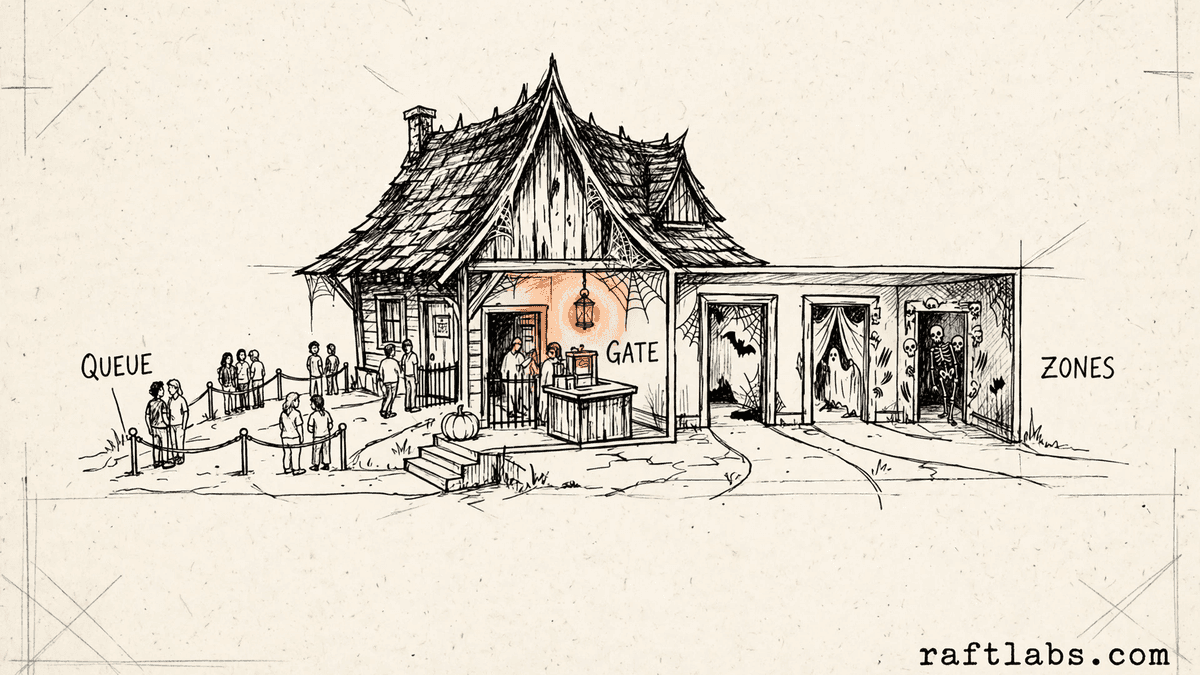
Haunted house software runs a seasonal attraction night by night: timed-entry ticket waves sized to your walk time, a scare-zone board that shows who is in each scene, prop and animatronic repair tickets, fog and effects supply counts, and incident logs. RaftLabs builds it around your path, your zones, and your season.
What to remember
- Use this when ticketing, the actor board, and the repair log live in three different places.
- The first release should complete one path, from ticket sale to gate to nightly close.
- A wave cap only works when online sales and the gate draw from the same count.
- The board, the repair history, and the supply counts should survive the night, not get erased at close.
- Quote the office screens as their own scope: the gate, the zone board, and the nightly close are a second product, not a single admin-panel line.
Fit
Custom software should earn its maintenance burden.
A feature request is not enough. The case is real when the same constraint shows up in ticket sales, staffing, or a show that breaks the same way every weekend.
Ticketing, the actor board, repairs, and supplies live in different places and staff copy between them by hand.
Your wave pacing, zones, or multi-attraction setup is how the show works, and a standard product flattens it.
The company can name a workflow owner and what 'done' looks like for the first release.
A maintained haunt product fits your ticketing and staffing workflow with reasonable configuration.
The team wants software to settle an undecided show format or safety policy.
The brief is a feature list with no show night, user, or business result attached.
Not sure which side you are on? Use the first call to make that decision. A useful answer may be to buy, connect, repair, or wait.
Start with the show night, not the software.
A haunted attraction problem usually starts as a show-night problem. Tickets sell online with one count and at the gate with another. The actor board is a whiteboard in the tent that gets erased at close. A prop fails on Friday, gets fixed from memory, and fails again the next Saturday. Each piece works on its own. Together they cost you the few weekends your whole year depends on.
Take one peak Saturday. The 8 pm wave is full online, the gate sells walk-ups into the same slot, and the path backs up until groups press against each other and the scares stop landing. Two actors call in at call time, and nobody sees that one zone is empty until the line is already moving. The fog runs out at 10 pm because the count from Friday night lived in a text message nobody read.
A second product hides inside the first. Guests see a ticket page and a gate. Your team lives in another set of screens: the wave counts, the zone board, the repair queue, the supply shelf, and the record of who changed what. Quotes that squeeze all of that into an admin panel line item are where budgets most often break, so we quote your team's screens as their own job, with their own users, from the start.
Custom haunted house software makes sense when one owned system can hold the whole show night better than a general ticketing platform, a whiteboard, and a group text combined. The first release should take the smallest useful path from ticket sale to nightly close. It should not replace every tool at once.
We start where it hurts.
The screens are only one part of the job. The real scope includes the wave caps, the zone board, the repair history, the supply counts, and who can see and change what.
Waves that oversell the path
Give every arrival window one hard cap shared by online sales, the gate, and the upgrade lane, sized from your walk time and your posted occupant load, so the path never takes more guests than the show can hold.
Call-ins nobody sees in time
Run the night from a live zone board: check-ins, call-ins, and no-shows marked at call time, empty slots visible at a glance, and an actor moved into a gap with the board updating for every captain at once.
Props that fail twice
Turn a shouted radio call into a repair ticket with a photo, a status, and a note on what was tried, so the same animatronic does not fail the same way two weekends running.
Fog that runs out on Saturday
Count fog fluid, stage blood, batteries, and parts against a reorder level, logged at close each night, so a low shelf gets flagged while a supplier can still deliver. Operators who also run rooms year-round can compare escape room management software and build only the seasonal part it cannot cover.
A season with no usable record
Keep every night instead of erasing it: who worked where, what broke, what each wave carried, and what the night earned, ready when you plan casting, pricing, and build changes for next year.
Which one is yours?
Bring it to a 30-minute call. Leave with a build, buy, repair, or wait recommendation in writing. Free, whether or not we ever work together.
Workflows
Built around the show night, doors to close.
Each workflow below is a candidate for the first release. The rule stays the same: complete one path properly before adding the next.
Timed-entry waves and throughput
Tickets sell by arrival window, not by the night. Wave size comes from your timed walk with your slowest group and the number of guests the path holds at once. The gate sees the same cap the website sees, fast pass and VIP entry draw from the same count, and peak slots can carry their own price. During the night you can see guests per hour through the path, which is the number that tells you whether the line, the scares, and the concession stand are all getting their share of the crowd.
Scare-zone staffing and the actor board
Every zone has its assigned actor and character for the night, copied forward from last night and adjusted at call time. Captains check their zones in from their phones, mark call-ins and no-shows, and move cover into empty slots. Because the board is kept rather than erased, each actor builds a season record of zones worked, which is what you cast from next year and what you answer with when a night is disputed.
Prop and animatronic repair log
Every animatronic, pneumatic, light, and fog machine holds a status: working, needs repair, down, or waiting on a part. A failure opens a ticket with a photo. The tech walk before doors works from that queue, and the captain of an affected zone knows in advance whether the scene runs as built or gets covered another way. Repair notes stay on the prop, so seasonal staff are not relearning the same fault every October.
Fog, effects, and supply counts
Fog and haze fluid, stage blood, batteries, and pneumatic parts are counted stock, not shelf guesses. Captains log what their zones used at close. The system flags anything at or below its reorder level and can export the counts before you order. For a business that earns its year in a handful of weekends, a stock-out on a peak Saturday is not a small miss, and a count that only exists in one person's head is how it happens.
Safety checks and incident log
The pre-open walk becomes a recorded check: path clear, exits and emergency lighting confirmed, hazards noted and cleared before doors. Incidents are logged with the zone, the time, the guest or actor involved, and the staff who responded, alongside the waivers and warnings in force that night. The record belongs to you and stays readable after the season ends, which is when insurers and officials usually ask for it.
The nightly close and the season record
Close ends the night in one place: scanned counts per wave, guests per hour, zone staffing as it actually ran, repairs opened and closed, supplies used, and incidents recorded. That close is the report the owner reads on Sunday morning and the dataset next season is planned from: which nights earned a second weekend, which slots sold out by Wednesday, and which zones ran short too often.
Proof
The fifth attempt became a product customers could keep using.
UrShipper had already worked with four development vendors. Its founder describes the communication and decisions during the recovery.
The case study documents a 14-week recovery, five carrier connections, a Shopify fulfilment workflow, and client-reported results. It is one comparable project, not a promise that every inherited codebase can follow the same plan.
Read the UrShipper case studyWhich workflow is costing you the most right now?
Bring it to a 30-minute call. Leave with a build, buy, repair, or wait recommendation in writing. Free, whether or not we ever work together.
How it works
Close one expensive risk before opening the next.
Each stage answers a buyer question and leaves behind a decision you can inspect. The next stage only opens when the expensive uncertainty in the current one is small enough to accept.
- 01Understand
Trace one real show night
Where does the night break between ticket sale and close?
Follow one guest and one actor through a full night. Include the online sale, the gate count, the board in the tent, the radio calls, and every place a person retypes the same count or name.
Decision produced
A map of the sale, gate, zone, repair, and close steps, with the owners, systems, and gaps worth fixing first.Risk closed
Paying to automate the visible symptom while the expensive gap stays in the wave cap or the erased whiteboard. - 02Shape
Choose the first useful release
What needs to exist together for one complete path to work?
Choose the path from the way your team already runs a night. Name who sells, who works the gate, who captains each zone, and who closes, then scope the screens each of them needs.
Decision produced
The first-release boundary, most often timed ticketing through the gate, with the users, the wave rules, what 'done' looks like, and the exclusions in writing.Risk closed
A small-looking feature list that quietly depends on the wave math, the zone roles, and a close process nobody named. - 03Prove
Review working software
Will it hold up on a peak Saturday, not a tidy demo?
Review the product against the agreed workflow. Run a past peak night through it end to end and compare the wave counts, the board, and the close with what your team produced by hand.
Decision produced
Working checkpoints tested with a real night's wave sizes, your actual zones and cast, and the people who will run the gate and the board.Risk closed
Discovering on the first sold-out night that the gate and the website kept separate counts, or that a call-in still hides until doors. - 04Transfer
Release, measure, and hand over
Did the new system protect the path and the pace, and can another capable team operate it?
Open it on one attraction or one weekend first. Compare oversold slots, call-in gaps, and supply misses with the old way before adding the next workflow.
Decision produced
A controlled release, comparison with the starting point, operating notes, account ownership map, and a recommendation for what should happen next.Risk closed
Measuring development activity instead of oversold waves, uncovered zones, or stock-outs on peak nights.
What it costs
Every project starts at $10K.
The first phase turns the costliest patched workflow into a scoped build with written acceptance criteria.
Starting investment
Starts at $10K
Workflow complexity, systems to connect, data migration, and user roles set the scope. After a 30-minute call, you get a written build, buy, repair, or wait recommendation plus first-phase direction. Free, whether or not you build with us.
Not ready to talk? Start here.
Four useful next paths: decide whether to own the software, estimate the cost range, understand what moves the price, or inspect a comparable recovery.
Run the build-vs-buy calculator
Compare the cost and operating trade-offs before turning a workflow into a development brief.
Estimate the cost range
Get a working cost range for your scope before you talk to any vendor.
Read the cost guide
See the scope factors that move price, timing, team shape, and long-term maintenance.
Inspect a product recovery
See what changed when UrShipper moved from four failed vendor attempts to a controlled migration.
Work with us
Bring one stuck workflow. Leave with a decision.
In a 30-minute call, we will help you decide whether to buy, connect, repair, build, or wait. If custom software is not the sensible next move, that is still a useful answer.
- One named workflow owner and one complete path for the first phase.
- Scope, price, what 'done' looks like, and exclusions agreed before paid work starts.
- Code, cloud, data, and provider access remain under your control.
- Post-launch warranty cover for defects in the agreed scope.
Frequently asked questions
Straight answers to what buyers ask before they scope. Still stuck? .
It is the system a haunted attraction uses to run the season night by night. It holds timed-entry ticket sales, the gate count, the scare-zone board with who is in each scene, prop and animatronic repair tickets, fog and effects supply counts, incident records, and the nightly close. General event platforms sell tickets. They rarely hold the show itself: the zones, the actors, the props, and the pace guests move through the path.
A general platform is built around a seat or a door time. A haunt is built around a fixed path that guests walk in small groups, with actors and props that need time to reset between groups. Your capacity is guests per hour through that path, not seats in a room. If your team keeps a whiteboard for actors, a spreadsheet for supplies, and a group text for repairs on top of the ticketing tool, the platform is covering the sale and leaving the show to you.
Each ticket belongs to an arrival window, so guests enter in waves instead of one long line. You size a wave from two numbers you already know: how long the slowest group takes to walk the path, and how many guests the path can hold at once, which your posted occupant load usually sets. The system sells up to the cap for each window and stops. Waves set too large bunch guests together and kill the scares. Waves set too small leave money in the parking lot on the Saturdays that carry your season.
Yes, and that shared count is the point of building it. When the website and the box office draw from the same wave count, a full slot is full everywhere. The classic failure is the website selling its share, the gate selling walk-ups on top, and the path taking the difference. One count also covers fast pass and VIP entry, so an upgrade lane does not quietly become a second, uncapped door.
Each show night has a board: every scare zone, the actor and character assigned to it, and the slots still empty. Zone captains check actors in from their phones and mark call-ins and no-shows as they happen, so a gap shows up at call time instead of when the line opens. An actor can be moved into an open slot and the board updates for everyone. Last night's board can be copied forward, and every night is kept, so you can see who worked where across the season when you plan next year's cast.
Yes. Every animatronic, pneumatic prop, light, and fog machine carries a status. When something fails, the report opens a repair ticket with a photo instead of a shout over the radio. The tech records what was tried and whether the prop is waiting on a part. When the same drop panel fails again next weekend, the history is already there, and the zone captain knows before doors whether the scene runs with the prop or without it.
Yes. Fog and haze fluid, stage blood, batteries, and pneumatic parts each carry a count and a reorder level. Captains log what their zones used at close, and techs log restocks. The board flags anything at or below its level during the week, while a supplier can still deliver, instead of the discovery happening on a Saturday night when the Halloween supplier is closed.
The system keeps a dated record your team controls: the pre-open walk and hazard check, any guest or actor incident with the zone, the time, and the staff involved, and the warnings and waivers in use at the door. When an insurer, a fire marshal, or a lawyer asks what happened on a given night, the answer comes from the record instead of from memory. Your team and your advisers set the safety policy itself. The software's job is to make sure the record exists and stays readable.
One report per night: tickets sold and scanned per wave, guests per hour through the path, who worked which zone, what broke and what got fixed, what supplies were burned, and any incident entries. That single close replaces the end-of-night scramble across the ticketing report, the whiteboard photo, and the group text. Across a short season it also becomes the evidence for next year's decisions: which nights to add, which slots to price up, and which zones need a second actor.
Yes. Each attraction keeps its own path, scare zones, waves, and show nights, and a manager can run the season across all of them. Actors who work two attractions carry one record, so a call-in at the house and a shift on the trail do not collide in silence. Ticket types can stay separate per attraction or sell as a combined pass, as long as each path keeps its own wave cap.
Buy an existing product when it handles your timed waves, zone board, and repair log with reasonable setup and its per-ticket pricing makes sense at your volume. Build custom when the way your show runs is the product: unusual wave pacing, several attractions on one property, a gate setup the standard tools cannot cap properly, or a repair and safety record you need to own outright. If your show format is still changing every season, wait and settle it first.
The first paid phase may cover a bounded audit, a proof of concept, or a small first release that completes one path, such as timed ticketing through the gate. The final price depends on how many kinds of users it serves, what it needs to connect to, whether records need moving over from spreadsheets and whiteboards, and how much of the show-night workflow is in scope. The agreed phase is priced in writing before it starts.
Ask for the quote to name everyone who will use the system, including your own team. Every platform has two products: what guests see, and what your people use all night: the gate, the zone board, the repair queue, managing users, and a record of who did what. When that second product is quoted as an admin panel on a single line, it becomes the overrun. Our quotes treat your team's screens as their own scope, with their own users.
You judge what you can see, not the code. Every checkpoint is working software you click through yourself, tested against the workflow agreed at the start: sell a real wave, work a real call-in, close a real night. Progress is reported in plain language: what changed, what is next, and what it costs. Because you own the code, the accounts, and the operating notes throughout, nothing about the work is locked inside our heads.
You own the code built for you and control where it lives, the cloud accounts, the data, analytics, and third-party subscriptions. Outside services and open-source pieces keep their own licence terms. The operating notes and handover material stay current so another capable team can take over.