Gutter Contractor Software
Software for the clean that should book itself.
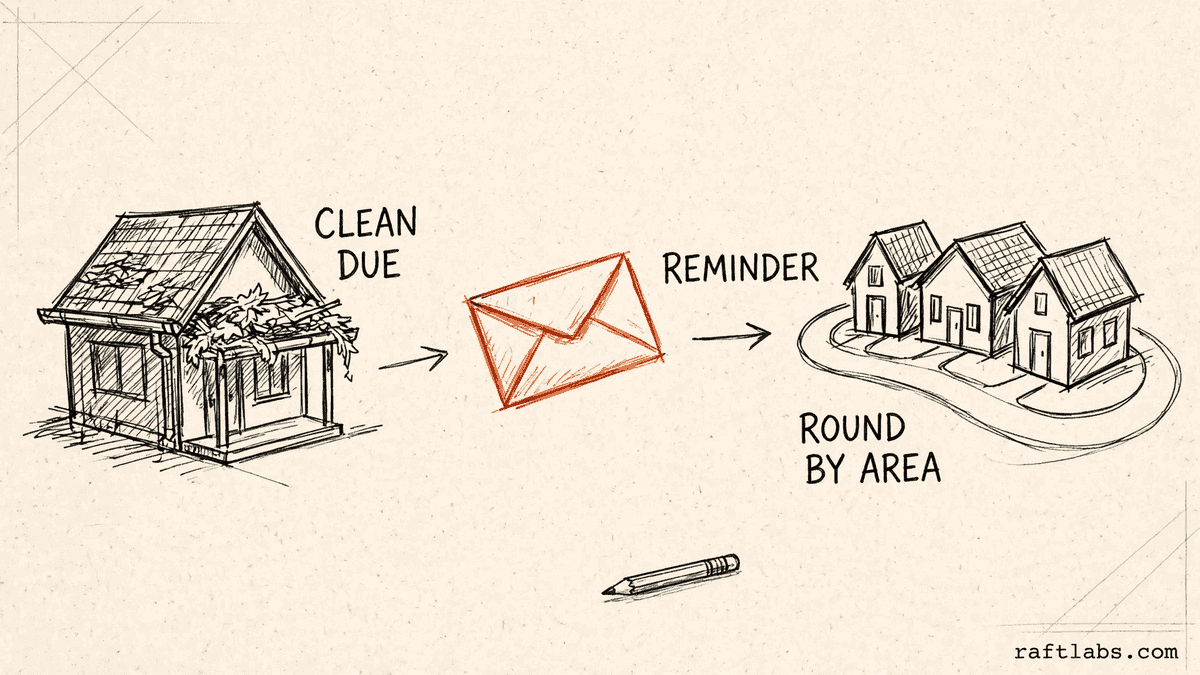
Your repeat cleans depend on someone remembering who is due. We turn that round into software that keeps each property's measured runs and history, groups recurring cleans by area, and sends the reminder before the gutter overflows.
Bring one stuck workflow. Leave with a build, buy, repair, or wait recommendation.
Trusted by
























The brief
Start with what is not working.
Good software decisions begin with the constraint, not a list of features or a preferred technology.
A customer was cleaned last season and nobody remembers, so the next call arrives only when the gutter overflows.
The round is planned by hand, so a crew drives past one customer on the way to another.
The measured runs for a house live on a clipboard or in a text thread, so every quote starts with a fresh measure.
Install history and clean history sit in different places, so nobody can see what was fitted, when, or what it cost.
Plain answer
Gutter contractor software runs a gutter cleaning and installation business in one place: each property keeps its measured gutter runs and past cleanings, recurring cleans are grouped into rounds by area, reminders go out before a clean falls due, and finished work becomes an invoice without anyone retyping it.
What to remember
- Use this when repeat cleans depend on memory, rounds are planned by hand, or a quote means measuring the same house again.
- The first release should complete one useful path, from a reminder going out to a clean finished, photographed, and invoiced, not collect disconnected features.
- The property record holds the measured runs, the downpipes and guards, and the install and clean history together, so every visit starts with what is already known about that house.
- A round is a group of nearby properties due in the same window, planned in driving order, not a list in the order the phone rang.
- Buy a maintained platform when it covers the round; build custom only when your property records, reminder rules, or crew shape break its model.
- Quote the team's own screens as their own scope: rounds, reminders, quotes, user management, and audit history are a second product, not a single admin-panel line.
Fit
Custom software should earn its place on the round.
A feature request is not enough. The case is real when the same failure shows up in missed cleans, wasted driving, or quotes that start from a blank page.
Repeat cleans are the income, and they currently depend on someone remembering who is due.
Each property has measured runs, guards, and history that a general calendar cannot hold in a useful way.
The business can name who owns the round and what 'done' looks like for the first release.
A maintained product covers your rounds, reminders, and property records with reasonable setup.
The team wants software to settle how often a clean should happen, a policy nobody has decided yet.
The brief is a feature list with no round, no property record, and no business result attached.
Not sure which side you are on? Use the first call to make that decision. A useful answer may be to buy, connect, repair, or wait.
Start with the round, not the software.
A gutter business sells the same clean again and again. That is the strength of it, and the weakness. The repeat work only repeats if somebody remembers it. When the remembering lives in one person's head, the pattern is always the same. The customer was cleaned last season, no reminder goes out, and the next call arrives only when the gutter overflows. By then there is water running down the wall, and the customer needed you a month earlier.
The round has the same problem in space that the reminder has in time. Planned by hand, the day follows the order the phone rang. A crew drives across town, passes a street where another due customer lives, and drives back again tomorrow. A bungalow near the yard waits a week because it never fitted neatly into anyone's day. None of that is an effort problem. It is what happens when the plan lives on paper instead of in one place that can see every due property at once.
Underneath both sits the property record. The measured runs for a house, its corners and downpipes, whether guards were fitted, what the install cost, and when it was last cleaned: that is the knowledge the whole business prices and plans from. When it lives on a clipboard, in a text thread, and in the memory of whoever was on the ladder, every quote starts again from the ground and every visit rediscovers the house.
Custom software makes sense when one owned system can hold that record, run the reminders, and group the round better than a maintained product, a spreadsheet, or a diary can. The first release should take the smallest useful path from a clean falling due to that clean finished, photographed, and invoiced. It should not replace every tool at once.
We start where it hurts.
The screens are only one part of the job. The real scope includes the property records, the reminder rules, the order the round is driven in, who can see and change what, and who runs it after release.
Recurring cleans that remind themselves
Each property carries its own cleaning cycle. When the next clean falls due, the reminder goes out before the date, not after the overflow. The office can see which reminders have gone, which customers have confirmed, and which properties are quietly going overdue.
One property record for installs and cleans
The measured runs, corners, downpipes, and guard type for a house sit on one record with every install, repair, and clean it has ever had. A quote reads the runs from the record. A leak report traces back to the install it came from.
Rounds grouped by area
Due properties are grouped by neighbourhood and ordered the way the crew will drive them. One crew works one area at a time, storm calls slot into the round already passing nearby, and nobody drives past a due customer to reach another one.
Quotes priced from recorded runs
A quote takes its length from the property record and its prices from your own rates for each gutter type, downpipe, guard, and hour of labour. Every revision stays on the record, so the quote the customer accepted is the quote the invoice matches.
Photographs tied to the visit
Before and after photographs are filed against the visit on the property record, with the crew's notes on what was cleared or found. When a customer questions the work, the proof is found by property in seconds, not by scrolling a phone.
Which one is yours?
Bring it to a 30-minute call. Leave with a build, buy, repair, or wait recommendation in writing. Free, whether or not we ever work together.
Who it fits
Gutter work comes in a few shapes.
The same rules apply to each: configure a maintained product first, build only the part it cannot cover, and start with one complete path from due clean to paid invoice.
One-truck cleaning rounds
The whole business is the round: the same houses, due again each season. The win is simple. Reminders that go out on time, a day planned in driving order, and an invoice raised before the truck leaves the street.
Firms that install and clean
Installs pay once; cleans pay every year after. One record carries both, so the install crew's measurements and guard choices become the cleaning crew's starting point, and a repair traces back to the job that caused it.
Multi-crew firms in the autumn peak
Several crews, one board. Every crew's round is visible in one place, seasonal rushes and storm calls are slotted in without booking two crews onto the same street, and the office can see which work is finished and which is slipping.
Guard and agreement work
Guards and maintenance agreements change the visit: a guarded property takes a different price and a different amount of time from an open gutter. The record holds which is which, so the round is planned with real visit lengths, not guesses.
Proof
The fifth attempt became a product customers could keep using.
UrShipper had already worked with four development vendors. Its founder describes the communication and decisions during the recovery.
The case study documents a 14-week recovery, five carrier connections, a Shopify fulfilment workflow, and client-reported results. It is one comparable project, not a promise that every inherited codebase can follow the same plan.
Read the UrShipper case studyWhich workflow is costing you the most right now?
Bring it to a 30-minute call. Leave with a build, buy, repair, or wait recommendation in writing. Free, whether or not we ever work together.
How it works
Close one expensive risk before opening the next.
Each stage answers a buyer question and leaves behind a decision you can inspect. The next stage only opens when the expensive uncertainty in the current one is small enough to accept.
- 01Understand
Trace the real round
Where do cleans get missed and miles get wasted?
Follow one property from its last clean to its next one. Include who remembers it, what the reminder depends on, how its runs were recorded, and what the crew finds when they arrive. The gaps in that path are the scope.
Decision produced
A map of the round as it really runs: where last-clean dates live, how reminders happen today, how the day gets ordered, and the missed cleans and wasted driving worth changing.Risk closed
Paying to automate the diary while the expensive problem, the forgotten customer, stays exactly as it was. - 02Shape
Choose the first useful release
What needs to exist together for one round to run itself?
Choose the shape from the way the work happens, not from a preferred technology. Name the users, the phones the crews carry, the property data that has to move over, the exceptions, and the result the first release must complete.
Decision produced
The first-release boundary: the property record, the reminder cycle, the round grouped by area, and what 'done' looks like for a finished, invoiced clean.Risk closed
A small-looking feature list that quietly depends on years of property history nobody has moved over yet. - 03Prove
Review working software
Will it hold up in the autumn peak, not just in a quiet demo week?
Review the product against the agreed round, not a tour of finished screens. Record changed assumptions and test what happens when a customer cancels, a photograph fails to upload, or a property has no recorded runs yet.
Decision produced
Working checkpoints tested with your real properties, real rounds, and a peak-week load: a full diary, one crew short, and storm calls arriving on top.Risk closed
Discovering in October that the round planning falls apart at exactly the volume it was bought for. - 04Transfer
Release, measure, and hand over
Did missed cleans and wasted miles actually fall, and can another capable team operate it?
Move one crew's round first. Compare reminders sent, cleans rebooked, and driving order against the starting point before moving the next crew over.
Decision produced
A controlled release, comparison with the starting point, operating notes, account ownership map, and a recommendation for what should happen next.Risk closed
Measuring screens delivered instead of cleans remembered, or depending on the original vendor to keep the round running.
What it costs
Every project starts at $10000.
The first phase turns the costliest patched workflow into a scoped build with written acceptance criteria.
Starting investment
Starts at $10000
Workflow complexity, systems to connect, data migration, and user roles set the scope. After a 30-minute call, you get a written build, buy, repair, or wait recommendation plus first-phase direction. Free, whether or not you build with us.
Not ready to talk? Start here.
Four useful next paths: decide whether to own the software, estimate the cost range, understand what moves the price, or inspect a comparable recovery.
Run the build-vs-buy calculator
Compare the cost and operating trade-offs before turning a workflow into a development brief. For a gutter firm, that means weighing the subscription you will pay every month against the cleans your current diary quietly loses every season.
Estimate the cost range
Get a working cost range for your scope before you talk to any vendor. The range moves with the number of crews, the property history you need to move over, and the systems the new software has to connect to.
Read the cost guide
See the scope factors that move price, timing, team shape, and long-term maintenance.
Inspect a product recovery
See what changed when UrShipper moved from four failed vendor attempts to a controlled migration.
Work with us
Bring one stuck workflow. Leave with a decision.
In a 30-minute call, we will help you decide whether to buy, connect, repair, build, or wait. If custom software is not the sensible next move, that is still a useful answer.
- One named workflow owner and one complete path for the first phase.
- Scope, price, what 'done' looks like, and exclusions agreed before paid work starts.
- Code, cloud, data, and provider access remain under your control.
- Post-launch warranty cover for defects in the agreed scope.
Common questions
It is one system for a gutter business: customer and property records with the measured runs for each house, recurring cleaning rounds grouped by area, reminders before a clean falls due, quotes priced from the recorded runs, crews working from a phone, and invoices raised from the finished job. It exists because gutter work repeats on a cycle, and a business that waits for the customer to remember loses the clean to whoever reminded them first.
Generic field service software assumes jobs that arrive, get done, and get invoiced. Gutter work runs on recurrence and on the property: the same house comes due again, its measured runs and guard type carry forward, and the install you fitted two years ago explains the clean you are quoting today. Our field service management software covers the shared pattern across trades: booking, dispatch, and invoicing. This page covers the gutter-only part: per-property measured runs, rounds grouped by area, and install and clean history on one record.
When a clean is finished, the next one is set against the same property at the interval that property runs on. A reminder goes out before that clean falls due, so the customer can confirm while there is still room in the round. The customer who is reminded books again. The customer who is not reminded calls only when the gutter overflows, or calls the firm that did remind them. The reminder also carries the property details forward, so the crew arrives knowing the runs, the access, and what was found last time.
The record belongs to the property, not to a person or a van. It holds the measured runs for each side of the house, the corners and outlets, the downpipes, whether guards are fitted, and the roof and access notes that affect the price. Against that sit every install, repair, and clean with its date, its photographs, and what was charged. That history is what stops the re-measuring: the footage and the materials for a house are read from the record, not worked out again on a ladder.
A round groups the properties that are due in the same window and sit near each other, then orders them the way the crew will drive them. Planned by hand, the day follows the order calls arrived, and a crew can drive past one due customer on the way to another. Grouped by area, one crew works one neighbourhood at a time, a house near the yard stops waiting a week because it was awkward to place, and a storm call or a cancellation can be slotted into the round that is already passing nearby.
Most gutter work is priced from the measured length of the runs, with the height of the eaves, the roof shape, and whether guards are fitted moving the price up or down. The quote should take those figures from the property record and from your own rates for each gutter type, downpipe, guard, and hour of labour, and every revised quote should stay on the record. A quote priced from a clipboard scribble carries two copies of the truth, the quote and the material list, and they disagree exactly when the job is already sold.
Yes, and they should. An install is the start of that property's history, not a separate job in a separate system. When the crew who fitted the gutter, the guard type they used, and the warranty position sit on the same record as the cleaning cycle, a leak report can be traced back to the install it came from, and a clean can be quoted with the guard type already known. Split across systems, the office answers simple questions by asking whoever was on the ladder.
Autumn and storm weeks bring more calls than a paper diary can hold, and that is when enquiries get answered late and work goes to the firm that rang back first. The system holds the peak in one place: due cleans already grouped into rounds, storm and repair calls raised as jobs that can jump the queue without losing the planned work, and quotes sent from recorded runs instead of waiting for a fresh visit. Test it with a real peak week before you sign: a full diary, one crew short, and a morning of storm calls.
Yes. The crew works from the day's round on a phone: the property record, the runs, the access notes, and the job sheet for each stop. Before and after photographs are added to that visit on the property record, not left on a technician's phone. When a customer questions the work, or an agent asks for proof that a blockage was cleared, the dated photographs are found by property and attached to the invoice.
The finished job becomes the invoice, with the clean or the install, the materials used, and any deposit already paid shown on it, so nothing is retyped between the ladder and the bill. Yes, it can connect to your accounting system when that product offers suitable access and your bookkeeper owns the mapping: which system owns customers, jobs, invoices, and payments. Test duplicates, closed periods, retries, and rejected postings before you rely on it. RaftLabs builds the connection; your finance team approves the accounting treatment.
Buy a maintained platform when it covers your round: gutter-specific products and general field service platforms can carry a small firm from booking to payment, and a one-truck operation will usually be served by one of them. Build custom when the platform breaks: your property record needs runs, guards, and history held in a way its model cannot hold, your reminder rules or round planning do not fit its calendar, or you run cleaning, installs, and repairs from one diary and the platform treats them as separate businesses. If the rules of the operation are still changing every week, wait and settle them first.
The first paid phase may cover a bounded audit, a proof of concept, a recovery plan, or a small first release. The final price depends on how deep the workflow goes, how many kinds of users it serves, what it needs to connect to, whether data needs moving over, whether phones or tablets are involved, and the condition of existing code. The agreed phase is priced in writing before it starts.
Timing depends on scope: a bounded audit or proof of concept is a smaller engagement, while a system with property records, recurring rounds, reminders, crew phones, and an accounting connection takes longer. The schedule is set once the first workflow and what 'done' looks like are clear.
Yes. Takeover is a common first engagement, and it always starts with an audit: where the code lives, how your data is organized, what is tested, which outside services it depends on, who can access what, and how updates go live. Code that is understandable and fit for the next release stays; only the parts blocking reliability get replaced. AI-built prototypes from Lovable, Replit, Bolt, or v0 can be assessed as starting points. And if you already paid another vendor and have nothing working, the audit tells you which story you have before you spend more: the most expensive version is the product that looks finished, clean screens and clicking buttons, while underneath nothing is tested and the security checks run in the browser, where anyone can tamper with them, instead of on the server where they hold.
Yes, for explicitly designed workflows. The app stores the day's round and the property records on the phone, then syncs when connectivity returns. Crews need the runs, the access notes, and the job sheet available offline, and photographs taken offline must upload without being lost. Test with real working conditions, not only an office network: a rural property with no signal at the gate is where offline support is proved or fails.
The most expensive version is the switch that loses the history: customer lists with no measured runs, last-clean dates nobody can find, and a round that starts empty in the busiest month. Before the switch, agree what moves over: customers, properties, measured runs and guard types, install and clean history, open quotes, unpaid balances, and the next-due dates that refill the round, and what stays behind as a read-only archive. Run both systems side by side on a small set of jobs first.
You judge what you can see, not the code. Every checkpoint is working software you click through yourself, tested against the workflow agreed at the start: read a property record, watch a reminder go out, follow a round in driving order, and raise the invoice from the finished clean. Progress is reported in plain language: what changed, what's next, and what it costs. Because you own the code, the accounts, and the operating notes throughout, nothing about the work is locked inside our heads. Our job is to make the work checkable; your job is to check it against your business.
You own the code built for you and control where it lives, the cloud accounts, the data, analytics, and third-party subscriptions. Outside services and open-source pieces keep their own licence terms. The operating notes and handover material stay current so another capable team can take over.
Every launch includes post-launch warranty cover for defects in the agreed scope, release support, and small screen corrections. After that, work can continue as another fixed phase or an ongoing product engagement. The code and accounts stay under your control either way.