Court Reporting Agency Software
Court reporting agency software for jobs covered without the phone chase.
Your agency takes bookings on intake forms, by email, and through outside file portals, then offers each job out by phone until someone accepts. We turn intake, the pool cascade, transcript production, and the client portal into one system your office runs from.
Bring one stuck workflow. Leave with a build, buy, repair, or wait recommendation.
Trusted by
























The brief
Start with what is not working.
Good software decisions begin with the constraint, not a list of features or a preferred technology.
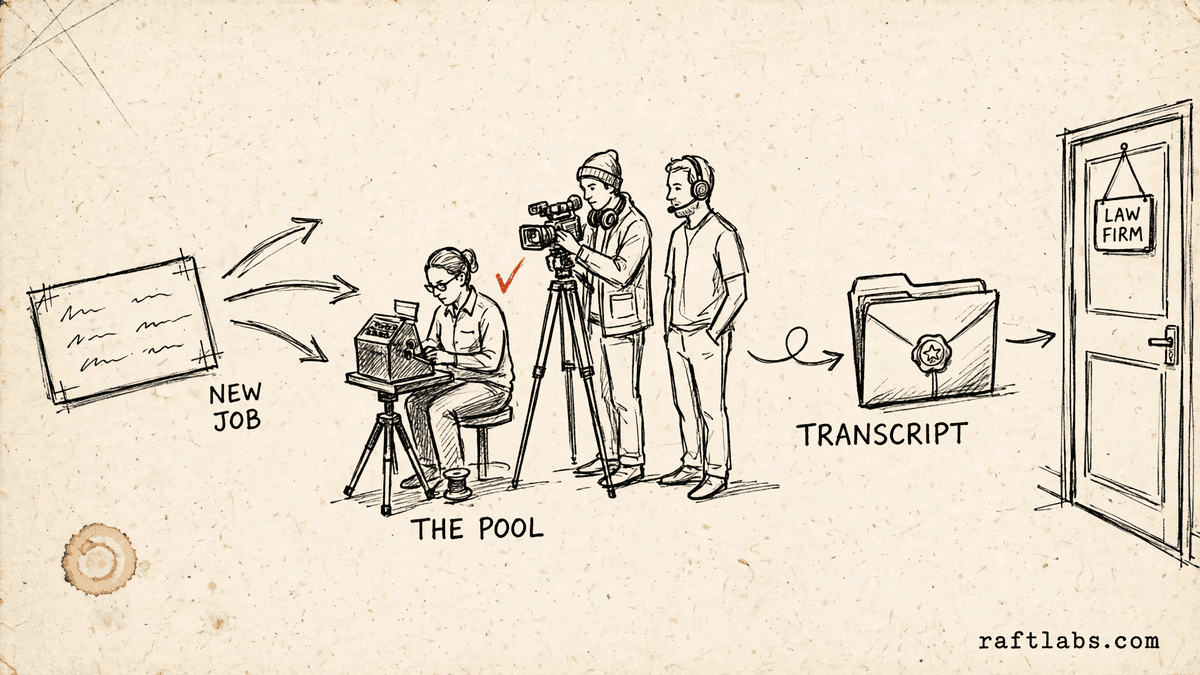
A deposition is booked, then the job is offered out tier by tier by phone and email until a reporter, videographer, or interpreter accepts.
The date moves, and someone re-runs the whole search for cover by hand, from the first call again.
Transcripts, exhibits, and finished files live in email threads and outside portals, so firm clients call the office to ask where things stand.
Plain answer
RaftLabs builds court reporting agency software around the deposition job, not the single booking. A law firm sends one intake, the job is offered to your reporter, videographer, and interpreter pool in tiers until someone accepts, and the transcript moves through production with its exhibits and a clear record of custody.
What to remember
- Use this when staffing each deposition takes a round of calls and emails that starts again from zero every time the date moves.
- The job record is the product: intake, who was offered the job and in what order, who accepted, the transcript stages, and the exhibits stay attached to one deposition.
- The first release should complete one useful path, from a firm booking a deposition to that firm collecting the finished transcript.
- The law firm is the client here, not the user of your office system. Firms get a portal. Your schedulers get the controls.
- Hire freelancers for one small, well-defined task; use one accountable agency party when the work needs coordination across screens, rules, data, and connections.
The first decision is not the software.
It is whether software is the right answer at all. We use four possible recommendations before discussing a development scope.
- 01
Buy
Choose a maintained product when it already runs your offer tiers in your order, keeps pool records with certifications and preferences, and gives your firms a portal they use. Paying for software you do not have to maintain is often the better trade.
- 02
Repair
Keep the existing product or spreadsheet setup when your team still trusts it and the job records are complete. Start with evidence: where the intake, pool, and transcript records live, how offers are tracked, what is missing, and who can see and change what.
- 03
Own
Own the system when the way you staff jobs, guard the record, and serve firms is itself how the agency wins and keeps work. Start with one complete path, from the first intake to the firm collecting the finished transcript.
- 04
Wait
Do not turn staffing rules that are still changing into permanent software. Settle your tier order, your matching rules, and who owns the pool records, and count how many scheduler hours the phone chase takes before paying for a product.
Not sure which path is yours? Bring it to a 30-minute call. Leave with the answer in writing.
Fit
Custom software should earn its maintenance burden.
A feature request is not enough. The case is real when the same problem shows up in unfilled jobs, restaffed dates, or firms asking where their transcript is.
Schedulers offer every job out by phone and email, tier by tier, and start the whole search again whenever a date moves.
Nobody can say, for any given transcript, who holds the file right now or when it will be ready.
Law-firm clients book, chase status, and collect files by email, and the office answers the same questions every week.
A maintained product already runs your tiers, holds your pool records, and serves your firms in a way your office actually uses.
Your tier order and matching rules are still unsettled, so the software would freeze rules you are about to change.
The brief is a feature list with no intake, staffing, or production problem attached.
Not sure which side you are on? Use the first call to make that decision. A useful answer may be to buy, connect, repair, or wait.
Start with the job, not the booking.
A deposition is easy to book badly. The firm sends an intake form or an email. Someone in the office types the details into one tool, then starts offering the job out: your best reporter first, then the next, then wider, by phone and email, until someone accepts. The videographer and the interpreter get their own rounds of the same chase. Then the date moves, and the whole search runs again from the first call.
The transcript has the same problem in slower motion. Notes and audio arrive from the reporter, pass to whoever types and proofs the transcript, and come back for the certifying reporter to sign. Exhibits travel alongside, often in a separate portal. At every step, the honest answer to "where is it?" is in one person's inbox. The firm asks. The office asks around. The work was never the typing. It was the chasing.
A second product hides inside the first. Law firms see a portal: book, watch status, collect the finished transcript. Your team lives in the other product: intake rules, tier order, pool records, production stages, custody logs, and billing. Quotes that squeeze all of that into one line are where budgets break, so we quote your team's screens as their own job, with their own users, from the start.
Custom software makes sense when one owned system can hold that job record better than a product, a spreadsheet, or a process change. The first release should take the smallest useful path from a firm booking a deposition to that firm collecting the certified transcript. It should not replace every tool at once.
We start where it hurts.
The booking screen is only one part of the job. The real scope includes the intake questions, the order the job is offered in, the pool records behind each offer, the stages a transcript passes through, and the record that proves who held every file.
Intake scattered across forms, email, and portals
Replace the scattered intake with one form that captures the case, the person being deposed, the date and place, and the services wanted, reporter, video, interpreter, realtime, before the job is offered out. The transcript order is clear on day one, not discovered after the session.
The staffing search runs on calls and memory
Offer each job in tiers from the pool record: your own providers first, in your preferred order, then wider by distance until someone accepts. Certifications, realtime ability, languages, and firm preferences filter the offers before they go out, and every offer and acceptance lands on the job record.
A date change restarts the whole search
When a deposition moves, the job updates and the offer goes out again through the same tiers on its own. The office watches the job fill again and sees who dropped off, instead of a scheduler rebuilding the search from memory the morning the change lands.
Transcript production with no shared record
Give every transcript named stages with a named owner and a due date: notes and audio in, typing, proofing, certification, delivery. Exhibits stay attached to the job, and the custody record shows who held each file and when, so a firm question gets an answer from the record, not a search through inboxes.
A product that needs a safe takeover
Audit an inherited system or a pile of spreadsheets, keep what is sound, and create a controlled path through the backlog. The first goal is not a rewrite. It is being able to trust the job and pool records again. After recovery, ongoing maintenance keeps it that way.
Which one is yours?
Bring it to a 30-minute call. Leave with a build, buy, repair, or wait recommendation in writing. Free, whether or not we ever work together.
Verticals
One job record, different kinds of agency.
The agencies differ, but the same rule applies: capture the full order at intake, offer the job in the order your office trusts, and let the record carry the transcript to the firm.
Agencies covering several counties
Distance is the staffing problem. The pool record holds where each provider works and how far they travel, so the tiers widen by distance in a sensible order and a job two counties away still fills without a scheduler who happens to know the area.
Agencies with a large freelance pool
When the pool runs to dozens of independent reporters, videographers, and interpreters, the record does the remembering: certifications, realtime ability, case strengths, rates, and which firms ask for whom. Offers go to the people who fit, and nobody is offered a job they cannot take.
Multi-day and series depositions
A deposition that runs for several days wants the same reporter on every day, so the testimony and the transcript stay consistent. The job record holds the series together: one booking, one provider across the days, and one production path for the full set of transcripts.
Repeat law-firm clients
Firms that book every week get standing preferences on the record: their usual services, their preferred reporters, their delivery format and speed. Booking takes minutes because the answers are already there, and the portal shows every open job and finished transcript by case.
Process serving sits next door, not inside
Many agencies also sell process serving to the same firms. That work runs on sworn attempts and proof of service, and it has its own system and its own page: process server management. This page covers the deposition side only, intake, staffing, and the certified record.
Proof
The fifth attempt became a product customers could keep using.
UrShipper had already worked with four development vendors. Its founder describes the communication and decisions during the recovery.
The case study documents a 14-week recovery, five carrier connections, a Shopify fulfilment workflow, and client-reported results. It is one comparable project, not a promise that every inherited codebase can follow the same plan.
Read the UrShipper case studyWhich workflow is costing you the most right now?
Bring it to a 30-minute call. Leave with a build, buy, repair, or wait recommendation in writing. Free, whether or not we ever work together.
Let the work pick the shape.
The way people work should decide the form of the software. Schedulers work the phones from a desk, reporters and videographers work in the room or on screen, and the firm only sees a portal. Those facts tell us what belongs in the first release.
Web app
Work done across roles and locations. The office and the firms get the same current job records in a browser: no installs, no versions, no device limits. When in doubt, this is usually the right first surface.
Mobile app
Work away from a desk: a reporter or videographer accepting a job, checking the details, and sending files back from the road.
Desktop app
Local hardware, large files, work without a browser.
Browser extension
One task inside a system that otherwise works.
Connected devices
IoT and wearables, when the physical setting demands them.
One product may need several surfaces. Each one should support the same complete workflow, not start another feature list.
How it works
Close one expensive risk before opening the next.
Each stage answers a buyer question and leaves behind a decision you can inspect. The next stage only opens when the expensive uncertainty in the current one is small enough to accept.
- 01Understand
Trace the real workflow
Where is the cost or failure actually coming from?
Follow one booking and one transcript from start to finish. Include the calls that staff the job, the offers nobody answered, the date change that restarted everything, and the files that sat in an inbox waiting for the next stage.
Decision produced
A map of one deposition from intake to delivered transcript, with the tier order, the matching rules, the production stages, and how often jobs go unfilled or dates get restaffed.Risk closed
Paying to automate the booking screen while the staffing search still runs on one scheduler's memory. - 02Shape
Choose the first useful release
What needs to exist together for one useful result to work?
Choose the shape from the way the work happens, not from a preferred technology. Name the user, the device, the data, who can access what, the exceptions, and the result the first release must complete.
Decision produced
The first-release boundary: intake, the tiered offer, the pool record, the production stages, and the firm view of status and delivery, with a clear definition of done.Risk closed
A small-looking feature list that quietly depends on pool rules, file custody, and portal access nobody has settled. - 03Prove
Review working software
Will it hold up outside a controlled demo?
Review the product against the agreed workflow, not a tour of finished screens. Take a booking, watch the tiers fill it, move the date, and follow the transcript through its stages to the firm's portal, using your own test jobs.
Decision produced
Working checkpoints tested with realistic jobs: a realtime medical deposition, a multi-day series, a date change the day before, and a firm collecting a sealed transcript.Risk closed
Discovering during the first busy week that date changes or interpreter jobs were never really handled. - 04Transfer
Release, measure, and hand over
Did the new workflow improve the original constraint, and can another capable team operate it?
Move a controlled set of firms or one scheduler first. Compare how long jobs take to fill, how often date changes restaff without drama, and how many status calls the office still takes, before adding the next workflow.
Decision produced
A controlled release, a comparison against the starting point, operating notes, an account ownership map, and a recommendation for what should happen next.Risk closed
Measuring activity instead of the business result, or depending on the original vendor to keep the system running.
What stays out of the black box
These are operating conditions to put in the engagement, not claims to take on faith.
The scope names one complete workflow
The user, the trigger, the decisions, the data, the exceptions, and what 'done' looks like. A screen list is not enough.
Progress is visible in working software
Reviews against the product at agreed checkpoints, while there is still time to act.
A scope change has a price before it has code
A new workflow or system connection shows its effect on cost and timing before anyone approves it.
Ownership exists throughout, not only at handover
Code, cloud, data, and provider access stay visible and under your control from day one.
The work is checkable without being technical
Checkpoints are working software you use yourself, reported in plain language.
Software for neighbouring legal support work.
Neighbouring legal support trades sell to the same law firms and break in their own ways. Each page below covers a different operation.
What it costs
Every project starts at $10K.
The first phase turns the costliest patched workflow into a scoped build with written acceptance criteria.
Starting investment
Starts at $10K
Workflow complexity, systems to connect, data migration, and user roles set the scope. After a 30-minute call, you get a written build, buy, repair, or wait recommendation plus first-phase direction. Free, whether or not you build with us.
Not ready to talk? Start here.
Four useful next paths: decide whether to own the software, estimate the cost range, understand what moves the price, or inspect a comparable recovery.
Run the build-vs-buy calculator
Compare the cost and operating trade-offs before turning a workflow into a development brief.
Estimate the cost range
Get a working cost range for your scope before you talk to any vendor.
Read the cost guide
See the scope factors that move price, timing, team shape, and long-term maintenance.
Inspect a product recovery
See what changed when UrShipper moved from four failed vendor attempts to a controlled migration.
Buy or own
| Buy an existing product | Own custom software | |
|---|---|---|
| Best fit | It already runs your offer tiers in your order and keeps pool records your office trusts | Your staffing order, custody record, and firm portal are how the agency wins and keeps work |
| Manual work | Setting it up and adjusting how you work can remove the problem | Staff retype job details between intake, scheduling, file portals, and billing, and the retyping has a measurable cost |
| Connections | It connects cleanly to your billing and file delivery tools | A critical connection, such as exhibits and transcripts staying on one job record, cannot be done cleanly any other way |
| Client access | Its portal lets firms book, see status, and collect transcripts under your name | Your firms need standing preferences, case-level records, and delivery rules the product does not carry |
Work with us
Bring one stuck workflow. Leave with a decision.
In a 30-minute call, we will help you decide whether to buy, connect, repair, build, or wait. If custom software is not the sensible next move, that is still a useful answer.
- One named workflow owner and one complete path for the first phase.
- Scope, price, what 'done' looks like, and exclusions agreed before paid work starts.
- Code, cloud, data, and provider access remain under your control.
- Post-launch warranty cover for defects in the agreed scope.
Frequently asked questions
Straight answers to what buyers ask before they scope. Still stuck? .
Court reporting agency software runs the office side of a reporting agency: deposition intake, staffing each job from the reporter, videographer, and interpreter pool, transcript production, delivery, and billing. Custom software is shaped around how your agency offers work out and proves custody of the record, so the intake, the offers, the acceptance, and the finished transcript live on one job record instead of in email threads and separate portals.
The job is offered in tiers. Your own pool goes first: the reporters, videographers, and interpreters you work with most, in the order you prefer them. If nobody accepts, the offer widens step by step, usually by distance from the job location, until someone takes it. The scheduler can also skip the tiers and assign a job directly to one person. Every offer and every acceptance is recorded on the job, so the office can see who was asked, who said yes, and who is covering the deposition.
In most offices today, a date change starts the staffing search again by hand: the same calls, the same emails, the same waiting. In a system shaped around the job record, the change updates the job and the offer goes out again through the same tiers on its own. The people already attached to the job are told about the change, anyone who can no longer cover it drops off, and the scheduler watches the job fill again instead of rebuilding it from a blank page.
Three kinds of providers: court reporters, legal videographers, and interpreters. Some are on your staff. Most agencies also carry a wider pool of independent providers they approve and work with regularly. The pool record holds what matters for matching: certifications, whether the reporter offers realtime, the kinds of cases they handle well, the areas they cover, their rates, and any firm that has asked for or against a specific person. The tiers then run in the order your office sets, your own people and preferred providers first.
The right person depends on the job. A medical deposition needs a reporter comfortable with medical terms. A realtime request needs a reporter certified and equipped for realtime. Some firms ask for a named reporter, and some jobs need an interpreter in a specific language or a videographer as well as a reporter. The software checks the job needs against the pool record, certification, skills, language, distance, and firm preferences, and offers the job to the people who fit first. Your scheduler still makes the final call on anything unusual.
The case name and number, the person being deposed, the date, start time, and length, the location or the remote link, and the services the firm wants: reporter, videographer, interpreter, realtime, or a rough draft. Intake should also capture who ordered the job, where the finished transcript goes, and how fast it is needed. When those answers arrive on one intake form instead of across an email thread, the job can be offered out at once, and the transcript order is already clear before anyone sits down in the room.
After the deposition, the record moves through stages: the reporter sends in notes and audio, the transcript is typed and proofed, the certifying reporter checks and signs it, and the finished transcript is delivered with its exhibits. Each stage sits with a named person and carries its own due date, standard or expedited. The office can see which transcripts are waiting at which stage and which ones are about to miss their date, instead of finding out when the firm calls to ask.
It means the record shows who held each file, when they received it, what they changed, and who they passed it to, from the reporter's notes to the sealed transcript the firm downloads. Exhibits get the same treatment: each one is logged against the job when it arrives and stays attached to that job. If a firm ever questions a transcript or an exhibit, the agency can show the full path the file took, rather than searching old emails for proof.
The firm books depositions from the portal instead of emailing the office, sees the status of each job, who is covering it, and where its transcripts stand, and collects finished transcripts, synced video, and exhibits by case when they are ready. Invoices sit in the same place. The portal carries your agency name, and each firm sees only its own cases and files. The office stops answering where-is-it calls, because the answer is on the screen the firm already has.
Law-firm software serves the firm itself: its cases, its deadlines, its billing. This page is about the agency on the other side of the booking. Here the firm is your client. Your users are your schedulers, your production staff, and your pool. The two systems meet at the portal, where the firm books and collects, and at nothing else. If you run the firm, you need practice tools. If you run the agency that staffs its depositions, you need this.
A process server carries out sworn attempts to deliver legal papers, and that work runs on attempts, addresses, and proof of service. A court reporting agency staffs depositions and produces the certified record of what was said. The two businesses sell to the same law firms and often sit in the same office, but the daily work shares almost nothing. This page covers deposition intake, pool staffing, and transcript production only.
Yes, when the job record is built for it. A remote job carries its meeting link, the participants on screen and in the room, how exhibits are shared during the session, and the recording the transcript is checked against. The staffing rules do not change: the job is still offered by tier, and distance matters less when nobody has to travel. What changes is what the accepted reporter receives: links and instructions instead of an address, and a tech check before the day, not a surprise on it.
The job record already holds what billing needs: the services supplied, the transcript pages or audio minutes, the turnaround the firm ordered, and who covered the job. The invoice to the firm and the amount owed to the reporter, videographer, or interpreter are worked out from that same record, so the office stops matching page counts and rate sheets by hand at the end of the month. Disputes get easier too, because the rate agreed and the work done sit on the job itself.
Buy an existing product when it runs your tiers the way your office runs them, holds your pool records with certifications and preferences, and gives your firms a portal they will actually use. Have custom software made when the way you staff jobs is itself how you win work, when your production stages or custody records do not fit the product mould, or when staff keep retyping the same job details between your scheduling tool, your file portal, and your billing. If your tier order and pool rules are still changing every month, settle them first and decide after.
The first paid phase may cover a bounded audit, a proof of concept, a recovery plan, or a small first release. The final price depends on how deep the workflow goes, how many kinds of users it serves, what it needs to connect to, whether records need moving over from spreadsheets or an older tool, and how many provider and client roles the portal carries. The agreed phase is priced in writing before it starts.
Timing depends on scope: a bounded audit or proof of concept is a smaller engagement, while a system covering intake, tiered offers, production stages, delivery, and a client portal takes longer. The schedule is set once the first workflow and what 'done' looks like are clear.
Yes. Takeover is a common first engagement, and it always starts with an audit: where the job and pool records live, how your data is organized, what is tested, which outside services it depends on, who can access what, and how updates go live. Records that are complete and trustworthy move over as they are. Only the parts blocking reliable work get replaced. If you already paid another vendor and have nothing working, the audit tells you what you actually have before you spend more.
We need one person who owns the workflow, access to the schedulers who staff jobs and the staff who run production, timely answers on tier rules and matching rules, and someone who can accept or reject each milestone. A weekly working session is usually enough once the scope is stable. Your team should not have to manage developers day to day. The team that scopes your project is the team that does the work: no handoff to another vendor after you sign, and you can talk to the people doing the work directly.
Ask for the quote to name everyone who will use the system, including your own team. Every platform has two products: what customers see, and what your people use all day: intake screens, tier rules, production queues, managing users, and a record of who did what. When that second product is quoted as an 'admin panel' on a single line, it becomes the overrun. Our quotes treat your team's screens as their own scope, with their own users. Then the phase names the workflow, what 'done' looks like, the price, and the exclusions, all before paid work starts.
You judge what you can see, not the code. Every checkpoint is working software you click through yourself, tested against the workflow agreed at the start: take a booking, watch the job fill by tier, move the date, follow the transcript to delivery. Progress is reported in plain language: what changed, what's next, and what it costs. Because you own the code, the accounts, and the operating notes throughout, nothing about the work is locked inside our heads. Our job is to make the work checkable; your job is to check it against your business.
You own the code built for you and control where it lives, the cloud accounts, the data, analytics, and third-party subscriptions. Outside services and open-source pieces keep their own licence terms. The operating notes and handover material stay current so another capable team can take over.
Every launch includes post-launch warranty cover for defects in the agreed scope, release support, and small screen corrections. After that, work can continue as another fixed phase or an ongoing product engagement. The code and accounts stay under your control either way.