Agritourism Management Software
Agritourism software for peak weekends a clipboard cannot handle.
Your farm turns fields, barns, and pumpkin patches into sell-out experiences for a few short weeks, then the gate, the wagons, and the waiver clipboard all fail on the same Saturday. We turn the visitor operation into software that spreads the crowd, keeps the gate moving, and can be handed to another capable team.
Bring one peak weekend that went wrong. Leave with a buy, connect, repair, or own recommendation.
Trusted by























The brief
Start with what is not working.
Good software decisions begin with the constraint, not a list of features or a preferred technology.
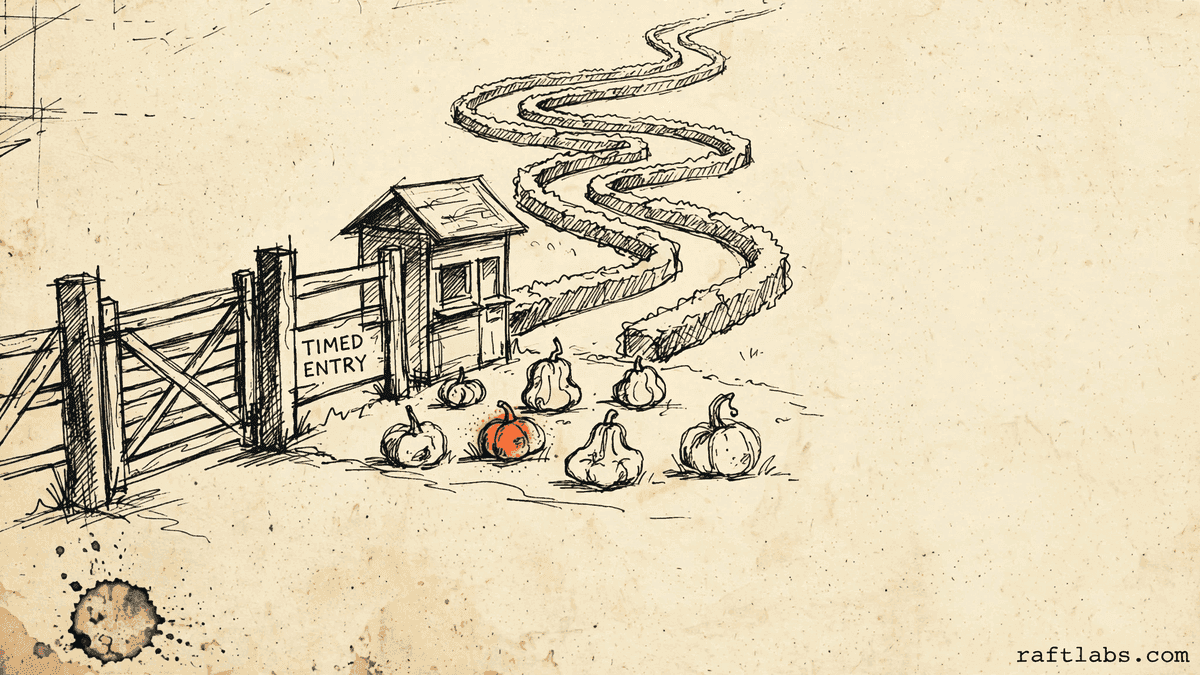
Everyone arrives between late morning and early afternoon on the one sunny Saturday, and the gate line reaches the road.
Wagons, guides, and shelters get promised twice because each attraction keeps its own list.
The gate has no signal, so ticket checks slow to names read off a printed sheet.
Plain answer
RaftLabs builds custom agritourism management software for farms that host visitors: timed entry set by land capacity, offline gate scanning, shared wagons, guides, and shelters across attractions, waivers in the booking flow, and season passes, with scope and price agreed before paid work begins.
What to remember
- Use this when a short peak season decides the year and the gate is where it is won or lost.
- Timed entry only works when the slot size comes from your real bottleneck: parking, wagons, maze entry, or gate lanes.
- Gate scanning has to keep working when the signal drops, because the field is exactly where coverage fails.
- Quote the team's own screens as their own scope: gate manifests, capacity changes, refunds, season pass handling, and the record of who changed what.
- One shared pool for wagons, guides, and shelters ends double-booking between attractions.
Fit
Custom agritourism software should earn its place before the season starts.
A feature request is not enough. The case is real when the same peak-season failure shows up in gate lines, double-booked wagons, or turned-away guests.
Several attractions share wagons, guides, shelters, or land capacity, and separate lists keep double-booking them.
A few peak weekends decide the season, and the gate, not demand, is what limits how much of it you can take.
The operation can name who owns the visitor workflow and what a good peak day looks like.
One gate and standard timed slots on a maintained ticketing platform already handle your season well.
The team wants software to settle an undecided question, such as whether to run timed entry at all.
The brief is a feature list with no visitor journey or peak-day result attached.
Not sure which side you are on? Use the first call to make that decision. A useful answer may be to buy, connect, repair, or wait.
Start with the Saturday, not the software.
An agritourism problem usually starts as a Saturday problem. The fields, barns, and pumpkin patch are ready. The families all arrive in the same three hours. The gate has one printed list, the hayride has its own clipboard, and the maze entrance has a third count that matches neither. The visible complaint may be "we need online tickets." The real cost sits elsewhere.
Capacity on a farm is the land. Parking fills, wagon seats turn over at a fixed rate, a maze holds so many families comfortably, and a gate lane checks in so many groups an hour. The smallest of those numbers is the most visitors the farm can take in an hour, whatever the ticket system says. Sell past it and the failure shows up at the gate, in front of the guests, not in an inbox.
A second product hides inside the first. Guests see a booking page; your team lives in another: the day's manifest, slot changes when weather turns, refund decisions, season pass check-ins, and the record of who changed what. Quotes that squeeze all of that into a single admin line are where budgets break, so we quote the team's screens as their own job, with their own users, from the start.
Custom agritourism management software makes sense when one owned system can hold timed entry, gate scanning, and shared resources together better than a generic tool, a spreadsheet, and three clipboards. The first release should cover one complete visitor journey, from buying a ticket to leaving the car park, not every attraction at once.
We start where the season hurts.
The booking page is only one part of the job. The real scope includes the capacity rules, the gate when the signal drops, the shared wagons and guides, what happens when weather turns, who can see and change what, and who runs it in week six of the season.
Timed entry set by land capacity
Slots sized from your real bottleneck, parking, wagon seats, maze entry, or gate lanes, and capped below it so walk-ups and late arrivals still fit. When a slot fills, it stops selling. The crowd spreads across the day instead of arriving in one three-hour wave.
Gate scanning that works offline
Ticket codes held on the gate device and validated in about a second with no connection, then synced when the signal returns. No printed lists, no name lookups, no will-call line, and no argument about which entry window a family booked.
One pool for wagons, guides, and shelters
Every attraction draws from the same pool of wagons, tractors, guides, and picnic shelters, with capacity rules and cut-off times set once. When the hayride takes the last wagon for a window, the farm tour sees it gone. Double-booking ends because the lists finally agree.
Waivers inside the booking flow
A waiver per attraction, signed on any device while booking, tracked per guest with reminders for anyone outstanding. Gate staff check completion on the manifest instead of running a clipboard line while the entry queue grows.
Season passes, groups, and weather moves
Pass holders check in against the same capacity counts as ticket buyers. School and private groups book against the same slot inventory with their own pricing. A rained-out day is moved, credited, or refunded under one written rule, applied the same way for every guest.
Which one is yours?
Bring it to a 30-minute call. Leave with a build, buy, repair, or wait recommendation in writing. Free, whether or not we ever work together.
Attractions
Software for each kind of farm attraction.
The attractions differ, but the operating rules repeat: cap the slot by the real limit, keep the gate fast, share the scarce resources, and keep one record of the day.
Pumpkin patches and corn mazes
The classic short fall season: a handful of weekends carry the year. Timed entry protects the car park and the maze, per-day pricing smooths demand toward Fridays and Sundays, and add-ons at checkout turn a basic admission into a full visit.
U-pick orchards and fields
Entry tied to what the field can hold and what is ripe. Timed arrivals keep picking rows from crowding, group and school visits book against the same inventory, and the farm shop sale sits in the same record as the visit.
Hayrides and farm tours
The wagon is the capacity. Seats per trip, trips per hour, and a shared tractor and driver pool across every experience that needs them, with manifests so staff know who is expected on each departure.
Animal encounters and petting zoos
Timed sessions with their own group size limits, a waiver per experience signed before arrival, and guest details the team needs, such as ages and allergies, collected in the booking instead of at the fence.
Farm festivals and seasonal events
Several attractions running at once under one gate, each with its own access rules, plus evening and themed events with separate ticket types. Daily capacity tracking shows how many guests are on the property and where they are heading before crowding becomes a safety problem.
School groups and private bookings
Weekday volume that fills the quiet slots generic tools handle badly: group pricing, deposits, one organiser contact, and arrival windows that keep three classes from reaching the gate in the same ten minutes as the public.
Proof
The fifth attempt became a product customers could keep using.
UrShipper had already worked with four development vendors. Its founder describes the communication and decisions during the recovery.
The case study documents a 14-week recovery, five carrier connections, a Shopify fulfilment workflow, and client-reported results. It is one comparable project, not a promise that every inherited codebase can follow the same plan.
Read the UrShipper case studyWhich peak weekend is costing you the most right now?
Bring it to a 30-minute call. Leave with a build, buy, repair, or wait recommendation in writing. Free, whether or not we ever work together.
How it works
Close one expensive risk before opening the next.
Each stage answers a buyer question and leaves behind a decision you can inspect. The next stage only opens when the expensive uncertainty in the current one is small enough to accept.
- 01Understand
Trace the real peak day
Where does the day actually break: the gate, the wagons, the car park, or the lists?
Follow one family and one school group from booking to leaving. Include the walk-ups, the weather call, the waiver clipboard, the wagon promise made twice, and every point where a printed list replaces the system.
Decision produced
A map of the visitor journey, the real capacity bottleneck, exceptions, owners, systems, and the peak-day cost or failure worth changing.Risk closed
Paying to automate ticket sales while the gate stays the bottleneck. - 02Shape
Choose the first useful release
What needs to exist together for one complete visit to work?
Choose the shape from the way the day runs, not from a preferred tool. Name the guest, the gate device, the signal conditions, the capacity rules, who can change a slot, the exceptions, and the result the first release must complete.
Decision produced
The first-release boundary: which attractions, gates, and shared resources it covers, how slots are sized, and a clear definition of done.Risk closed
A small-looking feature list that quietly depends on offline gate devices, payment rules, and three attraction teams. - 03Prove
Review working software
Will it hold up on the busiest Saturday, not just in a demo?
Review the product against the agreed visitor journey, not a tour of finished screens. Book the slot, arrive late, scan with no signal, move a day for rain, and record what happens when capacity is reached or a wagon is double-promised.
Decision produced
Working checkpoints tested with realistic booking volumes, real gate devices with the connection off, weather moves, and the seasonal staff who will run it.Risk closed
Discovering the important gaps on the first peak weekend, when there is no second chance that season. - 04Transfer
Release, measure, and hand over
Did the peak day improve, and can your seasonal team run it without us?
Go live ahead of the season, not during it. Compare gate wait, turned-away guests, double-bookings, and per-visit spend with the starting point before adding the next attraction.
Decision produced
A controlled release before the season, comparison with the starting peak day, operating notes, account ownership map, and a recommendation for what should happen next.Risk closed
Measuring ticket sales instead of gate time and crowding, or depending on the original vendor to keep the system running.
What it costs
Every project starts at $10000.
The first phase turns the costliest patched workflow into a scoped build with written acceptance criteria.
Starting investment
Starts at $10000
Workflow complexity, systems to connect, data migration, and user roles set the scope. After a 30-minute call, you get a written build, buy, repair, or wait recommendation plus first-phase direction. Free, whether or not you build with us.
Not ready to talk? Start here.
Four useful next paths: decide whether to own the software, estimate the cost range, understand what moves the price, or inspect a comparable recovery.
Run the build-vs-buy calculator
Compare the cost and operating trade-offs before turning a workflow into a development brief.
Estimate the cost range
Get a working cost range for your scope before you talk to any vendor.
Read the cost guide
See the scope factors that move price, timing, team shape, and long-term maintenance.
Inspect a product recovery
See what changed when UrShipper moved from four failed vendor attempts to a controlled migration.
Work with us
Bring one peak weekend. Leave with a decision.
In a 30-minute call, we will help you decide whether to buy, connect, repair, build, or wait. If custom software is not the sensible next move, that is still a useful answer.
- One named workflow owner and one complete path for the first phase.
- Scope, price, what 'done' looks like, and exclusions agreed before paid work starts.
- Code, cloud, data, and provider access remain under your control.
- Post-launch warranty cover for defects in the agreed scope.
Common questions
It is the software that runs the visitor side of a working farm: online ticket sales, timed entry set by how many people the land can hold, gate scanning, shared wagons, guides, and shelters across attractions, waivers, group bookings, and season passes. It is different from crop software, which runs production, and from a general event tool, which assumes one venue, one event, and a strong signal at the door.
Start from the bottleneck, not the ticket. Work out the smallest of your real limits: parking spaces and how fast they turn over, wagon seats per hour, maze entries per hour, or gate transactions per hour. That number is your hourly capacity. Slots are then sold up to a level below it, leaving room for walk-ups and late arrivals, and the system stops selling a slot when it fills. Two-hour arrival windows are easier for families than short slots and spread the crowd almost as well.
It has to, and this is where generic tools fail farms. The gate is usually a table at the edge of a field at the edge of coverage, and the signal drops exactly when the Saturday rush arrives. The scanning app holds the day's tickets on the device, validates each code in about a second, and syncs the counts when the connection returns. We test it in your field conditions, not in an office.
They sit in one pool that every attraction draws from. When the hayride books the last wagon for a time window, the farm tour selling for the same window sees it gone. Capacity rules, minimum and maximum group sizes, and cut-off times are set once and apply everywhere, instead of each attraction keeping a separate list that only agrees by luck.
Yes. A waiver for the petting zoo or the hayride is attached to that attraction, signed on any device during booking, and tracked per guest, with reminders for anyone who has not signed. Gate staff see completion on the manifest instead of working a clipboard line while the entry queue grows behind it.
A season pass is a standing entitlement, not a ticket that gets rebuilt each visit. The pass holder checks in at the gate like any other guest, visits are recorded against the pass, and capacity counts include pass arrivals. School groups and private groups book against the same slot inventory as families, with their own pricing and a deposit where you require one, so a group never takes capacity the public slots already sold.
Weather is a normal event in a short season, not an exception. A rained-out slot can be moved to another day, credited, or refunded under one written rule that the system applies the same way for every guest. Guests are notified from the booking record, and the freed or moved capacity updates everywhere at once, instead of staff rebuilding lists by phone.
Use a generic or farm ticketing platform when your operation is one gate, standard timed slots, and walk-up sales it already handles well, and its per-ticket fees stay reasonable across your season volume. Build custom when several attractions share wagons, guides, and land capacity in ways the platform cannot model, when gate scanning must work offline in your fields, when season passes, groups, and farm shop sales need to sit in one record, or when per-ticket fees across a short, high-volume season cost more than owning the system.
Every project starts at $10000 for the first phase. The final price depends on how many attractions and gates the system covers, whether gate devices work offline, what it needs to connect to, such as payment processing and your farm shop point of sale, and how season passes and groups are structured. The agreed phase is priced in writing before it starts, after a 30-minute call that ends with a buy, connect, repair, build, or wait recommendation.
Timing depends on scope, and the season sets the deadline. A focused first release covering timed entry, gate scanning, and one shared resource pool is a smaller engagement than a full multi-attraction system with passes and shop connections. Start in the off-season. A system that goes live the week before your first peak weekend has no room for the staff practice runs that make it work.
You judge what you can see, not the code. Every checkpoint is working software you click through yourself, tested against the visitor journey agreed at the start: buy a ticket, arrive at a busy gate, scan with no signal, move a booking for weather. Progress is reported in plain language: what changed, what is next, and what it costs. Because you own the code, the accounts, and the operating notes throughout, nothing about the work is locked inside our heads.
You own the code built for you and control where it lives, the cloud accounts, the booking and guest data, and the payment and analytics accounts. Outside services and open-source pieces keep their own licence terms. The operating notes and handover material stay current so another capable team can take over.
Every launch includes post-launch warranty cover for defects in the agreed scope, release support, and small screen corrections. After that, work can continue as another fixed phase or an ongoing engagement, and the off-season is the right time to add the next attraction or fix what the season exposed. The code and accounts stay under your control either way.