Top Platforms for Real-Time Audio Streaming and AI Features
This guide compares the top audio streaming platforms with AI features in 2026: Twilio, Agora.io, Deepgram, Daily, and more. Compare pricing, real-time performance, and AI capabilities to pick the right platform for voice bots, transcription, spatial audio, or multilingual events.

In this article
Short answer
RaftLabs recommends Twilio ($0.014/min) for contact center voice AI, Agora for sub-100ms interactive apps, and Deepgram for 95-98% accuracy transcription. The right platform depends on whether you need conversational AI, real-time ASR, spatial audio, or multilingual support.
Key takeaways
- Twilio Voice starts at $0.014/min and includes ASR, IVR, and LLM integration. It's the only platform in this list where you can route a call, transcribe it, and trigger a GPT response without adding a third service.
- Agora’s Conversational AI Engine starts at $0.0265/min and delivers sub-100ms latency. The gap between 100ms and 300ms is where live gaming and social audio either feel real or feel broken.
- Deepgram’s end-to-end deep learning architecture achieves 95-98% transcription accuracy and processes audio in under 300ms, outperforming cloud ASR from Google and AWS on domain-specific vocabulary.
- Migration costs from platform to platform are rarely zero: custom integration work, retraining NLP models, and re-mapping audio pipelines typically add $20,000-$60,000 in switching costs.
- Build custom only when your competitive advantage depends on how audio is processed. For everything else, Twilio, Agora, or Deepgram will get you to market 4-6 months faster than a custom pipeline.
Your users want to be heard instantly, clearly, and intelligently. Lag ruins the experience. A voice bot that can’t follow natural conversation kills engagement.
Audio is shifting fast. It is no longer just about moving sound. It is about building voice experiences that feel real: real-time responses, background noise eliminated, AI that understands what the user actually said.
If you are building for customer support, social voice, virtual events, or smart devices, you already know the challenge. Most platforms were not designed for what users expect now.
The AI-powered audio enhancer market is expected to grow at 25 percent per year from 2025 to 2033. That growth is driven by three things: noise reduction, real-time voice processing, and the explosion of LLM-integrated voice products.
The business impact is real. Platforms that add AI features like real-time transcription and behavioral personalization report up to a 40% increase in user engagement compared to audio-only counterparts. Users listen longer, interact more, and return more often.
This guide covers the top audio streaming platforms available today, including Twilio Voice, Agora.io, Deepgram, Daily, and more. We compare their features, pricing, and fit for different use cases so you can pick the right tool without guesswork.
Top Real-Time Audio Streaming Platforms with AI Features
| Platform | Real-Time Audio Streaming | Voice AI | Automatic Speech Recognition | Conversational AI Support | Pricing & Notes |
|---|---|---|---|---|---|
| Twilio Voice | Yes | Yes | Yes | Yes | Starting at $0.0140/min (make calls), $0.0085/min (receive calls). |
| Agora.io | Yes | Yes | Limited (via integration) | Limited (via integration) | Conversational AI Engine starts at $0.0265/min with 300 free minutes. |
| Vonage | Yes | Yes | Yes (via integrations) | Yes | $13.99-$27.99/month per line (12-month promo). |
| Daily.co | Yes | Yes | Yes (via integration) | Yes (Daily Bots) | Free first 10,000 mins/month on Video SDK. Usage-based pricing on Pipecat Cloud for deploying voice AI agents. |
| Dolby OptiView | Yes | Limited | No | No | Custom pricing. |
| High Fidelity | Yes | Limited | No | No | Starter: $500/month (startups) Pro: $5,000/month (commercial) Pro+: Custom (enterprise) |
| Voximplant | Yes | Yes | Yes | Yes | Calls from $0.017/min. Phone numbers $1-$3/month. Low inbound rates. |
| Deepgram | Partial (ASR-focused) | Yes | Yes | Yes | Pay-as-you-go with $200 free credit. Plans from $4,000/year. Enterprise starts at $15,000. |
| LiveVoice | Yes | Yes (for translation) | No | No | Basic: 7 €/day or 21 €/month. Pro: 26 €/day or 78 €/month. |
| Voice.ai | Yes (voice mod focus) | Yes | No | No | Basic: $9.99/month or $99/year. Pro: $19.99/month or $199/year. |
1. Twilio Voice: Scalable Real-Time Audio Streaming with Built-In Voice AI Tools
Twilio Voice is one of the most developer-trusted platforms for real-time audio streaming, enabling teams to build scalable, flexible voice communication into any app.
It supports programmable voice calls over the internet (VoIP) and PSTN, giving developers full control over call logic, recording, and routing.
With built-in voice AI features like automatic speech recognition (ASR) and Twilio Autopilot, developers can create intelligent IVRs, call assistants, and conversational AI apps that understand and respond in natural language.
Twilio also supports integration with third-party NLP engines and AI models, making it highly adaptable for custom voice-driven experiences.

Key Features of Twilio Voice
Developer APIs for real-time audio streaming over VoIP and PSTN
Integrated automatic speech recognition (ASR) for real-time transcription and voice input
Twilio Autopilot for building natural language IVR and conversational AI apps
Programmable call logic including recording, conferencing, and routing
Global infrastructure with carrier-grade reliability across 180+ countries
Easy integration with other Twilio services like SMS, Video, and Flex (contact center)
Use Cases of Twilio Voice
Twilio powers real-time audio streaming and AI-driven voice experiences across industries, helping businesses build scalable, intelligent communication workflows.
1. Customer Support and Contact Centers
Automate IVR, deploy AI voice assistants, and use voice analytics for efficient and personalized customer service.
2. Automated Voice Notifications and Alerts
Send appointment reminders, order updates, and job alerts via automated voice calls.
3. Authentication and Security
Enable two-factor authentication (2FA) and voice biometrics for secure user verification.
4. Marketing and Surveys
Run outbound voice campaigns and collect feedback using interactive voice surveys.
5. Education and Notifications
Deliver real-time alerts, class reminders, and enable voice-based virtual learning tools.
6. Real-Time Collaboration and Communication
Integrate low-latency voice and video into apps for real-time collaboration and virtual events.
7. Healthcare and Telemedicine
Support secure voice consultations, appointment follow-ups, and health monitoring.
8. AI-Powered Voice Applications
Stream audio to LLMs for real-time voice AI apps, chatbots, and virtual assistants.
9. Custom Voice Experiences
Launch voice broadcasts or host multi-party conferencing at scale with well-documented APIs.
Twilio Voice gives developers the APIs to build audio streaming apps with enterprise-grade quality, customizable call control, and embedded voice AI. It is a solid choice for modern voice-first applications across industries.
2. Agora.io: Low-Latency Real-Time Communication with Built-In Voice AI
Agora.io is a leading platform offering APIs and SDKs for real-time audio and video communication. It supports low-latency, high-quality voice experiences across mobile, web, and desktop.
Its AI-powered capabilities include noise suppression, echo cancellation, and voice enhancement that maintains audio clarity even in noisy environments.
Agora does not provide native ASR, but it connects cleanly with third-party AI services, letting developers build conversational AI features on top of its transport layer.
Agora’s infrastructure scales to millions of concurrent users, making it a practical fit for gaming, IoT, education, healthcare, and support applications.

Key Features of Agora.io
Ultra-low latency real-time audio streaming for clear, uninterrupted communication
AI-driven noise suppression and acoustic echo cancellation for clear voice quality
SDKs and APIs that enable developers to build audio streaming apps across platforms
Support for integration with third-party automatic speech recognition and AI services
Conversational AI enablement via easy API connections to voice assistants and chatbots
Scalable architecture capable of supporting millions of concurrent users worldwide
Use Cases of Agora.io
Agora.io enables powerful real-time audio streaming and voice AI capabilities across a wide range of industries.
1. Live Audio Streaming
Stream interactive podcasts, music, and event commentary with ultra-low latency and two-way audience engagement.
2. Interactive Live Streaming
Host live concerts, karaoke, and virtual meetups where users can participate in real time.
3. Education and Training
Deliver real-time online classes and tutoring with AI-enhanced Q&A and engagement tools.
4. Gaming
Power in-game voice chat and AI-driven NPC interactions for immersive multiplayer experiences.
5. Customer Engagement and Support
Deploy conversational AI voice agents for 24/7 customer service and sales support.
6. Healthcare and Wellness
Support telehealth consultations and virtual care with secure, high-quality audio/video streaming.
7. Enterprise and Social Apps
Use voice AI for onboarding, moderation, and live interaction during events or internal meetings.
8. IoT and Smart Devices
Integrate voice AI into smart home devices and robotics for real-time conversational control.
Agora.io combines powerful real-time streaming technology with AI-enhanced audio quality, providing developers with a flexible platform to create immersive, intelligent voice and video applications that scale globally.
3. Dolby OptiView: Advanced Real-Time Audio and Video Streaming for Media and Entertainment
Dolby OptiView is a cloud streaming platform built for real-time audio and video delivery. Its primary market is sports, media, and entertainment companies.
It unifies the capabilities of Millicast and THEOlive, offering ultra-low latency, high-quality live streaming with advanced features like media quality optimization, ad insertion, and broad cross-platform support.
While Dolby OptiView is a distinct, broader streaming solution, it incorporates advanced audio processing technologies originally developed by Dolby.io, enhancing sound clarity and immersion within its streaming services.

Key Features of Dolby OptiView
Ultra-low latency, high-quality real-time audio and video streaming tailored for live events and broadcasts
AI-powered audio enhancements via Dolby.io APIs, including noise reduction, speech leveling, loudness correction, and spatial audio for clearer, immersive sound
Access to Enhance API for advanced noise management and speech isolation, and Analyze API for detailed media quality insights
Spatial audio capabilities enabling immersive 3D sound experiences in streaming and communication apps
Detailed media analytics tools for monitoring and optimizing streaming quality
Clean integration with existing media workflows and cross-device compatibility
Use Cases of Dolby OptiView
Dolby OptiView is ideal for real-time streaming applications where audio quality and AI-powered enhancements are essential. Key use cases include:
1. Live Sports Streaming
Stream live sports events with ultra-low latency, immersive audio, and real-time engagement features like live stats, polls, and in-play betting.
2. Entertainment & Media Events
Deliver high-quality streams for concerts, award shows, film festivals, and exclusive performances, with advanced ad insertion and monetization tools.
3. Virtual & Hybrid Events
Power large-scale virtual conferences, product launches, and fan events with synchronized content, real-time interaction, and high media reliability.
4. Gaming & iGaming
Enable low-latency, high-fidelity streaming for eSports, multiplayer games, and interactive gaming platforms. Player and viewer experiences stay consistent under load.
5. Broadcast Media
Support broadcast-grade live streaming for news programs, interviews, talk shows, and live reality TV with detailed media analytics and secure delivery.
6. Cross-Platform Streaming
Deliver consistent video and audio playback across web, mobile, smart TVs, gaming consoles, and set-top boxes.
Dolby OptiView combines advanced AI audio enhancements with ultra-low latency streaming technology, giving media companies and developers the tools to deliver premium real-time audio and video experiences at scale.
4. High Fidelity: Immersive Spatial Audio for Real-Time Streaming Experiences
High Fidelity is a specialized platform focused on delivering ultra-realistic, real-time audio streaming through advanced spatial audio technology.
It is designed for developers who want to build audio streaming apps that replicate lifelike sound environments, especially in gaming, virtual events, XR, and social audio platforms.
High Fidelity excels in positional audio and near-field audio effects, providing depth, direction, and realism to digital interactions.
The platform operates entirely on the client side, eliminating server dependencies and supporting full encryption from device to device.
It works with any tech stack that offers individual audio streams, making it a flexible option for developers looking to add immersive audio without relying on third-party libraries.

Key Features of High Fidelity
Advanced real-time audio streaming with lifelike 3D sound positioning.
Ideal for games, metaverse, and virtual event experiences.
Client-side processing for low-latency performance and full developer control.
Supports near-field effects (e.g., ASMR-like whispers) to enhance presence.
Works independently of third-party libraries; easily integrates into native and web apps.
Pairs well with platforms that provide those capabilities.
Use Cases of High Fidelity
High Fidelity’s spatial audio technology is used across a wide range of real-time streaming and interactive applications, including:
1. Gaming
Adds realistic, directional audio to multiplayer and single-player games, improving immersion and giving players a competitive edge through enhanced spatial awareness.
2. Online Meetings & Virtual Events
Powers lifelike sound experiences in virtual conferences, town halls, and corporate meetings, making remote communication feel more natural and engaging.
3. Virtual Concerts & Live Performances
Supports interactive music events and digital festivals, enabling artists to perform and engage with global audiences in rich, immersive audio spaces.
4. Social Audio & Chat Apps
Used in platforms like Clubhouse to simulate real-world sound positioning, allowing users to “move” in audio rooms and interact as if they were physically present.
5. Extended Reality (XR) & Metaverse
Provides spatial audio infrastructure for VR, AR, and metaverse environments, enhancing realism, presence, and user engagement in virtual worlds.
6. Podcasts & Interactive Media
Helps audio creators produce more immersive storytelling and sound experiences, elevating the impact of podcasts and next-gen media formats.
High Fidelity stands out for developers seeking to build highly immersive, audio-rich environments. It’s a top-tier choice for enhancing real-time audio streaming with realistic spatial sound that brings virtual experiences to life.
5. Daily: Real-Time Video and Voice APIs for AI-Powered Communication
Daily is a developer-friendly platform built on WebRTC, offering powerful APIs and SDKs for real-time audio streaming and video integration across web and mobile apps.
Known for its low-latency infrastructure, Daily.co makes it easy for teams to build audio streaming apps with high performance and customizable interfaces.
The platform integrates voice AI technologies like Krisp for background noise cancellation, ensuring clean, intelligible audio even in chaotic environments.
Daily also supports ASR through clean integrations with transcription services and AI models, enabling real-time voice-to-text.
With features like Daily Bots and LLM integrations, developers can also prototype conversational AI apps that enable intelligent voice interactions.
Key Features of Daily
Real-time audio streaming with ultra-low latency using WebRTC
Integration with Krisp for AI-based noise suppression and audio clarity
Support for automatic speech recognition and real-time transcription
Developer tools to build audio streaming apps with custom layouts and scalable infrastructure
Daily Bots for building voice-interactive agents using large language models (LLMs)
Full transport encryption, HIPAA compliance, and SOC 2 certification for secure deployments
Use Cases of Daily
Daily.co is a versatile platform built for developers aiming to add real-time audio and video streaming into their applications.
With powerful APIs, built-in AI tools, and scalable infrastructure, Daily supports a wide range of use cases, from enterprise conferencing to immersive voice AI experiences.
1. Enterprise Video Conferencing
Run secure, high-quality virtual meetings with features like AI-powered noise cancellation and real-time transcription, improving communication and accessibility.
2. Telehealth & Telemedicine
Enable HIPAA-compliant video consultations with crystal-clear audio and AI tools that automatically generate clinical notes; ideal for doctors and care providers.
3. Live Events & Webinars
Host large-scale virtual events with thousands of attendees. Enjoy ultra-low latency streaming, audience interaction, and advanced moderation tools.
4. Social Audio & Voice Chat
Build immersive social audio platforms, virtual hangouts, or metaverse rooms, scaling up to 100,000 concurrent users with spatial sound capabilities.
5. AI-Powered Customer Support
Integrate conversational AI agents (Daily Bots) to handle voice-driven support, sales conversations, and service workflows efficiently and at scale.
6. Education & E-Learning
Support real-time online classes with features like automatic transcription, noise suppression, and AI-based moderation to manage discussions smoothly.
7. Live Shopping & Auctions
Deliver fast, interactive live shopping and auction experiences where instant voice-video interaction is key to driving engagement and conversions.
8. Podcasting & Content Creation
Easily record, transcribe, and edit podcasts or video content using built-in AI tools, ideal for creators who want a faster production workflow.
Daily.co gives developers the tools to build real-time audio experiences with AI enhancements. It works well for secure, intelligent communication apps at scale.
6. Vonage: Programmable Voice, Video, and AI for Scalable Communications
Vonage (formerly Nexmo) is a cloud communications platform offering programmable APIs for building audio streaming apps and integrating voice features across devices. With a global communications infrastructure and developer-friendly tools,
Vonage supports real-time audio streaming and delivers enhanced audio clarity using AI technologies like noise suppression and smart routing.
Its voice AI capabilities include tools for speech recognition, text-to-speech, and conversational logic, making it a powerful option for teams building interactive voice and conversational AI apps.
Vonage also provides flexible API integration with messaging, video, and verification services making it ideal for businesses scaling real-time communication.

Key Features of Vonage
Reliable real-time audio streaming with high-quality, low-latency voice delivery across global endpoints
Built-in voice AI features such as Krisp-powered noise cancellation and AI-enhanced audio filters
Support for automatic speech recognition (ASR) to transcribe and process calls in real time
Developer tools to build audio streaming apps with call control, SIP trunking, and multi-track recording
AI Studio for building no-code or programmable conversational AI apps across voice and messaging channels
Scalable infrastructure with global telephony support, phone number provisioning, and encryption compliance
Use Cases of Vonage
Vonage is a cloud communications platform for building real-time audio streaming and voice AI solutions at scale.
Here are the main use cases where Vonage powers AI-enhanced voice experiences across industries.
1. Enterprise Communication
Support secure, high-quality voice and video calls with AI enhancements like noise cancellation, real-time transcription, and detailed call analytics, suitable for businesses of all sizes.
2. Contact Centers
Enable smart customer interactions using Vonage AI Studio and Voice API. Support includes intelligent virtual agents, self-service automation, and clean handoffs to live agents.
3. Interactive Broadcasts & Webinars
Host large-scale, real-time events with up to 15,000 participants and stream to unlimited viewers. Ideal for virtual town halls, product launches, and webinars.
4. Customer Engagement
Create omnichannel conversational AI experiences across voice, SMS, WhatsApp, and other platforms to improve support, sales, and user engagement.
5. Telehealth & Remote Care
Deliver HIPAA-compliant audio and video consultations with features like AI-powered noise suppression and live transcription improving care quality and compliance.
6. Gaming & Social Apps
Enable real-time, low-latency voice chat and spatial audio for multiplayer games, social apps, and virtual events enhancing in-game communication and social immersion.
7. Automated Messaging & Notifications
Send AI-driven voice reminders, alerts, and interactive IVR experiences for scheduling, support, or business operations.
8. Audio Content Moderation & Insights
Use AI to process voice streams for live captioning, sentiment analysis, and content moderation in streaming, education, or broadcasting applications.
Vonage combines scalable infrastructure with advanced AI features, making it a go-to platform for building real-time audio streaming and voice-enabled applications with intelligence and flexibility.
7. Voximplant: Build Intelligent Real-Time Audio Streaming and Voice AI Applications
Voximplant is a powerful platform designed for developers to build real-time audio streaming and conversational AI applications with ease. It offers flexible APIs and SDKs that enable rapid creation of voice-first apps, including call centers, voice assistants, and interactive voice response (IVR) systems.
With built-in automatic speech recognition (ASR) and advanced voice AI capabilities, Voximplant helps teams deliver natural, real-time voice interactions.
Its scalable infrastructure supports real-time audio streaming with low latency, ensuring smooth and reliable communication experiences.
Developers can integrate speech-to-text, text-to-speech, and AI-driven conversational flows to build rich, intelligent audio streaming apps tailored to their needs.

Key Features of Voximplant
Real-time audio streaming with ultra-low latency for clear, uninterrupted voice communication
Full voice AI toolkit including ASR, natural language understanding (NLU), and text-to-speech (TTS)
Easy-to-use APIs and SDKs for rapid development of conversational AI apps and voice-enabled services
Ability to embed voice calling and conferencing functionality into any app or platform
Support for programmable call logic, intelligent call routing, and event-driven voice workflows
Integration with third-party AI and analytics tools to enhance user engagement and app intelligence
Use Cases of Voximplant
Voximplant offers a powerful platform for building real-time audio streaming and voice AI applications with complete programmability and control.
Here is how different industries use Voximplant’s capabilities to improve communication and automation.
1. Cloud Contact Centers
Automate customer support with voicebots, intelligent IVR, and conversational AI agents. Handle inbound and outbound calls efficiently, reducing wait times and improving satisfaction.
2. Voice Assistants & Chatbots
Build smart, voice-enabled assistants for sales, support, and FAQs, powered by natural language understanding (NLU) and text-to-speech (TTS) for lifelike conversations.
3. Interactive Voice Response (IVR) Systems
Design IVR menus that go beyond button presses. Recognize customer intent, automate routine inquiries, and route calls to the right destination without transfer delays.
4. Real-Time Audio Conferencing
Support crystal-clear, low-latency voice and video conferencing for team meetings, webinars, and scalable virtual events.
5. Automated Surveys & Notifications
Deploy programmable voice calls to conduct customer surveys, send reminders, or deliver important updates without manual intervention.
6. Telehealth & Healthcare Communication
Enable secure, HIPAA-compliant voice calls for appointment reminders, patient check-ins, and provider communication.
7. On-Demand Services & Marketplaces
Power real-time voice and messaging for ride-sharing, delivery, and gig platforms. Connects users and service providers reliably, even in low-bandwidth environments.
8. Omnichannel Customer Engagement
Combine voice, video, and messaging into unified customer journeys across mobile apps, websites, and social media platforms.
Voximplant’s full toolkit makes it a strong choice for developers building scalable, intelligent real-time audio streaming and voice AI applications.
8. Deepgram: AI-Powered Real-Time Audio Streaming and Speech Recognition at Scale
Deepgram is an advanced speech AI platform purpose-built for real-time audio streaming, transcription, and voice intelligence.
It gives developers the tools to build audio streaming apps with high-accuracy automatic speech recognition (ASR) and ultra-low latency, making it a strong fit for call analytics, voice bots, and conversational AI apps.
Deepgram's end-to-end deep learning architecture processes audio in real time, enabling fast and accurate transcription even in noisy environments or overlapping conversations.
With support for custom models, multiple languages, and industry-specific vocabularies, Deepgram delivers high performance for enterprise-grade voice solutions.

Key Features of Deepgram
Real-time streaming ASR for audio and voice data across industries
AI-driven voice processing optimized for low-latency, real-time audio streaming
Tools to build audio streaming apps with built-in transcription and keyword spotting
Customizable speech models trained on your data for higher accuracy
Support for multi-channel audio, punctuation, speaker diarization, and sentiment analysis
Easily integrates into pipelines for conversational AI apps, virtual assistants, or analytics platforms
Use Cases of Deepgram
Deepgram specializes in real-time audio streaming and AI-powered speech recognition, helping businesses unlock insights from voice data.
Let us take a look at how different industries use Deepgram for real-time audio streaming and AI-powered voice applications.
1. Contact Centers & Customer Support
Deliver real-time call transcription and voice analytics for agent assistance, quality assurance, and compliance monitoring.
2. Conversational AI & Voice Bots
Power intelligent IVR systems, virtual assistants, and AI-driven voice bots for customer support and sales workflows.
3. Live Captioning & Accessibility
Provide accurate real-time subtitles for webinars, live events, virtual classrooms, and media broadcasts enhancing accessibility for hearing-impaired users.
4. Healthcare Documentation
Automate transcription of patient consultations, medical dictation, and clinical notes saving time and boosting accuracy in healthcare settings.
5. Legal & Regulatory Compliance
Transcribe court proceedings, legal consultations, and depositions into searchable records for audits and documentation.
6. Media & Entertainment
Generate transcripts for podcasts, interviews, and videos making content more searchable, accessible, and SEO-friendly.
7. Sales Enablement & Analytics
Analyze sales conversations in real time to detect intent, identify opportunities, and improve team performance.
8. Education
Transcribe lectures, discussions, and training sessions giving students and teachers searchable, accessible learning material.
9. Market Research & Voice Analytics
Process voice feedback from interviews, surveys, and focus groups to extract key trends and specific findings your team can act on.
Deepgram combines high-accuracy ASR with real-time streaming capabilities. It's a strong choice for developers who need scalable, accurate voice understanding built directly into their audio applications.
10. LiveVoice: Real-Time Audio Streaming with AI-Powered Multilingual Capabilities
LiveVoice is a smart, low-latency platform designed for real-time audio streaming in multilingual and global event settings.
It allows event organizers, businesses, and developers to build audio streaming apps that deliver simultaneous interpretation, translation, and guided audio experiences to global audiences.
While not a full-stack conversational AI platform, LiveVoice uses voice AI and automatic speech recognition (ASR) to provide automated translations and transcriptions that improve accessibility and engagement in live settings.
The platform is ideal for conferences, virtual events, tours, and hybrid meetings where real-time audio must be streamed to multiple users in different languages.
Its browser-based interface and mobile app support make deployment easy, even for non-technical teams.

Key Features of LiveVoice
Ultra-low latency real-time audio streaming with high reliability
AI-assisted live translation using voice AI and ASR technologies
Allows users to build audio streaming apps for global, multilingual audio distribution
Scalable to thousands of listeners across languages and devices
Intuitive speaker-to-listener channel setup with minimal hardware requirements
Secure streaming with SSL encryption and access control features
Use Cases of LiveVoice
Let’s explore how LiveVoice enables real-time multilingual audio streaming across diverse applications and industries.
1. Conferences & Summits
Stream live interpretation in multiple languages, allowing international attendees to listen to presentations in their preferred language using their own devices.
2. Virtual & Hybrid Events
Enable real-time audio streaming and AI-powered translation for webinars, remote meetings, and hybrid workshops, ideal for global participation.
3. Guided Tours & Museums
Offer multilingual audio guides for cultural sites, museums, and city tours, letting visitors explore content in the language of their choice.
4. Silent Events & Overflow Rooms
Replace loudspeakers with personal device streaming for overflow rooms or silent event zones, maintaining clarity without disrupting other sessions.
5. Religious & Community Gatherings
Support real-time audio distribution and translation for multilingual religious services, sermons, and community events.
6. Educational & Training Sessions
Provide interpreted audio for virtual classrooms, corporate training, and educational workshops to accommodate diverse linguistic backgrounds.
7. Sports & Outdoor Events
Deliver real-time commentary and translations for outdoor concerts, stadium events, and public gatherings, accessible via mobile devices.
LiveVoice is a specialized solution for real-time multilingual audio delivery. With integrated voice AI and automatic speech recognition, it enables developers and event teams to build inclusive, scalable audio streaming apps that connect audiences across languages and locations.
11. Voice.ai: Real-Time Voice Transformation Powered by AI
Voice.ai is an innovative platform focused on real-time voice transformation using advanced voice AI technologies. It allows developers and creators to modify voices in real time for games, virtual events, streaming, and chat applications.
While its core use case isn’t traditional automatic speech recognition (ASR) or transcription, Voice.ai plays a strong role in real-time audio streaming, especially for personalization and identity masking.
Developers can use its SDKs and APIs to build audio streaming apps that integrate AI voice filters, character voices, and emotion-based voice modulation in real-time communication experiences.

Key Features of Voice.ai
Real-time voice AI engine for on-the-fly voice transformation
Supports high-quality, low-latency real-time audio streaming
Pre-trained AI voice models and custom voice cloning options
Developer APIs and SDKs to build audio streaming apps with character voice overlays
Works across games, chat apps, metaverse environments, and live streaming platforms
Voice privacy features for safe, anonymous conversations
Use Cases of Voice.ai
Let’s learn how Voice.ai powers real-time voice transformation and AI-driven audio experiences across gaming, streaming, virtual events, and more.
1. Gaming
Gamers and streamers use Voice.ai to change their voices into character or anonymous personas. It is widely used on platforms like Discord, Minecraft, and Fortnite to enhance role-playing and in-game communication.
2. Live Streaming and Content Creation
Creators on Twitch, YouTube, and TikTok use Voice.ai to add custom voice effects, build unique voice identities, and keep their audience engaged with entertaining audio experiences.
3. Virtual Events and Metaverse
Voice.ai supports immersive audio in virtual worlds and online events. Users can express themselves with customized or branded voices in metaverse platforms and virtual meetings.
4. Chat and Social Apps
Voice filters and real-time voice effects can be applied in apps like Zoom, WhatsApp, Google Meet, and TeamSpeak. This adds fun, privacy, or creativity to regular conversations.
5. Podcasting and Voiceovers
Voice.ai helps podcasters and video creators clone voices or generate speech from text. This allows for high-quality voiceovers and narration without hiring voice talent.
6. Privacy and Anonymity
Voice.ai is useful for anonymous conversations in sensitive settings. It is used in support groups, online forums, or helplines to protect speaker identity.
Voice.ai brings a unique layer of interactivity to real-time audio streaming by enabling expressive, customizable voice experiences. It’s a valuable tool for developers building immersive, voice-driven apps where personalization and real-time voice effects matter.
Also Read: video streaming app development guide
Audio streaming platforms vary widely in focus, pricing, and AI capability. Whether you need a simple conferencing tool or a full communications platform with speech recognition and voice transformation, there are strong options across every category.
How to Choose the Right Audio Streaming Platform
Picking the right audio streaming platform depends on what you need and who your audience is. Here are some simple steps to help you decide:
1. Understand Your Purpose and Audience
Think about why you need audio streaming.
Is it for live events, real-time conversations, or broadcasting content?
Also, know how big your audience is and what their needs are, like language support or accessibility.
2. Focus on Key Features
Good audio quality and low delay are important. For example, podcasts need clear sound, while live gaming needs very low latency.
If you want AI features like speech recognition or noise cancellation, check if the platform offers those or allows you to add them easily. Also, make sure the platform can grow with your needs.
3. Check Integration and Compatibility
The platform should work well with your current tools. Look for easy-to-use APIs and SDKs, and support for devices your audience uses.
It helps if it connects with software like analytics or customer management systems.
4. Think About Security and Compliance
Protecting user data is important. Choose platforms that use strong encryption and follow rules like HIPAA if you work in healthcare or finance.
5. Look at Cost and Support
Make sure the pricing fits your budget. Also, good customer support and clear instructions can save you time and problems later.
6. Try Before You Buy
Use free trials or demos to test the platform. This lets you check sound quality, speed, AI features, and how easy it is to use.
You can use the list above to compare popular platforms and find one that fits your needs and makes your users happy.
Build vs. Buy: When Should I Go Custom?
Deciding whether to build your own audio streaming or voice AI platform or buy an existing one is a big decision. It depends on your business goals, resources, and how important this tech is to your success.
Here are some key points to consider, with a slight edge to building custom when it really matters:

Strategic Importance and Differentiation
If audio streaming or voice AI is central to what makes your business special, building a custom solution lets you create unique features that competitors don’t have.
This kind of control creates real competitive differentiation. On the other hand, if the tech is more of a utility and not core to your edge, buying a ready solution saves time and money.
Unique Requirements and Customization Needs
When your needs are very specific and off-the-shelf platforms don’t fit your workflows or systems, custom builds let you tailor everything exactly how you want.
If standard options mostly fit and only small tweaks are needed, buying is simpler and quicker.
Time to Market and Speed
Building custom takes longer. You need the patience and resources to develop, test, and launch.
If speed is critical, buying lets you get started fast. But if you can invest the time, a custom solution will pay off in the long run.
Resource Availability and Expertise
Creating your own platform means having or hiring skilled developers and managers for the project and ongoing maintenance.
If you don’t have that talent or want to stay focused on your core business, buying makes sense. But if you have the right team or can build one, going custom means owning the whole tech stack.
Cost Considerations
Custom builds cost more upfront for development but can save money over time since you avoid ongoing subscription fees.
Buying usually means lower initial spend but recurring costs that add up. Long term, owning your platform can be more cost-effective if you plan to scale.
Scalability and Future-Proofing
With a custom platform, you decide how it grows and adapts with your business and new tech. Buying may limit you to the vendor’s roadmap and scalability options.
Risk and Reliability
Building custom carries more risk. Projects can run late, go over budget, or have bugs. But if you plan well and have skilled people, you control quality and fixes.
Buying means less risk because vendors maintain and update the platform regularly.
Vendor Lock-in and Flexibility
Custom solutions avoid vendor lock-in, giving you freedom to change and evolve as needed. Buying can tie you to one vendor, making future changes harder and more costly.
Integration with Existing Systems
Custom development lets you design tight integration with your current tools from the start. Buying may require extra work to connect everything, though many vendors offer good APIs and connectors.
If audio streaming or voice AI is a core part of your strategy and you have the right resources, building a custom solution is often worth the effort. It lets you innovate freely, scale on your terms, and avoid vendor limitations or surprises later.
However, if speed and simplicity are your priorities, buying an existing platform is a solid option. Just be mindful of the trade-offs and plan accordingly.
Use these insights along with our list of top platforms to help decide what works best for your business.
Conclusion
"The commoditization of real-time audio transport is complete. The battleground now is the AI layer on top: how well the platform understands speech, how fast it responds, and how deeply it integrates with your application logic. Developers who treat voice as a transport problem will lose to those who treat it as a reasoning problem." - Nitzan Shaer, Co-CEO, WEVO, speaking at Voice Summit 2024
Choosing the right audio streaming platform is a technical and commercial decision. The wrong choice costs you integration time, switching fees, and months of rework.
According to Gartner's 2024 Emerging Tech report, conversational AI and real-time speech processing are among the top technologies expected to reach mainstream adoption by 2026. That puts this category well past "nice to have" territory.
A quick decision guide:
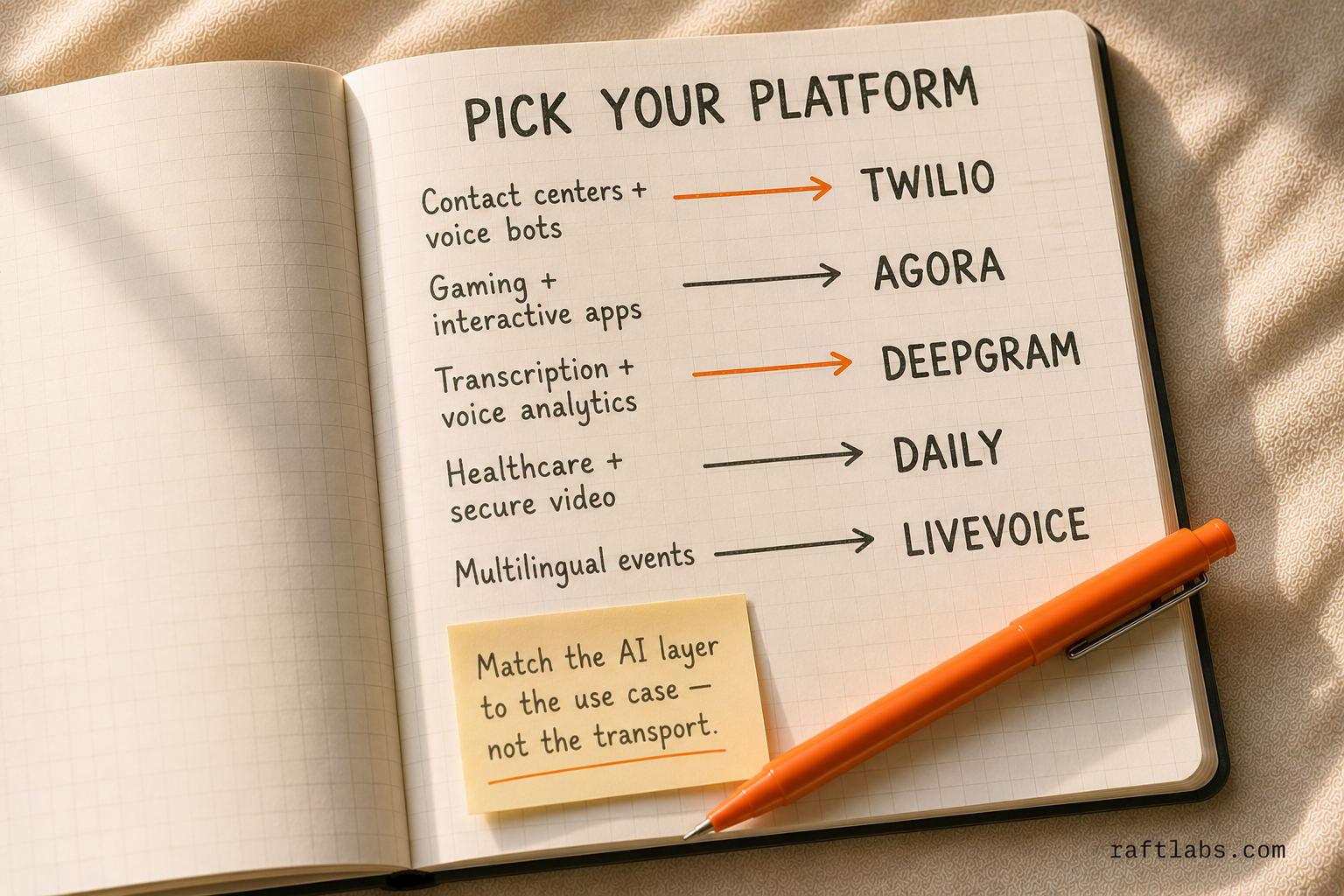
Contact centers and voice bots: Twilio Voice: broadest AI toolkit, widest carrier coverage
Interactive apps and gaming: Agora.io: sub-100ms latency, scales to millions of concurrent users
Transcription and voice analytics: Deepgram: highest ASR accuracy, deep learning pipeline
Healthcare and secure video: Daily: HIPAA-compliant, SOC 2 certified, WebRTC-native
Multilingual events: LiveVoice: low setup, purpose-built for interpretation workflows
If your product depends on how audio is processed and not just transported, RaftLabs can scope a custom build or integrate any of these platforms into your existing stack. We have shipped voice AI applications for contact centers, hospitality platforms, and SaaS products. Most engagements start with a 30-minute technical review.
Ask an AI
Get an instant summary of this post from your preferred AI assistant.
Frequently asked questions
- A basic audio streaming service moves sound from A to B. A voice AI platform adds speech recognition, noise suppression, real-time transcription, or LLM integration on top of that transport layer. Twilio, for example, adds ASR and conversational logic at $0.014/min. A raw streaming CDN won’t give you any of that.
- Costs vary by integration depth. Using an existing platform like Twilio or Agora for a voice bot with standard IVR and transcription typically runs $15,000-$40,000 in development time. Fully custom voice pipelines with proprietary ASR or spatial audio add $50,000-$150,000+. RaftLabs has built voice AI applications across both tiers and can scope your project in a 30-minute call.
- Deepgram is the strongest option for transcription-heavy workloads. Its end-to-end deep learning ASR achieves 95-98% accuracy and processes audio in under 300ms. Enterprise plans start at $15,000/year with custom model training included.
- Build custom when your competitive advantage depends on how audio is processed. A proprietary speaker-identification model or a voice experience that cannot run on a third-party cloud are good examples. For everything else, using Twilio, Agora, or Deepgram is faster and cheaper. The 25% annual growth in the AI audio enhancer market means vendor capabilities are improving fast.
- Twilio, Vonage, and Daily all offer HIPAA-compliant configurations. For GDPR compliance, data residency matters. Agora and Vonage offer EU data centers. Always request a signed Business Associate Agreement from any platform before processing patient or EU resident voice data.